Work record
Marbury v. Madison
1803 · 19th Century · Court Decision · English
Abstract
Question Presented. May a federal official be compelled by the justices, acting as a trial court, to hand over a signed and sealed appointment? Beneath that lies a larger issue: if a statute gives the tribunal authority the Constitution withholds, must judges enforce it?
Arguments. For the would-be magistrate, the appointment was finished at signing and sealing; delivering the paper was clerical, and the 1789 statute expressly let the justices issue such orders to officers. Jefferson's administration, though silent in court, held that nothing vested until delivery and that judges could not direct a cabinet secretary.
Holding. All four participating justices agreed. Marbury possessed a legal right and deserved a remedy, yet the statutory grant enlarged original jurisdiction beyond Article III and was therefore void, leaving the bench powerless to act. The rule to show cause was discharged.
Reasoning. Limits set down in writing would mean nothing if ordinary legislation could pass them. Courts must decide cases, so where statute and Constitution collide they apply the superior rule, as the judicial oath and the Supremacy Clause confirm.
Significance. This is the classic early exercise of judicial review over Congress. No further federal statute was invalidated until 1857, and later decisions such as Cooper v. Aaron (1958) relied on Marshall's reasoning when describing judicial authority.
Key figures
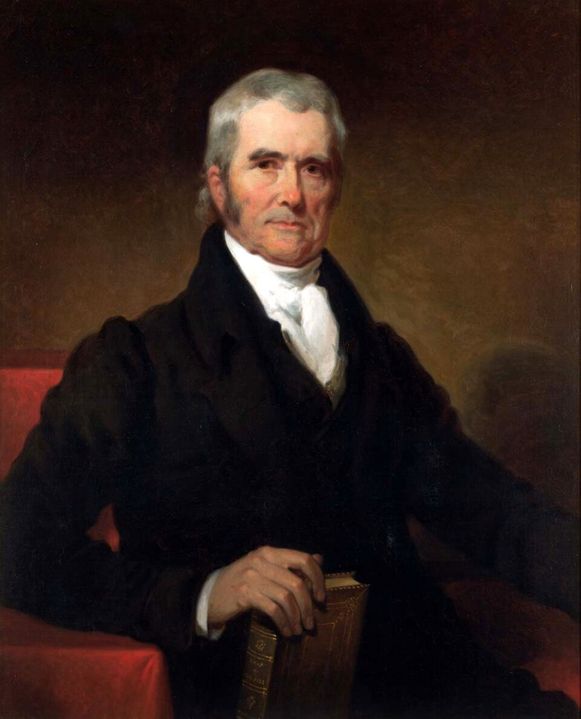
- John Marshall: Chief Justice who wrote for the four sitting justices
- William Marbury: Adams appointee seeking his undelivered magistrate's commission
- James Madison: Secretary of State who withheld the commission and filed no answer
- Charles Lee: Former Attorney General arguing the applicant's case

Summary
In the final days of his administration in March 1801, President John Adams nominated, and the Senate confirmed, dozens of justices of the peace for the District of Columbia under a new organic act. William Marbury was one of them. His commission was signed by Adams and sealed by Secretary of State John Marshall, but it was never delivered. Thomas Jefferson's new Secretary of State, James Madison, withheld it, and Marbury asked the Court, in its original jurisdiction, for a writ of mandamus ordering Madison to hand it over. Section 13 of the Judiciary Act of 1789 appeared to authorize such writs. Marbury's counsel, Charles Lee, argued that the appointment was complete once the President signed and the seal was affixed; that delivery was a ministerial duty owed to the officer; and that mandamus was the established remedy when an official refused a plain legal duty. Madison made no appearance and offered no argument. The administration's position, stated outside the courtroom, was that an undelivered commission conferred nothing and that courts had no business directing the President's chief officers. The Court decided on 24 February 1803, 4-0, in an opinion by Chief Justice Marshall organized around three questions. Has Marbury a right to the commission? Yes: the appointment was complete, and the five-year office could not be revoked at pleasure. Do the laws afford him a remedy? Yes: where a specific legal duty is owed to an individual, the courts must protect the right, though political and discretionary acts of the executive lie beyond judicial inquiry. Is the remedy a mandamus from this Court? Here the opinion turns. Article III lists the cases of original jurisdiction, and Marshall read Section 13 as adding mandamus to that list. A legislative act contrary to the written Constitution, he reasoned, is void, and judges sworn to support the Constitution must prefer it when the two conflict. The Court therefore lacked jurisdiction and discharged the rule. The library text gives the Opinion of the Court in full; Cranch's summary of counsel's arguments and every footnote are left out. Marbury never received his office. A week after Marbury, in Stuart v. Laird, the Court upheld the Repeal Act of 1802. The Court did not again hold an act of Congress unconstitutional until Dred Scott v. Sandford in 1857. In Cooper v. Aaron (1958) the justices cited Marbury for the proposition that the federal judiciary is supreme in the exposition of the Constitution, and the case has remained the standard starting point for the study of judicial review.
Virtues in this work
- Prudence: Marshall affirms Marbury's right while declining to issue a writ the administration was prepared to ignore, protecting the Court's authority in a dangerous political moment.
- Justice: The opinion insists that every vested legal right deserves the protection of the laws, even against the highest executive officers.
- Humility: The Court refuses to exercise a power Congress had offered it because the Constitution did not grant that power.
Plot or Argument
- The rule to show cause and the order of questions
Marshall recalls that a rule was granted at the previous term requiring Madison to show cause, notes that none was shown, and sets out the three questions the Court will answer in turn: right, remedy, and whether the remedy is a mandamus from this Court.
- Does Marbury have a right to the commission?
Tracing the constitutional steps of nomination, confirmation, commission and seal, the opinion holds that the appointment was complete when the President signed and the seal was affixed. Delivery is not essential, and because the office was for five years independent of the executive, the appointment could not be withdrawn.
- Do the laws afford a remedy?
Citing Blackstone and English practice, Marshall insists that every right carries a remedy in a government of laws. He separates political acts entrusted to executive discretion, which no court may examine, from specific duties assigned by law on which individual rights depend, which courts must enforce.
- Is mandamus the proper remedy, and may this Court issue it?
Mandamus suits the case, since the duty to deliver is ministerial and no other remedy is adequate. But the Constitution gives the Court original jurisdiction only in cases affecting ambassadors, other public ministers and consuls, and those in which a state is a party. Reading Section 13 of the Judiciary Act as granting original jurisdiction to issue the writ here, Marshall finds it outside Article III.
- A law repugnant to the Constitution is void
The opinion reasons from the nature of a written constitution of limited powers: either the Constitution is paramount law or it is alterable by ordinary statute, and there is no middle ground. Judges must say what the law is, and when a statute conflicts with the Constitution they must apply the higher law. The judicial oath, the Supremacy Clause's words in pursuance thereof, and specific prohibitions such as the ban on export taxes confirm the point. The rule is discharged.
Characters
- John Marshall, Chief Justice; author of the opinion
Virginian appointed by Adams in 1801 who, as outgoing Secretary of State, had sealed Marbury's commission.
- William Marbury, applicant for the writ
Maryland-born Federalist financier named a justice of the peace for Washington County in the District of Columbia.
- James Madison, respondent; Secretary of State
Jefferson's Secretary of State, who held back the commission and did not appear before the Court.
- Charles Lee, counsel for Marbury
Former Attorney General under Washington and Adams who presented the case for the writ.
- Thomas Jefferson, President of the United States
Republican President who regarded the undelivered commissions as void.
- Levi Lincoln, Attorney General
Acting Secretary of State in March 1801, who testified with reluctance about what became of the commissions.
Lessons
Every right a remedy
Marshall builds the first two-thirds of the opinion on an old common-law maxim, borrowed from Blackstone: where there is a legal right, there is a legal remedy when it is invaded. A government that cannot be made to honour its own legal obligations, he argues, would not deserve to be called a government of laws.
- Which three questions does Marshall pose, and in what order does he answer them?
- Why does Marshall bring up the English practice of suing the King by petition?
- Can a right exist in any meaningful sense if no court will enforce it?
Political discretion and legal duty
The opinion does not claim that courts may review everything the executive does. Marshall separates matters committed to the President's judgment, answerable only politically, from specific duties fixed by statute on which a private person's rights depend. That line has been drawn and redrawn by courts ever since.
- What examples of purely political executive acts does Marshall offer?
- Why is the delivery of a completed commission placed on the ministerial side of the line?
- Who decides whether a question is political or legal?
The argument from a written constitution
Marshall's case for judicial review rests on a chain of reasoning: the people fixed limits in writing; limits that can be passed at will are no limits; so a contrary statute is void; and judges, who must decide cases, must decide which rule governs. Critics in Jefferson's circle answered that each branch could interpret the Constitution for itself.
- Why, according to Marshall, did the people commit the Constitution to writing?
- How do the judicial oath and the Supremacy Clause support his conclusion?
- Does Marshall's reasoning show that courts must have the final word, or only that they must apply the Constitution in the cases before them?
Winning by declining power
The Court found that Marbury was wronged yet refused to order Madison to act, so there was no command for the administration to defy. Students of the case have long admired, and some have questioned, the way the opinion asserted a large principle while giving the executive the immediate result it wanted.
- What would likely have happened if the Court had issued the writ and Madison had ignored it?
- Was it necessary for Marshall to decide the first two questions before reaching jurisdiction?
Context
The election of 1800 transferred the presidency and Congress from the Federalists to Jefferson's Republicans. In its last weeks the Federalist Congress passed the Judiciary Act of 1801, creating new circuit judgeships, and an act organizing the District of Columbia that authorized justices of the peace. The new Republican Congress repealed the 1801 Judiciary Act in March 1802 and reset the Court's terms, so that the justices did not meet between December 1801 and February 1803. Impeachment of federal judges was openly discussed; Justice Samuel Chase was impeached by the House in 1804 and acquitted by the Senate in 1805.
Composition
Marbury and three other appointees applied for the rule in December 1801. Argument took place in February 1803, with Charles Lee presenting affidavits and testimony from State Department clerks and Attorney General Levi Lincoln. Marshall delivered the opinion on 24 February 1803, and it was printed in William Cranch's first volume of reports. The library text, from Wikisource, reproduces the Opinion of the Court and leaves out Cranch's statement of the case and argument.
Reception
Republican newspapers objected chiefly to the opinion's discussion of Marbury's rights and the executive's duties, which Jefferson regarded as beyond what the Court needed to decide; the jurisdictional holding drew less notice at the time. The opinion was cited sparingly through the nineteenth century. Scholars continue to debate whether Marshall's reading of Section 13 was necessary, whether he should have recused himself, and how far judicial review was already accepted in 1803, citing earlier state cases and Federalist No. 78.
Comparisons
- the-federalist-papers
Hamilton's Federalist No. 78 argues that the courts must treat the Constitution as fundamental law and set aside contrary statutes, a line of reasoning Marshall follows closely without citing it.
- the-anti-federalist-papers
The essays of Brutus warned in 1788 that federal judges, independent and unreviewable, would expound the Constitution according to its spirit and enlarge national power; Marbury shows the judicial power the Anti-Federalists foresaw, though here used to decline jurisdiction.
- the-founding-documents
Marshall's argument turns on specific words of the Constitution: the list of original jurisdiction in Article III, the judicial oath in Article VI, and the Supremacy Clause's phrase in pursuance thereof.
- jefferson-selected-writings
Jefferson's letters set out the departmental view that each branch decides constitutional questions for itself in its own sphere, the principal rival to the theory of judicial review announced in Marbury.
- mcculloch-v-maryland
Sixteen years later Marshall turned from limiting Congress to upholding its implied powers, and from judicial authority over federal statutes to federal supremacy over state law.
- dred-scott-v-sandford
Dred Scott (1857) was the next decision after Marbury in which the Court declared an act of Congress, the Missouri Compromise restriction, unconstitutional.
Quotes
Frequently cited
“It is emphatically the province and duty of the Judicial Department to say what the law is.”
Frequently cited
“The very essence of civil liberty certainly consists in the right of every individual to claim the protection of the laws whenever he receives an injury.”
Frequently cited
“The Government of the United States has been emphatically termed a government of laws, and not of men.”
“Questions, in their nature political or which are, by the Constitution and laws, submitted to the Executive, can never be made in this court.”
“Between these alternatives there is no middle ground. The Constitution is either a superior, paramount law, unchangeable by ordinary means, or it is on a level with ordinary legislative acts, and, like other acts, is alterable when the legislature shall please to alter it.”
“To withhold the commission, therefore, is an act deemed by the Court not warranted by law, but violative of a vested legal right.”
For Students
A reading companion for classical Christian high school students. See the student guide.
Reading Guide
Watch for
- The three questions Marshall announces at the start and the way each answer prepares the next.
- The distinction between a commission (the evidence of an appointment) and the appointment itself.
- Marshall's separation of political, discretionary acts of the executive from ministerial duties owed to individuals.
- The turning point where Marshall compares Section 13 of the Judiciary Act with the list of original jurisdiction in Article III.
- The closing appeal to the judicial oath and to the words in pursuance of the Constitution.
Key terms and names
- Writ of mandamus
- A court order commanding a public official to perform a specific duty required by law; Marbury asked for one directing Madison to deliver his commission.
- Commission
- The signed and sealed document that evidences an appointment to office.
- Original jurisdiction
- The power of a court to hear a case first rather than on appeal; Article III gives the Court original jurisdiction only in a few listed kinds of cases.
- Appellate jurisdiction
- The power to review decisions already made by lower courts.
- Ministerial act
- A duty fixed by law that leaves the official no discretion, such as recording or delivering a completed commission.
- Judicial review
- The power of courts to decline to enforce a law because it conflicts with the Constitution.
- Rule to show cause
- A preliminary order requiring a party to explain why the court should not grant the relief requested.
Seminar Questions
- Comprehension At what moment, according to Marshall, was Marbury's appointment complete?
- Comprehension What does Article III say about the cases in which the Court has original jurisdiction, and how did Section 13 of the Judiciary Act go beyond it in Marshall's reading?
- Comprehension What did the Court finally order at the end of the opinion?
- Interpretation Why might Marshall have answered the questions of right and remedy at length when the case was finally decided on jurisdiction?
- Interpretation How does Marshall use the judicial oath to argue that judges may not enforce an unconstitutional law?
- Interpretation Marshall says some executive acts can never be examined in court. How does that limit strengthen the rest of his argument?
- Big Question In a self-governing republic, who should have the last word on what the Constitution means: the courts, the elected branches, or the people?
Faith Connections
- 2 Chronicles 19:5-7 (Scripture)
Jehoshaphat charges the judges he appoints to remember that they judge not for man but for the LORD, a reminder that judging is answerable to a law above the judge's own will.
- Deuteronomy 17:18-20 (Scripture)
The king of Israel is to write out a copy of the law and read it all his days so that his heart is not lifted above his brethren; even the highest ruler is placed under a written law.
- Samuel Rutherford, Lex, Rex (1644) (Great Conversation)
The Scottish Presbyterian argued that the law is king and not the king the law, an older statement of the idea Marshall expresses in the phrase a government of laws.
Logic and Rhetoric
Central argument: Marbury has a vested right to his commission and the laws must give him a remedy, but this Court can grant only the jurisdiction the Constitution allows; because the written Constitution is paramount law, a statute that enlarges that jurisdiction is void, and judges deciding a case must follow the Constitution over the statute.
Rhetorical device: dilemma (disjunctive argument). Marshall states that the Constitution is either superior law or alterable at the legislature's pleasure and that there is no middle ground (quote 4), then shows that the second alternative would make written constitutions absurd.
Debate: Resolved: that the Court in Marbury v. Madison should have issued the writ of mandamus to Secretary Madison.
Memory Work
It is emphatically the province and duty of the Judicial Department to say what the law is.
The Government of the United States has been emphatically termed a government of laws, and not of men.
Writing Prompts
Essay: Trace Marshall's argument that a law repugnant to the Constitution is void, identifying each premise, and explain which premise an opponent such as Jefferson would most likely deny.
Comparison with The Federalist Papers: Compare Hamilton's account in Federalist No. 78 of the judiciary as the least dangerous branch with Marshall's reasoning in Marbury. Where does Marshall echo Hamilton, and what does he add?
Medical Lens
The opinion concerns a judicial commission, the writ of mandamus and the Court's jurisdiction, and contains no medical material.
Creative Prompts
- Classroom
Stage the February 1803 hearing as a moot court: one team argues for Marbury as Charles Lee did, a second team writes the brief Madison never filed, and a bench of four justices must answer Marshall's three questions in order.
- Essay
Explain the step in Marshall's reasoning that moves from Marbury has a right and a remedy to this Court cannot grant it, and assess whether his reading of Section 13 was the only reasonable one.
- Dialogue
Write an exchange of letters in March 1803 between Jefferson and a Federalist friend of the Chief Justice about what the opinion actually decided.
- Fiction
Tell the story of a State Department clerk who finds a stack of signed, sealed commissions on a desk on the morning of 4 March 1801.
Further Reading
- Marbury v. Madison: The Origins and Legacy of Judicial Review, William E. Nelson
Short scholarly account of the case and of how its meaning changed over two centuries.
- The Great Decision: Jefferson, Adams, Marshall, and the Battle for the Supreme Court, Cliff Sloan and David McKean
Narrative history of the political struggle behind the case.
- The Great Chief Justice: John Marshall and the Rule of Law, Charles F. Hobson
Study of Marshall's jurisprudence by the editor of his papers.
- John Marshall and the Heroic Age of the Supreme Court, R. Kent Newmyer
Full intellectual biography of Marshall and the early Court.
Verification notes
All six quotations were located by Grep as exact strings in content/texts/marbury-v-madison.txt. The vote of 4-0 reflects the four justices who sat (Marshall, Paterson, Chase, Washington); Cushing and Moore were absent. Web search was unavailable while this record was written, so dates and procedural details (the December 1801 rule, the 24 February 1803 decision, Stuart v. Laird a week later) rest on standard histories of the case rather than a fresh check. The attribution of the government of laws phrase to the Massachusetts Constitution of 1780 is widely accepted, though the opinion itself does not name its source.
- Confirm that Justices Cushing and Moore did not participate and that the decision date was 24 February 1803.
- Confirm the number of justice-of-the-peace commissions left undelivered and that three other appointees joined Marbury's application.
- Confirm that the Court met in a committee room of the Capitol during the February 1803 term.