Work record
Roe v. Wade
1973 · Postwar Contemporary · Court Decision · English
Abstract
Question Presented. May Texas make it a crime to procure an abortion except to save the mother's life, or does the Fourteenth Amendment protect a personal decision of this kind against such a ban?
Arguments. The appellant relied on precedents protecting marriage, family life and contraception, contending that personal liberty and privacy extend here too. Texas maintained that life is present from conception, that an unborn child counts as a constitutional person, and that elected lawmakers should balance the interests involved.
Holding. Seven Justices ruled for Roe. Blackmun located a qualified privacy right in Fourteenth Amendment liberty, set it against state interests in health and potential life, and refused to say when life starts. He announced stage-by-stage rules in which regulation increases as pregnancy advances and prohibition becomes permissible after viability.
Dissents. White, with Rehnquist, saw no textual or historical basis for the ruling and warned that it took a divisive moral and legal question away from voters and lawmakers. Rehnquist also faulted the Court for answering a hypothetical controversy, preferred deferential review, and pointed to restrictive statutes standing when the Amendment was ratified.
Significance. Casey (1992) kept Roe's core while adopting a different test, and Dobbs (2022) overruled both cases, leaving regulation to the States. Debate over the decision continues. The library file contains Blackmun's opinion and the two dissents.
Key figures
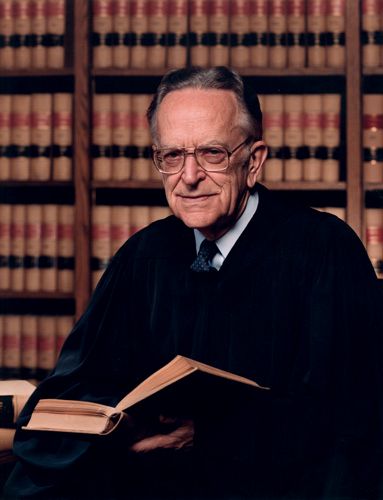
- Harry A. Blackmun: Justice who wrote for the seven-member majority
- Byron R. White: Justice who dissented, joined by Rehnquist
- William H. Rehnquist: Justice who filed a separate dissent
- Jane Roe: Pseudonymous Texas plaintiff
- Henry Wade: Dallas County district attorney, the named appellee
- Sarah Weddington: Counsel who argued for the appellant

Summary
Roe v. Wade came to the Court from Texas, where statutes dating in substance from 1857 made it a crime to procure an abortion except on medical advice to save the mother's life. In 1970 a pregnant woman suing as Jane Roe brought a class action in federal court in Dallas against Henry Wade, the county's district attorney, claiming the statutes were vague and invaded a right of personal privacy. A three-judge district court declared the statutes void but declined to enjoin their enforcement, and both sides appealed. The case was argued in December 1971, reargued in October 1972, and decided on 22 January 1973 together with Doe v. Bolton, a challenge to Georgia's newer statute. The question was whether the Constitution protects a woman's decision to end a pregnancy against a State's criminal prohibition, and if so, how far a State may regulate. Counsel for Roe argued that the liberty and privacy recognized in earlier decisions about marriage, family and contraception reached this decision too. Texas answered that the State has a compelling interest in protecting life from conception, that the unborn are persons within the Fourteenth Amendment, and that the people's elected legislature is the proper body to weigh the competing claims. By a vote of 7–2 the Court affirmed the judgment for Roe. Justice Blackmun's opinion first settled questions of standing and mootness, then surveyed attitudes from antiquity through the Hippocratic Oath, the common law, English and American statutes, and professional associations. It held that the right of privacy, founded in the Fourteenth Amendment's concept of liberty, is broad enough to include the decision, but that the right is qualified and must be weighed against the State's interests in maternal health and in potential life. The Court declined to decide when life begins, held that the word person in the Amendment does not include the unborn, and set out a framework tied to the stages of pregnancy, with viability as the point after which a State could prohibit abortion subject to exceptions. Justice White, joined by Justice Rehnquist, found nothing in the Constitution's language or history to support the judgment and described it as raw judicial power that withdrew from the people and their legislatures a question on which reasonable people differ. Justice Rehnquist added that the record showed no plaintiff suited to the broad rule announced, that a rational-basis test should govern, and that the many state laws in force when the Fourteenth Amendment was adopted show the asserted right is not rooted in the nation's traditions. The library text gives Blackmun's opinion and both dissents, but not the concurrences of Chief Justice Burger and Justices Douglas and Stewart; the opinions' notes are dropped except for Rehnquist's lists of state abortion statutes, which close the file. In 1992 Planned Parenthood v. Casey retained Roe's central holding while discarding its trimester framework, and in 2022 Dobbs v. Jackson Women's Health Organization overruled both decisions; half a century after Blackmun wrote, the decision remains debated.
Virtues in this work
- Prudence: Blackmun begins by naming the convictions and influences that shape opinion on the question before resolving to decide by constitutional measurement.
- Humility: Rehnquist opens his dissent by saying the majority's historical research and legal scholarship command his respect before he states his disagreement.
- Justice: Both the majority and White's dissent insist that the interests on each side be weighed, disagreeing chiefly over whether a court or a legislature should do the weighing.
Plot or Argument
- Parts I-IV: the Texas statutes, the parties and justiciability
Blackmun sets out the Texas statutes and the course of the litigation, then asks which plaintiffs may sue. Roe has standing, and her case is not moot even though her pregnancy has ended, because such a question is capable of repetition yet evading review. Dr. Hallford, facing state prosecution, must make his defense in the state courts, and the Does' claim is too speculative to present a live controversy.
- Parts V-VI: the claim and a long survey of history
The appellant locates the right in the liberty of the Due Process Clause, in privacy cases, or in the Ninth Amendment. Before ruling, the opinion reviews ancient attitudes, the Hippocratic Oath, the common law's quickening distinction, English statutes from 1803, American statutes from 1821, and the positions of the American Medical Association, the American Public Health Association and the American Bar Association.
- Part VII: three reasons offered for the laws
The opinion weighs three historical justifications for nineteenth-century abortion statutes: discouraging illicit conduct, which Texas does not press; protecting the woman's health; and protecting prenatal life, which some argue is present from conception.
- Parts VIII-IX: privacy, personhood and the beginning of life
Although the Constitution does not mention privacy, the Court traces a line of decisions protecting certain personal matters and holds the right broad enough to cover the decision, while stressing that it is not unqualified. It then concludes that person in the Fourteenth Amendment does not include the unborn and declines to resolve when life begins, since physicians, philosophers and theologians have reached no consensus.
- Parts X-XII: the framework and the judgment
The State's interest in the mother's health becomes compelling at about the end of the first trimester, and its interest in potential life at viability. Part XI summarizes the resulting rules stage by stage, and Part XII holds that the Texas statutes fall as a unit, leaving injunctive relief unnecessary because Texas officials are expected to honour the declaratory judgment.
- Dissent of Justice White
Joined by Rehnquist, White argues that the Court has fashioned a new right with scant reason or authority, disabling the legislatures of all fifty States from weighing the interests at stake. He would leave the issue to the people and their political processes and would reverse in both the Texas and Georgia cases.
- Dissent of Justice Rehnquist
Rehnquist objects that no plaintiff in the record was shown to be in the stage of pregnancy the ruling chiefly governs, so the Court decides a hypothetical case. On the merits he would apply the rational-basis test, likens the compelling-interest approach to the reasoning of Lochner v. New York, and lists the state laws in force in 1868 as evidence that the framers of the Fourteenth Amendment did not intend to withdraw this subject from the States.
Characters
- Harry A. Blackmun, author of the opinion of the Court
Associate Justice from Minnesota who wrote for the seven-member majority.
- Byron R. White, dissenting Justice
Associate Justice whose dissent, joined by Rehnquist, objected that the Court had no constitutional warrant for its judgment.
- William H. Rehnquist, dissenting Justice
Associate Justice, newly appointed, who wrote a separate dissent on standing, the proper test and the history of state law.
- Warren E. Burger, Chief Justice
Joined the majority and filed a short concurrence that the library text does not include.
- Jane Roe, appellant
Pseudonym of the Texas woman who brought the class action challenging the state statutes.
- Henry Wade, appellee
District Attorney of Dallas County, the official responsible for enforcing the Texas statutes there.
- Sarah Weddington, counsel for the appellant
Texas lawyer who argued Roe's case at both the first argument and the reargument.
Lessons
Constitutional measurement amid strong convictions
Blackmun opens by acknowledging that philosophy, religion, experience and family values shape every person's view of the subject, and then states that the Court's task is to decide by constitutional measurement rather than by emotion. Whether any court can fully separate the two is a question both the majority and the dissents keep in view.
- Which influences on a person's views does Blackmun list in his opening pages?
- Why might a judge begin a contested opinion by naming the strength of the convictions on every side?
- What would it look like for a judge to decide a case free of emotion and predilection?
Finding an unwritten right
The majority admits that the Constitution does not mention privacy, but it draws on a line of decisions that located such a right in several amendments and in the liberty of the Fourteenth Amendment. The dissents reply that this reasoning lacks support in the text and history of the Constitution. The disagreement is over how judges should identify rights the document does not name.
- Which amendments does the Court say earlier cases relied on for a right of privacy?
- How does the Ninth Amendment figure in the district court's reasoning and in Blackmun's?
- What evidence would persuade you that an unnamed right belongs in the Constitution?
Who weighs the competing interests?
Both opinions agree that weighty interests are at stake on more than one side. The majority holds that the Constitution itself sets limits on how a State may strike the balance; White holds that the weighing belongs to the people and their legislatures, and that a court which takes it over exercises power without warrant.
- What does White mean by calling the judgment an exercise of raw judicial power?
- According to the majority, at what points do the State's interests become compelling?
- What are the strengths of leaving such a question to courts, and what are the strengths of leaving it to legislatures?
Tradition and the reach of a ruling
Rehnquist makes two kinds of argument. One is historical: dozens of state laws restricting abortion stood when the Fourteenth Amendment was ratified. The other is about judicial craft: a court should not formulate a rule broader than the facts of the case before it require.
- Why does Rehnquist count the state laws on the books in 1868?
- What is the Ashwander principle he invokes, and how does he apply it to Roe's record?
- Should the meaning of a constitutional amendment be fixed by the laws in force when it was adopted?
Context
By the late 1960s a national debate over state abortion laws was under way. Texas kept a nineteenth-century statute allowing abortion only to save the mother's life, while about a third of the States, Georgia among them, had adopted reform laws, and a few had repealed most restrictions. The Court's privacy decisions, especially Griswold v. Connecticut (1965) on married couples' use of contraceptives and Eisenstadt v. Baird (1972) extending that protection to unmarried persons, supplied the doctrinal background for the challenge.
Composition
The case was filed in March 1970 in the Northern District of Texas. The Supreme Court heard argument on 13 December 1971; after Justices Powell and Rehnquist were seated in January 1972, it ordered reargument, which took place on 11 October 1972. Blackmun's opinion was announced on 22 January 1973 alongside Doe v. Bolton. White's dissent was filed in Doe v. Bolton and applies to both cases, which is why it closes with the Georgia judgment. The library text follows the Wikisource transcription of the U.S. Reports, 410 U.S. 113.
Reception
Later cases refined the decision's application, and in 1976, 1983 and 1986 the Court applied and reaffirmed it against various state regulations. In Planned Parenthood of Southeastern Pennsylvania v. Casey (1992) the Court reaffirmed what it called Roe's essential holding but replaced the trimester framework with an undue-burden standard. In Dobbs v. Jackson Women's Health Organization (2022) the Court overruled Roe and Casey and returned the question to the States, though as a chapter in constitutional history the decision remains debated.
Comparisons
- planned-parenthood-v-casey
Nineteen years later the Casey joint opinion kept Roe's central holding on grounds of stare decisis while abandoning the trimester scheme that Blackmun had laid out in Part XI.
- dobbs-v-jackson-womens-health-organization
The Dobbs majority adopted much of the historical argument of Rehnquist's Roe dissent, including his count of state laws in force in 1868, and overruled Roe in 2022.
- lochner-v-new-york
Blackmun quotes Holmes's Lochner dissent on a Constitution made for people of differing views, while Rehnquist argues that Roe's method more closely resembles Peckham's Lochner majority.
- the-founding-documents
The opinions turn on the Ninth Amendment's reservation of rights to the people and on the Due Process Clause of the Fourteenth Amendment, both printed with the Constitution in this collection.
- the-federalist-papers
Hamilton's Federalist No. 78 describes the judiciary as having neither force nor will but merely judgment, a description both the majority's claim of constitutional measurement and White's charge of raw judicial power invite readers to test.
- the-anti-federalist-papers
Brutus warned in 1788 that federal judges would interpret the Constitution according to its spirit and reason and would answer to no one, a concern that recurs in White's dissent.
Quotes
Frequently cited
“Our task, of course, is to resolve the issue by constitutional measurement, free of emotion and of predilection.”
Frequently cited
“This right of privacy, whether it be founded in the Fourteenth Amendment's concept of personal liberty and restrictions upon state action, as we feel it is, or, as the District Court determined, in the Ninth Amendment's reservation of rights to the people, is broad enough to encompass a woman's decision whether or not to terminate her pregnancy.”
Frequently cited
“As an exercise of raw judicial power, the Court perhaps has authority to do what it does today; but in my view its judgment is an improvident and extravagant exercise of the power of judicial review that the Constitution extends to this Court.”
“We need not resolve the difficult question of when life begins.”
“I find nothing in the language or history of the Constitution to support the Court's judgment.”
“To reach its result, the Court necessarily has had to find within the scope of the Fourteenth Amendment a right that was apparently completely unknown to the drafters of the Amendment.”
For Students
A reading companion for classical Christian high school students. See the student guide.
Reading Guide
Watch for
- Blackmun's opening paragraphs, where he names the convictions that shape every reader's view and sets the standard of constitutional measurement.
- Part VIII's admission that the Constitution does not mention privacy, followed by the list of precedents the Court relies on.
- The point in Part IX where the Court declines to decide when life begins, and its reasons.
- White's contrast between the Court's power and its proper use of that power.
- Rehnquist's appeal to the state laws in force in 1868 and to the rule that courts should decide no more than the facts require.
Key terms and names
- Due Process Clause
- The Fourteenth Amendment's command that no State deprive any person of life, liberty or property without due process of law.
- Right of privacy
- A constitutional protection for certain personal decisions that the Court had found in earlier cases, though the word does not appear in the Constitution.
- Compelling state interest
- A governmental interest strong enough to justify limiting a fundamental right under the strictest standard of review.
- Rational-basis test
- The deferential standard, favoured by Rehnquist, under which a law stands if it is rationally related to a legitimate state objective.
- Standing
- A party's right to bring a lawsuit, which requires a real and personal stake in the controversy.
- Capable of repetition, yet evading review
- An exception to mootness allowing courts to decide a question that recurs but ends too quickly to be fully litigated.
- Viability
- The stage the Court treated as the point after which a State's interest in potential life becomes compelling.
Seminar Questions
- Comprehension What did the Texas statutes forbid, and what single exception did they allow?
- Comprehension Which three state interests does Part VII identify, and which does Texas not press?
- Comprehension On what two grounds does Rehnquist dissent, one procedural and one on the merits?
- Interpretation Why does Blackmun devote so much of the opinion to history before stating the Court's holding?
- Interpretation White and Blackmun both speak of weighing interests. Where exactly do they disagree?
- Interpretation How do Blackmun and Rehnquist each use the history of nineteenth-century statutes, and why do they reach different conclusions from it?
- Big Question When citizens hold deep and opposed convictions about a question, what makes a decision by a court or a legislature legitimate in the eyes of those who disagree with it?
Faith Connections
- Leviticus 19:15 (Scripture)
Israel's judges are told to do no unrighteousness in judgment, favouring neither the poor nor the mighty, a standard of impartiality the Roe majority claims in its opening and the dissents say it has not kept.
- Proverbs 18:17 (Scripture)
The first to plead his cause seems right until his neighbour comes and searches him; reading the majority and both dissents in full is the way to test each argument fairly.
- Alexander Hamilton, The Federalist No. 78 (1788) (Great Conversation)
Hamilton argued that the courts, having neither force nor will but merely judgment, are the least dangerous branch, a claim that frames the debate between Blackmun and White over the limits of judicial review.
Logic and Rhetoric
Central argument: The majority reasons that the liberty protected by the Fourteenth Amendment includes a right of privacy that covers this decision, that the State's interests in health and potential life grow stronger as pregnancy advances, and that a framework of stages accommodates both. The dissents answer that neither the text nor the history of the Constitution supports such a right, that the many laws in force in 1868 show it is not fundamental, and that the weighing of these interests belongs to legislatures.
Rhetorical device: concession and reversal. White grants that the Court perhaps has authority to do what it does, then turns the concession against the majority by calling the judgment an improvident and extravagant exercise of judicial review (quote 4).
Debate: Resolved: that when the Constitution does not name a right, its existence should be decided chiefly by the history of the laws in force when the relevant amendment was adopted.
Memory Work
Our task, of course, is to resolve the issue by constitutional measurement, free of emotion and of predilection.
I find nothing in the language or history of the Constitution to support the Court's judgment.
Writing Prompts
Essay: Explain the strongest argument of the majority and the strongest argument of the dissents in Roe, each in terms its authors would accept, and then identify the single question on which their disagreement finally turns.
Comparison with The Federalist Papers: Using Federalist No. 78, assess how Blackmun's opinion and White's dissent each understand the duty of judges to declare the meaning of the Constitution.
Medical Lens
Part VI of Blackmun's opinion is a history of how the Hippocratic Oath, the common law and nineteenth- and twentieth-century medical and public-health associations treated the question, read here only as a chapter in the history of medical ethics and professional bodies influencing legislation; the record carries no clinical content.
Creative Prompts
- Classroom
Stage a moot court on the reargument of October 1972 in which one team argues from the privacy precedents and the other from the text and the state laws of 1868, with student justices required to question both sides equally.
- Essay
Write a short appellate brief on one narrow issue in the case, such as whether Roe's claim was moot once her pregnancy had ended, using only the reasoning set out in Part IV and in Rehnquist's dissent.
- Dialogue
Write a conversation between two law clerks in 1972, one working for Blackmun and one for White, about whether the Ninth Amendment or the Fourteenth Amendment is the better place to look for unenumerated rights.
- Essay
Compare Blackmun's use of history in Part VI with Rehnquist's use of history in Part II of his dissent, and explain what question each is asking the past to answer.
Further Reading
- Roe v. Wade: The Abortion Rights Controversy in American History, N. E. H. Hull and Peter Charles Hoffer
A volume in the Landmark Law Cases series tracing the litigation and the arguments around it.
- Becoming Justice Blackmun, Linda Greenhouse
Draws on Blackmun's papers to show how the opinion was drafted and revised.
- The Tempting of America: The Political Seduction of the Law, Robert H. Bork
An argument for interpreting the Constitution by its original understanding, with an extended critique of Roe's method.
- Democracy and Distrust: A Theory of Judicial Review, John Hart Ely
A study of when courts should override legislatures, by a scholar who was also among the earliest critics of Roe's reasoning.
Verification notes
All six quotations were found by Grep as exact strings in content/texts/roe-v-wade.txt (Wikisource transcription of 410 U.S. 113). The vote of 7–2, the argument dates of 13 December 1971 and 11 October 1972, and the decision date of 22 January 1973 are standard facts of the case. White's dissent appears in the U.S. Reports with Doe v. Bolton and applies to both cases. The record describes the opinions' arguments only, makes no judgment on the decision, and gives no clinical detail; the reading level reflects the mature subject.
- Confirm the authorBio statement that Blackmun had served as resident counsel to the Mayo Clinic before his judicial career.
- Confirm that about a third of the States had reformed their abortion laws by 1973, as stated in the historical overview.