Work record
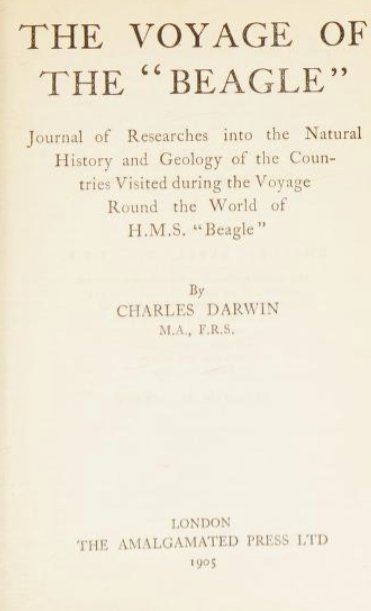
The Voyage of the Beagle
1839 (revised 1845) · 19th Century · Travel · English
Abstract
Background. Darwin joined HMS Beagle at twenty-two as an unpaid gentleman naturalist on an Admiralty survey of South American coasts. His journal, first printed alongside FitzRoy's account, was rewritten in 1845 with sharper attention to geology and species distribution.
Scope. Most of the five years were spent in South America, with Darwin often ashore for weeks; the homeward crossing of the Pacific and Indian Oceans is covered more briskly.
Content. He digs giant extinct mammals from the cliffs at Punta Alta near Bahía Blanca, rides with gauchos across the pampas, watches the Fuegian mission falter, and crosses the Andes, finding marine shells high in the range. He experiences the 1835 Chilean earthquake at Valdivia, then surveys the ruins of Concepción and the uplifted coast. In the Galápagos he notes tortoises and mockingbirds that differ from island to island, and at the Keeling atoll he tests a theory that coral reefs grow upward on slowly sinking foundations.
Method. Specimen collecting, careful measurement and comparison across regions, with Lyell's Principles of Geology as a constant guide. Darwin shipped crates of fossils, skins and plants home to Henslow at Cambridge, and his notes record fevers, saddle-sores and scarce food as part of the work.
Significance. The book made Darwin's name as a scientific traveller and preserves the observations from which his later work on species took shape.
Key figures
- Charles Darwin: Young naturalist and narrator, collecting and theorizing ashore
- Robert FitzRoy: Captain of HMS Beagle, commanding the surveying voyage
- Benjamin Bynoe: Ship's surgeon, thanked by Darwin for care during illness
- Jemmy Button, York Minster and Fuegia Basket: Fuegians returned home by FitzRoy after a stay in England
- Richard Matthews: Missionary landed with the Fuegians at Woollya
- General Juan Manuel de Rosas: Argentine commander whose camp Darwin visited on the Río Colorado

Summary
The Voyage of the Beagle is Darwin's account of his five-year journey around South America, the Pacific, Australia, and the Atlantic aboard HMS Beagle. It is a travel book before it is an evolutionary treatise: Darwin describes landscapes, fossils, earthquakes, volcanoes, coral reefs, animals, plants, Indigenous peoples, imperial violence, slavery, disease, and the practical hardships of field observation. The young naturalist learns to see deeply. Geological time enlarges under his feet; species vary by island and coast; extinction becomes visible in fossil bones; and human societies appear within the conditions of British imperial travel. Medical relevance is secondary but real. The book records fever, exposure, diet, fatigue, fear, injury, and the bodily demands of exploration, while also showing the observational discipline that later naturalized mind and behavior. The South American chapters give that discipline a concrete training ground. Darwin searches for fossil bones at Bahia Blanca, rides across the pampas, watches earthquake damage at Concepcion, records the Fuegian mission, and later studies volcanic craters and island variation in the Galapagos. The coral reef chapters then turn travel observation into a theory of subsidence and formation. Its value in this library is contextual: it shows Darwin before Darwinism, gathering habits of patient attention that would transform nineteenth-century thought. The Voyage of the Beagle is therefore a record of apprenticeship. It shows how field notes, specimens, discomfort, encounter, and comparison became the groundwork for later arguments about life, inheritance, and human continuity with nature. Darwin's thanks to Captain FitzRoy and Surgeon Bynoe also remind readers that the book is shipboard science. Observation depends on naval surveying, medical care, collecting networks, and the practical discipline of moving through difficult environments. The illness and exposure recorded during inland excursions also matter. Feverish districts, exhausting rides, scarce food, insects, and weather make natural history a bodily practice rather than a detached catalog of specimens.
Plot or Argument
- The Voyage of the Beagle: The early South American chapters
The early South American chapters introduce Darwin as traveler, collector, geologist, and observer of colonial society.
- The Voyage of the Beagle: Patagonia Tierra del Fuego
Patagonia, Tierra del Fuego, and the Andes test assumptions about human difference, hardship, and natural history.
- The Voyage of the Beagle: Fossils earthquakes and volcanic
Fossils, earthquakes, and volcanic islands enlarge Darwin's sense of geological time and transformation.
- The Voyage of the Beagle: The Galapagos chapters record
The Galapagos chapters record island variation, though Darwin only later recognized their evolutionary significance.
- The Voyage of the Beagle: Later chapters through the
Later chapters through the Pacific, Australia, and return voyage complete a global apprenticeship in observation.
Lessons
The Voyage of the Beagle teaches historical caution
The Voyage of the Beagle rewards readers who keep its categories in their own century before translating them into ours. It can sharpen modern judgment precisely because its insights and errors are both visible.
- Which term in The Voyage of the Beagle most resists a modern equivalent?
- Where does historical distance make the work more useful rather than less useful?
The Voyage of the Beagle links evidence and authority
The work shows how observation becomes authority through cases, examples, institutional setting, or aphoristic force. It asks readers to notice who gets to define suffering and what counts as proof.
- What kind of evidence is most persuasive in this work?
- Where does professional or authorial authority clarify the subject, and where does it distort it?
The Voyage of the Beagle complicates mind and body
Whether medical, philosophical, or scientific, the work refuses a simple split between inner life and bodily condition. Its best passages make symptoms, emotions, habits, and values part of one historical field.
- How does the work connect bodily signs with inner experience?
- What would be lost if the work were read only as medicine or only as literature?
The Voyage of the Beagle warns against easy progress stories
The text may mark an advance, but it also carries assumptions later readers have reason to question. It is strongest when read as a record of struggle rather than as a straight road to the present.
- Which part of the work feels most forward-looking?
- Which part most clearly shows the limits of its age?
Context
First published in 1839 as part of the Beagle voyage narrative and revised in 1845, the book made Darwin known as a scientific traveler.
Composition
The voyage from 1831 to 1836 gave Darwin specimens, notes, and questions that later informed evolutionary theory.
Reception
The narrative remains a major Victorian travel book and a document of science within empire.
Comparisons
- on-the-origin-of-species
The Voyage of the Beagle pairs with this work because Origin supplies the evolutionary framework that later books apply to human beings and behavior.
- the-descent-of-man
The Voyage of the Beagle pairs with this work because Darwin extends evolutionary thinking to human mind, morals, sex, and heredity.
- heart-of-darkness
The Voyage of the Beagle pairs with this work because Conrad gives another imperial travel text in which observation exposes moral and bodily danger.
- gullivers-travels
The Voyage of the Beagle pairs with this work because Swift satirizes travel, knowledge, and human pride in ways that sharpen Darwin's observational seriousness.
Quotes
For Students
A reading companion for classical Christian high school students. See the student guide.
Reading Guide
Watch for
- Darwin's digging at Punta Alta near Bahia Blanca, where he unearths the bones of giant extinct mammals and begins to ask why such creatures vanished from a land still able to support large animals.
- The account of the Fuegians, including those FitzRoy had taken to England and was returning home with a missionary, and Darwin's astonishment at the distance between the people of Tierra del Fuego and the Englishmen on board.
- The great earthquake of 1835, felt at Valdivia, and the ruins of Concepcion, where Darwin sees the land raised by several feet and connects the event to fossil shells he later finds high in the Andes.
- The Galapagos chapter, where the vice-governor tells Darwin he can identify a tortoise's island by its shell, and Darwin notes, too late to sort all his specimens, that the finches and mockingbirds differ from island to island.
- The coral reef chapter, where Darwin argues that atolls form as reefs keep growing upward on slowly sinking land.
Key terms and names
- HMS Beagle
- The Royal Navy survey ship commanded by Robert FitzRoy that carried Darwin from 1831 to 1836. Its work was charting coasts, which gave Darwin long periods ashore while the ship surveyed.
- Robert FitzRoy
- The Beagle's captain, a skilled hydrographer and devout man who wanted a gentleman naturalist as a companion. He brought three Fuegians back to their homeland on this voyage.
- Megatherium
- The giant ground sloth whose remains Darwin collected in Argentina. Its bones, and those of other extinct giants, set him thinking about extinction and the relation of fossil to living species.
- Pampas
- The great grassy plains of Argentina that Darwin crossed on horseback with gauchos, recording their skills, their diet of meat, and the frontier wars of his day.
- Galapagos Archipelago
- The volcanic islands on the equator where Darwin observed giant tortoises, marine iguanas, and birds that varied by island, a little world of its own far from the mainland.
- Subsidence
- The slow sinking of the earth's crust. Darwin's theory of coral reefs uses it to explain how fringing reefs become barrier reefs and finally atolls.
- Charles Lyell
- The geologist whose Principles of Geology Darwin carried on the voyage. Lyell taught that the earth was shaped by slow, ordinary causes over vast spans of time, and Darwin read every landscape in that light.
Seminar Questions
- Comprehension What did Darwin find at Punta Alta and Bahia Blanca, and what questions did those fossils raise for him about extinction?
- Comprehension What evidence did the earthquake at Concepcion give Darwin about how mountains and coastlines are raised?
- Comprehension What did Darwin observe about the tortoises and birds of the different Galapagos islands, and why did he regret how he had labeled his specimens?
- Interpretation Darwin describes the landscapes of Brazil and Patagonia with wonder, yet his attention keeps returning to measurement and comparison. How does the book combine the traveler's delight with the scientist's discipline?
- Interpretation Darwin speaks strongly against the slavery he witnessed in Brazil, and he also records the hardships of the Fuegians. How does his response to these people compare with his response to animals and landscapes?
- Interpretation Many of Darwin's later theories are only hinted at in the Voyage. Which observations in the book seem most important in hindsight, and why might Darwin have been unable to see their significance at the time?
- Big Question Does careful observation of nature lead the mind toward a Creator, away from one, or neither?
Faith Connections
- Job 38-39 (Scripture)
God answers Job by pointing to the sea, the weather, the wild goat, the ostrich, and the horse. Darwin's catalogue of rheas, condors, and tortoises is the same kind of attention to creatures beyond human use, and Job raises the question whether such attention ends in wonder, humility, or explanation.
- Psalm 104 (Scripture)
The psalmist sees mountains, springs, wild animals, and the sea as one ordered household of creatures fed by God. Darwin's Beagle chapters describe the same web of relations among land, climate, and living things, while asking how it came to be arranged that way.
- Basil of Caesarea, Hexaemeron (Homilies on the Six Days) (Church Fathers)
Basil preached on creation with close attention to fish, birds, plants, and their habits, urging his hearers to learn from observing them. He offers an early Christian model of natural history as part of praising the Creator, a useful contrast with the purely naturalist account Darwin later developed.
- William Paley, Natural Theology (1802) (Great Conversation)
Paley argued that the intricate fitness of living things to their conditions points to a designer. Darwin studied Paley at Cambridge and admired his reasoning, and the Voyage shows him gathering the very evidence about adaptation that he would later explain by natural causes.
Logic and Rhetoric
Central argument: If the earth is shaped by slow causes still at work, as the raised coast at Concepcion and the shells in the Andes suggest, then the present landscape records an immense history. Fossil species resemble the living species of the same continent, and island populations differ from island to island. Therefore the distribution of living things must be explained by their history in particular places, not only by their fitness for present conditions.
Rhetorical device: comparison by juxtaposition. In the Galapagos chapter Darwin sets the tortoises, finches, and plants of one island beside those of its neighbors and beside those of South America, letting the reader see the pattern of small differences and shared resemblance before he offers any explanation.
Debate: Resolved: The Voyage of the Beagle is more valuable as a work of travel literature than as a work of science.
Writing Prompts
Essay: Trace Darwin's growing sense of geological time through three episodes in the Voyage: the fossils at Bahia Blanca, the earthquake at Concepcion, and the coral reefs. Argue how these observations changed the way he saw the living creatures he met.
Comparison with On the Origin of Species: The Voyage of the Beagle records observations of fossils, island variation, and geographical distribution that Darwin used twenty years later in On the Origin of Species. Compare how the same evidence appears in the travel journal and in the argument of the Origin, and argue what Darwin gained and lost in turning field notes into theory.
Medical Lens
The Voyage of the Beagle has medium medical relevance for this library. Its key tags are fever-infection, pain, public-health-sanitation, mind-body. Read these tags historically: they point to language, practices, institutions, and embodied experience in the work, not to retrospective diagnosis of named people.
- South America chapters
Darwin records illness, exposure, fatigue, and the bodily demands of collecting and travel.
- imperial encounters
Darwin's observations of slavery in Brazil, frontier warfare in Argentina, and disease among peoples the ship visited set his natural history within the voyage's human world.
- Galapagos chapters
Island observation becomes a training ground for later biological theory rather than a finished evolutionary argument.
Listen to the book
Public-domain audiobook from LibriVox, read by Various volunteers. Recording: Voyage of the Beagle on LibriVox (Internet Archive).
LibriVox recordings are volunteer readings released into the public domain. The reading may follow a different edition from the text in this library.
Creative Prompts
- Essay
Write a historically careful essay on one term from The Voyage of the Beagle that should not be translated too quickly into a modern diagnosis.
- Dialogue
Stage a conversation between Charles Darwin and a contemporary psychiatrist about evidence, humility, and the risks of naming suffering.
- Classroom
Ask students to separate what The Voyage of the Beagle observes well from what its era leads it to misunderstand.
Further Reading
- Charles Darwin: Voyaging, Janet Browne
- The Voyage of the Beagle, Charles Darwin
- Darwin's Dangerous Idea, Daniel C. Dennett
Verification notes
Metadata, summary, and medical tags are based on well-established publication history and the attached public-domain source. Quotes are intentionally omitted in the generated pass pending primary-text selection and verification.
No verification flags recorded.