Work record
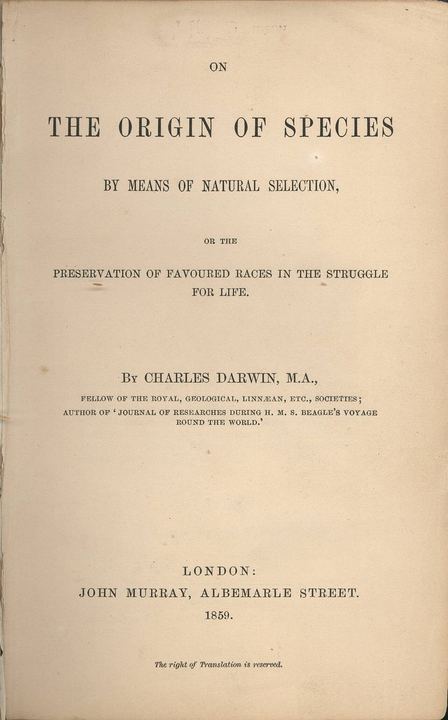
On the Origin of Species
1859 · 19th Century · Philosophy · English
Abstract
Background. Darwin had gathered evidence on the transmutation of species since the Beagle voyage of 1831-1836 and was drafting a large manuscript titled Natural Selection. Wallace's letter from the Malay Archipelago in 1858 led to a joint Linnean Society presentation and the hurried writing of this shorter book, which Darwin called an abstract.
Argument. Breeders create distinct races of pigeons, cattle and cabbages by keeping slight differences over many generations. Nature, Darwin proposes, does likewise: populations multiply faster than their means of support, a struggle for existence follows, and individuals with favourable variations leave more offspring. Over immense time this selection, joined to divergence of character, splits one stock into varieties, species and genera.
Structure. Chapters I-V set out variation, struggle, selection and laws of variation. Chapters VI-IX meet difficulties: organs of extreme perfection such as the eye, instinct, the sterility of hybrids and gaps in the rocks. Chapters X-XIII bring evidence from fossil succession, geographical distribution, island faunas, classification, embryology and rudimentary organs; Chapter XIV recapitulates and closes on the entangled bank.
Key Concepts. Struggle for existence, natural selection, descent with modification, divergence, extinction and the imperfection of the geological record.
Significance. Issued by John Murray and revised through six editions in Darwin's lifetime, it supplied the framework for later genetics, ecology and epidemiology, including the study of pathogen and drug resistance.
Key figures
- Charles Darwin: Naturalist of the Beagle voyage, writing from Down House in Kent
- Alfred Russel Wallace: Naturalist whose 1858 letter outlined the same theory independently
- Charles Lyell: Geologist whose gradualist deep time underpins the argument
- Thomas Robert Malthus: Economist whose population principle Darwin extends to all living things
- Joseph Dalton Hooker: Botanist friend who supplied data on plant distribution

Summary
On the Origin of Species argues that species are not fixed, separately created kinds but populations changed over time by variation, inheritance, struggle, natural selection, and descent with modification. Darwin begins with variation under domestication, using pigeons, livestock, and cultivated plants to show how small differences can be preserved and accumulated. He then transfers attention to nature, where organisms produce more offspring than can survive and where slight advantages may alter survival and reproduction across immense time. The book's force lies in its patient accumulation of evidence. Darwin discusses geographical distribution, island species, fossils, classification, rudimentary organs, embryology, instinct, hybridism, and the imperfections of the geological record. He also gives objections serious space, especially the difficulty of complex organs such as the eye and the apparent gaps between forms. His method is cautious but revolutionary: he asks readers to imagine life historically, relationally, and at population scale. The medical relevance is substantial even though the book is not about clinical care. Darwin's account of heredity, variation, adaptation, competition, and population thinking reshaped later biology and medicine. It opened new ways to think about pathogens, immunity, development, inherited disease, degeneration, and the relation between organism and environment. Later interpreters also invoked it in debates over eugenics and social policy, which are distinct from Darwin's own argument about natural history. The book's religious and philosophical significance comes from its change in explanatory scale. Design, order, suffering, extinction, and beauty are considered through lawlike processes rather than isolated acts. The famous closing image of tangled bank life gathers that vision: many forms arise, perish, and diversify from simple beginnings. On the Origin of Species remains important because it shows a scientific argument remaking common assumptions about nature, time, inheritance, and the place of human beings among living things. Its argument proceeds by ordinary examples patiently extended until the whole history of life looks different.
Plot or Argument
- Variation under domestication
Artificial selection gives readers a familiar model for cumulative change.
- Natural selection
Struggle, inheritance, and advantage become the engine of adaptation.
- Difficulties and consequences
Darwin faces objections about organs, instincts, fossils, and classification.
Key claims
The main steps of the argument, in order, and how they fit together.
- Breeders produce distinct races of animals and plants by preserving slight differences over many generations.How it is supported: Examples of pigeons, cattle, cabbages and other domestic breeds.
- Individuals in nature vary, and many of these variations are inherited by their offspring.How it is supported: Observations of variation in wild species and the laws of variation.
- Populations multiply faster than their means of support, so a constant struggle for existence follows.How it is supported: Reasoning from rates of increase and the limits of food and space.
- Variations giving even a slight advantage tend to be preserved because their bearers leave more offspring.How it is supported: Analogy with artificial selection applied to the struggle for existence.
- Over immense time, selection and divergence of character split one stock into varieties, species and genera.How it is supported: Reasoning about accumulated small changes and the branching of descent.
- Apparent difficulties such as complex organs, instinct, hybrid sterility and gaps in the fossil record can be answered.How it is supported: Graded steps in eye structure and the imperfection of the geological record.
- Descent with modification explains classification, distribution, island faunas, embryology and rudimentary organs better than separate creation.How it is supported: Evidence gathered from fossils, geography, embryos and vestigial structures.
Argument map
Supported by
- 5Over immense time, selection and divergence of character split one stock into varieties, species and genera.
which rests on
- 4Variations giving even a slight advantage tend to be preserved because their bearers leave more offspring.
- 1Breeders produce distinct races of animals and plants by preserving slight differences over many generations.
- 2Individuals in nature vary, and many of these variations are inherited by their offspring.
- 3Populations multiply faster than their means of support, so a constant struggle for existence follows.
- 6Apparent difficulties such as complex organs, instinct, hybrid sterility and gaps in the fossil record can be answered.
- 7Descent with modification explains classification, distribution, island faunas, embryology and rudimentary organs better than separate creation.
Therefore
Plain-language summaries of the author's argument, not quotations.
Lessons
On the Origin of Species: formed attention
On the Origin of Species teaches students to slow down before judgment. tenth-grade readers can study how a revolutionary argument proceeds cautiously, anticipating objections and asking readers to change scale
- Where does On the Origin of Species reward patient attention?
- Which early impression in On the Origin of Species has to be revised?
On the Origin of Species: order and disorder
On the Origin of Species makes order visible by showing what damages it. the book accumulates evidence from domestic breeding, geography, fossils, classification, embryology, and difficult cases before closing with a new view of life
- What kind of disorder is most dangerous in On the Origin of Species?
- Does On the Origin of Species restore order, expose its fragility, or both?
On the Origin of Species: body and soul
On the Origin of Species gives the medical lens a human scale. Darwin matters to medicine through heredity, variation, adaptation, population thinking, and later debates over degeneration, eugenics, and disease ecology
- How does bodily vulnerability change the argument of On the Origin of Species?
- Where should a reader avoid reducing moral or spiritual suffering to diagnosis?
Context
On the Origin of Species stands at a historically important crossing point for 19th century study. It should be read with attention to its original language, audience, institutional setting, and later classroom life.
Composition
On the Origin of Species is dated 1859; the record uses the date as a teaching anchor while recognizing that transmission, translation, and publication history may be more complicated than a single year suggests.
Reception
On the Origin of Species has remained teachable because later readers found in it more than antiquarian interest: it continues to frame arguments about truth, order, suffering, imagination, and the moral life.
Comparisons
- principia
On the Origin of Species can be compared with principia to test how different periods handle authority, suffering, formation, and the shape of a good life.
- the-republic
On the Origin of Species can be compared with the-republic to test how different periods handle authority, suffering, formation, and the shape of a good life.
Quotes
Frequently cited
“There is grandeur in this view of life, with its several powers, having been originally breathed into a few forms or into one”
Frequently cited
“from so simple a beginning endless forms most beautiful and most wonderful have been, and are being, evolved”
“Nothing is easier than to admit in words the truth of the universal struggle for life, or more difficult—at least I have found it so—than constantly to bear this conclusion in mind”
For Students
A reading companion for classical Christian high school students. See the student guide.
Reading Guide
Where it fits: In the tenth-grade year on Nature and Cosmos, the Origin shows how a modern naturalist explained the variety of living things through law and long time, and it pairs naturally with the Principia, the other great modern account of nature by law, and with the Timaeus and On the Making of Man for older accounts of design.
Watch for
- The opening chapter on variation under domestication, especially Darwin's pigeons. Notice how breeders' selection of small differences becomes his model for what nature might do over far longer time.
- Chapter III on the struggle for existence, where Darwin warns that it is easy to admit this struggle in words and hard to keep it constantly in mind.
- The single diagram of branching lines in Chapter IV and the image of a great tree of life at the end of that chapter.
- The chapter on Difficulties on Theory, where Darwin faces the objection that an organ as perfect as the eye could not have been formed by small steps.
- The closing paragraph of the book, with the entangled bank of plants, birds, insects and worms, and the final sentence on the grandeur of this view of life.
Key terms and names
- Variation
- The small differences among individuals of the same kind. Darwin begins with them because selection, natural or human, can only work on differences that already exist and can be inherited.
- Artificial selection
- The breeder's choice of which animals or plants to breed, as with Darwin's fancy pigeons. It gives readers a familiar model before he asks them to imagine nature selecting.
- Struggle for existence
- Darwin's phrase, applying Malthus to all living things, for the fact that more creatures are born than can survive. He uses it broadly, including a plant at the edge of a desert struggling against drought.
- Natural selection
- The preservation of favorable variations and the loss of injurious ones through the struggle for existence. Darwin presents it as the main, though not the only, means of change.
- Descent with modification
- Darwin's description of how species arise: living things descend from common ancestors and are changed along the way. It explains why classification looks like a family tree.
- Imperfection of the geological record
- Darwin's chapter-length answer to the objection that the fossil record lacks transitional forms. He argues that fossils preserve only scattered fragments of the history of life.
- Rudimentary organs
- Organs that seem to serve little or no purpose, such as teeth in the embryos of whales that will never use them. Darwin reads them as traces of descent.
Seminar Questions
- Comprehension Why does Darwin begin with breeders and pigeons instead of with wild species?
- Comprehension What does Darwin mean by the struggle for existence, and what examples does he give of struggle that does not involve fighting?
- Comprehension How does Darwin answer the objection that the eye is too complex to have been formed by natural selection?
- Interpretation Darwin says it is easy to admit the struggle for life in words but hard to keep it in mind. Why does he think readers resist this conclusion, and what changes when they accept it?
- Interpretation Darwin gives many pages to objections against his own theory. How does this choice strengthen or weaken his argument?
- Interpretation Why does Darwin end with the entangled bank and the word grandeur? What view of nature is he asking readers to share?
- Big Question If living things arose through natural processes over long ages, does that rule out, permit, or support the belief that nature is the work of a Creator?
Faith Connections
- Psalm 104 (Scripture)
The psalmist praises God for every creature in its place, from the wild goats in the hills to the young lions seeking their food from God, and says that God sends forth his spirit and they are created. Darwin's careful attention to living things in their surroundings can be read beside this psalm's attention to the same world.
- Job 38-39 (Scripture)
God answers Job with questions about the lion, the raven, the wild goat, the ostrich and the horse, beyond any human power to explain. The passage asks how far the study of creatures can reach, a question Darwin's patient observation sharpens.
- Romans 8:19-22 (Scripture)
Paul says the whole creation groans in travail, subjected to futility in hope of liberation. Darwin's struggle for existence describes the same suffering in nature, and Paul's verses give a way to discuss what that suffering means.
- Augustine, The Literal Meaning of Genesis (Church Fathers)
Augustine taught that God created all things at once, with some placed in creation as hidden causes that unfold in time. Christian readers after Darwin often returned to this teaching as a way to read Genesis alongside an account of development in nature.
Logic and Rhetoric
Central argument: Individuals vary, and many variations are inherited. More individuals are born than can survive, so there is a constant struggle for existence. Any variation that gives even a slight advantage will tend to be preserved, and over immense time such preserved differences accumulate. Therefore species are not fixed but have descended with modification from common ancestors, which explains the facts of classification, geographical distribution, embryology and rudimentary organs better than separate creation of each species.
Rhetorical device: argument from analogy. Darwin's opening chapter builds his case on the breeder: if human selection of pigeons can produce forms as different as the pouter and the fantail, nature selecting over far longer ages could produce much more. The rest of the book depends on readers accepting the analogy.
Debate: Resolved: Darwin's theory of natural selection is compatible with belief that nature is the work of a Creator.
Memory Work
from so simple a beginning endless forms most beautiful and most wonderful have been, and are being, evolved
Nothing is easier than to admit in words the truth of the universal struggle for life, or more difficult—at least I have found it so—than constantly to bear this conclusion in mind
Writing Prompts
Essay: Darwin devotes whole chapters to objections against his theory, including the eye and the gaps in the fossil record. Analyze how he handles one of these objections and argue whether his method of answering difficulties makes the Origin more or less persuasive.
Comparison with On the Nature of the Universe: In Book 5 Lucretius describes the earth bringing forth creatures, some of which could not survive or breed and so perished. Compare this ancient account with Darwin's natural selection and argue what Darwin adds that Lucretius lacks, and whether the two share the same view of design in nature.
Medical Lens
Darwin matters to medicine through heredity, variation, adaptation, population thinking, and later debates over degeneration, eugenics, and disease ecology
- Variation under domestication
On the Origin of Species gives this tag concrete force through darwin matters to medicine through heredity, variation, adaptation, population thinking, and later debates over degeneration, eugenics, and disease ecology
- Natural selection
On the Origin of Species gives this tag concrete force through darwin matters to medicine through heredity, variation, adaptation, population thinking, and later debates over degeneration, eugenics, and disease ecology
- Difficulties and consequences
On the Origin of Species gives this tag concrete force through darwin matters to medicine through heredity, variation, adaptation, population thinking, and later debates over degeneration, eugenics, and disease ecology
Listen to the book
Public-domain audiobook from LibriVox, read by Michael Armenta. Recording: Origin Of Species by Means of Natural Selection (version 2) on LibriVox (Internet Archive).
LibriVox recordings are volunteer readings released into the public domain. The reading may follow a different edition from the text in this library.
Creative Prompts
- Essay
Write a class essay on how On the Origin of Species defines maturity without reducing maturity to success.
- Dialogue
Stage a dialogue between a defender and a critic of On the Origin of Species's central moral claim.
Further Reading
Verification notes
Core bibliographic and interpretive claims are stable; quotations should be drawn only from the attached public-domain text when one is present.
No verification flags recorded.