Work record
Theodore Roosevelt: An Autobiography
1913 · Early 20th Century · Memoir · English
Abstract
Background. Written in the year after a failed third-party bid for the White House, the book let a former president explain his record and his principles to a broad magazine readership. Its author was then fifty-four and a contributing editor of that weekly.
Content. Early chapters move from an asthmatic Manhattan childhood and self-imposed physical training to legislative apprenticeship, cattle country, reform of patronage and of a big-city police force, and a volunteer cavalry regiment in Cuba. Later ones defend his handling of the executive office, forests and irrigation, corporate combinations and labor, the hemisphere and the canal, and peacemaking between great powers.
Method. Anecdote alternates with argument. Roosevelt names colleagues generously, quotes letters and reports at length, and treats each office as a lesson in character as well as policy. Humor and self-mockery, as in the frontier tale of a bully who mocks his spectacles, lighten the policy chapters.
Themes. Courage acquired through practice, the duty of strenuous effort, public office as a trust, the land held for future generations, fairness between capital and labor, and national strength in the service of peace.
Significance. A primary document of the Progressive Era, it is the classic statement of the stewardship view of the presidency and of early American conservation, written by the leader who shaped both.
Key figures
- Theodore Roosevelt: Narrator, rancher, soldier, reformer and president
- Theodore Roosevelt Sr.: His father and moral model
- Jacob Riis: Reform journalist and companion on police rounds
- Leonard Wood: Surgeon and colonel of the Rough Riders
- Gifford Pinchot: Chief forester and conservation leader
- John Hay: Secretary of State in the Panama negotiations

Summary
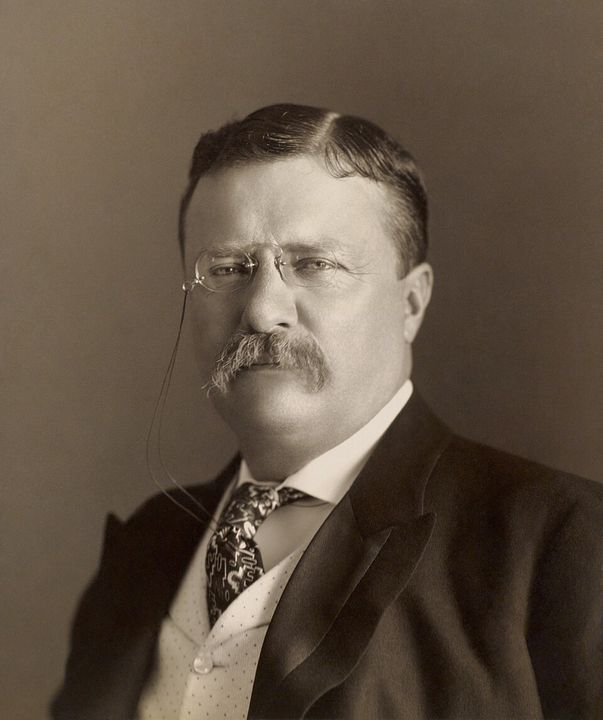
Theodore Roosevelt's Autobiography, written at Sagamore Hill in 1913, is less a full life than a series of chapters on the work and convictions of a public man. A foreword dated 1 October 1913 calls for joining practical efficiency with lofty idealism. Chapter I describes his Dutch and Southern ancestry, his father, whom he calls the best man he ever knew, his mother and his uncle James Bulloch, a sickly boyhood of asthma, a love of natural history, the spectacles that showed him how beautiful the world was, and Harvard. Chapter II, The Vigor of Life, tells how he built up his body by exercise, boxing, riding and hunting, and how, following a hint from Marryat, he learned courage by acting as if he were not afraid. Chapters III and V recount his entry into politics through a Republican district club, three terms in the New York Assembly, and six years on the Civil Service Commission. Chapter IV, In Cowboy Land, recalls his cattle ranches on the Little Missouri, round-ups, blizzards, a bully in a hotel bar-room who calls him Four Eyes, and the vigilantes and rustlers of the cattle country. Chapter VI covers his two years as president of the New York police board, his midnight rambles with Jacob Riis and his enforcement of the Sunday closing law. Chapter VII describes his work as Assistant Secretary of the Navy, the raising of the First Volunteer Cavalry with Leonard Wood, the landing in Cuba, the charge at Kettle Hill and San Juan on 1 July 1898, and the fever-stricken army's return; appendices print officers' reports. Chapters VIII and IX cover the New York governorship, his family life, his reading and his outdoor pursuits. The presidential chapters explain his stewardship theory of executive power, the Reclamation Act, national forests and bird reservations, the Northern Securities suit and the regulation of corporations, the anthracite coal strike, the square deal between capital and labor, meat inspection and pure food, the Monroe Doctrine and the Venezuelan and Santo Domingo questions, the acquisition of the Panama Canal Zone, and, in Chapter XV, the Portsmouth peace between Russia and Japan and the battle fleet's voyage round the world. The book was serialized in The Outlook and published by Macmillan in November 1913; it says nothing of his first wife, Alice Hathaway Lee, who died in 1884. The library text is the 1920 Scribner edition, which reprints the 1913 text complete with its appendices.
Virtues in this work
- Fortitude: A sickly, asthmatic boy, he trains himself painfully in body and spirit and learns courage by acting as if he were unafraid.
- Industry: As police commissioner he walks the city at midnight with Jacob Riis to see for himself whether patrolmen are on their posts.
- Justice: In the letter printed in Chapter XIII he insists that the square deal applies equally to wrongdoing capitalists and wrongdoing labor leaders.
- Prudence: He sets aside national forests and fifty-one bird reservations so that natural resources will be kept for future generations.
Plot or Argument
- Foreword and Chapter I: Boyhood and Youth
Ancestry, his father and mother, asthma, home schooling, natural history, spectacles, travels abroad, and Harvard.
- Chapter II: The Vigor of Life
Building the body through exercise, boxing, riding and hunting, and learning courage by practising it.
- Chapter III: Practical Politics
Joining the Twenty-first District Republican Association, three years in the New York Assembly, and lessons about bosses and reformers.
- Chapter IV: In Cowboy Land
The Chimney Butte and Elkhorn ranches on the Little Missouri, round-ups, hard winters, frontier characters, a bar-room bully, and the rustlers and vigilantes of the range.
- Chapters V-VI: Civil Service and the New York Police
The merit system on the Civil Service Commission; the police board, Jacob Riis, tenement inspections and Sunday closing.
- Chapter VII: The War of America the Unready
The Navy Department under Secretary Long, Dewey's appointment, the Rough Riders, the Cuban campaign, Kettle Hill and San Juan, fever in the army and the round robin; appendices with reports.
- Chapters VIII-IX: Governor and Family Man
The governorship of New York and dealings with Senator Platt; Sagamore Hill, his children, books and the outdoors.
- Chapters X-XI: The Presidency and Natural Resources
The steward theory of executive power, appointments, the Progressive cause, Pinchot and the Forest Service, reclamation, and the bird and game reservations.
- Chapters XII-XIII: The Big Stick and the Square Deal
Antitrust suits including Northern Securities, railroad regulation, the coal strike, labor disputes, meat inspection and pure food, and his view of equal justice for capital and labor.
- Chapters XIV-XV: Panama and the Peace of Righteousness
The Monroe Doctrine, Venezuela and Santo Domingo, the revolution in Panama and the canal; the Portsmouth peace, the Hague, relations with Japan and the battle fleet's voyage; appendices.
Characters
- Theodore Roosevelt, author and narrator
Naturalist, rancher, reformer, soldier and president writing an account of his public work and convictions.
- Theodore Roosevelt Sr., father
Philanthropic New York merchant whom his son calls the best man he ever knew.
- Martha Bulloch Roosevelt, mother
Georgia-born mother whose brothers served the Confederacy at sea.
- Jacob Riis, journalist and reformer
Author of How the Other Half Lives, Roosevelt's guide through the tenements as police commissioner.
- Leonard Wood, colonel of the Rough Riders
Army surgeon who commanded the regiment while Roosevelt served as lieutenant colonel.
- Gifford Pinchot, chief forester
The man to whom, Roosevelt says, the nation owes most for the preservation of its natural resources.
- William Sewall and Wilmot Dow, ranch partners
Maine woodsmen who built the Elkhorn ranch house with him.
- John Hay and Elihu Root, secretaries of state
Cabinet officers in his foreign and Panama policies.
Lessons
Making the body and the spirit
Roosevelt describes himself as a sickly, nervous boy who trained himself painfully not only in body but in soul and spirit. He learned courage by acting as if he were not afraid until the habit became real. He offers his life as evidence that an ordinary person can grow strong through steady effort.
- What weaknesses does Roosevelt describe in his boyhood?
- What did Roosevelt learn from the passage in Marryat about fearlessness?
- Can courage really be learned by practice, as Roosevelt claims?
Idealism joined to practical work
The foreword argues that lofty idealism and practical efficiency are each common but rarely joined. Roosevelt shows this in the police board, where he and Riis went out at midnight to see conditions for themselves, and in politics, where he joined a district club rather than criticizing from outside. He believes good intentions must be made effective.
- Why did Roosevelt join a local political club when friends told him politicians were rough men?
- What did he learn from his night walks with Jacob Riis?
- Which is harder to find in a leader, high ideals or the ability to carry them out?
Stewardship of power and of the land
Roosevelt held that a president is a steward of the people, bound to do whatever the nation's needs require unless the Constitution or laws forbid it. He applied the same idea of stewardship to forests, water and wildlife, creating national forests and bird reservations. The chapters invite readers to consider what it means to hold something in trust for others.
- How does Roosevelt describe the president's power in Chapter X?
- Which conservation measures does he list at the end of Chapter XI?
- What are the strengths and dangers of Roosevelt's broad view of executive power?
Equal justice to rich and poor
Roosevelt calls his policy the square deal: he sued corporations he believed broke the law and condemned labor leaders he thought guilty of wrongdoing. The foreword asks for a nation where a poor man who works hard can live comfortably and a rich man cannot live dishonestly. He judges both by conduct, not by class.
- What does Roosevelt mean when he says a square deal is a square deal to every one?
- Why did he intervene in the coal strike of 1902?
- Is it possible for a government to be equally fair to employers and workers?
Context
Roosevelt's career spans the Gilded Age and the Progressive Era, when rapid industrial growth, great corporations, labor conflict, immigration and crowded cities led to calls for civil service reform, regulation and conservation. The United States became a world power after the Spanish-American War of 1898 and the acquisition of the Philippines, Puerto Rico and Guam. As president Roosevelt pursued antitrust suits, railroad regulation, food and drug laws and the conservation of public lands, mediated the Russo-Japanese War, and secured the Panama Canal Zone after Panama's separation from Colombia in November 1903. His interpretation of the Monroe Doctrine, the Roosevelt Corollary of 1904, asserted a right to intervene in the Caribbean. These policies were controversial in his day and remain debated among historians, especially the Panama episode and the breadth of executive power he claimed.
Composition
Roosevelt wrote the book in 1913 at Sagamore Hill, after his defeat as the Progressive candidate in 1912, and it ran in installments in The Outlook, of which he was a contributing editor, before Macmillan published it in November 1913. The foreword notes that some chapters of his life could not yet be written. Long appendices reprint official reports, letters and documents in support of his account, especially of the Cuban campaign and Panama. The Gutenberg text follows a 1920 edition published by Charles Scribner's Sons.
Reception
Reviewers welcomed the book's energy and range, and it has remained in print as a primary source for the Progressive Era and for Roosevelt's own view of his presidency. Historians value it for his statement of the stewardship theory of the presidency, later contrasted with William Howard Taft's narrower view of executive power, and for his account of conservation. Biographers note what it omits, including his first marriage and the 1912 campaign, and read its defenses of policy as advocacy by a participant.
Comparisons
- citizenship-in-a-republic
Roosevelt's 1910 Sorbonne speech, with its man in the arena, compresses the creed of the Autobiography's foreword and Chapter II: action over criticism, courage practised, and duty joined to effort.
- personal-memoirs
Grant's memoirs, which Roosevelt admired, are a soldier-president's account written from the war outward; Roosevelt's is a reformer-president's account that gives war a single chapter among many on politics and policy.
- monroe-doctrine
Chapter XIV opens with Roosevelt's interpretation of Monroe's 1823 message and explains how he applied it to Venezuela and Santo Domingo; reading Monroe's text alongside shows how the principle was extended.
- autobiography-of-andrew-carnegie
Carnegie writes as the great industrialist of the age and Roosevelt as the president who sought to regulate great corporations; both value self-made effort and public duty.
- franklin-autobiography-and-poor-richard
Both autobiographies present a programme of self-improvement and civic usefulness, Franklin through rules of virtue and Roosevelt through strenuous physical and moral training.
- walden
Thoreau and Roosevelt both loved the American outdoors and wrote as naturalists, but Thoreau sought solitude and simplicity while Roosevelt joined the strenuous outdoor life to national policy in forests and wildlife reserves.
Quotes
Frequently cited
“My father, Theodore Roosevelt, was the best man I ever knew.”
Frequently cited
“I was a sickly, delicate boy, suffered much from asthma, and frequently had to be taken away on trips to find a place where I could breathe.”
Frequently cited
“There were all kinds of things of which I was afraid at first, ranging from grizzly bears to "mean" horses and gun-fighters; but by acting as if I was not afraid I gradually ceased to be afraid.”
Frequently cited
“But life is a great adventure, and the worst of all fears is the fear of living.”
Frequently cited
“every executive officer, and above all every executive officer in high position, was a steward of the people bound actively and affirmatively to do all he could for the people”
Frequently cited
“The only safe rule is to promise little, and faithfully to keep every promise; to "speak softly and carry a big stick."”
“I had no idea how beautiful the world was until I got those spectacles.”
“When I say "Square deal," I mean a square deal to every one”
For Students
A reading companion for classical Christian high school students. See the student guide.
Reading Guide
Watch for
- The foreword's pairs of qualities, such as efficiency and idealism, and where they reappear in the book.
- How Roosevelt describes his own weakness and training in Chapters I and II.
- The frontier stories of Chapter IV and what Roosevelt says the West taught him.
- The stewardship theory of the presidency in Chapter X.
- How Roosevelt argues for his policies with documents, letters and appendices.
Key terms and names
- Strenuous life
- Roosevelt's ideal of vigorous effort in body, work and public service, the subject of an 1899 speech and of Chapter II.
- Civil service reform
- The movement to fill government jobs by merit examinations rather than political patronage.
- Rough Riders
- The First United States Volunteer Cavalry, raised in 1898 under Leonard Wood and Roosevelt.
- Stewardship theory
- Roosevelt's view that the president may do anything the nation's needs require unless the Constitution or the laws forbid it.
- Square Deal
- Roosevelt's name for his policy of fair treatment for business, labor and the public alike.
- Conservation
- The wise use and preservation of forests, water, soil and wildlife for future generations.
- Big stick
- From the proverb speak softly and carry a big stick, his shorthand for diplomacy backed by readiness to act.
Seminar Questions
- Comprehension What jobs did Roosevelt hold between leaving Harvard and becoming president?
- Comprehension What happened at Kettle Hill and San Juan, according to Chapter VII?
- Comprehension What conservation measures does Roosevelt list in Chapter XI?
- Interpretation Why does Roosevelt begin with his father and his own weakness as a boy?
- Interpretation What does Roosevelt mean by joining practical efficiency to lofty idealism, and where does he show it?
- Interpretation Why might Roosevelt include so many letters and official reports in his appendices?
- Big Question Should a president use every power not forbidden to him, or only those clearly granted?
- Big Question How should a reader weigh a public figure's account of his own decisions?
Faith Connections
- Matthew 25:14-30 (Scripture)
Roosevelt alludes to this parable when he rejects the negative merit of keeping one's talents undamaged in a napkin and insists that officers must actively use their powers for the people.
- 1 Corinthians 9:24-27 (Scripture)
Paul disciplines his body like an athlete for an imperishable prize; Roosevelt's training of body and spirit in Chapter II follows a similar idea of discipline.
- Genesis 2:15 (Scripture)
God places man in the garden to work it and keep it; Roosevelt's language of stewardship over forests and wildlife echoes this charge.
- Micah 6:8 (Scripture)
To do justly, love mercy and walk humbly sums up the ideal of the foreword, which asks for justice to others, generosity, and charity toward the wrongdoer.
Logic and Rhetoric
Central argument: A nation, like a person, needs practical efficiency joined to idealism, and courage joined to love of righteousness. Strong character can be built by steady effort, and government should act vigorously for the common good while judging rich and poor by the same standard. Therefore Roosevelt argues that his record of reform, conservation and active diplomacy was the right use of the power entrusted to him.
Rhetorical device: antithesis. The foreword is built on balanced pairs: practical efficiency and lofty idealism, love of peace and courage, the largest charity toward the wrongdoer and relentless war against the wrongdoing.
Debate: Resolved: that Roosevelt's stewardship theory of the presidency serves a republic better than a strict reading of executive power.
Memory Work
There were all kinds of things of which I was afraid at first, ranging from grizzly bears to "mean" horses and gun-fighters; but by acting as if I was not afraid I gradually ceased to be afraid.
But life is a great adventure, and the worst of all fears is the fear of living.
Writing Prompts
Essay: Roosevelt presents his life as proof that character is made, not born. Using episodes from at least three chapters, evaluate how well his story supports that claim.
Comparison with Citizenship in a Republic ("The Man in the Arena"): Compare Roosevelt's man in the arena in the Sorbonne speech with the self-portrait in Chapters I-II of the Autobiography; what qualities of the citizen do both emphasize?
Medical Lens
Roosevelt gives a vivid lay account of childhood asthma: nights sitting up in bed gasping while his father carried him about the room, and trips in search of air he could breathe. He links his recovery to strenuous exercise, a view of body-building as moral discipline typical of his era's ideal of the strenuous life; this is his own interpretation, not a medical finding. His late discovery of severe nearsightedness leads him to sympathize with children wrongly blamed as stupid when their trouble is physical, and to support school efforts to correct such defects. In Chapter VII he describes the wounds of the Cuban campaign, an officer shot through the head behind the eyes who survived with one eye blinded, and the malaria, dysentery and some yellow fever that struck the army after the fighting; he recounts the officers' round robin urging that the army be sent home before it was destroyed by disease. The colonel of the regiment, Leonard Wood, had trained at Harvard Medical School as an army surgeon. Later chapters touch public health through tenement inspections with Jacob Riis, meat inspection, the Pure Food and Drugs Act, and laws protecting miners' lives and health.
- Chapter I
Childhood asthma and the discovery of his nearsightedness and first spectacles.
- Chapter II
Building up a weak constitution by exercise and his account of training soul and spirit along with the body.
- Chapter VI
Night tours of the tenement districts with Jacob Riis and the work of the police and health boards.
- Chapter VII
Wounds at San Juan, malaria and dysentery in the army before Santiago, and the round robin to General Shafter.
- Chapter XII
Inspection of the packing-houses and the passage of the meat inspection law and the Pure Food and Drugs Act.
Creative Prompts
- Classroom
Make a timeline of Roosevelt's offices from the New York Assembly to the presidency, adding one decision he describes for each.
- Essay
Roosevelt says courage can be learned by acting as if one were not afraid. Describe a time you or someone you know tested this idea.
- Dialogue
Write a conversation between Roosevelt and Gifford Pinchot on a Western trail about why the nation's forests should be kept in public hands.
- Fiction
Write a newspaper reporter's account of a midnight walk with Police Commissioner Roosevelt and Jacob Riis through the Lower East Side in 1896.
Further Reading
- The Rise of Theodore Roosevelt, Edmund Morris
- Mornings on Horseback, David McCullough
His childhood, family and asthma.
- The Rough Riders, Theodore Roosevelt
- The River of Doubt, Candice Millard
His 1913-14 Brazilian expedition.
Verification notes
Contents, names, chapter titles and locators were checked against the attached Gutenberg text, prepared from a 1920 Scribner edition of the 1913 book. The Outlook serialization and Macmillan's November 1913 first edition, the omission of Alice Hathaway Lee, and the biographical facts in authorBio (Nobel Prize 1906, River of Doubt expedition, death in 1919) are from standard references. The book's account of the coal strike, trusts and Panama is Roosevelt's own and is summarized as such. Quotes were checked against the attached text.
- The exact months of the Outlook serialization in 1913.
- Whether the 1920 Scribner edition differs in any substantive way from the 1913 Macmillan first edition.