Work record
Citizenship in a Republic ("The Man in the Arena")
1910 · Early 20th Century · Oratory · English
Abstract
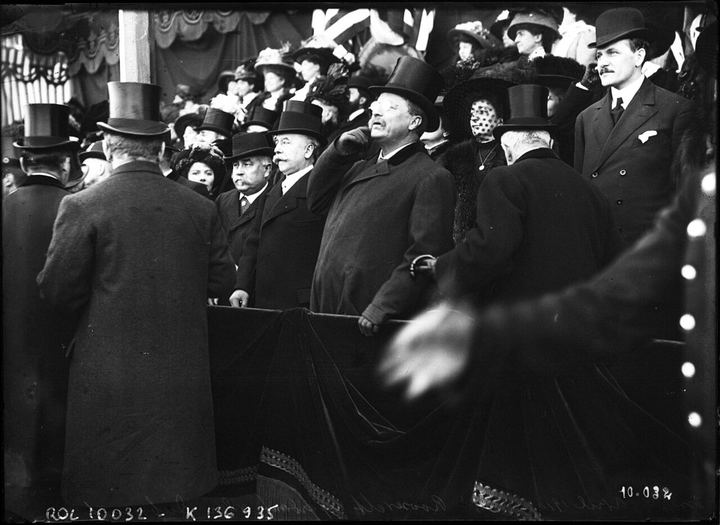
Background. Having handed the White House to Taft, Roosevelt spent a year collecting specimens in Kenya and Uganda, then crossed Europe as the most famous private citizen alive. Paris invited him to lecture before scholars, officials, and students.
Argument. Kings may carry a passive people, but republics rise or sink with the ordinary voter, so the speech catalogs the qualities that voter needs. Roosevelt ranks moral fiber over cleverness, demands labor, readiness for righteous war, and families, and insists that fortunes, eloquence, and newspapers deserve respect only when they serve the common good.
Method. Paired extremes structure nearly every paragraph: sneerer and fop, dreamer and cynical operator, class arrogance and class envy. A cattle-range anecdote and a long excerpt from Lincoln anchor the abstractions.
Key Concepts. Equal opportunity with unequal reward for unequal service; human rights over property when the two collide; liberty measured by how minorities fare; patriotism as the ground of decent dealings among nations, with no double standard between private and public honesty.
Significance. French audiences received the lecture enthusiastically, and it quickly appeared in print on both sides of the Atlantic. One paragraph praising the bloodied striver over the onlooker has since outrun the rest, surviving on locker-room walls, in political farewells, and as the source of book titles.
Key figures
- Theodore Roosevelt: Former U.S. president, guest speaker of the University of Paris
- Abraham Lincoln: Quoted at length on the equality affirmed in the Declaration
- Hotspur: Shakespeare's battle-worn warrior, held up over the fastidious lord
- Gamaliel and Paul: Teacher and pupil standing for Old World learning and New
- Jean Froissart: Medieval chronicler cited on France's never-failing defenders

Summary
On 23 April 1910 Theodore Roosevelt, a year out of the presidency and fresh from a long hunting expedition in East Africa, addressed a packed hall at the Sorbonne in Paris. He spoke as the citizen of one great republic to the citizens of another, and his subject was the character that self-government demands of ordinary people. He opens with homage to the old university and a sketch of American history: the frontier generations had to set learning aside to subdue a continent, and their successors must now recover it, sitting, as Paul did, at the feet of Gamaliel. His thesis follows. Under kings or oligarchs the quality of the rulers decides a nation's fate; in a republic it is decided by the average citizen, and that average cannot stay high unless the educated leaders are higher still. To his learned audience he issues a warning against the cynic who sneers at effort he never attempts. The paragraph that follows, on the man in the arena whose face is marred by dust and sweat and blood and who, if he fails, fails while daring greatly, became the most quoted passage he ever wrote. The long middle of the speech sets out what good citizenship requires. Character ranks above intellect and physical strength. The average man must work, be ready to fight in a just cause, and raise a family. Wealth is to be honored only for the service behind it, and oratory and journalism only for the truth they carry. Efficiency without a moral sense makes a man more dangerous, while ideals must be pursued in practical ways. Roosevelt rejects both extreme individualism and extreme socialism, quotes Lincoln on the meaning of equality, and calls for equality of opportunity with reward according to service. The last third warns against dividing a republic along lines of class, illustrated by a story from his ranching days in which he fired a cowboy who offered to steal cattle for him. He ends by defending patriotism as the root of good international conduct and by honoring France as one of the nations that teach mankind.
Virtues in this work
- Fortitude: Roosevelt honors the man in the arena who strives valiantly and, if he fails, fails while daring greatly.
- Industry: He insists that the average man must earn his own livelihood and that leisure must never mean idleness.
- Justice: He calls for equality of opportunity, puts human rights above property rights in a real conflict, and condemns class hatred on either side.
- Honor: He defines character as force and courage joined to good faith and sense of honor, and denies any separate morality for public life.
- Prudence: He asks that ideals be realized in practical fashion and that every proposed reform be judged on its merits by hard-headed examination.
Plot or Argument
- Exordium: the New World comes to the Old (Paragraphs 1-4)
Roosevelt pays tribute to the Sorbonne, recalls how frontier hardship forced his forebears to leave behind the inherited learning of Europe, and argues that a mature America must now learn from the Old World without merely copying it.
- The average citizen decides a republic's fate (Paragraphs 5-7)
In monarchies the rulers' quality is decisive; in republics like France and the United States, success depends on the average man and woman doing their duty. The educated have received much and owe much, and must guard against the failings peculiar to their class.
- The cynic and the man in the arena (Paragraphs 8-10)
The man of lettered leisure is tempted to pose as a cynic. Roosevelt answers that credit belongs to the one who strives and errs and spends himself in a worthy cause, not to the critic, and praises France for proving that high culture and leadership in arms can go together.
- Character first: work, courage, family, and the right use of gifts (Paragraphs 11-18)
Above body and mind stands character. The citizen must work, be able to fight for righteousness, and raise children; wealth, oratory, and journalism earn respect only by the service and truth behind them. Property rights matter, but where they clash with human rights, the human must prevail.
- Efficiency, moral sense, and practical ideals (Paragraphs 19-28)
The good citizen needs both efficiency and conscience; the timid good man and the able villain both fail the republic. Roosevelt rejects the closet philosopher and the impracticable visionary, steers between extreme individualism and extreme socialism, quotes Lincoln's 1857 reading of equality in the Declaration, and asks for equal opportunity with rewards proportioned to service.
- Liberty, class, patriotism, and farewell to France (Paragraphs 29-36)
Liberty is tested by the treatment of minorities; class hatred, whether of rich or poor, has ruined past republics. The story of the maverick shows why a man who will steal for you will steal from you. True patriotism makes a nation a good neighbor, and Roosevelt closes by praising France's place among the teachers of mankind.
Key claims
The main steps of the argument, in order, and how they fit together.
- In a republic the nation's fate depends on the character and conduct of the average citizen.How it is supported: A contrast with monarchies and oligarchies, where the rulers' quality decides.
- The average citizen stays high only if the educated, who have received much, stand higher still.How it is supported: Reasoning that those given much owe much.
- Credit belongs to the one who strives and spends himself in the arena, not to the cynic who sneers at effort.How it is supported: The man in the arena passage, set against the pose of the lettered critic.
- Character ranks above both intellect and physical strength as the citizen's most important quality.How it is supported: An appeal to what has sustained or ruined nations in history.
- Good citizens must work, be ready to fight for righteousness, and raise families.How it is supported: Argument from what a self-governing people needs in order to endure.
- Wealth, eloquence, and journalism deserve respect only for the service and truth behind them.How it is supported: Paired contrasts between the right use and the misuse of each gift.
- A republic should offer equal opportunity, reward service in proportion, and put human rights above property when the two clash.How it is supported: A long quotation of Lincoln's 1857 reading of equality in the Declaration.
- Private and public honesty follow one standard, and class hatred of rich or poor has ruined past republics.How it is supported: The cattle-range story of the maverick: a man who will steal for you will steal from you.
Argument map
Supported by
- 1In a republic the nation's fate depends on the character and conduct of the average citizen.
which rests on
- 2The average citizen stays high only if the educated, who have received much, stand higher still.
- 3Credit belongs to the one who strives and spends himself in the arena, not to the cynic who sneers at effort.
- 4Character ranks above both intellect and physical strength as the citizen's most important quality.
which rests on
- 5Good citizens must work, be ready to fight for righteousness, and raise families.
- 6Wealth, eloquence, and journalism deserve respect only for the service and truth behind them.
- 8Private and public honesty follow one standard, and class hatred of rich or poor has ruined past republics.
- 7A republic should offer equal opportunity, reward service in proportion, and put human rights above property when the two clash.
Therefore
Plain-language summaries of the author's argument, not quotations.
Lessons
The arena belongs to the doer
Roosevelt's most famous paragraph is a rebuke to his own audience of scholars. Criticism costs nothing, he argues, while honest effort always risks visible failure; the one who strives and falls short deserves more honor than the one who never tries. Error is treated not as disgrace but as the price of any real effort.
- Why does Roosevelt give this warning to a university audience in particular?
- Does Roosevelt reject all criticism, or only a certain kind? Point to the words that decide it.
- Think of a time when fear of looking foolish kept you out of the arena. What did it cost?
A republic rests on ordinary character
The speech's thesis is that self-government shifts the burden of national greatness from rulers to citizens. Plain virtues such as work, courage, honesty, and family loyalty therefore become public matters, and the educated are held to a higher standard because the average depends on them.
- How does Roosevelt contrast government by one or a few with a democratic republic?
- What does he mean by saying that the stream will not rise higher than its source?
- Do you agree that the character of ordinary citizens matters more than the brilliance of leaders?
If you will steal for me, you will steal from me
The maverick anecdote turns a ranch-hand's misplaced loyalty into a political principle: a public man who promises to do wrong on your behalf has shown he will do wrong against you when it suits him. Roosevelt applies the same honesty test to nations, refusing any separate morality for public life.
- Why did Roosevelt fire a cowboy who was trying to enrich him?
- How does he apply the story to voters and politicians?
- Is Roosevelt right that political morality is no different from private morality?
Context
Roosevelt left the presidency in March 1909 and spent nearly a year on a natural-history expedition in East Africa for the Smithsonian. In the spring of 1910 he made a celebrated tour of European capitals, received by monarchs and crowds alike. France was then the leading republic among the great European powers, governed under the Third Republic, while the United States was in the middle of the Progressive Era debates over trusts, wealth, and the reach of government that run through the speech.
Composition
Roosevelt prepared the address before his arrival in Paris and delivered it on 23 April 1910 in the great amphitheater of the Sorbonne. It was printed promptly, circulated in French translation, and collected later that year in African and European Addresses, alongside his Guildhall, Berlin, and Oxford lectures. The speech quotes Lincoln's 1857 Springfield remarks on the Declaration of Independence and alludes to Acts 22:3, Shakespeare's Hotspur, the Song of Roland, and Froissart.
Reception
The speech was warmly received in Paris and widely reported in the American press. Over the following century the arena paragraph detached itself from the rest and became a standalone text, quoted by presidents, coaches, soldiers, and writers and printed on countless plaques. The phrase daring greatly in particular has supplied titles for later books.
Comparisons
- pericles-funeral-oration
Pericles says Athens counts the man who takes no part in public life as useless, a direct ancestor of Roosevelt's scorn for the citizen of whom all that can be said is that he is harmless.
- democracy-in-america
Tocqueville, a Frenchman, explained American democracy to Europe; seventy-five years later Roosevelt stood in Paris to tell the French what both republics required of their citizens, worrying like Tocqueville about materialism and the quality of the average man.
- washington-farewell-address-and-selected-letters
Washington warned that faction and party spirit could destroy the Union; Roosevelt warns that division along class lines has destroyed republics before.
- if-kipling
Kipling's poem, published the same year, lists the same manly virtues of trying, failing, and trying again without bitterness that Roosevelt praises in the man in the arena.
Quotes
Frequently cited
“The credit belongs to the man who is actually in the arena, whose face is marred by dust and sweat and blood; who strives valiantly; who errs, and comes short again and again, because there is no effort without error and shortcoming; but who does actually strive to do the deeds; who knows the great enthusiasms, the great devotions; who spends himself in a worthy cause; who at the best knows in the end the triumph of high achievement, and who at the worst, if he fails, at least fails while daring greatly, so that his place shall never be with those cold and timid souls who know neither victory nor defeat.”
Frequently cited
“Yes, my friend, and if you will steal for me you will steal from me.”
“The average citizen must be a good citizen if our republics are to succeed.”
“The poorest way to face life is to face it with a sneer.”
“It is not the critic who counts; not the man who points out how the strong man stumbles, or where the doer of deeds could have done them better.”
“But above mind and above body stands character--the sum of those qualities which we mean when we speak of a man's force and courage, of his good faith and sense of honor.”
“In a republic, to be successful we must learn to combine intensity of conviction with a broad tolerance of difference of conviction.”
“I believe that a man must be a good patriot before he can be, and as the only possible way of being, a good citizen of the world.”
For Students
A reading companion for classical Christian high school students. See the student guide.
Reading Guide
Watch for
- The opening homage to the Sorbonne and the image of Paul learning at the feet of Gamaliel, which sets America as student and then teacher.
- The run of who-clauses in the arena paragraph, each adding a mark of the striver, ending on those cold and timid souls.
- Roosevelt's repeated pairing of two dangers, such as the cynic and the fop, the closet philosopher and the mob leader, extreme individualism and extreme socialism.
- The block quotation from Lincoln on what the Declaration meant by equality, and Roosevelt's use of it to argue for equal opportunity.
- The ranch anecdote about the maverick, the one personal story in the speech, placed where he turns to public honesty.
Key terms and names
- Sorbonne
- The historic university of Paris, which Roosevelt calls the most famous university of medieval Europe, where he gave this address.
- Gamaliel
- The Pharisee teacher at whose feet Paul was educated (Acts 22:3); Roosevelt casts the Old World as Gamaliel and the New World as the pupil who may become a teacher.
- Man in the arena
- Roosevelt's figure for the person who actually attempts great deeds and bears the dust and blood of the effort, set against the detached critic.
- Hotspur
- Harry Percy in Shakespeare's Henry IV, Part 1, the impetuous warrior whom Roosevelt prefers to the foppish lord who complained about the vile guns.
- Closet philosopher
- Roosevelt's name for the theorist who tells from his library how men should be governed under ideal conditions but is of no use in actual government.
- Maverick
- An unbranded calf missed in the round-up; by range custom it was branded for the owner of the range where it was found, which is the point of Roosevelt's story.
- Doctrinaire
- One who applies a theory rigidly regardless of circumstances; Roosevelt warns against doctrinaires of both extreme individualism and extreme socialism.
Seminar Questions
- Comprehension According to Roosevelt, why does the quality of the average citizen matter more in a republic than under a king or an oligarchy?
- Comprehension What three ordinary qualities does Roosevelt list in Paragraphs 12-14 as the foundation of good citizenship?
- Comprehension What did the newly hired cowboy do on the range, and how did Roosevelt respond?
- Interpretation Roosevelt praises the man who fails while daring greatly. Does he think failure itself is admirable, or something else? Use the wording of Paragraph 9.
- Interpretation Why does Roosevelt treat the gift of oratory with suspicion in a speech that is itself a piece of oratory?
- Interpretation How does Roosevelt use Lincoln's words on the Declaration to separate the equality he supports from the equality he rejects?
- Big Question Is it possible to be a good citizen of the world without first being a good citizen of one country, as Roosevelt claims?
- Big Question Does honor belong to effort or to results? How would Roosevelt and a Christian account of faithfulness answer?
Faith Connections
- Acts 22:3 (Scripture)
Paul says he was brought up at the feet of Gamaliel; Roosevelt borrows the scene to describe America's debt to European learning and its hope of one day teaching in turn.
- 1 Corinthians 9:24-27 (Scripture)
Paul compares the Christian life to a contest in the stadium, running and striving for a prize; Roosevelt's arena likewise honors the one who competes over the one who watches.
- Luke 12:48 (Scripture)
To whom much is given, much will be required; Roosevelt applies the principle almost word for word to his educated audience in Paragraph 7.
- Revelation 3:15-16 (Scripture)
The church at Laodicea is rebuked for being neither cold nor hot; Roosevelt's scorn for the tepid soul and the cold and timid souls echoes that warning against lukewarmness.
Logic and Rhetoric
Central argument: In a republic the fate of the nation depends on the average citizen; the average stays high only if leaders are higher; the qualities that matter most are not intellect or polish but character shown in work, courage, family duty, and honest public conduct; therefore the educated must reject cynicism, enter the arena, and judge every gift, from wealth to eloquence, by the moral use made of it.
Rhetorical device: Antithesis. Paragraph 9 sets the critic against the man in the arena, and the closing clause sets the striver against those cold and timid souls who know neither victory nor defeat.
Debate: Resolved: The person who tries and fails deserves more honor than the critic who never tries.
Memory Work
The credit belongs to the man who is actually in the arena, whose face is marred by dust and sweat and blood; who strives valiantly; who errs, and comes short again and again, because there is no effort without error and shortcoming; but who does actually strive to do the deeds; who knows the great enthusiasms, the great devotions; who spends himself in a worthy cause; who at the best knows in the end the triumph of high achievement, and who at the worst, if he fails, at least fails while daring greatly, so that his place shall never be with those cold and timid souls who know neither victory nor defeat.
Yes, my friend, and if you will steal for me you will steal from me.
Writing Prompts
Essay: The arena paragraph is usually read alone. Read it within the whole Sorbonne address and argue what Roosevelt meant by it there: whom was he warning, and what kind of effort was he praising?
Comparison with Pericles' Funeral Oration: Pericles and Roosevelt both describe what a free people demands of its citizens. Compare their accounts of the citizen who stays out of public life, and of the place of learning and courage in a free state.
Creative Prompts
- Classroom
Read the arena paragraph alone, then read Paragraphs 8 and 10 on either side of it, and discuss how the passage changes when restored to its setting as a warning to scholars.
- Essay
Roosevelt says the good citizen needs both efficiency and moral sense. Using his examples of the money-maker, the orator, and the journalist, argue whether either quality can be trusted without the other.
- Fiction
Write the maverick story from the cowboy's side: the morning on the range, the brand, and the long ride back to the ranch after being let go.
Further Reading
- African and European Addresses, Theodore Roosevelt
The 1910 collection in which the Sorbonne speech was published with his other European lectures.
- Colonel Roosevelt, Edmund Morris
Final volume of Morris's trilogy, covering the African expedition and the 1910 European tour.
- Theodore Roosevelt: An Autobiography, Theodore Roosevelt
Roosevelt's own account of his ranching years and political convictions.
- Mornings on Horseback, David McCullough
Verification notes
Date, place, and publication are well documented. Paragraph locators count the blocks of the stored text, including Lincoln's quoted passage as Paragraph 25. The stored text's spellings and double hyphens are quoted as stored. The French translation was issued in 1910 by Hachette as Le Citoyen d'une République; audience size is not given here because estimates vary.
No verification flags recorded.