Work record
United States v. Wong Kim Ark
1898 · 19th Century · Court Decision · English
Abstract
Question Presented. Does a person born on American soil to Chinese subjects who reside here permanently, conduct business, and hold no diplomatic post become a citizen at birth by force of the Fourteenth Amendment, so that federal exclusion statutes cannot keep him out?
Arguments. Federal lawyers maintained that nationality passes from parents, as in Roman and continental practice, and that the jurisdiction clause demanded undivided political loyalty, which subjects of a foreign emperor barred from naturalization could not give their offspring. Counsel for Wong answered that inherited common law, carried into every state, conferred membership by birthplace, and that the constitutional text said exactly that.
Holding. By six votes to two, with Justice McKenna not participating, the justices upheld Wong's release. Gray's survey of authorities from 1608 onward found the territorial principle confirmed, not created, in 1868, subject only to a few longstanding exceptions. Fuller and Harlan objected that the founders had abandoned feudal allegiance and followed international usage.
Significance. The ruling became the controlling authority on citizenship for children of foreign nationals born within the country. Congress repealed the exclusion statutes in 1943, and later nationality codes restated the birthplace rule. Its full scope remains a subject of scholarly and judicial discussion.
Text. The edition offers the entire majority opinion and an opening portion of the dissent, cut where marked, without notes.
Key figures
- Wong Kim Ark: American-born son of Chinese merchants, refused reentry in 1895
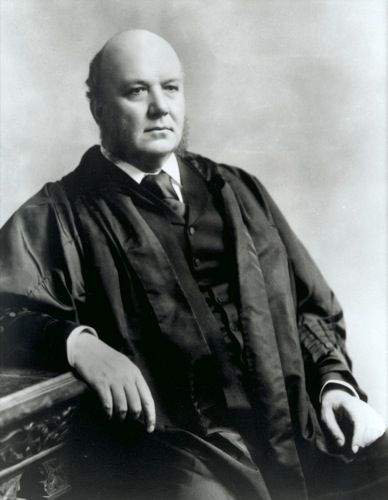
- Horace Gray: Massachusetts justice who traced birthright citizenship from Calvin's Case
- Melville W. Fuller: Chief Justice who argued that nationality follows descent
- John Marshall Harlan: Kentucky justice who joined Fuller in dissent
- Holmes Conrad: Solicitor General, arguing for the government

Summary
Wong Kim Ark was born in San Francisco in 1873 to Chinese parents who lived there as merchants and were subjects of the Emperor of China. His parents returned to China in 1890. He visited China that year and came back without difficulty, but when he returned from a second visit in August 1895 the collector of customs at San Francisco refused to let him land, ruling that he was a Chinese laborer barred by the Chinese Exclusion Acts. A federal district court granted his petition for habeas corpus, and the United States appealed. The parties agreed on the facts, so the sole issue was legal: whether a child born in the United States to Chinese parents who were permanently domiciled there, and not in diplomatic service, became a citizen at birth under the first clause of the Fourteenth Amendment. The government argued that citizenship follows the parents, as in the Roman law and the modern codes of Europe, and that the words "subject to the jurisdiction thereof" required full political allegiance, not merely the obedience owed by any resident. Since Chinese subjects could not become naturalized Americans, it said, their children could not owe complete allegiance to the United States. Wong's counsel replied that the English common law, inherited by the colonies and the states, made birth within the territory the test of nationality, and that the amendment's plain words confirmed that rule. On 28 March 1898 the Court affirmed, six to two. Justice Gray traced the rule of birth within the allegiance from Calvin's Case of 1608 through Blackstone, Story and American decisions, concluding that it governed before the amendment and was reaffirmed by it. The jurisdiction clause, he held, carried only the old exceptions: children of foreign diplomats, children born on foreign public ships or to enemies during hostile occupation, and children of members of Indian tribes, as in Elk v. Wilkins (1884). Statutes forbidding Chinese naturalization could not narrow the Constitution's words, and Wong had done nothing to lose his citizenship. Chief Justice Fuller, joined by Justice Harlan, dissented. He argued that the feudal doctrine of indelible allegiance had been rejected in America, that the founders followed the law of nations on nationality, and that the Civil Rights Act of 1866 and the amendment used the jurisdiction clause to require allegiance owed to no foreign power. The library text contains Gray's full opinion and the first portion of Fuller's dissent, ending where the excerpt is marked, with footnotes left out. The decision settled that children born on American soil to domiciled aliens are citizens, a rule Congress later restated in nationality statutes. The Chinese Exclusion Acts were repealed in 1943. How far the holding extends to children of parents not lawfully domiciled has been argued by scholars and litigated in federal courts in recent years.
Virtues in this work
- Justice: Gray insists that the courts must give full effect to the Constitution's words even where Congress and the executive had chosen to deny Chinese immigrants citizenship.
- Fortitude: Wong Kim Ark pursued his claim through two federal courts over more than two years rather than accept his exclusion from the only country he had lived in.
- Prudence: Gray tests the government's theory by its consequences for thousands of children of European immigrants before rejecting it.
Plot or Argument
- I. The question and the rule of construction
Gray states the agreed facts and the single question, then sets out his method: the Constitution's words must be read in light of the common law that preceded them, since the framers did not define citizen or natural-born citizen.
- II. Birth within the allegiance in English law
Gray reviews Calvin's Case (1608) and later English authorities, showing that every child born within the King's dominions was a natural-born subject, with narrow exceptions for children of ambassadors and of hostile occupiers.
- III. The same rule in the colonies and the United States
Citing Story, Kent, Inglis v. Sailors' Snug Harbor and Lynch v. Clarke, Gray argues that the American states and the Union kept the territorial rule after independence.
- IV. The Roman rule of descent considered
Gray answers the government's claim that citizenship by parentage was the true rule of international law, noting that European nations adopted it only recently and that it never displaced the common law in America.
- V. The Fourteenth Amendment and the jurisdiction clause
Gray holds that the amendment and the Civil Rights Act of 1866 reaffirmed birthright citizenship, and that subject to the jurisdiction thereof excludes only the traditional exceptions plus children of tribal Indians, the point of Elk v. Wilkins.
- VI-VII. Naturalization laws and the agreed facts
Acts of Congress and treaties barring the naturalization of Chinese immigrants cannot alter the Constitution's grant of citizenship by birth. Wong never renounced his citizenship, so the order releasing him is affirmed.
- Fuller's dissent (excerpt)
Fuller argues that nationality belongs to public and international law, that the founders rejected feudal perpetual allegiance, and that citizenship by descent always governed children of Americans born abroad; the excerpt ends as he turns to the natural-born citizen clause.
Characters
- Wong Kim Ark, appellee
San Francisco-born cook and laborer denied reentry in 1895 after a visit to China.
- Justice Horace Gray, author of the majority opinion
Massachusetts justice whose long historical survey grounded the holding in the common law.
- Chief Justice Melville W. Fuller, dissenter
Chief Justice who argued that American citizenship rests on allegiance and descent rather than mere place of birth.
- Justice John Marshall Harlan, joined the dissent
Kentucky justice who joined Fuller's opinion.
- Holmes Conrad, Solicitor General
Argued for the United States that the jurisdiction clause required complete political allegiance.
- John H. Wise, collector of customs at San Francisco
Official who refused Wong Kim Ark permission to land in August 1895.
Lessons
Reading new words in light of old law
The Constitution used the phrase natural-born citizen without defining it, and the Fourteenth Amendment spoke of persons born in the United States. Gray read both against the common law the framers knew, while Fuller argued that independence and the law of nations had displaced that inheritance.
- Why does Gray begin with an English case from 1608?
- What reasons does Fuller give for thinking the common law rule did not survive the Revolution?
- When the Constitution leaves a term undefined, where should judges look for its meaning?
Soil and blood: two theories of belonging
The case set two old principles against each other: citizenship by place of birth (jus soli) and citizenship by descent (jus sanguinis). Each has a long history and a reasoned defense, one emphasizing protection by the land of birth, the other the bond of family and chosen allegiance.
- What does each principle suggest about what makes a person a member of a political community?
- Which countries in Gray's survey followed each rule, and when?
- Could a nation reasonably combine the two principles, as the United States does for children born abroad to citizens?
The limits of legislative power over citizenship
Congress could decide whom to naturalize, and it had barred Chinese immigrants from naturalization. Gray held that this power could not reach those whom the Constitution itself made citizens by birth, placing birthright citizenship beyond ordinary legislation.
- What is the difference between citizenship by birth and citizenship by naturalization in Gray's opinion?
- Why does it matter whether a right comes from the Constitution or from a statute?
One man's case, many people's status
Wong Kim Ark's petition concerned only whether he could land in San Francisco, yet the ruling fixed the status of every child born to domiciled aliens. Gray noted that the government's theory would have unsettled the citizenship of thousands of children of European immigrants as well.
- How does Gray use the children of European immigrants to test the government's argument?
- Why might the parties have agreed on the facts and asked the Court only a legal question?
- What responsibilities come with a decision whose reach goes far beyond the individual before the Court?
Context
Chinese immigrants came to California in large numbers from the 1850s to work in mining, railroad building and agriculture. Congress passed the Chinese Exclusion Act in 1882, suspending the immigration of Chinese laborers, and extended and tightened it with the Geary Act of 1892; federal naturalization statutes, limited to white persons and persons of African descent, did not permit Chinese immigrants to become citizens. Whether children born in America to Chinese parents were citizens was therefore a pressing question for officials at the ports.
Composition
District Judge William W. Morrow ruled for Wong Kim Ark in January 1896, and the government appealed in order to obtain a definitive ruling. The case was argued in March 1897 and decided a year later. Gray's opinion is among the longest historical opinions of its era, drawing on English reports, treatises on the law of nations, executive opinions and American statutes.
Reception
Federal immigration officials continued to scrutinize claims of birth in the United States, and many Chinese Americans had to prove their birthplace in hearings, but the principle of birthright citizenship for children of domiciled aliens was settled. Congress repealed the exclusion laws in 1943, and the Indian Citizenship Act of 1924 extended citizenship to Native Americans born in the United States, the group Gray had left aside under Elk v. Wilkins. The Nationality Act of 1940 and the Immigration and Nationality Act of 1952 restated birthright citizenship. Scholars continue to debate the precise meaning of the jurisdiction clause, and the question of its application to children of parents without lawful domicile has come before federal courts in the twenty-first century.
Comparisons
- dred-scott-v-sandford
Taney's 1857 opinion denied that descendants of enslaved Africans could be citizens; the citizenship clause interpreted in Wong Kim Ark was written in 1868 to settle that question by the fact of birth.
- slaughter-house-cases
Gray examines a passing remark in the 1873 Slaughter-House opinion about children of foreign subjects and concludes it was not a considered holding on the jurisdiction clause.
- commentaries-on-the-laws-of-england
Blackstone's account of natural-born subjects and allegiance is one of the main authorities Gray relies on for the common law rule.
- plessy-v-ferguson
Decided by nearly the same bench two years earlier, Plessy also turned on the Fourteenth Amendment; Harlan dissented in both cases, on opposite sides of the majority's reading.
- the-founding-documents
The Constitution's natural-born citizen requirement for the presidency and its naturalization power form the background both Gray and Fuller interpret.
Quotes
Frequently cited
“the Fourteenth Amendment affirms the ancient and fundamental rule of citizenship by birth within the territory, in the allegiance and under the protection of the country, including all children here born of resident aliens”
Frequently cited
“The Amendment, in clear words and in manifest intent, includes the children born, within the territory of the United States, of all other persons, of whatever race or color, domiciled within the United States.”
“To hold that the Fourteenth Amendment of the Constitution excludes from citizenship the children, born in the United States, of citizens or subjects of other countries would be to deny citizenship to thousands of persons of English, Scotch, Irish, German, or other European parentage who have always been considered and treated as citizens of the United States.”
“Whatever considerations, in the absence of a controlling provision of the Constitution, might influence the legislative or the executive branch of the Government to decline to admit persons of the Chinese race to the status of citizens of the United States, there are none that can constrain or permit the judiciary to refuse to give full effect to the peremptory and explicit language of the Fourteenth Amendment”
“Nationality is essentially a political idea, and belongs to the sphere of public law.”
“The framers of the Constitution were familiar with the distinctions between the Roman law and the feudal law, between obligations based on territoriality and those based on the personal and invisible character of origin, and there is nothing to show that, in the matter of nationality, they intended to adhere to principles derived from regal government, which they had just assisted in overthrowing.”
For Students
A reading companion for classical Christian high school students. See the student guide.
Reading Guide
Watch for
- The agreed facts, especially the parents' permanent domicile and their non-diplomatic status.
- Calvin's Case and the idea of birth within the allegiance of the King.
- The four exceptions Gray reads into the phrase subject to the jurisdiction thereof.
- Gray's distinction between naturalization, which Congress controls, and citizenship by birth.
- Fuller's appeal to the law of nations, Vattel and the right of expatriation.
Key terms and names
- Jus soli
- Latin for right of the soil: citizenship determined by place of birth.
- Jus sanguinis
- Latin for right of blood: citizenship inherited from one's parents.
- Allegiance
- The duty of loyalty a person owes to a sovereign or nation in return for protection.
- Domicile
- A person's fixed, permanent home, which Gray stresses Wong's parents had in San Francisco.
- Naturalization
- The legal process by which a person born a foreigner becomes a citizen.
- Habeas corpus
- A writ requiring authorities to justify holding a person; Wong used it to challenge his detention.
- Expatriation
- Voluntarily giving up one's citizenship, a right Congress declared in 1868.
Seminar Questions
- Comprehension What facts did the parties agree on, and why was Wong Kim Ark refused entry in 1895?
- Comprehension What exceptions to birthright citizenship does Gray identify in the phrase subject to the jurisdiction thereof?
- Comprehension According to Fuller, which body of law should govern questions of nationality?
- Interpretation Why does Gray treat the laws barring Chinese naturalization as irrelevant to Wong's citizenship?
- Interpretation How does Fuller use the American right of expatriation to argue against the English common law rule?
- Big Question What makes someone truly a member of a nation: the place of birth, the family one is born into, or the allegiance one chooses?
Faith Connections
- Leviticus 19:33-34 (Scripture)
Israel is told to treat the stranger who dwells among them as one born among them, a law of hospitality that frames questions of belonging.
- Ephesians 2:19 (Scripture)
Paul tells Gentile believers they are no longer strangers and foreigners but fellow citizens with the saints, drawing on the language of civic membership.
- Philippians 3:20 (Scripture)
Paul reminds Christians that their citizenship is in heaven, placing earthly citizenship within a larger allegiance.
Logic and Rhetoric
Central argument: Because the Constitution's language must be read against the common law, and that law made birth within the territory and allegiance the source of nationality, the Fourteenth Amendment makes citizens of all children born here to domiciled aliens, subject only to narrow traditional exceptions that Congress's naturalization laws cannot enlarge; Fuller answers that nationality is a matter of public and international law, which looks to descent and allegiance.
Rhetorical device: argument from consequences. In quote 2 Gray shows that the government's reading would strip citizenship from thousands of children of English, Irish and German immigrants, a result he expects no reader to accept.
Debate: Resolved: that the phrase subject to the jurisdiction thereof requires more than residence and obedience to the laws.
Memory Work
The Amendment, in clear words and in manifest intent, includes the children born, within the territory of the United States, of all other persons, of whatever race or color, domiciled within the United States.
Nationality is essentially a political idea, and belongs to the sphere of public law.
Writing Prompts
Essay: Explain how Gray and Fuller each use history to interpret the Fourteenth Amendment, and identify the one historical fact on which their disagreement most depends.
Comparison with Dred Scott v. Sandford: Compare the test of citizenship in Taney's opinion with the test Gray applies forty-one years later, and explain how the Fourteenth Amendment changed the question the Court had to answer.
Medical Lens
Gray's and Fuller's opinions are studies of nationality, allegiance and naturalization law, and say nothing about health or medicine.
Creative Prompts
- Classroom
Hold a moot court on the agreed facts of 1895: one side argues from Calvin's Case and Blackstone, the other from Vattel and the Civil Rights Act of 1866, and student justices must vote and explain.
- Essay
Write a short brief for the United States explaining what subject to the jurisdiction thereof meant, using only arguments the dissent or the government actually raised.
- Fiction
Tell the story of Wong Kim Ark waiting aboard ship in San Francisco Bay in the autumn of 1895 while his lawyers prepare a petition for habeas corpus.
- Classroom
Build a timeline of American citizenship law from the Naturalization Act of 1790 through Dred Scott, the Fourteenth Amendment, Wong Kim Ark, the Indian Citizenship Act and the repeal of exclusion in 1943.
Further Reading
- Laws Harsh as Tigers: Chinese Immigrants and the Shaping of Modern Immigration Law, Lucy E. Salyer
Study of how Chinese immigrants used the federal courts, including habeas corpus petitions, during the exclusion era.
- At America's Gates: Chinese Immigration during the Exclusion Era, 1882-1943, Erika Lee
History of the enforcement of the exclusion laws and of Chinese American communities in that period.
- Democracy Reborn: The Fourteenth Amendment and the Fight for Equal Rights in Post-Civil War America, Garrett Epps
Account of the drafting of the Fourteenth Amendment, including its citizenship clause.
Verification notes
All six quotations were matched by Grep against content/texts/united-states-v-wong-kim-ark.txt: four from Gray's opinion and two from Fuller's own words in the dissent excerpt (passages Fuller quotes from Cushing, Vattel and others were avoided). The stored dissent stops partway, so arguments from its later pages are summarized only in general terms. The 1873 birth year is the agreed fact in the opinion. The 6-2 vote and McKenna's nonparticipation were checked against standard references. COURT_TASK.md lists schoolBand 9-10; the schema permits only 9-12.
- Confirm that Holmes Conrad argued for the United States and that the collector who denied entry was John H. Wise.
- Review the sentence on recent litigation over the jurisdiction clause against current case law before publication.