Work record
On the Fabric of the Human Body (Preface)
1543 · Renaissance Early Modern · Essays · Latin
Abstract
Background. Renaissance medical schools taught the body from recovered Greek texts, chiefly Galen, with occasional ceremonial dissections. A young Brabant physician, appointed at Padua the day after his doctorate, began dissecting human corpses himself and found the books wrong in many particulars.
Content. Addressing Charles V, the preface traces how physicians gave up handwork, leaving remedies to apothecaries and operations to barbers. It mocks the lecturer who recites Galen from on high while an ignorant assistant cuts, argues that Galen's descriptions came from monkeys, outlines the seven books, and justifies the many illustrations.
The Treatise. The main work proceeds from skeleton and muscles to vessels, nerves, abdominal and thoracic organs, and the brain, with plates of unprecedented precision. Among its corrections are a one-piece human jaw and the absence of the network of vessels Galen had placed beneath the brain.
Availability. The library stores no text of this preface, because no English version of confirmed public-domain status has been found. The entry is therefore descriptive, with no quotations.
Significance. Issued in the same year as Copernicus's astronomy, the book founded modern descriptive anatomy, made the dissecting professor the norm, and opened the line of Paduan research that led to Harvey. Its posed skeletons and flayed figures were copied for generations of textbooks.
Key figures
- Andreas Vesalius: Professor of surgery and anatomy at Padua, author of the Fabrica
- Charles V: Holy Roman Emperor, to whom the preface is addressed
- Galen: Ancient Greek physician whose anatomical authority the work tests and corrects
- Johannes Oporinus: Basel printer who produced the folio
- Jan Steven van Calcar: Painter from Titian's circle often credited with some of the illustrations

Summary
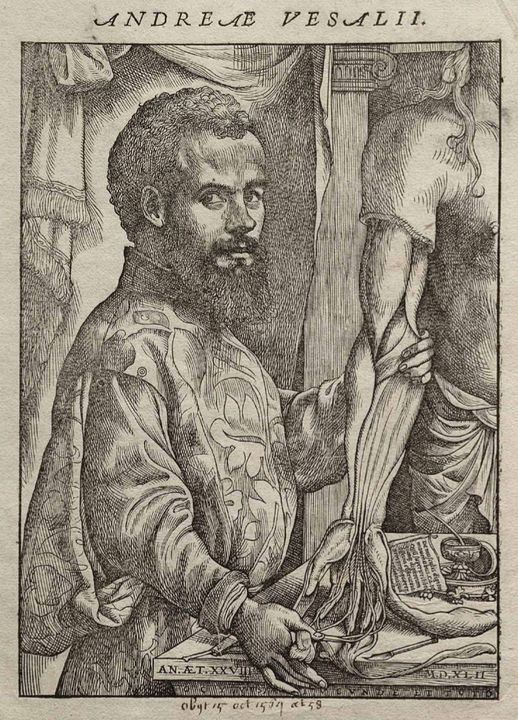
De humani corporis fabrica libri septem (Seven Books on the Fabric of the Human Body) was printed at Basel by Johannes Oporinus in 1543, when its author, Andreas Vesalius, professor at Padua, was twenty-eight. Its seven books describe the bones and cartilages, the ligaments and muscles, the veins and arteries, the nerves, the organs of nutrition and generation, the heart and the organs of the chest, and the brain and the senses. More than two hundred woodcuts, cut with great care and placed beside the text, show skeletons and flayed 'muscle men' posed in landscapes, alongside detailed views of organs and instruments. The artists were probably trained in Titian's workshop in Venice; Jan Steven van Calcar is often named, though the attribution of particular plates is debated. This library entry centres on the preface, a dedicatory letter to the Emperor Charles V, which explains why the book was needed. Vesalius argues that ancient physicians practised all three parts of medicine, diet, drugs and the work of the hands, but that later physicians kept only the prescribing of diets and remedies, leaving the preparation of medicines to apothecaries and surgery to barbers. Anatomy decayed as a result. In the universities, he complains, one man read Galen aloud from a high chair while an unlearned barber cut the body below, so that the professor, like a chattering jackdaw, spoke of things he had never examined and the dissector could not explain what he exposed. Vesalius claims he has put his own hand to dissection and found that Galen, whom he honours as the greatest of the ancient anatomists, had described the bodies of apes and other animals rather than of human beings, so that his account contains many errors. He defends the use of pictures, comparing them to the diagrams of geometry, and anticipates resistance from older Galenists. The Fabrica itself corrects Galen on points such as the human lower jaw, which it shows as a single bone, and the sternum, and it doubts that blood passes through the wall between the ventricles of the heart, a doubt stated more strongly in the revised edition of 1555. The book became the foundation of modern anatomy, though later anatomists in turn corrected Vesalius. No public-domain English translation of the preface has been identified for the library, so no text is stored and nothing is quoted here; the summary and guide describe the preface in paraphrase.
Virtues in this work
- Fortitude: In the preface the young Vesalius publishes corrections of Galen while openly expecting opposition from older and more established physicians.
- Industry: He describes putting his own hands to the dissection that university professors had left to barbers.
- Humility: Even while correcting Galen, he honours him as the foremost of ancient anatomists and frames his work as a return to the practice of the ancients.
Plot or Argument
- Dedication to Charles V
Vesalius addresses the emperor as patron of learning and offers him a work on the structure of the human body, the most noble of subjects for a physician.
- How medicine was divided
Ancient medicine joined regimen, drugs and handwork; later physicians abandoned the hand, giving the compounding of drugs to apothecaries and operations to barbers, and so lost the knowledge of the body on which all three depend.
- The decay of anatomical teaching
In the schools, professors read from Galen in a high chair while barber-dissectors cut, with neither able to correct the other; the result, Vesalius says, was confident talk about things never seen.
- Galen and the apes
Vesalius praises Galen but argues from his own dissections that Galen worked chiefly on animals, especially apes, and that his followers merely abridged him, perpetuating his errors about human structure.
- The plan of the seven books
The preface outlines the seven books, from bones to brain, and explains the role of the illustrations, which let the reader see the parts as on a dissecting table.
- Defending pictures and novelty
Vesalius answers those who think pictures unnecessary, compares them with the diagrams of geometry, and expects opposition from older men loyal to Galen.
Lessons
The hand and the head belong together
Vesalius argues that medicine declined when learned physicians stopped working with their own hands and left the body to barbers. His remedy is a physician who both reads and dissects, joining book learning to direct observation.
- Why does Vesalius think dividing medicine among physicians, apothecaries and barbers harmed it?
- Are there fields today in which theory and practice have drifted apart in a similar way?
Honour a master by testing him
Vesalius calls Galen the prince of anatomists even while correcting him. He presents himself not as Galen's enemy but as one returning to the ancient practice of dissection that Galen himself valued.
- How can a student respect an authority while showing that he made mistakes?
- Why might Galen's followers have been more rigid than Galen himself?
- What made it possible for Vesalius to see what earlier readers had missed?
Seeing is part of knowing
The Fabrica's woodcuts were planned with the text and placed beside it. Vesalius argues that pictures, like geometric diagrams, fix in the mind what words alone cannot, and the book's images shaped anatomical illustration for centuries.
- Why does Vesalius compare anatomical pictures to geometrical diagrams?
- What are the risks of learning from pictures rather than from the thing itself?
The body as a work of wonder
Like Galen before him, Vesalius writes of the body as a marvellous fabric, a made thing, and the title itself suggests craftsmanship. Anatomy was for him both a medical discipline and a way of contemplating the order of the human frame.
- What does the word 'fabric' suggest about how Vesalius saw the body?
- Do the posed skeletons and muscle men in landscapes suggest anything beyond anatomy, such as reflection on mortality?
Context
Renaissance humanists had recovered Galen's Greek texts and printed them in Latin, and Paris and Padua taught anatomy chiefly from Galen. Public dissections were rare, ceremonial events using the bodies of executed criminals. Artists such as Leonardo da Vinci had studied anatomy privately, and printing now made accurate, repeatable images possible. Vesalius worked in this setting, using both humanist learning and his own dissections.
Composition
Vesalius prepared the Fabrica in Padua between about 1539 and 1542, using bodies supplied by the Paduan authorities, and sent the woodblocks over the Alps to Basel, where Oporinus printed the folio in 1543. The Epitome, a shorter version with large plates for students, appeared the same year and was dedicated to the future Philip II. A revised second edition followed in 1555.
Reception
Some Galenists, including Vesalius's former teacher Jacobus Sylvius, attacked the book, while younger anatomists at Padua, such as Realdo Colombo and Gabriele Falloppio, built on and corrected it. The plates were widely copied. Through the Padua anatomical tradition the Fabrica led toward William Harvey, who studied there, and its title-page dissection scene became a classic image of the new anatomy.
Comparisons
- galen-selected-works
Galen's anatomy, based largely on animal dissection, was the authority Vesalius both revered and corrected; reading On the Natural Faculties beside the Fabrica's preface shows two physicians who each insisted that medicine must rest on the physician's own observation.
- harvey-on-the-motion-of-the-heart-and-blood
Harvey, trained at Padua in the tradition Vesalius founded, pressed Vesalius's doubt about pores in the septum of the heart to a new account of the circulation of the blood.
- hippocratic-writings
Vesalius appeals to the ancient Greek ideal of a physician who practised regimen, drugs and surgery together, an ideal he finds in the Hippocratic tradition.
- copernicus-on-the-revolutions
Published in the same year, 1543, Copernicus's book and the Fabrica are often paired as twin landmarks of the Scientific Revolution, each revising an ancient authority, Ptolemy and Galen respectively.
- novum-organum
Bacon's call to learn from nature rather than from books alone was anticipated in Vesalius's insistence that anatomy be learned at the dissecting table.
Quotes
For Students
A reading companion for classical Christian high school students. See the student guide.
Reading Guide
Watch for
- Vesalius's account of how the three parts of ancient medicine (diet, drugs and handwork) were split among physicians, apothecaries and barbers.
- The picture of a university anatomy lesson, with the lecturer in his chair and the barber at the table, and the image of chattering jackdaws.
- The way Vesalius praises Galen even while arguing that Galen dissected apes rather than humans.
- His defence of illustrations and the comparison with the diagrams of geometry.
- His remark that he is not yet twenty-eight and expects opposition from older Galenists.
Key terms and names
- Fabrica
- Latin for a made structure or workmanship; the title presents the body as a crafted fabric of parts.
- Galenism
- The system of anatomy, physiology and therapy derived from Galen, dominant in European medical schools until the seventeenth century.
- Barber-surgeon
- A craftsman who shaved, bled, set bones and performed operations, usually without university training.
- Dissection
- The cutting open of a dead body to study its structure; in Vesalius's day public dissections used executed criminals.
- Rete mirabile
- A network of blood vessels at the base of the brain in some animals, which Galen ascribed to humans and Vesalius could not find.
- Epitome
- The short companion to the Fabrica, published in 1543 with large plates for students.
Seminar Questions
- Comprehension According to the preface, how did medicine come to be divided among physicians, apothecaries and barbers?
- Comprehension What does Vesalius say was wrong with the way anatomy was taught in the universities of his day?
- Comprehension Why does Vesalius think Galen made errors about the human body?
- Interpretation Vesalius presents his reform as a return to ancient practice rather than a break with it. Why might he have framed it that way, and is the framing accurate?
- Interpretation How do the Fabrica's illustrations support or extend the argument of the preface?
- Interpretation Why might older physicians have resisted Vesalius's corrections even when the evidence was before them?
- Big Question When should a student trust a long-standing authority, and when should he insist on seeing for himself?
Faith Connections
- Psalm 139:13-15 (Scripture)
The psalmist praises God for being fearfully and wonderfully made and 'curiously wrought' in secret. Vesalius's careful description of the body's fabric gives a physician's view of the same workmanship.
- Job 10:11 (Scripture)
'Thou hast clothed me with skin and flesh, and hast fenced me with bones and sinews.' Job's description of the body's layers parallels the order of the Fabrica, from bones to sinews and flesh.
- 1 Corinthians 12:14-26 (Scripture)
Paul describes the body as many members each needed by the others. Vesalius's complaint that medicine suffered when its parts were separated echoes this picture of members that cannot say to one another, 'I have no need of thee.'
- Gregory of Nyssa, On the Making of Man (Church Fathers)
Gregory reflects on the structure of the human body as suited to a rational soul made in God's image. Vesalius's anatomy offers the detailed observation that such reflection later drew upon.
Logic and Rhetoric
Central argument: Medicine once united regimen, drugs and the work of the hands; when physicians abandoned handwork, knowledge of the body decayed and teaching came to rely on reading Galen, who had described animals rather than humans; therefore anatomy must be restored by physicians who dissect human bodies themselves, and the results set out in a full description with accurate pictures.
Rhetorical device: satirical description. Vesalius sketches the university anatomy lesson, the lecturer perched high in his chair talking like a jackdaw about things he has never examined while an unlettered barber cuts below, making the old method look absurd before he argues against it.
Debate: Resolved: Physicians should be trained by their own hands-on observation rather than by the authority of texts.
Writing Prompts
Essay: Vesalius argues that anatomy declined because physicians left handwork to barbers and learned from books instead of bodies. Explain his diagnosis and remedy, and argue whether his reform was a revolution against Galen or a return to Galen's own methods.
Comparison with Galen: Selected Works: Galen insisted that the best physician be a philosopher trained in observation; Vesalius used observation to correct Galen. Compare the two physicians' views of how medical knowledge should be gained, and argue what Vesalius owed to the man he corrected.
Medical Lens
The Fabrica is a founding text of modern anatomy and a central document in the history of surgery and medical education. The preface diagnoses a professional problem: the separation of learned physic from manual surgery and pharmacy, which left university physicians ignorant of the body and barber-surgeons without theory. Vesalius's reform, the professor who dissects with his own hands while lecturing, reshaped anatomical teaching. His argument that Galen had described animal rather than human anatomy marked a turn from textual authority to observation, though Vesalius kept much of Galen's physiology, including the humours and spirits. The Fabrica's account of the brain, nerves and sense organs in Book VII matters for the history of neuroanatomy; Vesalius found no rete mirabile at the base of the human brain, a structure Galen had described from animals and placed at the centre of the production of animal spirits. Bodies came from executed criminals, a source of anatomical material that raised ethical and legal questions in later centuries.
- Preface to Charles V
The division of medicine among physicians, apothecaries and barbers, and its consequences for knowledge of the body.
- Preface to Charles V
Satire of lecture-room anatomy, with the professor reading Galen from a chair while an unlearned barber dissects.
- Preface to Charles V
Argument that Galen dissected apes and other animals, so that many of his anatomical claims do not hold for humans.
- Fabrica, Book VI
Description of the heart and doubt that blood sweats through the septum between the ventricles, sharpened in the 1555 edition.
- Fabrica, Book VII
The brain, its ventricles and the sense organs, including the absence in humans of the rete mirabile described by Galen.
Creative Prompts
- Classroom
Show students a reproduction of the Fabrica's title page and the muscle-men plates, and have them list what the images say about who should teach anatomy and how.
- Essay
Vesalius blamed the decline of anatomy on the separation of thinking from handwork. Write an essay on whether a modern profession you know keeps theory and practice together or apart.
- Dialogue
Write a conversation in Paris around 1545 between Vesalius and his old teacher Jacobus Sylvius, who defended Galen against his former student.
Further Reading
- Andreas Vesalius of Brussels, 1514–1564, C. D. O'Malley
- The Illustrations from the Works of Andreas Vesalius of Brussels, J. B. de C. M. Saunders and Charles D. O'Malley
- The Fabric of the Human Body: An Annotated Translation of the 1543 and 1555 Editions, Daniel H. Garrison and Malcolm H. Hast (trans.)
- The Anatomical Renaissance, Andrew Cunningham
Verification notes
No full text is stored and nothing is quoted. Under the library's rule, quotations require exact wording from a verified public-domain English source. English translations of the preface exist, such as Benjamin Farrington's (1932) and modern complete translations, but none has been confirmed as public domain. The account of the preface (the dedication to Charles V, the division of medicine among physicians, apothecaries and barbers, the lecturer in the chair and the jackdaws, Galen's reliance on apes, the defence of illustrations, Vesalius's age) was checked against a summary and translated excerpt on a Stanford course page (https://web.stanford.edu/class/history13/Readings/vesalius.htm) and standard histories. Book contents, the 1555 revision and the corrections of Galen (single mandible, sternum, rete mirabile, septum) follow standard accounts. The attribution of the woodcuts to Jan Steven van Calcar or other members of Titian's workshop is debated.
- Exact number of woodcuts in the 1543 edition (counts vary with how initials and repeated blocks are counted).
- A public-domain English translation of the preface, if one is identified, before adding any quotations.
- Whether Vesalius's age at publication is best given as 28 (he says he was not yet 28 when writing).