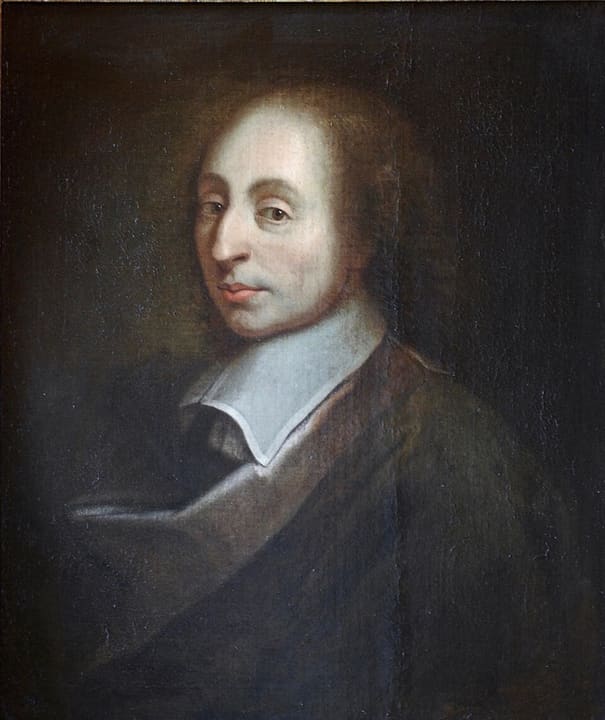
Blaise Pascal (1623–1662) was raised in Clermont and Paris by his father Étienne after his mother's death in 1626. He published a treatise on conic sections at sixteen, built a calculating machine at nineteen, and organised the Puy de Dôme barometric experiment (1648). With Fermat he laid the foundations of probability theory. Drawn to Jansenism in 1646, he had an overwhelming religious experience on the night of 23 November 1654 and sewed the 'Memorial' recording it into his coat. He wrote the Provincial Letters (1656–57) against Jesuit casuistry and died in Paris at thirty-nine after years of chronic illness.
The Pensées ('Thoughts') are the fragments of an unfinished apology for the Christian religion, found after Pascal's death in 1662 as nearly a thousand notes, many on slips of paper threaded together in bundles. Pascal had planned a work that would first unsettle the complacent unbeliever (the honnête homme of polite society) by showing the misery and contradiction of the human condition, then show that Christianity alone explains that condition and offers its remedy.