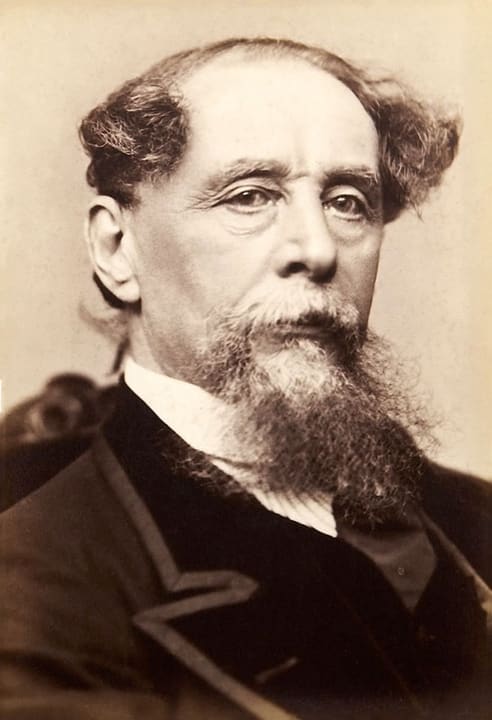
Charles Dickens (1812-1870) was the most popular English novelist of the Victorian age. Sent to work in a blacking warehouse at twelve while his father was imprisoned for debt, he became a court reporter and journalist before The Pickwick Papers (1836-37) made him famous. Oliver Twist, his second novel, appeared while he was editing Bentley's Miscellany; later books include David Copperfield, Bleak House, Hard Times and Great Expectations, most of them issued in parts and read aloud across the English-speaking world.
“My father’s family name being Pirrip, and my Christian name Philip, my infant tongue could make of both names nothing longer or more explicit than Pip. So, I called myself Pip, and came to be called Pip.”
“Pause you who read this, and think for a moment of the long chain of iron or gold, of thorns or flowers, that would never have bound you, but for the formation of the first link on one memorable day.”
“Pip, dear old chap, life is made of ever so many partings welded together, as I may say, and one man’s a blacksmith, and one’s a whitesmith, and one’s a goldsmith, and one’s a coppersmith.”
Oliver Twist, subtitled The Parish Boy's Progress, follows an orphan from a workhouse cradle to a safe home, passing on the way through the criminal underworld of 1830s London. Oliver is born in a workhouse in an unnamed town; his mother dies within minutes, leaving only a locket and a ring that later prove who she was.
David Copperfield is the first-person autobiography of a novelist looking back on his life. David is born at Blunderstone in Suffolk six months after his father's death, on a night when his formidable great-aunt Betsey Trotwood storms out on learning he is not a girl.
Bleak House is built around Jarndyce and Jarndyce, an endless lawsuit over a disputed will in the Court of Chancery, and around a secret that links a great lady to an orphan girl. Dickens tells it in two voices: an unnamed narrator in the present tense who surveys London's fog, the lawcourts, fashionable society and the slum called Tom-all-Alone's, and Esther Summerson, who writes her own story modestly in the past tense.
Hard Times, subtitled For These Times, is Dickens's shortest and most concentrated novel, set in Coketown, a smoky northern mill town of red brick, black canals, and identical streets. Thomas Gradgrind, a retired hardware merchant and later a member of Parliament, runs a model school and his own household on a single principle: children must be taught Facts and nothing else.
A Tale of Two Cities moves between London and Paris from 1775 to the Reign of Terror in 1793-94. In Book the First, Recalled to Life, Jarvis Lorry, a clerk of Tellson's Bank, travels by the Dover mail and sends back the cryptic message Recalled to life by the porter Jerry Cruncher.
Great Expectations is the first-person story of Philip Pirrip, called Pip, an orphan brought up by hand by his harsh elder sister and her gentle husband Joe Gargery, the village blacksmith on the Kent marshes. On Christmas Eve, in the churchyard where his parents lie, an escaped convict seizes Pip and makes him bring a file and food; Pip steals both from his sister's house, and the convict is later recaptured struggling with another fugitive.