Work record
A Tale of Two Cities
1859 · 19th Century · Novel · English
Abstract
Background. Dickens launched his weekly All the Year Round with this book, building its picture of revolutionary France on Carlyle's history and on the idea of a rival's self-sacrifice he had acted in The Frozen Deep two years before.
Plot. A physician buried alive in the Bastille is brought to London, where his daughter marries an exile who hides his noble name. Sydney Carton, the exile's near double, loves her without hope. When revolution comes, the son-in-law returns to Paris to save a servant, is seized, freed, and seized again; a letter the doctor once hid in his cell supplies the evidence that condemns him. Carton smuggles himself into the Conciergerie, sends the prisoner out drugged, and rides the tumbril in his stead.
Structure. Each of the three books carries a motto-title: Recalled to Life, The Golden Thread, The Track of a Storm. Doubles organize the design: two capitals, two lookalike rivals, two fierce women, and comic grave-robbing that mirrors the solemn theme of rising from death.
Themes. Vengeance breeding vengeance, the long shadow of injustice, imprisonment and recovery, and redemption through a substituted death.
Significance. Among the most read of Dickens's books, it fixed the popular English image of the Terror, and its first and last sentences rank with the most quoted lines in the language.
Main characters
- Sydney Carton: Gifted, self-despising lawyer who dies in another man's place
- Charles Darnay: Evremonde heir who gives up his name and estate
- Lucie Manette: Daughter whose devotion holds the family together
- Doctor Alexandre Manette: Physician broken by the Bastille and slowly mended
- Jarvis Lorry: Tellson's clerk, businesslike and quietly devoted
- Madame Defarge: Implacable knitter of the revolutionary register
- Ernest Defarge: Wine-shop keeper and leader of the Jacques
- Miss Pross: Lucie's fierce English protector
- Jerry Cruncher: Bank messenger who robs graves by night
- John Barsad: Turncoat spy, secretly Miss Pross's brother Solomon

Watch the summary
A Tale of Two Cities in 156 seconds · 2:36
Summary
A Tale of Two Cities moves between London and Paris from 1775 to the Reign of Terror in 1793-94. In Book the First, Recalled to Life, Jarvis Lorry, a clerk of Tellson's Bank, travels by the Dover mail and sends back the cryptic message Recalled to life by the porter Jerry Cruncher. At Dover he tells young Lucie Manette that her father, Doctor Alexandre Manette, believed dead, has been released after eighteen years in the Bastille. In the Paris suburb of Saint Antoine, where a broken wine cask sets the starving poor licking the street, the wine-seller Ernest Defarge keeps the doctor in a garret, where he cobbles shoes and knows himself only as One Hundred and Five, North Tower. Lucie's touch and golden hair begin his recovery. Book the Second, The Golden Thread, opens in 1780 at the Old Bailey, where the French emigrant Charles Darnay is tried for treason; he is acquitted when the barrister Stryver's dissolute assistant, Sydney Carton, shows that he looks so like Darnay that the identifying witness cannot be trusted. Darnay is in fact the nephew of the cruel Marquis St. Evremonde, whose carriage runs down a peasant child in Paris; the father, Gaspard, stabs the Marquis in his bed and is hanged. Darnay renounces his inheritance, teaches French in England, and marries Lucie. Carton, who has wasted his gifts, confesses his love to Lucie and promises he would give his life for anyone dear to her. On the wedding day Manette learns Darnay's true family name and relapses into shoemaking for nine days. Meanwhile Madame Defarge knits into her stitches a register of aristocrats marked for vengeance. In July 1789 the Bastille falls, and Defarge searches Manette's old cell. In 1792 a letter from the imprisoned steward Gabelle draws Darnay to Paris, where he is arrested as an emigrant. Book the Third, The Track of a Storm, follows Manette's efforts, aided by his standing as a former Bastille prisoner, to free his son-in-law. Darnay is acquitted, then rearrested the same night. At his second trial Defarge reads a letter Manette wrote in prison in 1767, describing how the Evremonde brothers summoned him to a dying peasant girl and her wounded brother, and then had him imprisoned for knowing too much; Madame Defarge is the girl's surviving sister. Darnay is condemned to death. Carton, using his hold over the spy John Barsad, enters the prison, drugs Darnay and takes his place. Miss Pross, Lucie's devoted companion, struggles with Madame Defarge, whose pistol goes off and kills her. The family escapes to England, and Carton goes to the guillotine comforting a young seamstress. Dickens serialized the novel weekly in his new magazine All the Year Round from April to November 1859, with simultaneous monthly parts and a volume edition that year.
Virtues in this work
- Charity: Carton takes Darnay's place at the guillotine so that Lucie may keep the life she loves.
- Fortitude: Miss Pross stands her ground against an armed Madame Defarge to protect Lucie's escape.
- Justice: Darnay renounces an estate built on the misery of its tenants and returns to France to help the imprisoned Gabelle.
- Friendship: Jarvis Lorry stays at the Manettes' side for eighteen years, from Dover to the escape from Paris.
Plot or Argument
- Book I, Chapters 1-4: The period and the mail
Dickens sets 1775 England and France side by side; Jarvis Lorry rides the Dover mail, sends back Recalled to life, and at Dover tells Lucie that her father lives.
- Book I, Chapters 5-6: The wine-shop and the shoemaker
In Saint Antoine the spilled wine and the scrawled word Blood foreshadow revolution; in Defarge's garret Manette, absorbed in shoemaking, slowly recognizes his daughter.
- Book II, Chapters 1-6: Trial and doubles
Darnay's Old Bailey treason trial, won by Carton's resemblance to him; Carton plays jackal to Stryver; the household in Soho and its echoing footsteps.
- Book II, Chapters 7-9: Monseigneur
The Marquis St. Evremonde's carriage kills Gaspard's child; Darnay argues with his uncle, who is stabbed that night by a man of the people.
- Book II, Chapters 10-20: Promises, knitting and a relapse
Darnay and Stryver seek Lucie's hand; Carton declares his love and his willingness to die for her; Jerry Cruncher digs for bodies; Madame Defarge knits her register; Manette relapses for nine days after the wedding and later explains the case to Lorry.
- Book II, Chapters 21-24: The sea rises
The storming of the Bastille, the killing of Foulon, the burning of the Evremonde chateau, and Gabelle's appeal, which draws Darnay to the Loadstone Rock of Paris.
- Book III, Chapters 1-7: In secret and in triumph
Darnay is imprisoned at La Force; Manette's influence and the Republic's courts secure his acquittal; he is rearrested the same evening.
- Book III, Chapters 8-10: The substance of the shadow
Miss Pross finds her brother Solomon, who is the spy Barsad; Carton plays his hand at cards; Manette's buried Bastille letter condemns the Evremondes and Darnay with them.
- Book III, Chapters 11-15: The far, far better thing
Manette relapses; Carton takes Darnay's place in the Conciergerie; Miss Pross defeats Madame Defarge; Carton dies at the guillotine with a vision of a renewed Paris and of Lucie's descendants.
Characters
- Sydney Carton, barrister's assistant
A brilliant, dissipated lawyer who believes his life wasted and finally gives it for Lucie's family.
- Charles Darnay, French emigrant
Nephew of the Marquis St. Evremonde, who renounces his family's estate and marries Lucie.
- Lucie Manette, the golden thread
A gentle young woman whose love restores her father and binds the other characters together.
- Doctor Alexandre Manette, physician and former prisoner
A physician imprisoned eighteen years in the Bastille for witnessing an aristocrat's crime, who recovers but relapses under stress.
- Jarvis Lorry, banker
A methodical clerk of Tellson's Bank who becomes the family's loyal guardian.
- Miss Pross, Lucie's companion
A fierce, devoted Englishwoman who defeats Madame Defarge in the final struggle.
- Jerry Cruncher, porter and resurrection-man
Tellson's odd-job man, who secretly digs up bodies to sell and resolves to give it up.
- Ernest Defarge, wine-seller
Manette's former servant and a leader of the Saint Antoine revolutionaries.
- Madame Defarge, revolutionary
Therese Defarge, who knits a register of the condemned and seeks the extinction of the Evremonde line.
- John Barsad, spy
Solomon Pross, Miss Pross's brother, a spy for both England and the Republic, whom Carton forces to help him.
- Marquis St. Evremonde, aristocrat
Darnay's uncle, contemptuous of the poor, killed in his bed after his carriage kills a child.
- Stryver, barrister
A bullying, ambitious lawyer who profits from Carton's work.
Lessons
A wasted life redeemed by sacrifice
Sydney Carton calls himself useless and drinks away his talent, yet he keeps the promise made to Lucie in Book II, Chapter 13. Dickens shows that a life is measured by what it is finally given for, and he frames Carton's death with the words of John 11.
- Why does Carton say he is incapable of better things, and is he right?
- What do the words he repeats while walking the Paris streets in Book III, Chapter 9 reveal about his change?
- Is Carton's death a suicide, a sacrifice, or something else?
Cruelty breeds its own monsters
The Marquis treats the poor as vermin, and the Revolution answers with the guillotine and Madame Defarge's knitting. In Book III, Chapter 15 Dickens says that the same seed will yield the same fruit, judging both the old regime and the Terror it produced.
- What does the death of Gaspard's child show about the Marquis and the society around him?
- How does Madame Defarge's history explain her hatred, and does it justify it?
- Does Dickens take the side of the aristocrats or of the Revolution?
Love that restores
Lucie is the golden thread of Book II: her patience draws her father back from the garret, holds the Soho household together and moves Carton's heart. Dickens presents faithful domestic love as a power stronger than imprisonment and hatred.
- How does Lucie bring her father back to himself in Book I, Chapter 6?
- Why is Lucie a magnet for so many characters, including Carton and Stryver?
The past does not stay buried
Manette's letter, hidden in his Bastille cell, returns eighteen years later to condemn the son-in-law he loves. Jerry Cruncher's grave-robbing, Recalled to life, and Carton's resurrection text all play on what rises again from the grave.
- Why does Manette's own letter destroy his happiness?
- How do the comic scenes of Jerry Cruncher echo the novel's serious theme of resurrection?
Context
The novel spans the last years of the French old regime and the Revolution: the fall of the Bastille on 14 July 1789, the rural risings that burned chateaux, the emigration of nobles, the September massacres of 1792 and the Terror of 1793-94, when revolutionary tribunals sent thousands to the guillotine. Dickens contrasts this with an England of hangings, debtors' prisons and a corrupt Old Bailey, refusing to make either country simply virtuous.
Composition
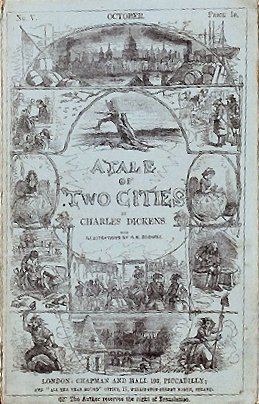
Dickens wrote the novel in 1859 to launch his new weekly, All the Year Round, where it ran from 30 April to 26 November 1859, while appearing also in monthly parts with illustrations by Hablot K. Browne (Phiz). His preface credits Thomas Carlyle's The French Revolution (1837) and says the idea came to him while acting in Wilkie Collins's play The Frozen Deep in 1857. It is one of his only two historical novels, with Barnaby Rudge.
Reception
Contemporary reviewers were divided, and some thought the book thin in humor and character by Dickens's standard, but it became one of his most widely read novels, a fixture of school reading in Britain and America, and the source of many stage, film and radio adaptations. Its opening and closing sentences are among the best known in English fiction.
Comparisons
- the-scarlet-pimpernel
Both novels rescue the condemned from the Terror; Orczy's hero is a disguised English nobleman who escapes again and again, while Carton saves one man by dying in his place.
- common-sense-rights-of-man-and-other-writings
Paine's Rights of Man defended the Revolution against Burke in 1791; Dickens, writing seventy years later, explains the Revolution's causes but recoils from the Terror Paine himself barely survived.
- great-expectations
Written immediately after, Great Expectations also turns on a hidden past, a prison, and a young man who learns that his fortune is bound up with someone he despised.
- a-christmas-carol
Scrooge and Carton both undergo a change of heart that Dickens frames as a resurrection, one comic and domestic, the other tragic and historical.
- the-hiding-place
Both books set ordinary households against a state that imprisons and kills by category; Corrie ten Boom's memoir shows sacrificial rescue in history rather than fiction.
Quotes
Frequently cited
“It was the best of times, it was the worst of times”
Frequently cited
“It is a far, far better thing that I do, than I have ever done; it is a far, far better rest that I go to than I have ever known.”
“A wonderful fact to reflect upon, that every human creature is constituted to be that profound secret and mystery to every other.”
“a man who would give his life, to keep a life you love beside you”
“there had been a strong and extraordinary revival of the train of thought and remembrance that was the first cause of the malady”
“Crush humanity out of shape once more, under similar hammers, and it will twist itself into the same tortured forms.”
“I am the Resurrection and the Life, saith the Lord: he that believeth in me, though he were dead, yet shall he live”
For Students
A reading companion for classical Christian high school students. See the student guide.
Reading Guide
Watch for
- The paired opening chapter of Book I, which sets England and France side by side, and the closing chapter of Book III, which answers it.
- Every scene at Manette's shoemaker's bench: the garret in Book I, Chapter 6, the relapse in Book II, Chapter 18, and the bench's destruction in Book II, Chapter 19.
- Carton's resemblance to Darnay, first used to win the Old Bailey trial in Book II, Chapter 3, and used again at the end.
- Madame Defarge's knitting in Book II, Chapters 15-16, and what her register becomes in Book III.
- The words from John 11 that Carton hears in his mind in Book III, Chapter 9 and that return at the scaffold.
Key terms and names
- Recalled to life
- Lorry's coded message about Manette's release in Book I, which becomes the title of Book I and a pattern for every rescue and resurrection in the novel.
- Saint Antoine
- The poor quarter of eastern Paris where the Defarges keep their wine-shop and from which the attack on the Bastille is launched.
- One Hundred and Five, North Tower
- Manette's cell in the Bastille, the only name he can give himself when found, and the place where his hidden letter is later discovered.
- Jacques
- The code name the revolutionaries of Saint Antoine use for one another, so that Defarge and his comrades are Jacques One, Two, Three and so on.
- Tellson's Bank
- The cramped, old-fashioned London bank, with a Paris house, for which Lorry works and through which the English characters keep contact with France.
- Emigrant
- A French noble who fled the Revolution; on returning to Paris in 1792 Darnay is arrested under the laws against such persons.
- La Guillotine
- The beheading machine of the Terror, which Dickens personifies as a goddess with her worshippers.
Seminar Questions
- Comprehension Why was Doctor Manette imprisoned in the Bastille, and how is the reason finally revealed in Book III, Chapter 10?
- Comprehension How does Carton save Darnay at the Old Bailey in Book II, and how does he save him again in Book III?
- Comprehension What is Madame Defarge's connection to the Evremonde family?
- Interpretation Why does Dickens open the novel with a sentence built entirely of contradictions, and how does the rest of the book bear it out?
- Interpretation Miss Pross and Madame Defarge fight in Book III, Chapter 14. What does each woman stand for, and why does love win?
- Interpretation Manette's love for Lucie restores him, yet his own letter condemns her husband. What is Dickens saying about the power of the past?
- Big Question Can justice ever be achieved by vengeance, or does vengeance always become a new injustice?
- Big Question Is it possible for a person who has wasted his life to redeem it in a single act?
Faith Connections
- John 11:25-26 (Scripture)
Jesus's words at the tomb of Lazarus, read in the Anglican burial service, are the words Carton repeats as he walks Paris and as he goes to the scaffold; they turn his death into an act of hope.
- John 15:13 (Scripture)
Greater love has no man than this, that a man lay down his life for his friends. Carton, who was not even Darnay's close friend, lays down his life for Lucie's sake and for the family she loves.
- Romans 12:19-21 (Scripture)
Paul forbids private vengeance and commands overcoming evil with good. Madame Defarge's register is the opposite path, and its end in Book III, Chapter 14 shows vengeance consuming itself.
- Edmund Burke, Reflections on the Revolution in France (1790) (Great Conversation)
Burke predicted that the Revolution's contempt for inherited order would end in bloodshed; Dickens agrees about the Terror but insists, unlike Burke, that the old regime's cruelty had made it inevitable.
Logic and Rhetoric
Central argument: Long cruelty crushes human beings out of shape, so the cruelty of the Evremondes produces the cruelty of Madame Defarge and the guillotine. Vengeance only repeats the original wrong. What breaks the cycle is self-giving love: Lucie's love restores her father, and Carton's sacrifice saves Darnay and gives his own life meaning. Therefore the novel argues that history is redeemed not by revolution or by power but by love that dies for others.
Rhetorical device: antithesis and anaphora. The opening sentence of Book I, Chapter 1 sets pairs of opposites, beginning 'it was the best of times, it was the worst of times,' in a long repeated pattern that frames the whole tale of two cities.
Debate: Resolved: that Dickens judges the French Revolution more harshly than the old regime it overthrew.
Memory Work
It is a far, far better thing that I do, than I have ever done; it is a far, far better rest that I go to than I have ever known.
It was the best of times, it was the worst of times
Writing Prompts
Essay: Trace the theme of resurrection from Recalled to life in Book I through Jerry Cruncher's grave-robbing to Carton's death, and argue what kind of resurrection Dickens finally affirms.
Comparison with The Scarlet Pimpernel: Carton and Sir Percy Blakeney both rescue victims of the Terror. Compare a hero who saves many by cleverness and escapes with one who saves a single man by dying, and argue which is the greater act.
Medical Lens
Doctor Manette is one of Victorian fiction's most careful portraits of the lasting effects of long imprisonment. Freed after eighteen years of solitary confinement, he has narrowed his identity to a cell number and a cobbler's bench; recovery comes through his daughter's care, and relapse follows when Darnay's true name revives the memories of the Evremonde case. In Book II, Chapter 19, a physician discusses his own illness in the third person as a case, attributes it to the return of a train of distressing associations, notes the patient's amnesia for the episode, and agrees, reluctantly, that the old tools be destroyed. Modern readers often compare these episodes with post-traumatic or dissociative states; that reading is interpretive, and Dickens's vocabulary is the period's language of shock and mental strain. The novel adds an eighteenth-century physician's case history in Manette's Bastille letter (a young woman in a high fever of the brain, treated with narcotics he distrusts, and a boy dying of a sword wound), Carton's purchase of a stupefying drug from a Paris chemist, Jerry Cruncher's trade as a resurrection-man supplying bodies to anatomists, Carton's heavy drinking, and the hunger of Saint Antoine.
- Book I, Chapter 6
Manette at his shoemaker's bench in Defarge's garret, answering to his cell number and slowly recognizing Lucie's hair.
- Book II, Chapters 18-19
Manette's nine-day relapse after the wedding; his clinical conversation with Lorry about the case and the destruction of the bench.
- Book III, Chapter 10
Manette's letter describes attending the Evremonde brothers' victim in a high fever of the brain, using narcotic medicines from their case, and the dying brother's wound, and records his fear that his reason will not remain unimpaired.
- Book II, Chapter 14
Jerry Cruncher goes fishing by night in a churchyard; his son learns that he is a resurrection-man.
- Book III, Chapters 9 and 13
Carton buys powders from a chemist and later uses a drug to render Darnay insensible before the exchange in the prison.
- Book II, Chapter 5
Carton works through the night for Stryver with wet towels on his head and a bowl of punch.
- Book I, Chapter 5
The starving people of Saint Antoine scoop spilled wine from the street; Hunger is described as a presence in every house.
Listen to the book
Public-domain audiobook from LibriVox, read by Paul Adams. Recording: Tale of Two Cities (version 2) on LibriVox (Internet Archive).
LibriVox recordings are volunteer readings released into the public domain. The reading may follow a different edition from the text in this library.
Creative Prompts
- Essay
Compare Carton and Darnay as doubles. What does each have that the other lacks, and why must it be Carton who dies?
- Dialogue
Write the conversation between Madame Defarge and the Vengeance on the morning she sets out for Lucie's lodging, in your own words.
- Classroom
Trace every use of resurrection in the novel, from Recalled to life and Jerry Cruncher's night work to Carton's last walk, and chart how the idea changes.
- Fiction
Tell the last ride in the tumbril from the point of view of the young seamstress.
Further Reading
- The French Revolution: A History, Thomas Carlyle
The history Dickens credited in his preface.
- Citizens: A Chronicle of the French Revolution, Simon Schama
- Charles Dickens: A Life, Claire Tomalin
- Great Expectations, Charles Dickens
Verification notes
Plot, chapter locators and the 1859 serial publication in All the Year Round are standard. All quotes were found verbatim in the attached Project Gutenberg #98 text, which does not reproduce Dickens's preface; the preface's mentions of Carlyle and The Frozen Deep are stated from the well-known first edition. Readings of Manette's condition as post-traumatic or dissociative are interpretive.
- Exact serial dates in All the Year Round (30 April to 26 November 1859) and the monthly-parts schedule.