Work record
Great Expectations
1860-61 · 19th Century · Novel · English
Abstract
Background. Dickens began the novel in autumn 1860 to restore flagging sales of his weekly All the Year Round, opening it on the estuary marshes near Cooling and Rochester he had known since boyhood.
Narrative. The orphan Pip feeds a fugitive on Christmas Eve, is sent to play at Satis House, and falls for the cold Estella. Told by Jaggers of an unnamed patron, he becomes a London gentleman ashamed of Joe, until the transported convict Magwitch returns from New South Wales as his benefactor. Pip hides him, discovers that Estella is Magwitch's daughter and Compeyson the bridegroom who deserted Miss Havisham, fails to get him abroad, and loses the fortune when Magwitch dies under sentence. Nursed through fever by Joe, he spends eleven years abroad with Herbert before meeting the widowed Estella.
Structure. An older Pip narrates in three stages matching the original volumes. Dickens replaced his first ending, in which the pair part, after Bulwer-Lytton urged a more hopeful close.
Themes. Gentility against goodness, guilt and gratitude, polite wealth secretly resting on a convict's labour, and the waste wrought by revenge in Satis House's rotting wedding feast.
Significance. Chesterton and Shaw admired its unity and moral seriousness, and the churchyard opening and Miss Havisham's room are among the most recognized scenes in English fiction.
Main characters
- Pip (Philip Pirrip): Orphan narrator raised for the forge and then for gentility
- Joe Gargery: Pip's brother-in-law, a blacksmith of steady, unassuming goodness
- Mrs Joe Gargery: Pip's harsh elder sister, disabled by an unseen assailant
- Abel Magwitch: Escaped convict, later transported, who secretly funds Pip's expectations
- Miss Havisham: Jilted recluse of Satis House who stopped her clocks at the betrayal
- Estella: Miss Havisham's ward, trained to wound men; Magwitch's lost daughter
- Herbert Pocket: Pip's cheerful London roommate and loyal friend
- Mr Jaggers: Formidable criminal lawyer who administers Pip's fortune
- John Wemmick: Jaggers's clerk, dry at the office, warm at his Walworth castle
- Biddy: Sensible village girl who teaches Pip and later marries Joe
- Compeyson: Gentleman swindler, Magwitch's enemy and Miss Havisham's false bridegroom
- Orlick: Resentful journeyman who attacks Mrs Joe and later Pip

Summary
Great Expectations is the first-person story of Philip Pirrip, called Pip, an orphan brought up by hand by his harsh elder sister and her gentle husband Joe Gargery, the village blacksmith on the Kent marshes. On Christmas Eve, in the churchyard where his parents lie, an escaped convict seizes Pip and makes him bring a file and food; Pip steals both from his sister's house, and the convict is later recaptured struggling with another fugitive. Pip is then sent to play at Satis House, where the wealthy Miss Havisham, jilted on her wedding day, still wears her yellowed bridal dress among stopped clocks and a rotting wedding feast. Her proud adopted daughter Estella mocks Pip as a common laboring boy, and he grows ashamed of the forge and of Joe even after he is bound as Joe's apprentice. His sister is struck down by an unseen attacker and left an invalid, and the kind, clever Biddy comes to keep house. Then the London lawyer Jaggers announces that Pip has great expectations: an unnamed benefactor will make him a gentleman. Believing Miss Havisham is his patron and Estella intended for him, Pip goes to London, shares rooms with the cheerful Herbert Pocket, runs into debt and is embarrassed when Joe visits. Estella, raised to break men's hearts, marries the brutish Bentley Drummle. One stormy night the convict, Abel Magwitch, returns from New South Wales, where he has grown rich, and reveals that he is Pip's benefactor, having risked hanging to see the gentleman he made. Pip is horrified, yet he and Herbert shelter him. Pip learns that Magwitch's old enemy Compeyson was Miss Havisham's faithless bridegroom and that Estella is Magwitch's lost daughter. Miss Havisham, repenting what she has done, begs Pip's forgiveness; her dress catches fire and Pip is burned saving her. Pip barely escapes murder by the journeyman Orlick, his sister's attacker. An attempt to smuggle Magwitch abroad by the Thames fails; Compeyson drowns in the struggle, and Magwitch, injured and condemned, dies in the prison infirmary holding Pip's hand, after Pip tells him his daughter lives. His wealth is forfeit. Pip falls into a fever and is nursed by Joe, who quietly pays his debts. Returning to ask Biddy to marry him, Pip finds her Joe's bride. He works for eleven years in Herbert's firm in the East and, revisiting Satis House, meets the widowed Estella, softened by suffering, and sees no shadow of another parting.
Virtues in this work
- Charity: Joe nurses Pip through his fever and secretly pays his debts after Pip has neglected him for years.
- Humility: Pip comes to recognize his ingratitude, holds the convict's hand as he dies and asks Joe and Biddy to forgive him.
- Friendship: Herbert Pocket stands by Pip through debt and danger and helps him shelter Magwitch.
- Industry: After losing his fortune Pip works for years as a clerk and then partner in Herbert's firm and pays his way.
Plot or Argument
- First stage: the marshes and Satis House (Chapters I-XIX)
Pip helps the convict, visits Miss Havisham and Estella, grows ashamed of the forge, is apprenticed to Joe, and learns of his expectations.
- Second stage: the London gentleman (Chapters XX-XXXIX)
Pip lives in London with Herbert Pocket, learns from Jaggers and Wemmick, neglects Joe and Biddy, pursues Estella, and is visited by Magwitch, who reveals himself as the benefactor.
- Third stage: loss and recovery (Chapters XL-LIX)
Pip learns the hidden histories of Magwitch, Compeyson, Miss Havisham and Estella, attempts Magwitch's escape, stands by him in his trial and death, is nursed by Joe, and finds a humbler life and a final meeting with Estella.
Characters
- Pip (Philip Pirrip), Narrator
An orphan blacksmith's apprentice whose sudden fortune makes him a snob, and whose loss of it teaches him gratitude and humility.
- Joe Gargery, Pip's brother-in-law
A simple, strong, tender-hearted blacksmith whose patient goodness never changes.
- Mrs Joe Gargery, Pip's sister
A harsh, quick-tempered woman who raises Pip by hand and is crippled by a blow from an unseen attacker.
- Abel Magwitch (Provis), The convict and secret benefactor
The fugitive Pip feeds on the marshes, who spends his transported life making Pip a gentleman in gratitude.
- Miss Havisham, Recluse of Satis House
A jilted heiress who stops her clocks at the hour of her betrayal and raises Estella to wreak revenge on men.
- Estella, Miss Havisham's adopted daughter
A beautiful, cold young woman taught to have no heart, who is later revealed as Magwitch's daughter.
- Herbert Pocket, Pip's friend
A cheerful, generous young gentleman who shares Pip's lodgings and helps him hide Magwitch.
- Mr Jaggers, Criminal lawyer
A formidable London lawyer who manages Pip's fortune and keeps everyone's secrets.
- John Wemmick, Jaggers's clerk
A dry clerk in the office who becomes warm and domestic at his little castle in Walworth with his Aged Parent.
- Biddy, Village girl
Pip's kind and sensible friend and teacher, who later marries Joe.
- Compeyson, Gentleman swindler
Magwitch's partner in crime and Miss Havisham's false bridegroom.
- Orlick, Joe's journeyman
A sullen, resentful worker who attacks Mrs Joe and later tries to kill Pip.
Lessons
The gentleman and the true gentleman
Pip thinks money and manners make a gentleman, yet the least polished characters, Joe and in his rough way Magwitch, show the most loyalty and self-sacrifice. Dickens measures a man by his heart and conduct rather than his rank.
- Why is Pip ashamed of Joe during his London visit?
- Which characters in the novel are true gentlemen, and why?
Ingratitude recognized
Pip the narrator judges his younger self honestly, admitting that he was too cowardly to do what he knew to be right. The novel shows that seeing one's own ingratitude is the beginning of a changed heart.
- Where does the older Pip most sharply criticize the younger Pip?
- What finally changes his feelings toward Magwitch?
Revenge that ruins its maker
Miss Havisham stops time to nurse her injury and trains Estella to break hearts. Her vengeance destroys both her own life and the girl's capacity to love, until she cries out in remorse and asks forgiveness.
- What does Satis House look like, and what does it say about Miss Havisham?
- How has Miss Havisham harmed Estella as well as Pip?
Forgiveness and faithful love
Joe nurses Pip through his fever and pays his debts without reproach, and Pip prays beside the dying Magwitch for mercy on a sinner. Forgiveness given and received runs through the closing chapters.
- How does Joe treat Pip after his fortune is lost?
- Why does Pip choose the publican's prayer from the Gospel for Magwitch?
Context
The novel is set in the early nineteenth century, from about 1812 into the 1840s, when convicts were held on prison hulks in the Thames estuary and transported for life to New South Wales, and a transported man who returned to England could be hanged. It reflects a society in which new commercial wealth was making gentlemen of men without birth, and in which the meaning of gentility was widely debated. Dickens drew on the Kent marshes near Rochester and Cooling that he had known from childhood.
Composition
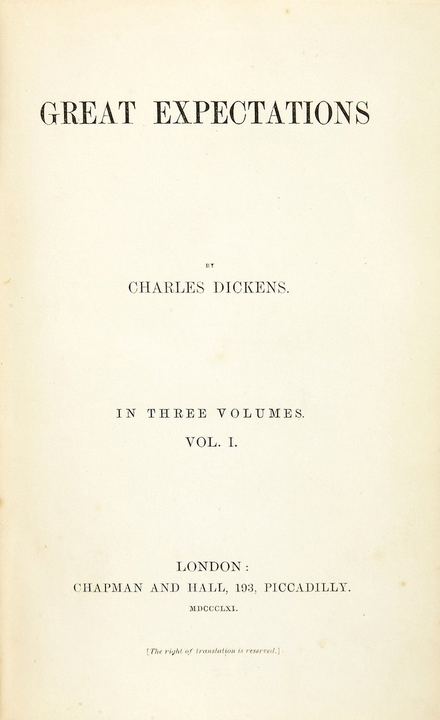
Dickens began the novel in 1860 to revive the sales of All the Year Round, and it ran weekly from December 1860 to August 1861 before appearing in three volumes. Its three stages correspond to the volume divisions. His original ending had Pip and Estella meet briefly and part; on the advice of the novelist Edward Bulwer-Lytton he wrote the more hopeful ending printed in the book. The attached Gutenberg text follows the 1867 edition.
Reception
The novel was a popular success and has remained one of Dickens's most admired works, praised by G. K. Chesterton, George Bernard Shaw and many later critics for its unity, its first-person narration and the moral seriousness of Pip's self-judgment. Its opening in the churchyard and the image of Miss Havisham's wedding feast are among the best-known scenes in English fiction.
Comparisons
- david-copperfield
Dickens's earlier first-person novel of a boy's growth is warmer and more autobiographical; Pip's story is darker and more critical of its narrator.
- silas-marner
Published the same year, Eliot's novel also turns on a hidden parentage and a humble adoptive father whose love counts for more than wealth.
- a-christmas-carol
Both begin at Christmas and turn on the conversion of a hardened heart, Scrooge's in a night and Pip's over years.
- the-count-of-monte-cristo
Both novels involve a secret fortune from a wronged man's long exile and a plan carried out through others, but Dumas follows the avenger while Dickens follows the beneficiary.
Quotes
Frequently cited
“My father’s family name being Pirrip, and my Christian name Philip, my infant tongue could make of both names nothing longer or more explicit than Pip. So, I called myself Pip, and came to be called Pip.”
Frequently cited
“Pause you who read this, and think for a moment of the long chain of iron or gold, of thorns or flowers, that would never have bound you, but for the formation of the first link on one memorable day.”
Frequently cited
“Heaven knows we need never be ashamed of our tears, for they are rain upon the blinding dust of earth, overlying our hard hearts.”
Frequently cited
“Pip, dear old chap, life is made of ever so many partings welded together, as I may say, and one man’s a blacksmith, and one’s a whitesmith, and one’s a goldsmith, and one’s a coppersmith.”
Frequently cited
“You are part of my existence, part of myself.”
Frequently cited
“I have been bent and broken, but—I hope—into a better shape.”
Frequently cited
“I saw no shadow of another parting from her.”
“In a word, I was too cowardly to do what I knew to be right, as I had been too cowardly to avoid doing what I knew to be wrong.”
“In the little world in which children have their existence whosoever brings them up, there is nothing so finely perceived and so finely felt as injustice.”
“I lived rough, that you should live smooth; I worked hard, that you should be above work.”
“Take nothing on its looks; take everything on evidence. There’s no better rule.”
“Take the pencil and write under my name, ‘I forgive her.’”
“O Lord, be merciful to him a sinner!”
For Students
A reading companion for classical Christian high school students. See the student guide.
Reading Guide
Watch for
- How the older narrator comments on his younger self; listen for regret and honesty in his voice.
- The details of Satis House in Chapter VIII: the clocks, the dress, the cake, and what they say about Miss Havisham.
- Joe's London visit in Chapter XXVII, and who behaves better, Joe or Pip.
- Magwitch's return in Chapter XXXIX, and how Pip's feelings toward him change by Chapter LVI.
- Joe's care for Pip in Chapter LVII and the last meeting with Estella in Chapter LIX.
Key terms and names
- Bildungsroman
- A novel of a young person's growth and education into maturity; Pip's story is a classic example.
- Expectations
- In the period, a young man's prospect of inheriting property; Pip's expectations are the promise of a fortune.
- Hulks
- Old warships moored in the Thames estuary and used as floating prisons for convicts awaiting transportation.
- Transportation
- The punishment of shipping convicts to a penal colony such as New South Wales; return before the end of the sentence was a capital crime.
- Apprentice
- A youth bound by indentures to learn a trade from a master; Pip is bound to Joe as a blacksmith.
- Retrospective narration
- A story told by an older narrator looking back, who knows more than his younger self did at the time.
Seminar Questions
- Comprehension What does the convict make Pip do in the first chapters, and how does Pip do it?
- Comprehension Who is Pip's real benefactor, and why did he make Pip a gentleman?
- Comprehension What happens when Pip and Herbert try to take Magwitch out of England?
- Interpretation Why does Pip become ashamed of Joe, and what does that shame reveal about what he values?
- Interpretation In what ways are Miss Havisham and Magwitch alike as makers of other people's lives?
- Interpretation Is the published ending, with its hope of no further parting, true to the rest of the novel?
- Big Question What makes a person a true gentleman or lady: birth, money, education, manners or something else?
Faith Connections
- Luke 18:13 (Scripture)
The publican's prayer, God be merciful to me a sinner, which Pip adapts beside Magwitch's deathbed after reading with him of the two men who went up into the Temple to pray.
- Luke 15:20-24 (Scripture)
Like the prodigal's father, Joe receives the returning Pip without reproach, nursing him and paying his debts before Pip can ask.
- Ephesians 4:32 (Scripture)
Be kind and tenderhearted, forgiving one another; Miss Havisham begs Pip's forgiveness and Pip, in turn, seeks Joe's and Biddy's.
- Boethius, The Consolation of Philosophy II (Great Conversation)
Lady Philosophy teaches that the gifts of Fortune are never truly one's own; Pip's expectations come and go, and what remains is the love of Joe, Biddy and Herbert.
Logic and Rhetoric
Central argument: Pip believes that wealth and refinement will make him worthy of Estella and of respect. His fortune comes from a convict and makes him ungrateful and idle, while Joe, Biddy and Magwitch show the loyalty he lacks. When the fortune is lost, love and forgiveness remain. Therefore true worth lies in gratitude, humility and faithful love rather than in great expectations.
Rhetorical device: retrospective irony. When the older Pip writes that he was too cowardly to do what he knew to be right, the reader sees the young boy's fear and the grown man's judgment of it at the same moment.
Debate: Resolved: that Magwitch's gift did Pip more good than harm.
Memory Work
Heaven knows we need never be ashamed of our tears, for they are rain upon the blinding dust of earth, overlying our hard hearts.
Pip, dear old chap, life is made of ever so many partings welded together, as I may say, and one man’s a blacksmith, and one’s a whitesmith, and one’s a goldsmith, and one’s a coppersmith.
Writing Prompts
Essay: Trace Pip's attitude toward Joe from Chapter VI to Chapter LVII and argue what finally teaches him to value Joe rightly.
Comparison with David Copperfield: Both David Copperfield and Pip tell their own stories as grown men. Compare how each judges his younger self, and argue which narrator is more honest.
Medical Lens
The novel records several medical events in ordinary early-nineteenth-century terms. Mrs Joe's head injury leaves her with impaired sight, hearing, memory and speech, communicating by signs traced on a slate. Miss Havisham's seclusion is a study in fixed, self-nursed grief that wastes her health, and after her dress catches fire she is dressed with cotton-wool by the surgeons and lies in delirium repeating the same phrases. Pip's burned hands and arm are dressed by a surgeon, and after Magwitch's death he falls into a long fever with delirium, nursed back to health by Joe. Magwitch, injured in the river struggle, declines and dies in the prison infirmary.
- Chapter XVI
Mrs Joe's condition after the blow from the leg-iron: impaired senses and memory, and the signs she traces on a slate.
- Chapter VIII
Satis House and Miss Havisham's stopped clocks and withered bridal dress.
- Chapter XLIX
Miss Havisham's dress catches fire; the surgeon dresses her burns and Pip's.
- Chapter LVI
Magwitch's decline and death in the prison infirmary.
- Chapter LVII
Pip's fever and delirium, and Joe's nursing.
Listen to the book
Public-domain audiobook from LibriVox, read by Mark F. Smith. Recording: Great Expectations on LibriVox (Internet Archive).
LibriVox recordings are volunteer readings released into the public domain. The reading may follow a different edition from the text in this library.
Creative Prompts
- Classroom
Map Pip's three stages on a timeline and mark, for each, how he treats Joe; then discuss where his change of heart truly begins.
- Essay
Argue whether Magwitch or Miss Havisham does Pip more harm with their gifts, using the scenes in which each reveals their purpose.
- Dialogue
Write a letter Joe might dictate to Biddy for Pip in London, in Joe's voice, using what the novel shows of his speech.
Further Reading
- Charles Dickens: A Critical Study, G. K. Chesterton
- The Life of Charles Dickens, John Forster
- David Copperfield, Charles Dickens
Verification notes
Plot, publication history and the history of the revised ending are standard. Chapter locators follow the attached Gutenberg text of the 1867 edition, which prints the revised ending. Quotes are verified against that text.
No verification flags recorded.