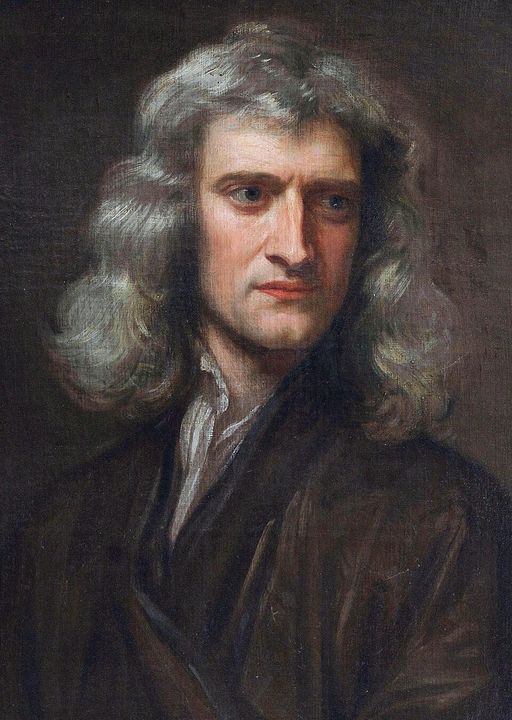
Isaac Newton was an English mathematician, natural philosopher, and theologian whose work on motion, gravitation, optics, and calculus transformed early modern science. The Principia supplied a mathematical architecture for celestial and terrestrial mechanics.
“For the Rays to speak properly are not coloured. In them there is nothing else than a certain Power and Disposition to stir up a Sensation of this or that Colour.”
“the main Business of natural Philosophy is to argue from Phaenomena without feigning Hypotheses, and to deduce Causes from Effects, till we come to the very first Cause, which certainly is not mechanical”
“it seems probable to me, that God in the Beginning form'd Matter in solid, massy, hard, impenetrable, moveable Particles, of such Sizes and Figures, and with such other Properties, and in such Proportion to Space, as most conduced to the End for which he form'd them”
Newton's Principia sets out the mathematical principles of natural philosophy and shows that the same laws can explain terrestrial motion and celestial order. The work begins with definitions of mass, quantity of motion, inertia, impressed force, centripetal force, absolute and relative space, and absolute and relative time.
Opticks, or a Treatise of the Reflexions, Refractions, Inflexions and Colours of Light, is Isaac Newton's experimental account of light and colour, written in English and published in London in 1704. Newton opens by announcing that his design is not to explain the properties of light by hypotheses but to propose and prove them by reason and experiments, and the three books carry out that plan.