Work record
Principia
1687 · Renaissance Early Modern · Philosophy · Latin
Abstract
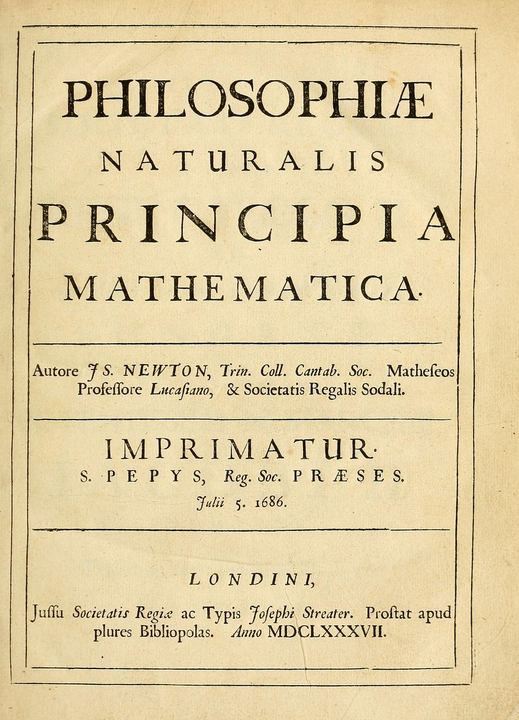
Background. In 1684 Halley asked Newton what orbit an inverse-square attraction would produce. Newton's short answer, De motu, grew within about eighteen months into Philosophiae Naturalis Principia Mathematica, published under the Royal Society's imprimatur in 1687 at Halley's expense.
Method. Newton proceeds like Euclid, from definitions of mass, momentum and force and three axioms or laws of motion to demonstrated propositions, then checks them against observation. He states causes only as far as phenomena warrant.
Structure. Book I treats motion under centripetal forces in a void, proving that elliptical orbits imply inverse-square attraction. Book II examines motion in resisting fluids, pendulums and waves, and finds Cartesian vortices inconsistent with Kepler's laws. Book III, The System of the World, applies the results to Jupiter's satellites, the planets, the moon's irregularities, tides, the shape of the earth, precession and comets.
Key Concepts. Inertia, force as change of motion, equal and opposite action, universal gravitation, absolute space and time, and the Rules of Reasoning in Philosophy. The General Scholium of 1713 ascribes cosmic order to a divine Lord and declares that he frames no hypotheses about gravity's cause.
Significance. The work joined celestial and terrestrial physics and fixed the model of mathematical explanation for later science. Eighteenth-century physicians borrowed its forces and attractions to model circulation, nerves and fevers.
Key figures
- Edmond Halley: Astronomer who prompted the work and paid for its printing
- Johannes Kepler: Whose planetary laws Newton derives from an inverse-square force
- René Descartes: Whose vortex theory of the heavens Book II undermines
- Roger Cotes: Editor of the 1713 second edition and author of its preface

Summary
Newton's Principia sets out the mathematical principles of natural philosophy and shows that the same laws can explain terrestrial motion and celestial order. The work begins with definitions of mass, quantity of motion, inertia, impressed force, centripetal force, absolute and relative space, and absolute and relative time. It then states the three laws of motion: persistence in uniform motion, change proportional to impressed force, and reciprocal action. From these axioms Newton builds a geometrical argument through propositions on orbits, areas, centripetal forces, resistance, pendulums, fluids, tides, comets, and the system of the world. The decisive achievement is universal gravitation: falling bodies, projectiles, the Moon, planets, and tides are brought under one mathematical account. Newton's method matters as much as his conclusions. He converts physical questions into measurable relations and uses idealized mathematics to interpret observed phenomena without pretending that every cause is immediately known. The famous refusal to feign hypotheses belongs to this discipline of explanation. The medical relevance is indirect and historical. Principia is not about anatomy or disease, but Newtonian mechanics reshaped later physiology, medicine, and psychology by making force, motion, attraction, pressure, circulation, vibration, and lawlike system powerful models for bodies and nerves. Eighteenth-century physicians and natural philosophers often borrowed mechanical language to explain respiration, blood flow, sensation, and even mental disturbance. The work therefore belongs to the background of modern biomedical explanation, especially where the living body was imagined as a system of moving parts. At the same time, Newton's natural philosophy was not simply mechanistic atheism; the General Scholium places cosmic order in relation to divine governance. Principia's importance lies in the way it remade intellectual expectations: nature could be read mathematically, across scales, with laws precise enough to join apple, ocean, comet, and planet. Its rigor helped define what counted as explanation for later sciences that studied both matter and life.
Plot or Argument
- Definitions and laws
Mass, force, inertia, and the three laws establish the grammar of Newtonian explanation.
- Motion in systems
Mathematical propositions show how bodies move under centripetal forces.
- System of the world
The heavens and the earth are drawn into one explanatory order.
Key claims
The main steps of the argument, in order, and how they fit together.
- Natural philosophy should begin from precise definitions of mass, motion and force, as geometry begins from definitions.How it is supported: Euclidean method of definitions and axioms
- Bodies persist in rest or straight motion unless a force acts, change of motion follows the force, and action equals reaction.How it is supported: Stated as three laws, confirmed by experiments and observation
- A body moving in an ellipse with the sun at a focus must be drawn by a force varying inversely as the square of distance.How it is supported: Geometrical demonstration in Book I
- Vortex theories of planetary motion cannot be reconciled with the observed laws of planetary orbits.How it is supported: Analysis of motion in fluids in Book II
- The planets, the moon, falling bodies, tides and comets all move as an inverse-square attraction would require.How it is supported: Astronomical data on Jupiter's moons, the planets, the moon, tides and comets in Book III
- By the Rules of Reasoning, the same natural effects must be assigned to the same causes.How it is supported: Methodological rules stated at the start of Book III
- One should state causes only as far as phenomena warrant, framing no hypotheses about the hidden cause of gravity.How it is supported: The General Scholium
- The elegant order of the solar system points to the design and dominion of an intelligent and powerful Lord.How it is supported: The General Scholium's reflection on cosmic order
Argument map
Supported by
- 3A body moving in an ellipse with the sun at a focus must be drawn by a force varying inversely as the square of distance.
which rests on
- 1Natural philosophy should begin from precise definitions of mass, motion and force, as geometry begins from definitions.
- 2Bodies persist in rest or straight motion unless a force acts, change of motion follows the force, and action equals reaction.
- 5The planets, the moon, falling bodies, tides and comets all move as an inverse-square attraction would require.
which rests on
- 4Vortex theories of planetary motion cannot be reconciled with the observed laws of planetary orbits.
- 6By the Rules of Reasoning, the same natural effects must be assigned to the same causes.
which rests on
- 7One should state causes only as far as phenomena warrant, framing no hypotheses about the hidden cause of gravity.
- 8The elegant order of the solar system points to the design and dominion of an intelligent and powerful Lord.
Therefore
Plain-language summaries of the author's argument, not quotations.
Lessons
Principia: formed attention
Principia teaches students to slow down before judgment. tenth-grade students encounter the ambition of mathematical natural philosophy and the discipline required to turn observation into lawlike explanation
- Where does Principia reward patient attention?
- Which early impression in Principia has to be revised?
Principia: order and disorder
Principia makes order visible by showing what damages it. the work proceeds from definitions and axioms through propositions about motion, resistance, orbital dynamics, and the system of the world
- What kind of disorder is most dangerous in Principia?
- Does Principia restore order, expose its fragility, or both?
Principia: body and soul
Principia gives the medical lens a human scale. the medical lens is indirect: mechanics reshaped physiology, nerves, circulation, and later models of body and mind by making force and motion newly authoritative
- How does bodily vulnerability change the argument of Principia?
- Where should a reader avoid reducing moral or spiritual suffering to diagnosis?
Context
Principia stands at a historically important crossing point for renaissance early modern study. It should be read with attention to its original language, audience, institutional setting, and later classroom life.
Composition
Principia is dated 1687; the record uses the date as a teaching anchor while recognizing that transmission, translation, and publication history may be more complicated than a single year suggests.
Reception
Principia has remained teachable because later readers found in it more than antiquarian interest: it continues to frame arguments about truth, order, suffering, imagination, and the moral life.
Comparisons
- on-the-origin-of-species
Principia can be compared with on-the-origin-of-species to test how different periods handle authority, suffering, formation, and the shape of a good life.
- discourse-on-method
Principia can be compared with discourse-on-method to test how different periods handle authority, suffering, formation, and the shape of a good life.
Quotes
“Every body perseveres in its state of rest, or of uniform motion in a right line, unless it is compelled to change that state by forces impressed thereon”
For Students
A reading companion for classical Christian high school students. See the student guide.
Reading Guide
Where it fits: In the tenth-grade year on Nature and Cosmos, the Principia is the moment when the ordered cosmos of the Timaeus becomes a single mathematical system binding heaven and earth, and it sets up the later questions about design and natural law raised by On the Origin of Species and the Regensburg Lecture.
Watch for
- The Definitions at the opening, especially the Scholium on absolute and relative time, space, place, and motion, and the thought experiment of the rotating bucket of water that Newton uses to show that true circular motion can be detected.
- The three Axioms or Laws of Motion and their corollaries, including the parallelogram of forces. Everything in the three books is derived from these few statements.
- Book I, Prop. 1, where Newton proves geometrically that a body pulled toward a fixed centre sweeps out equal areas in equal times, turning Kepler's observed rule into a consequence of a central force.
- The close of Book II, where Newton argues that Descartes' hypothesis of whirling vortices cannot be reconciled with the observed motions of the planets.
- The Rules of Reasoning in Philosophy at the head of Book III and the General Scholium at the end of the work, where Newton states his method and speaks of the intelligent and powerful Being who governs the system of the world.
Key terms and names
- Quantity of matter
- Newton's first definition, what we now call mass, measured by density and bulk together. It is distinct from weight, which depends on gravity.
- Vis insita (inertia)
- The innate force of matter by which every body resists change in its state of rest or uniform straight motion. Newton's first law states its consequence.
- Centripetal force
- Newton's coinage for any force drawing a body toward a centre. Books I and III show that planetary orbits require such a force, varying inversely as the square of the distance.
- Absolute and relative space
- In the Scholium to the Definitions, Newton distinguishes true, mathematical space that remains always similar and immovable from the measures of space we take from moving bodies.
- Universal gravitation
- The conclusion of Book III that every particle of matter attracts every other with a force proportional to their masses and inversely as the square of the distance between them. It explains the fall of bodies, the Moon's orbit, the tides, and comets by one law.
- Rules of Reasoning
- The four rules opening Book III, beginning with the principle that we should admit no more causes of natural things than are both true and sufficient to explain their appearances.
- General Scholium
- The concluding essay added in the second edition of 1713. It rejects the vortex theory, sets out Newton's view of God as Lord over all, and declares that he frames no hypotheses about the cause of gravity.
Seminar Questions
- Comprehension State Newton's three laws of motion in your own words, and give an example from the Principia's own discussion for each.
- Comprehension What does Newton's rotating bucket experiment in the Scholium to the Definitions show about the difference between true and relative motion?
- Comprehension Which phenomena does Book III bring under the single law of universal gravitation, and what does Newton say in the General Scholium he has not yet discovered about gravity?
- Interpretation Newton titled his book Mathematical Principles of Natural Philosophy rather than a physics of causes. Why does he insist on describing how gravity acts mathematically while declining to say what gravity is?
- Interpretation The first Rule of Reasoning tells us to admit no more causes than are true and sufficient. How does this rule shape Newton's argument that the force keeping the Moon in its orbit is the same force that makes a stone fall?
- Interpretation In the General Scholium, Newton argues that the elegant arrangement of sun, planets, and comets could only proceed from the counsel of an intelligent and powerful Being. Is this argument part of his natural philosophy, or an addition to it, and how would Newton answer?
- Big Question If the motions of the heavens and the earth follow one mathematical law, does that make the world more or less a sign of its Creator, and what does a law of nature actually explain?
Faith Connections
- Job 38:31-33 (Scripture)
God asks Job whether he can bind the Pleiades, loose the cords of Orion, or knows the ordinances of the heavens. The Principia is the first work to write some of those ordinances in mathematics, yet Newton's General Scholium still treats them as the decrees of a Lord over all.
- Colossians 1:16-17 (Scripture)
Paul writes that all things were created through Christ and in him all things hold together. Newton's universal gravitation describes how the parts of the cosmos hold together, and readers have long asked how a lawlike natural order relates to this deeper claim about what sustains it.
- Boethius, Consolation of Philosophy III, metre 9 (Great Conversation)
Philosophy's hymn praises the One who governs the world by perpetual reason and binds the elements by number. Newton's book gives a mathematical form to that ancient conviction that the cosmos is ruled by reason and measure.
- Blaise Pascal, Pensees, the fragment on the two infinities (Great Conversation)
Pascal, writing a generation before the Principia, describes human beings suspended between the infinitely great and the infinitely small and humbled by both. Newton's success in measuring the heavens can be read alongside Pascal's warning that knowledge of nature does not by itself settle the human place in it.
Logic and Rhetoric
Central argument: Every body perseveres in rest or uniform straight motion unless acted on by a force, change of motion is proportional to the impressed force, and every action has an equal and opposite reaction. From these laws Newton proves that a body moving in an ellipse with the sun at one focus must be drawn by a force varying inversely as the square of the distance. The planets, the Moon, falling bodies, the tides, and comets all display motions that follow from such a force. By the Rules of Reasoning, the same effects must be assigned to the same cause. Therefore a single universal gravitation governs heaven and earth alike.
Rhetorical device: axiomatic method. Newton imitates Euclid's Elements, laying down Definitions and Axioms or Laws of Motion at the start and then proceeding through numbered Lemmas, Propositions, Corollaries, and Scholia. The first law, Every body perseveres in its state of rest, or of uniform motion in a right line, unless it is compelled to change that state by forces impressed thereon, functions like a geometrical axiom from which the rest is demonstrated.
Debate: Resolved: Newton was right to refuse to frame hypotheses about the cause of gravity.
Memory Work
Every body perseveres in its state of rest, or of uniform motion in a right line, unless it is compelled to change that state by forces impressed thereon
Writing Prompts
Essay: Newton claims to deduce the system of the world from phenomena by mathematical reasoning, yet he ends the Principia by speaking of God's dominion. Using the Rules of Reasoning, the argument for universal gravitation in Book III, and the General Scholium, argue whether Newton's theology is a conclusion of his science, a presupposition of it, or a separate kind of knowledge he sets beside it.
Comparison with Timaeus: Plato's Timaeus describes a divine craftsman who orders the cosmos according to mathematical proportions, and Newton's Principia describes a world governed by mathematical laws under an intelligent Lord. Compare the two accounts of how mathematics reveals the cosmos, and argue which gives the better account of why the world should be intelligible at all.
Medical Lens
the medical lens is indirect: mechanics reshaped physiology, nerves, circulation, and later models of body and mind by making force and motion newly authoritative
- Definitions and laws
Principia gives this tag concrete force through the medical lens is indirect: mechanics reshaped physiology, nerves, circulation, and later models of body and mind by making force and motion newly authoritative
Creative Prompts
- Essay
Write a class essay on how Principia defines maturity without reducing maturity to success.
- Dialogue
Stage a dialogue between a defender and a critic of Principia's central moral claim.
Further Reading
Verification notes
Core bibliographic and interpretive claims are stable; quotations should be drawn only from the attached public-domain text when one is present.
No verification flags recorded.