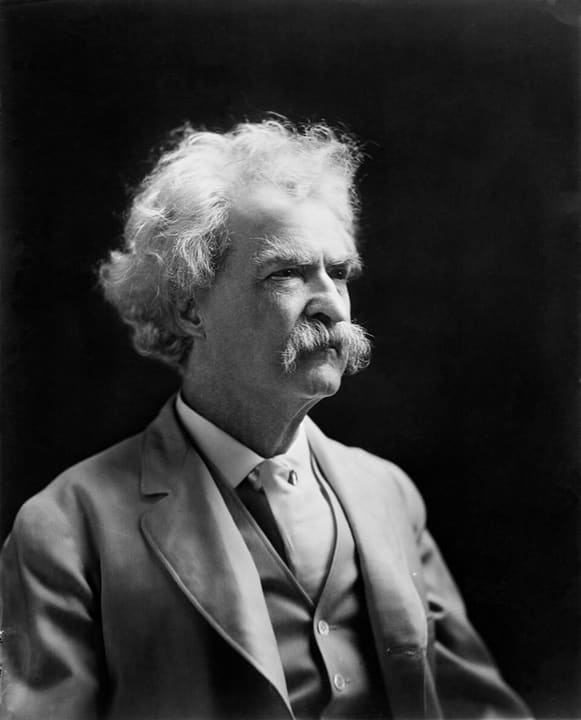
Mark Twain was the pen name of Samuel Langhorne Clemens (1835–1910), who grew up in Hannibal, Missouri, on the Mississippi River. He worked as a printer, riverboat pilot, miner and journalist before becoming famous for humorous sketches and travel books such as The Innocents Abroad. His novels include The Adventures of Tom Sawyer, Adventures of Huckleberry Finn and A Connecticut Yankee in King Arthur's Court. He was the most celebrated American humorist and lecturer of his era.
A Connecticut Yankee in King Arthur's Court (1889)
Frequently Cited
“Persons attempting to find a motive in this narrative will be prosecuted; persons attempting to find a moral in it will be banished; persons attempting to find a plot in it will be shot.”
“But I reckon I got to light out for the Territory ahead of the rest, because Aunt Sally she’s going to adopt me and sivilize me, and I can’t stand it. I been there before.”
“The face of the water, in time, became a wonderful book--a book that was a dead language to the uneducated passenger, but which told its mind to me without reserve”
“He had discovered a great law of human action, without knowing it—namely, that in order to make a man or a boy covet a thing, it is only necessary to make the thing difficult to attain”
The Adventures of Tom Sawyer is a comic and nostalgic novel of boyhood set in the 1840s in St. Petersburg, a small Missouri town on the Mississippi modelled on Twain's Hannibal. Tom is an orphan living with his kind, anxious Aunt Polly, his priggish half-brother Sid and his cousin Mary.
The Prince and the Pauper opens in London in October 1537, when two boys are born on the same day: Edward Tudor, longed-for son of Henry VIII, and Tom Canty, unwanted son of a thief in Offal Court, off Pudding Lane. Tom is beaten by his father John and his grandmother, but his gentle mother and sisters Nan and Bet love him, and the old priest Father Andrew teaches him reading, a little Latin, and tales of kings.
Life on the Mississippi is Mark Twain's book about the great river in two eras: the steamboat age of his youth and the changed river he revisited in 1882. It opens with three chapters of history and lore, from De Soto and La Salle to the keelboat and raft men, including a long raft episode with the boy Huck Finn borrowed from the novel Twain was then writing.
Huckleberry Finn tells his own story in the speech of a half-schooled Missouri boy, some forty or fifty years before the book appeared. After the treasure found at the end of The Adventures of Tom Sawyer, the Widow Douglas has taken Huck in to civilize him, while her sister Miss Watson drills him in manners and spelling.