Work record
Adventures of Huckleberry Finn
1884 (UK) / 1885 (US) · 19th Century · Novel · English
Abstract
Background. Twain returned to the narrator of his boys' book of 1876 and let him tell a far darker tale, drawing on the slaveholding river world of his Hannibal youth and on his piloting years.
Plot. Fleeing a brutal father, Huck joins a fugitive named Jim on a raft. Fog carries them beyond the mouth of the Ohio, and the current takes them ever deeper into slave country. Ashore Huck meets a feuding gentry clan, a town that shoots and lynches, and a pair of frauds who cheat mourners of a dead tanner's estate and at last sell Jim. Huck resolves to rescue his friend; Tom Sawyer joins and complicates the attempt, which ends in a bullet wound, Jim's recapture, and news that he was already legally free.
Form. Every sentence comes through a boy's ungrammatical, image-rich speech, and Twain reproduced several distinct regional and racial dialects. Episodes of shore life alternate with quiet stretches on the water.
Themes. Conscience against custom, friendship across the color line, the gentility and violence of the river towns, fraud and credulity, and the pull of freedom westward.
Significance. Removed from a Massachusetts library in its first year, it later came to be counted among the foundational American novels for proving that plain vernacular could carry serious fiction.
Main characters
- Huckleberry Finn: Runaway boy and first-person narrator
- Jim: Escaped slave seeking freedom and his family
- Tom Sawyer: Huck's bookish friend who returns for the rescue
- Pap Finn: Huck's violent, alcoholic father
- The Duke and the King: Itinerant swindlers posing as exiled nobility
- Miss Watson: Jim's owner, who frees him in her will
- Aunt Sally Phelps: Tom's aunt, who wishes to adopt Huck

Summary
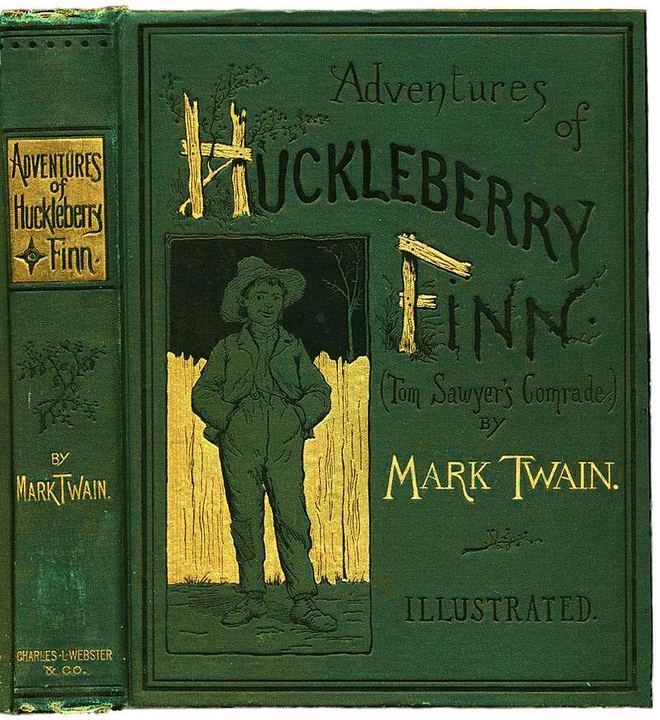
Huckleberry Finn tells his own story in the speech of a half-schooled Missouri boy, some forty or fifty years before the book appeared. After the treasure found at the end of The Adventures of Tom Sawyer, the Widow Douglas has taken Huck in to civilize him, while her sister Miss Watson drills him in manners and spelling. His drunken father, Pap, returns to claim Huck's money, kidnaps him, and locks him in a cabin across the river, where Pap suffers a night of delirium tremens and chases his son with a knife. Huck escapes by faking his own murder with a pig's blood and hides on Jackson's Island. There he finds Jim, Miss Watson's slave, who has run away because she meant to sell him down the river to New Orleans. The two set off on a raft, hoping to reach Cairo, Illinois, and take a steamboat up the Ohio to the free states. They board a wrecked steamboat, the Walter Scott, and escape a gang of robbers; they are separated in a fog, and Huck's cruel joke on Jim afterward ends in a humble apology. They drift past Cairo in the night, and a steamboat smashes the raft. Huck washes ashore among the Grangerfords, a genteel Kentucky family locked in a feud with the Shepherdsons, and watches his friend Buck shot in the river. Reunited with Jim, he welcomes two swindlers onto the raft, who call themselves the Duke of Bridgewater and the lost Dauphin of France. They stage the Royal Nonesuch, work a camp-meeting, and pose as the English brothers of the dead Peter Wilks to seize his daughters' inheritance, until Huck hides the gold in the coffin and the real brothers arrive. Finally the king sells Jim for forty dollars. Alone, Huck struggles with his conscience, writes a letter to Miss Watson to tell where Jim is, and then tears it up, choosing to steal Jim out of slavery even if it means hell. At the Phelps farm he is mistaken for Tom Sawyer, Aunt Sally's nephew, and the real Tom arrives and takes the name of his brother Sid. Tom turns the rescue into a long romance of escape drawn from his adventure books. In the breakout Tom is shot in the leg, and Jim gives up his own freedom to stay with the doctor and nurse him. Tom then reveals that Miss Watson died two months earlier and freed Jim in her will; Jim tells Huck that the dead man in the floating house was Pap. Huck ends planning to light out for the Territory. Chatto and Windus published the book in London on 10 December 1884, and Charles L. Webster and Company in New York on 18 February 1885, with illustrations by E. W. Kemble.
Virtues in this work
- Friendship: Huck tears up his letter to Miss Watson in Chapter XXXI and resolves to free Jim, choosing loyalty to his friend over everything he has been taught.
- Charity: Jim gives up his chance of escape to stay beside the wounded Tom Sawyer and help the doctor nurse him.
- Humility: After Jim rebukes his trick in the fog, Huck goes and apologizes to him and never plays him such a trick again.
- Justice: Huck steals back the Wilks gold from the frauds and hides it in Peter Wilks's coffin so the orphaned sisters will not be robbed.
Plot or Argument
- Chapters I-VII: The widow's house and Pap's cabin
Huck chafes under the Widow Douglas and Miss Watson, plays at robbery with Tom Sawyer's gang, and is seized by Pap, whose drunken rages drive him to fake his own death and escape down the river.
- Chapters VIII-XI: Jackson's Island
Huck finds the runaway Jim on the island; they find a dead man in a floating house, Jim is bitten by a rattlesnake, and Huck, dressed as a girl, learns from Mrs. Loftus that men are coming to hunt Jim.
- Chapters XII-XVI: The raft, the wreck and the fog
On the raft they escape robbers on the wrecked Walter Scott, lose each other in the fog, and miss Cairo; Huck saves Jim from slave hunters with a smallpox lie, and a steamboat runs down the raft.
- Chapters XVII-XVIII: The Grangerfords and the feud
Huck lives with a hospitable, pious Kentucky family whose feud with the Shepherdsons ends in a massacre on the riverbank; he flees back to Jim and the raft.
- Chapters XIX-XXIII: The king and the duke
Two frauds take over the raft; they work a camp-meeting, rehearse Shakespeare, stage the Royal Nonesuch, and Huck witnesses Colonel Sherburn shoot Boggs and face down a lynch mob.
- Chapters XXIV-XXX: The Wilks inheritance
The king and duke pose as the dead Peter Wilks's brothers; Huck pities Mary Jane, hides the gold in the coffin, and the arrival of the real brothers leads to a graveyard reckoning and the frauds' escape.
- Chapters XXXI-XXXIII: Huck's decision
The king sells Jim; Huck writes to Miss Watson, then tears up the letter and resolves to free Jim, and at the Phelps farm he is taken for Tom Sawyer just as Tom arrives.
- Chapters XXXIV-XLII: The evasion
Tom turns Jim's rescue into an elaborate imitation of prison romances; in the escape Tom is shot in the leg, and Jim stays to help the doctor nurse him and is recaptured.
- Chapter the Last: Out of bondage
Tom reveals that Miss Watson freed Jim in her will, Jim tells Huck that Pap is dead, and Huck resolves to head west rather than be adopted by Aunt Sally.
Characters
- Huckleberry Finn, narrator and protagonist
Thirteen- or fourteen-year-old son of the town drunkard, practical, superstitious and tender-hearted, who tells the story in his own vernacular.
- Jim, Huck's companion
Miss Watson's slave, who runs away to keep from being sold away from his wife and children and becomes Huck's protector and friend on the raft.
- Tom Sawyer, Huck's friend
Romantic, book-fed boy who leads a play robber gang and later stages Jim's escape at the Phelps farm.
- Pap Finn, Huck's father
Violent, drunken father who claims Huck's money and keeps him locked in a cabin.
- The Widow Douglas, Huck's guardian
Kindly widow who takes Huck in and tries to civilize him.
- Miss Watson, the widow's sister
Strict spinster who owns Jim, plans to sell him, and frees him in her will.
- The Duke, confidence man
Younger swindler who claims to be the Duke of Bridgewater and deals in patent medicines and stage shows.
- The King, confidence man
Old swindler who claims to be the lost Dauphin, Louis XVII, and sells Jim for forty dollars.
- Buck Grangerford, Huck's friend in Kentucky
Boy of Huck's age killed in his family's feud with the Shepherdsons.
- Colonel Sherburn, townsman of Bricksville
Proud man who shoots the drunken Boggs and then scorns the mob that comes to lynch him.
- Mary Jane Wilks, Peter Wilks's niece
Generous orphan whose trust in the frauds moves Huck to protect her inheritance.
- Aunt Sally and Uncle Silas Phelps, Tom's aunt and uncle
Kind, simple Arkansas farm couple who hold Jim and take Huck for Tom.
- Judge Thatcher, town judge
Keeper of Huck's money, to whom Huck signs it over to keep it from Pap.
Lessons
A conscience trained wrong
Huck has been taught by church and town that helping a runaway is theft and sin, and his conscience accuses him for it. His friendship with Jim pulls against those lessons, and in Chapter XXXI he chooses Jim while still believing he is choosing damnation. Twain lets the reader see what Huck cannot: that his heart is right and his teaching wrong.
- Why does Huck feel better after writing the letter to Miss Watson, and why does he tear it up?
- Huck believes he will go to hell for freeing Jim. What does the novel want the reader to believe about his choice?
- Can a conscience be mistaken? How would anyone know?
Jim's dignity on the raft
After the fog in Chapter XV, Huck tries to convince Jim it was all a dream, and Jim's grieved answer shames him into apologizing. On the raft Jim stands Huck's watches, shelters him, and speaks of his own wife and children. The friendship grows out of shared danger and is tested by Huck's habits of thought.
- What does Jim say to Huck after the trick in the fog, and why does it change Huck?
- Where in the book does Jim act most like a father to Huck?
- Why does Jim stay with the wounded Tom when he could escape?
The river and the shore
The raft is the place of freedom and honesty, and nearly every stop on shore shows people at their worst or most foolish: the feud, the shooting of Boggs, the lynch mob, the gulled crowds of the Royal Nonesuch, the greed around the Wilks coffin. Twain's satire falls on the respectable and the swindlers alike.
- Why does Huck say there is no home like a raft?
- The Grangerfords go to church to hear a sermon on brotherly love with their guns between their knees. What is Twain saying?
- Which of the towns along the river seems worst, and why?
Romance against reality
Tom Sawyer runs his life by adventure books, and his scheme to free Jim in the style of famous prisoners turns a simple rescue into a cruel game. Huck admires Tom but sees more truly. The ending asks how much of Tom's romance remains in the world around him.
- Why does Tom insist on so many difficulties in freeing Jim when he knows Jim is already free?
- Is Huck's admiration for Tom a strength or a weakness?
Context
The story is set in the Mississippi Valley before the Civil War, in a slaveholding society that Twain knew from his Hannibal childhood. Missouri was a slave state; Illinois across the river was free, and the Ohio at Cairo was the route north. The Fugitive Slave Act of 1850 made helping a runaway a crime, and the church, the courts and public opinion of the river towns supported slavery. Twain wrote after Reconstruction, in the 1870s and 1880s, and the novel uses the vocabulary of its setting, including the racial slur common in that speech, which appears many times. An explanatory note lists the several dialects Twain reproduced, among them the Missouri dialect of Black speakers, the backwoods Southwestern dialect and the Pike County speech with four varieties.
Composition
Twain began the book in 1876, soon after finishing The Adventures of Tom Sawyer, put it aside for several years, and finished it in 1883 after revisiting the river for Life on the Mississippi. A raftsmen episode written for the novel was printed instead in Life on the Mississippi. The book appeared in London from Chatto and Windus on 10 December 1884 and in New York from Twain's own firm, Charles L. Webster and Company, on 18 February 1885, with 174 illustrations by E. W. Kemble.
Reception
The public library of Concord, Massachusetts, removed it in 1885 as coarse and unfit for readers, and similar objections followed for decades. Later writers and critics came to rank it among the founding works of American fiction, praising its vernacular narration; Ernest Hemingway wrote in Green Hills of Africa (1935) that all modern American literature comes from it. It remains one of the most widely read and most often challenged American novels.
Comparisons
- the-adventures-of-tom-sawyer
The earlier book's treasure sets up Huck's situation, and the return of Tom in the final chapters sets Tom's book-learned romance against the hard knowledge Huck has gained on the river.
- don-quixote
Tom explicitly cites Don Quixote in Chapter III, and his rescue of Jim, staged from adventure books, is a Quixotic enterprise seen through the eyes of a Sancho-like companion.
- narrative-and-fourth-of-july
Douglass's account of escaping slavery in Maryland gives the factual counterpart to Jim's flight, including the hunters, the rewards and the separation of families that Jim fears.
- twelve-years-a-slave
Northup's narrative of being sold south to Louisiana describes the down-river fate Jim runs to escape when Miss Watson plans to sell him to New Orleans.
- the-odyssey
Both are voyages of episodes on water and shore, with liars, hosts and monsters at each landing; Huck, like Odysseus, survives by invented names and stories.
- to-kill-a-mockingbird
Each novel is told by a child of the South whose sense of right is formed against the town's opinion, and each turns on a mob confronted by one person.
Quotes
Frequently cited
“Persons attempting to find a motive in this narrative will be prosecuted; persons attempting to find a moral in it will be banished; persons attempting to find a plot in it will be shot.”
Frequently cited
“You don’t know about me without you have read a book by the name of The Adventures of Tom Sawyer; but that ain’t no matter.”
Frequently cited
“All right, then, I’ll _go_ to hell”
Frequently cited
“But I reckon I got to light out for the Territory ahead of the rest, because Aunt Sally she’s going to adopt me and sivilize me, and I can’t stand it. I been there before.”
“Dat truck dah is _trash;_ en trash is what people is dat puts dirt on de head er dey fren’s en makes ’em ashamed.”
“We said there warn’t no home like a raft, after all. Other places do seem so cramped up and smothery, but a raft don’t. You feel mighty free and easy and comfortable on a raft.”
“You can’t pray a lie—I found that out.”
“Human beings _can_ be awful cruel to one another.”
For Students
A reading companion for classical Christian high school students. See the student guide.
Reading Guide
Watch for
- Every moment Huck's conscience speaks: after the fog in Chapter XV, at the approach to Cairo in Chapter XVI, and in the letter scene of Chapter XXXI. Notice what his conscience tells him and what he does instead.
- The contrast between the raft and the shore. Mark the peaceful passages on the river, such as the sunrise at the start of Chapter XIX, and set them beside the feud, the shooting of Boggs and the Wilks swindle.
- The names and stories Huck invents for himself, from Sarah Williams in Chapter XI to Tom Sawyer at the Phelps farm, and why he needs each one.
- How Jim speaks of his own family, especially when he remembers striking his little daughter who could not hear in Chapter XXIII.
- Tom Sawyer's book-learned plans in Chapters II and XXXIV-XXXIX, and how Huck judges them.
Key terms and names
- St. Petersburg
- Huck's fictional Missouri river town, modeled on Twain's Hannibal, where the story begins with the Widow Douglas and Miss Watson.
- Sold down the river
- Sale of a slave to the plantations of the lower Mississippi, which Jim learns Miss Watson plans for him for eight hundred dollars. It is the reason he runs away.
- Cairo
- The Illinois town where the Ohio meets the Mississippi. Huck and Jim plan to sell the raft there and go up the Ohio to the free states, but they pass it in the fog.
- Sivilize
- Huck's spelling of what the widow and Aunt Sally want to do to him: clean clothes, regular meals, school and church. The word frames the first and last chapters.
- The Royal Nonesuch
- The shabby stage show the king and duke play in Bricksville, which gulls the townsmen on the first night and nearly gets the frauds killed on the third.
- Feud
- The thirty-year blood quarrel between the Grangerfords and the Shepherdsons, whose cause no one can remember, as Buck explains to Huck in Chapter XVIII.
- The evasion
- Tom's name for his elaborate plan to free Jim from the hut at the Phelps farm, borrowed from stories of famous prisoners like the Man in the Iron Mask.
Seminar Questions
- Comprehension How does Huck escape from Pap's cabin, and why does he make it look as if he has been murdered?
- Comprehension Why does Jim run away from Miss Watson, and where do he and Huck hope to go?
- Comprehension What happens to Jim after the king and duke reach Pikesville in Chapter XXXI, and what does Huck decide to do about it?
- Interpretation Huck says that you cannot pray a lie. What does his failed prayer in Chapter XXXI reveal about the difference between what he has been taught and what he truly wants?
- Interpretation The Grangerfords are courteous, churchgoing and brave, yet they kill and are killed over a forgotten quarrel. Why does Twain place this episode at the center of the voyage?
- Interpretation Colonel Sherburn tells the lynch mob that they are cowards who act only in crowds. Is he right, and does the book agree with him?
- Interpretation When Tom arrives at the Phelps farm the novel changes tone. Does Tom's evasion strengthen or weaken the friendship of Huck and Jim the reader has watched on the raft?
- Big Question When the law, the church and the community all say one thing and your friendship says another, how should a person decide what is right?
Faith Connections
- Deuteronomy 23:15-16 (Scripture)
The Law of Moses forbids returning an escaped slave to his master and commands that he be allowed to live where he chooses. Huck believes he is breaking God's law by hiding Jim, but this passage stands on the side of the choice he makes.
- Luke 10:25-37 (Scripture)
Asked who is my neighbor, Jesus answers with a story in which the despised outsider shows mercy. On the raft Huck learns to see Jim as his neighbor, and in Chapter XL Jim shows the Samaritan's mercy to the wounded Tom.
- Matthew 15:8 (Scripture)
Jesus quotes Isaiah against people who honor God with their lips while their hearts are far from Him. The Grangerfords' sermon on brotherly love, heard with guns at hand, and the king's camp-meeting fraud show worship in words without the heart.
- Thomas Aquinas, Summa Theologiae I-II, q. 19, a. 5 (Great Conversation)
Aquinas teaches that one must follow conscience even when it is mistaken, and that an erring conscience still binds. Huck's anguish is that of a boy who acts against what he believes his conscience requires, which makes his choice in Chapter XXXI a sharp case for discussing how conscience is formed.
Logic and Rhetoric
Central argument: Huck has been taught that helping Jim is stealing and that stealing is sin. Yet on the raft he comes to know Jim as a friend who has cared for him, grieved for him and stood his watches. When he must choose between returning Jim to slavery and keeping faith with him, his love for Jim proves stronger than his teaching. Therefore the novel argues that a conscience shaped by an unjust society can be corrected by friendship and honest sight, even when the person who acts on it still believes himself wrong.
Rhetorical device: dramatic irony. In Chapter XXXI Huck says, All right, then, I'll go to hell, believing he has chosen wickedness, while the reader sees that this is the best act in the book; the gap between Huck's judgment and the reader's carries the novel's argument.
Debate: Resolved: The last eleven chapters at the Phelps farm are a fitting ending to Adventures of Huckleberry Finn.
Memory Work
You can’t pray a lie—I found that out.
We said there warn’t no home like a raft, after all. Other places do seem so cramped up and smothery, but a raft don’t. You feel mighty free and easy and comfortable on a raft.
Writing Prompts
Essay: Trace Huck's conscience through Chapters XV, XVI and XXXI, and argue whether the boy who tears up the letter has changed his beliefs or only his loyalties.
Comparison with The Adventures of Tom Sawyer: Tom Sawyer appears in both novels. Compare Tom's games of robbers and prisoners with Huck's real dangers on the river, and argue what Twain gains by bringing Tom back for the ending of Huckleberry Finn.
Medical Lens
Pap Finn's attack of delirium tremens in Chapter VI is one of the most vivid literary scenes of alcohol withdrawal in nineteenth-century American fiction: he sees snakes, cries that the dead are coming for him, and chases Huck as the Angel of Death. Huck reports it without medical vocabulary, which is part of its force; Pap's earlier sham temperance reform under the new judge, ending in a drunken night and a broken arm, is a comic study of relapse. The river world is full of irregular medicine. The duke dabbles in patent medicines, mesmerism and phrenology, and the king claims laying on of hands for cancer and paralysis; Jim treats a rattlesnake bite with Pap's whiskey and folk remedies, and the hairball oracle and snakeskin omens show the superstitions that sat beside them. Huck turns away slave hunters in Chapter XVI by letting them think his family has smallpox, a fear grounded in the epidemics of the river towns. Dr. Robinson, who exposes the king's fraud at the Wilks funeral, and the country doctor who treats Tom's gunshot wound and praises Jim's nursing, are the book's two honest physicians. Emmeline Grangerford's obituary verses satirize the period's cult of mourning.
- Chapter V
Pap swears off drink before the new judge, who weeps over his reform; that night he gets drunk, rolls off the porch roof and breaks his arm.
- Chapter VI
Pap's delirium tremens in the cabin: visions of snakes, terror of the dead, and his chase of Huck with a clasp-knife.
- Chapter X
Jim is bitten by a rattlesnake, drinks Pap's whiskey as a remedy and ties the snake's rattles to his wrist; Huck blames handling the snakeskin.
- Chapter XVI
Huck lets slave hunters believe his father on the raft has smallpox, and they keep their distance and give him money.
- Chapter XVII
Huck describes the dead Emmeline Grangerford's mourning pictures and obituary poems.
- Chapter XIX
The duke and the king list their trades, including patent medicines, mesmerism, phrenology and faith healing.
- Chapters XXV-XXIX
Dr. Robinson denounces the king as a fraud at the Wilks house and later helps test the claimants.
- Chapters XL-XLII
Tom is shot in the calf during the escape; the doctor treats him and testifies that Jim stayed to help nurse him at the risk of his freedom.
Listen to the book
Public-domain audiobook from LibriVox, read by Various volunteers. Recording: Adventures of Huckleberry Finn (Dramatic Reading) on LibriVox (Internet Archive).
LibriVox recordings are volunteer readings released into the public domain. The reading may follow a different edition from the text in this library.
Creative Prompts
- Essay
Compare Huck's decision in Chapter XXXI with Jim's decision in Chapter XL to stay with the wounded Tom. Which is the greater act of courage, and why?
- Fiction
Write the letter Jim might have sent to his wife after the novel ends, telling her about the raft, the fog and the Phelps farm.
- Classroom
Map the voyage from St. Petersburg past Cairo to the Phelps farm, marking each stop on shore with what Huck learns there about people.
- Dialogue
Stage a conversation between Huck and the Widow Douglas after the book ends, in which he tries to explain why he tore up the letter.
Further Reading
- The Adventures of Tom Sawyer, Mark Twain
- Life on the Mississippi, Mark Twain
Twain's memoir of piloting, which includes the raftsmen episode written for Huckleberry Finn.
- Mark Twain: A Life, Ron Powers
- Mr. Clemens and Mark Twain, Justin Kaplan
- Green Hills of Africa, Ernest Hemingway
Contains Hemingway's famous verdict on the novel's place in American literature.
Verification notes
All eight quotes were found by Grep in content/texts/adventures-of-huckleberry-finn.txt (Project Gutenberg #76) and copied exactly, including curly apostrophes and the underscores the Gutenberg file uses for italics; chapter locators follow the CHAPTER headings in that file (chapters I-XLII and Chapter the Last). The duke's and king's trades (Chapter XIX), Pap's delirium tremens (Chapter VI) and the smallpox ruse (Chapter XVI) were also checked in the stored text. Publication dates, publishers, Kemble as illustrator, the 1876-1883 writing span and the 1885 Concord ban were checked at https://en.wikipedia.org/wiki/Adventures_of_Huckleberry_Finn. The library text includes Twain's Notice and Explanatory note.
- The count of 174 Kemble illustrations in the first edition.
- That the raftsmen passage was composed for this novel and first printed in Life on the Mississippi (1883), Chapter 3.
- Exact wording of Hemingway's remark in Green Hills of Africa (1935); it is paraphrased here, not quoted.
- The precise sale price Miss Watson was offered for Jim (believed eight hundred dollars, Chapter VIII).