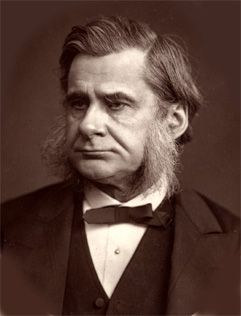
Thomas Henry Huxley (1825–1895) trained in medicine at Charing Cross Hospital, served as assistant surgeon and naturalist aboard HMS Rattlesnake on its survey voyage to Australia and New Guinea (1846–1850), and became a Fellow of the Royal Society and lecturer in natural history at the Government School of Mines in London. He was a comparative anatomist, a public lecturer and a leading defender of Darwin's theory; he coined the word agnostic in 1869 and was President of the Royal Society from 1883 to 1885. Samuel Wilberforce (1805–1873), third son of the anti-slavery leader William Wilberforce, took first-class honours in mathematics at Oriel College, Oxford, and became Bishop of Oxford in 1845 and Bishop of Winchester in 1869. A celebrated preacher and energetic reformer of his diocese, he founded Cuddesdon theological college and took a keen interest in natural history.
The Huxley-Wilberforce Debate is the name later given to an unscheduled exchange on Saturday, 30 June 1860, at the Oxford meeting of the British Association for the Advancement of Science, seven months after Charles Darwin published On the Origin of Species. It was not a formal debate with set speeches and a motion, and no transcript was taken.