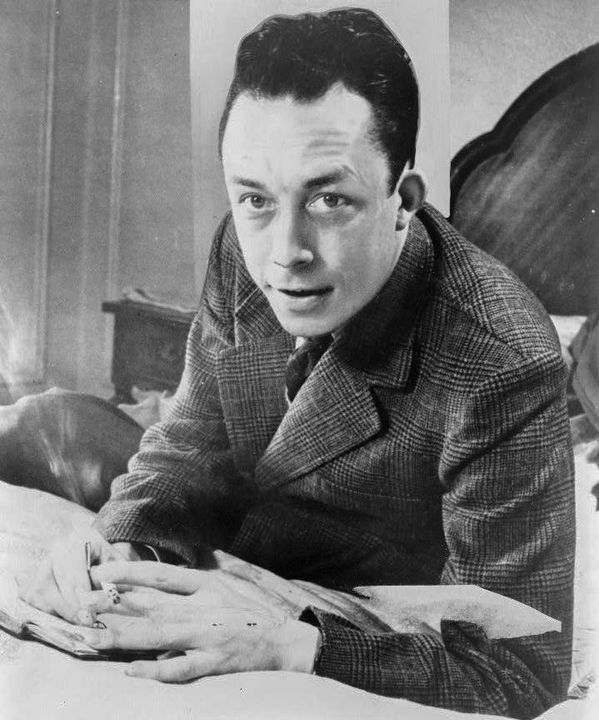
Albert Camus (1913–1960) was a French novelist, essayist and playwright born in Mondovi, French Algeria, and raised in poverty in Algiers by his widowed, partly deaf mother after his father was killed in the First World War. He studied philosophy at the University of Algiers, worked as a journalist, and during the German occupation edited the Resistance newspaper Combat in Paris. His works include The Stranger, The Myth of Sisyphus, The Plague, The Rebel and The Fall. He received the Nobel Prize in Literature in 1957 and died in a car accident in January 1960.
Frequently Cited
“there's no question of heroism in all this. It's a matter of common decency.”
The Stranger is a short novel in two parts narrated by Meursault, a young shipping clerk in Algiers in French Algeria, who reports what he sees and feels in plain, flat sentences and seldom explains himself.
Part One, in six chapters, covers about eighteen days.
The Plague is a chronicle of an epidemic of bubonic and then pneumonic plague in Oran, a commercial port on the Algerian coast, in an unspecified year of the 1940s. The narrator, who reveals himself only at the end as the physician Bernard Rieux, writes as an impartial witness, drawing also on the notebooks of his friend Jean Tarrou.
The Fall is a short novel in six chapters made up entirely of the monologue of Jean-Baptiste Clamence, a Frenchman living in Amsterdam, who over five days talks to a stranger he meets at a sailors' bar called Mexico City. The listener never speaks in the text; his replies are implied by Clamence's answers.