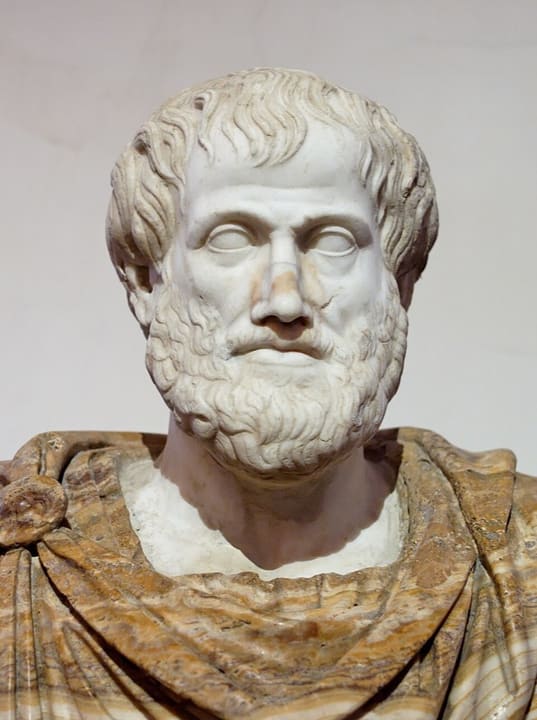
Aristotle was a Greek philosopher, student of Plato, tutor to Alexander, and founder of the Lyceum. His biological, logical, ethical, and metaphysical writings gave later readers a vocabulary for substance, cause, soul, perception, and living form.
“It is like a rout in battle stopped by first one man making a stand and then another, until the original formation has been restored. The soul is so constituted as to be capable of this process.”
“If then it is both by nature and for an end that the swallow makes its nest and the spider its web, and plants grow leaves for the sake of the fruit and send their roots down (not up) for the sake of nourishment, it is plain that this kind of cause is operative in things which come to be and are by nature.”
De Anima asks what soul is by beginning with the observable powers of living things. Aristotle reviews earlier accounts from thinkers such as Democritus, Empedocles, Anaxagoras, and Plato, then rejects explanations that make soul either a wandering body, a harmony, or a separate passenger inside the organism.
Politics examines the polis as the community ordered toward living well. Aristotle begins with the household, including relations of master and slave, husband and wife, parent and child, and then argues that the city exists by nature because human beings possess speech about justice and advantage.
This volume joins two treatises by Aristotle that together set out what scientific knowledge is and how the natural world is to be understood. The Posterior Analytics, in two books, belongs to the logical works later grouped as the Organon.
The Nicomachean Ethics asks what the human good is and how a life can be shaped toward it. Aristotle begins from the idea that every craft, inquiry and action aims at some good, and that the highest practical good is eudaimonia, often translated happiness or flourishing.
The Poetics is Aristotle's short treatise on the art of poetry, chiefly tragedy and epic, and the oldest surviving work of literary theory in the West. It opens by defining all poetry, together with music and dance, as imitation (mimesis), and by distinguishing the arts according to the medium of imitation (rhythm, language, melody), the objects imitated (people better than us, worse, or like us), and the manner (narration or enactment).