AD 354-430 · North African bishop and theologian of the early Church
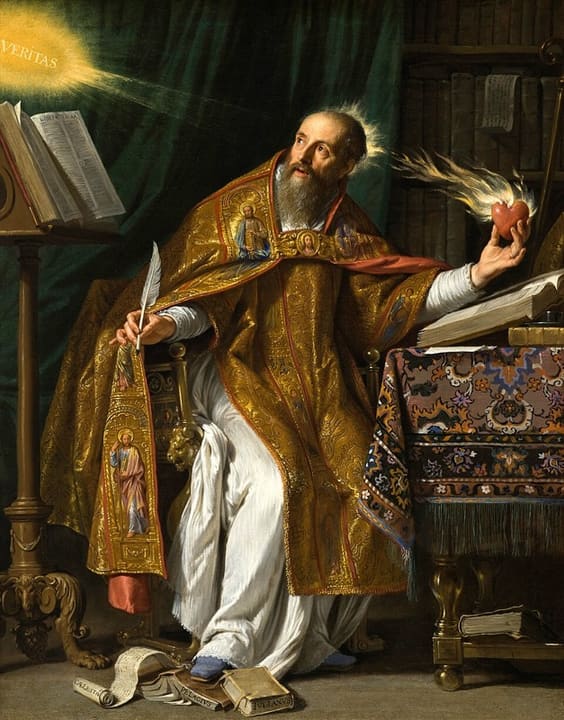
Posthumous or imagined likeness of Augustine of Hippo. Source · Public domain
About Augustine of Hippo
Aurelius Augustinus (354–430) was born at Thagaste in Roman North Africa to a pagan father and a Christian mother, Monica. He became a teacher of rhetoric in Carthage, Rome and Milan, spent nine years as a Manichaean, and converted to Christianity in 386 under the influence of Ambrose of Milan. Ordained in Africa, he became bishop of Hippo Regius in 395/396 and wrote prolifically, notably The City of God; he is among the most influential theologians of Western Christianity.
“Accordingly, two cities have been formed by two loves: the earthly by the love of self, even to the contempt of God; the heavenly by the love of God, even to the contempt of self”
The Confessions is a prayer in thirteen books addressed to God, in which Augustine recounts his life up to his mother's death and then turns to philosophical reflection on memory, time and the creation narrative of Genesis. Books I to IX are autobiographical.
Augustine's Homilies on the Gospel of John are pastoral expositions of one of Christianity's most theologically dense texts. Preached to a congregation rather than composed as a detached treatise, they move through John's prologue, signs, discourses, passion narrative, resurrection appearances, and final scenes with Peter and the beloved disciple.
City of God is Augustine’s monumental argument that Rome’s disaster does not discredit Christianity and that human history must be understood through two loves. The immediate occasion is the sack of Rome by Alaric in 410, after which critics blamed Christians for weakening the old gods.