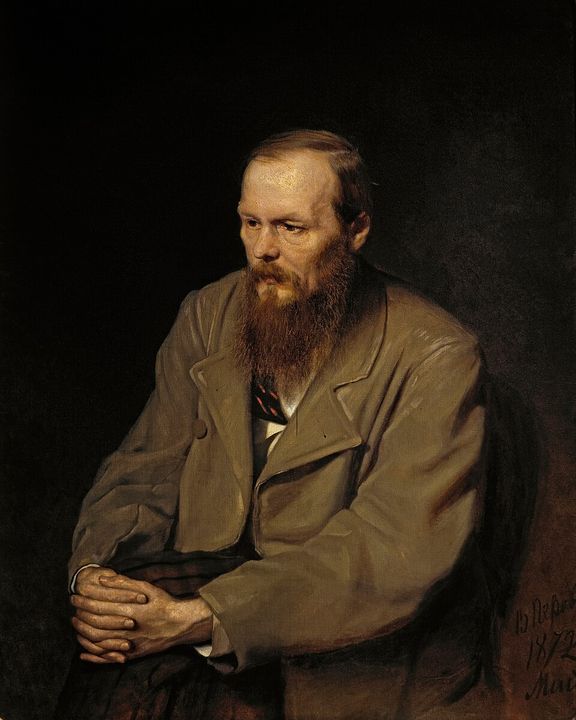
Fyodor Dostoevsky (1821-1881) was a Russian novelist and short-story writer whose fiction explores conscience, suffering, faith, humiliation and psychological extremity. Before his Siberian imprisonment, he wrote urban and sentimental fiction about lonely dreamers and the poor. White Nights is one of his tenderest early works.
“I admit that twice two makes four is an excellent thing, but if we are to give everything its due, twice two makes five is sometimes a very charming thing too.”
White Nights is narrated by an unnamed young dreamer in St. Petersburg, a lonely man who lives more intensely in imagination than in social life. During the luminous northern nights, he wanders the city and feels intimate with streets, houses and imagined lives while remaining isolated from actual human companionship.
Notes from Underground is a short novel in two parts, presented as the private notes of an unnamed retired civil servant of forty who lives in a shabby room on the edge of St. Petersburg. A footnote signed by the author explains that the writer of the notes is imaginary but represents a type produced by Russian society of the time.
Crime and Punishment follows Rodion Raskolnikov, an impoverished former student in St. Petersburg, as he murders the pawnbroker Alyona Ivanovna and her sister Lizaveta while testing an idea about extraordinary persons who may step over ordinary law. Dostoevsky makes the crime happen early, so the central drama becomes not detection alone but the decomposition of Raskolnikov's theory inside his body, mind, and relationships.
The Idiot tells what happens when a man of complete goodness and simplicity enters the money-driven society of St. Petersburg in the late 1860s. Prince Lev Nikolayevich Myshkin, the last of an old noble family, returns to Russia after four years in a Swiss sanatorium, where Dr. Schneider treated him for the epileptic illness that left him so slow as a child that people called him an idiot.
The Meek One (Krotkaya), also translated as A Gentle Creature, is a long short story that Dostoevsky published in his one-man journal A Writer's Diary in November 1876, prompted by newspaper reports of suicides, including that of a young seamstress who leapt from a window holding an icon. In a short preface Dostoevsky calls it a 'fantastic' story, explaining that it is realistic in every respect except its form: it imagines the inner monologue of a man as though a stenographer could record his chaotic thoughts.
The Brothers Karamazov centers on the murder of Fyodor Pavlovich Karamazov, a sensual, neglectful father whose sons embody conflicting responses to desire, faith, reason, and guilt. Dmitri is passionate, impulsive, indebted, and publicly at war with his father over inheritance and Grushenka.