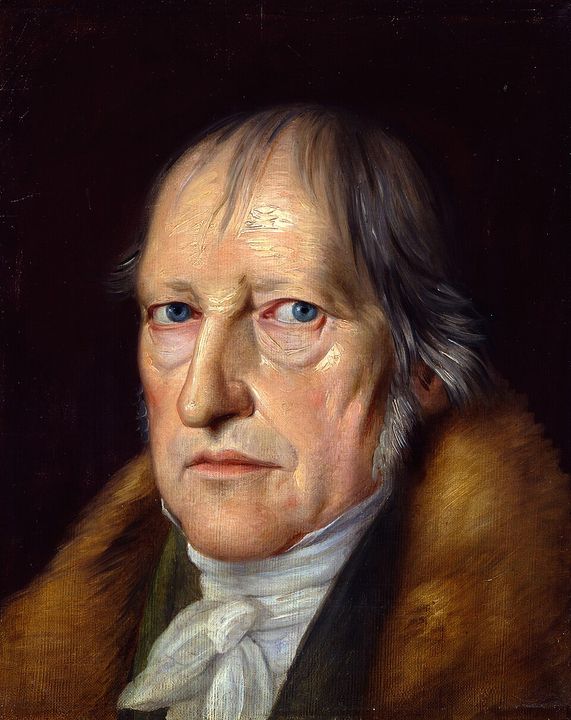
Georg Wilhelm Friedrich Hegel (1770–1831) was born in Stuttgart and studied theology and philosophy at the Tübingen seminary, where he shared rooms with Hölderlin and Schelling. After years as a house tutor in Bern and Frankfurt he taught at Jena, where he finished the Phenomenology of Spirit (1807), then edited a newspaper in Bamberg and served as rector of a gymnasium in Nuremberg, where he wrote the Science of Logic (1812–16). He was professor at Heidelberg from 1816 and at Berlin from 1818, succeeding Fichte, and his lectures there on history, art, religion and the history of philosophy were published by his students after his death. He died in Berlin in November 1831.
Frequently Cited
“What is rational is real ; And what is real is rational.”
“When philosophy paints its grey in grey, one form of life has become old, and by means of grey it cannot be rejuvenated, but only known. The owl of Minerva takes its flight only when the shades of night are gathering.”
Hegel's Philosophy of Right (Grundlinien der Philosophie des Rechts) was written as a textbook for his Berlin lectures on law, ethics and the state. Its preface is dated June 1820, and the book appeared in Berlin late that year with 1821 on the title page.
The Philosophy of History (Vorlesungen über die Philosophie der Geschichte) is the posthumous edition of the lectures on the philosophy of world history that G. W. F. Hegel gave five times at the University of Berlin between the winter of 1822-23 and that of 1830-31. Hegel never wrote it as a book.