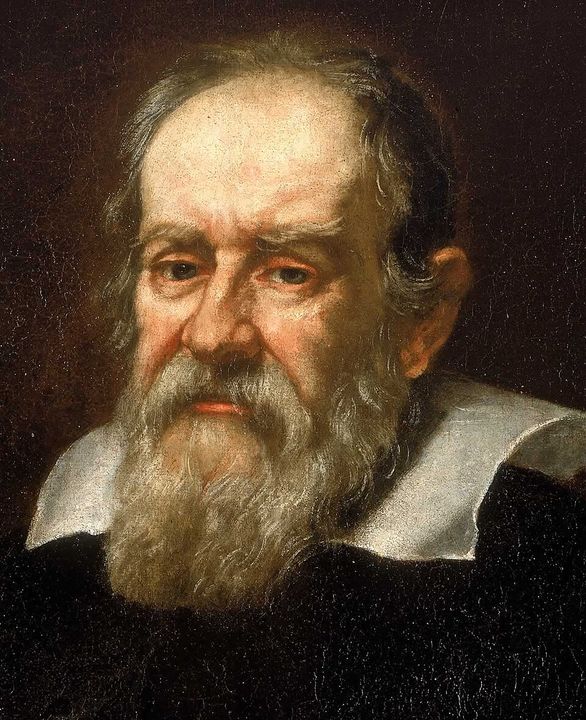
Galileo Galilei, painted by Justus Sustermans (c. 1640). Source · Public domain
About Galileo Galilei
Galileo Galilei (1564–1642) was born at Pisa, studied medicine and then mathematics at the university there, and taught mathematics at Pisa and later at Padua (1592–1610). His telescopic discoveries of 1609–1610 made him famous and won him appointment as chief mathematician and philosopher to Cosimo II de' Medici, Grand Duke of Tuscany. His defence of the Copernican system led to an admonition in 1616 and, after the Dialogue Concerning the Two Chief World Systems (1632), to his trial by the Roman Inquisition in 1633. He spent his last years under house arrest at Arcetri near Florence, where he completed the Two New Sciences (1638).
This volume gathers three works from the three stages of Galileo's career: the discoverer, the defender, and the old master of mechanics. The Starry Messenger (Sidereus Nuncius), printed at Venice in March 1610 and here read in Edward Stafford Carlos's 1880 English version, reports what Galileo saw through a telescope he had built and improved after hearing of a Dutch spyglass.