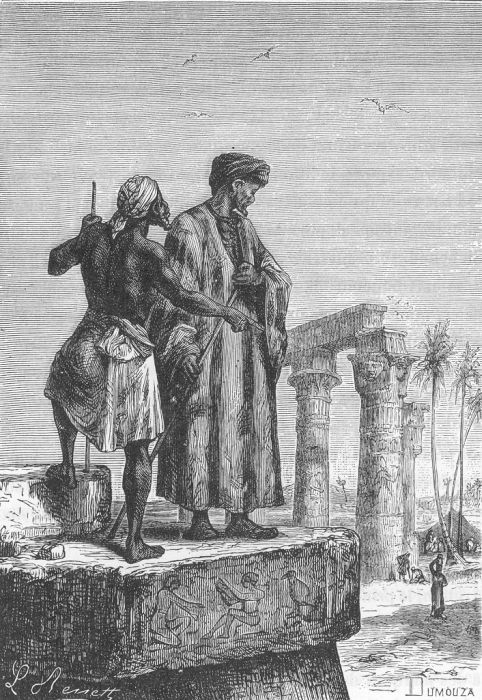
Ibn Battuta in Egypt as imagined by Léon Benett (1878). Source · Public domain
About Ibn Battuta
Abu Abd Allah Muhammad ibn Battuta (1304-c. 1368/69) was a Moroccan Muslim scholar of the Maliki school of law, born at Tangier into a Berber family of judges. He left home on pilgrimage in 1325 and travelled for nearly thirty years through North Africa, Arabia, Persia, Anatolia, the Golden Horde, Central Asia, India, the Maldives, Southeast Asia and China, and later to Granada and Mali, often serving as a judge. On his return he dictated his memories at Fez to the scholar Ibn Juzayy, at the command of the Marinid sultan Abu Inan.
Frequently Cited
“I was astonished at what he said, and determined with myself to visit those countries : nor did I give up my purpose till I had met all the three mentioned by him, and presented his compliments to them.”
The Travels of Ibn Battuta is the account of a Moroccan legal scholar who left Tangier in June 1325, aged twenty-one, to make the pilgrimage to Mecca and did not settle at home again until 1349. Its Arabic title, given by its editor Ibn Juzayy, means A Gift to Those Who Contemplate the Wonders of Cities and the Marvels of Travelling; it is usually called simply the Rihla, the Journey.