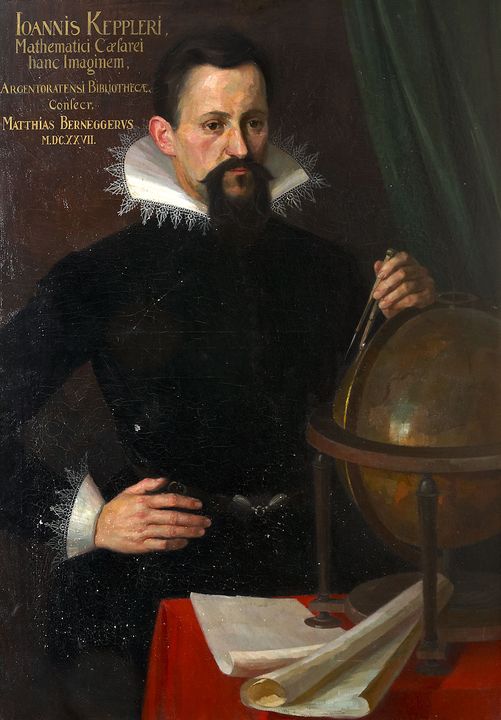
Johannes Kepler (1571–1630) was born in Weil der Stadt in Württemberg and studied theology and astronomy at the Lutheran university of Tübingen, where Michael Maestlin introduced him to Copernicus. While teaching mathematics at Graz he published the Mysterium Cosmographicum (1596). In 1600 he joined Tycho Brahe in Prague and on Tycho's death in 1601 succeeded him as Imperial Mathematician to Rudolf II. He later worked in Linz and elsewhere, wrote on optics, defended his mother in a long witchcraft trial, published the Epitome of Copernican Astronomy and the Rudolphine Tables (1627), and died at Regensburg in 1630.
This record joins two Latin books by Johannes Kepler that together contain the three laws of planetary motion and the religious vision that drove his astronomy. The library does not store a text: the English translations of both books (William Donahue's New Astronomy, 1992; E. J. Aiton, A. M. Duncan and J. V. Field's Harmony of the World, 1997; and Charles Glenn Wallis's earlier version of Harmony Book V) are under copyright, and no public-domain English translation is available, so the record gives a summary and guide only.