Work record
New Astronomy and The Harmony of the World
1609-1619 · Renaissance Early Modern · Essays · Latin
Abstract
Background. Tycho Brahe's death in 1601 left the Imperial Mathematician in Prague with the finest planetary records in Europe and an unsolved problem: Mars refused every circular scheme. Kepler, a Lutheran schooled at Tübingen and already committed to Copernicus, set out to solve it.
Method. Kepler narrates his own campaign, testing model after model against the Danish observations, rejecting a nearly successful one for an eight-minute error, and seeking a solar power to explain the speeds he computed.
Findings. The 1609 volume establishes the elliptical path with the sun at a focus and the equal-areas rule. The 1619 volume, after geometry, music theory and a reformed doctrine of aspects, adds the proportion between periodic times and orbital size.
Key Concepts. Physical causes in astronomy; accuracy of observation as a judge of theory; Scripture describing heaven as it appears; creation ordered by number, figure and consonance; planetary melodies heard only by the intellect.
Availability. No text is stored in this library and nothing is quoted: the Latin is public domain, but every modern English version, including the Donahue and Aiton-Duncan-Field translations, is under copyright.
Significance. Newton's gravitation explained the three laws, and the Rudolphine Tables proved their worth to working astronomers. Scholars still weigh how far Kepler's devotion to harmonic order drove the discoveries it surrounds.
Key figures
- Johannes Kepler: Lutheran mathematician to the emperor and narrator of his own discovery
- Tycho Brahe: Observer whose naked-eye records of Mars were Kepler's evidence
- Nicolaus Copernicus: Earlier reformer whose moving Earth Kepler upholds
- Rudolf II: Habsburg emperor and dedicatee of the 1609 book
- William Gilbert: Magnetic philosopher behind Kepler's solar force
- Robert Fludd: English Hermetic writer answered in the appendix on harmony
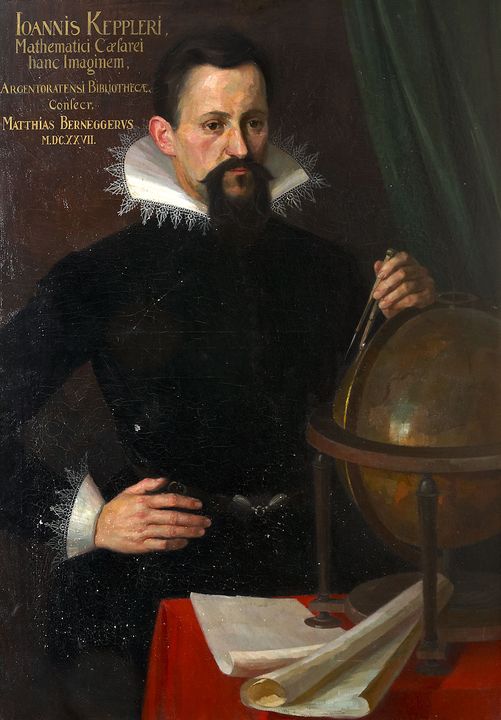

Summary
This record joins two Latin books by Johannes Kepler that together contain the three laws of planetary motion and the religious vision that drove his astronomy. The library does not store a text: the English translations of both books (William Donahue's New Astronomy, 1992; E. J. Aiton, A. M. Duncan and J. V. Field's Harmony of the World, 1997; and Charles Glenn Wallis's earlier version of Harmony Book V) are under copyright, and no public-domain English translation is available, so the record gives a summary and guide only. Astronomia Nova (New Astronomy), issued in 1609, tells the story of Kepler's long campaign against the orbit of Mars, which he called a war. Working from Tycho Brahe's unprecedentedly accurate observations, he first built a circular model that matched them within eight minutes of arc, and then rejected it because Tycho's data could not be wrong by that much. He showed that the Earth's orbit also requires correction, and he looked for a physical cause of planetary motion in a force issuing from the turning sun, drawing on William Gilbert's work on magnetism. Along the way he found that a line from the sun to a planet sweeps out equal areas in equal times, and after many failed attempts he concluded that the orbit of Mars is an ellipse with the sun at one focus. These are now called Kepler's first two laws. The book's introduction argues that the motion of the Earth does not contradict Scripture, which speaks of nature in the language of ordinary appearance. Harmonices Mundi (The Harmony of the World), published at Linz in 1619, is a vast study in five books of the geometric and musical ratios Kepler believed God had built into creation. Book I treats regular polygons and which can be constructed; Book II shows how regular figures fit together in tilings and solids; Book III derives the musical consonances from the division of a string; Book IV applies harmonic ratios to astrological aspects and to the soul's response to them; and Book V finds harmonies in the planets' speeds at their nearest and farthest points from the sun, giving each planet a melodic range. In Book V Kepler announces what is now his third law, that the squares of the planets' periods are proportional to the cubes of their mean distances, which he says he found in 1618. The book closes with a hymn of praise to the Creator.
Virtues in this work
- Fortitude: Kepler persisted for years through dozens of failed calculations in what he called his war on Mars.
- Humility: He abandoned his own carefully built circular model of Mars rather than doubt Tycho's observations by eight minutes of arc.
- Piety: He closes Book V of the Harmony of the World with a prayer of thanks to the Creator whose order he believed he had uncovered.
Plot or Argument
- New Astronomy, Part I: equivalent hypotheses
Kepler shows that the Ptolemaic, Copernican and Tychonic systems can be made to reproduce the same observed motions, so geometry alone cannot decide among them; physical causes must.
- New Astronomy, Part II: the vicarious hypothesis and eight minutes
Using Tycho's oppositions of Mars, Kepler builds a circular model that fits longitudes well yet errs by up to eight minutes of arc elsewhere. Trusting Tycho's accuracy, he abandons it, a decision he says led to the reform of all astronomy.
- New Astronomy, Part III: the Earth's orbit and the physical cause
Triangulating from Mars, Kepler corrects the Earth's orbit and argues that a planet moves more slowly the farther it is from the sun, suggesting a moving power from the rotating sun. From this he derives the area rule, his second law.
- New Astronomy, Parts IV–V: the ellipse and the latitudes
After testing ovals and rejecting them, Kepler finds that the orbit of Mars is an ellipse with the sun at a focus. He explains the planet's motion by a magnetic-like attraction and repulsion, and treats the inclination of the orbit in the final part.
- Harmony of the World, Books I–III: geometry and music
Kepler classifies regular polygons by their constructibility, shows how regular figures combine in plane tilings and solids, and grounds the musical consonances in the divisions of a string that correspond to constructible figures.
- Harmony of the World, Book IV: harmonies in the soul and the earth
Kepler argues that the soul perceives harmonic proportions and that the angles between planets as seen from Earth act on natural and human souls. He reforms astrology to a theory of aspects rather than signs and houses.
- Harmony of the World, Book V: the music of the heavens and the third law
Comparing each planet's fastest and slowest angular speeds as seen from the sun, Kepler finds musical intervals and assigns each planet a melodic range; he states the relation between periods and distances, and ends with a prayer of thanks. An appendix compares his work with Ptolemy's Harmonics and answers Robert Fludd.
Characters
- Johannes Kepler, author
Imperial Mathematician who narrates his own trials and errors in the New Astronomy.
- Tycho Brahe, source
Danish astronomer whose precise observations of Mars made the new astronomy possible.
- Nicolaus Copernicus, predecessor
Proposer of the sun-centred system Kepler defends and transforms.
- Rudolf II, patron
Holy Roman Emperor to whom the New Astronomy is dedicated.
- William Gilbert, influence
English physician whose De Magnete suggested to Kepler a magnetic cause of planetary motion.
- Claudius Ptolemy, predecessor
Author of the Almagest and of the Harmonics, which Kepler compares with his own work.
Lessons
Eight minutes of arc
Kepler had a model of Mars that most astronomers would have accepted, but it disagreed with Tycho's observations by about a quarter of the moon's apparent width. Because he trusted the observations, he discarded years of work. The episode shows how respect for accurate evidence can overturn a satisfying theory.
- Why did Kepler trust Tycho's data over his own elegant model?
- What would have been lost if he had treated the discrepancy as observational error?
- Can you think of another discovery that began with a small, stubborn disagreement?
Asking why, not only how
Earlier astronomers aimed mainly to predict where planets would appear. Kepler insisted on finding a physical cause for their motions, and his search for a force from the sun led him to the area law. His causes were later replaced by Newton's gravitation, but his question shaped the future of physics.
- How did Kepler's belief in a physical cause change the kind of astronomy he did?
- Is a theory that predicts correctly without explaining anything still good science?
Science as praise
For Kepler, finding the geometric order of the heavens was a way of reading the Creator's thoughts and giving thanks. The Harmony of the World ends in prayer. In his work, faith supplied both the motive for inquiry and the expectation of finding order.
- How does Kepler's belief that God created with geometry shape what he looks for in the heavens?
- Why does he argue in the New Astronomy that Scripture speaks of nature according to appearances?
- What might be gained and what risked by expecting nature to be beautiful?
Truth mixed with error
The same book that announces the third law also assigns melodies to planets and reforms astrology. Kepler's discoveries arose together with ideas later abandoned. Reading him teaches patience with the way real inquiry advances.
- Which of Kepler's ideas in Book V survived and which did not?
- Should we judge a scientist by his lasting results or by his whole way of thinking?
Context
Kepler worked in the generation after Copernicus's On the Revolutions (1543), when the sun-centred system was known to astronomers but not widely accepted, and when Tycho Brahe had proposed a compromise in which the planets circle the sun while the sun circles a stationary Earth. Tycho's observatory at Hven had produced the most accurate naked-eye observations ever made. Kepler, a devout Lutheran trained for the ministry, lived amid the religious divisions that would lead to the Thirty Years' War, which began in 1618, the year he found the third law.
Composition
Kepler joined Tycho in Prague in 1600 and was assigned the orbit of Mars. He found the area rule by about 1602 and the elliptical orbit by 1605, but disputes with Tycho's heirs over the observations delayed publication until 1609. Astronomia Nova was printed at Heidelberg at the emperor's expense. Kepler had planned a work on cosmic harmony since the 1590s; he completed Harmonices Mundi at Linz, and it was printed there in 1619. He reports in Book V that the relation of periods to distances came to him in March 1618 and was confirmed in May.
Reception
Few contemporaries accepted the ellipses at once; Galileo, for example, did not adopt them. The Rudolphine Tables (1627), built on Kepler's laws, proved far more accurate than earlier tables and won them acceptance among astronomers. Newton's Principia (1687) derived the three laws from universal gravitation and gave Kepler his lasting place in physics. Historians differ on how to weigh Kepler's mystical and harmonic ideas: some treat them as obstacles he overcame, others, such as Max Caspar and later scholars, as the very source of his persistence and discoveries.
Comparisons
- copernicus-on-the-revolutions
Copernicus moved the Earth but kept circles and epicycles; Kepler adopted the moving Earth and replaced the circles with ellipses governed by physical causes.
- ptolemy-almagest
Ptolemy's geometric models aimed to save the appearances; Kepler showed in Part I of the New Astronomy that such models are interchangeable and demanded a physical account. Book V of the Harmony also engages Ptolemy's Harmonics.
- gilbert-de-magnete
Gilbert's claim that the Earth is a great magnet suggested to Kepler that a magnetic power from the sun moves the planets.
- galileo-selected-writings
Kepler and Galileo corresponded and both championed Copernicus, yet Galileo kept circular orbits, while Kepler welcomed Galileo's telescopic discoveries in print.
- principia
Newton derived Kepler's three laws from the inverse-square law of gravitation, turning Kepler's empirical discoveries into consequences of a single principle.
- timaeus
Plato's account of a craftsman who orders the cosmos by number and harmonic ratio stands behind Kepler's conviction that God created by geometry.
Quotes
For Students
A reading companion for classical Christian high school students. See the student guide.
Reading Guide
Watch for
- Kepler's dedication of the New Astronomy to Rudolf II, where he describes his struggle with Mars as a military campaign.
- The moment in Part II when Kepler rejects his own model because it disagrees with Tycho's observations by eight minutes of arc.
- The introduction's argument that Scripture speaks of the heavens according to how they appear, and is not a textbook of astronomy.
- The construction of musical consonances from geometric figures in Book III of the Harmony.
- The statement of the third law and the closing prayer in Book V of the Harmony.
Key terms and names
- Ellipse
- An oval curve with two foci; Kepler showed that Mars moves on one with the sun at one focus, ending two thousand years of circular astronomy.
- Area law
- Kepler's second law: a line from the sun to a planet sweeps out equal areas in equal times, so the planet moves faster when nearer the sun.
- Third law
- The squares of the planets' orbital periods are proportional to the cubes of their mean distances from the sun, announced in Harmony Book V.
- Vicarious hypothesis
- Kepler's provisional circular model of Mars in the New Astronomy, accurate in longitude but off by eight minutes elsewhere, which he abandoned.
- Tycho Brahe
- The Danish nobleman whose decades of precise observations Kepler inherited in Prague and refused to doubt.
- Celestial harmony
- Kepler's name for the musical ratios he found between the fastest and slowest motions of the planets, which only the mind, not the ear, can perceive.
- Accommodation
- The principle that Scripture speaks of natural things in the language of ordinary appearance, which Kepler used to reconcile the moving Earth with passages such as Joshua's command to the sun.
Seminar Questions
- Comprehension What were the eight minutes of arc, and why did they matter so much to Kepler?
- Comprehension State Kepler's three laws in your own words and say in which book each appears.
- Comprehension What did Kepler think moved the planets, and whose work on magnetism influenced him?
- Interpretation Kepler tells the story of his errors as well as his successes in the New Astronomy. Why might he have chosen to narrate his mistakes?
- Interpretation How does Kepler use the idea that Scripture speaks according to appearances to defend the motion of the Earth? Is the argument convincing?
- Interpretation In the Harmony, Kepler's third law appears beside planetary melodies and a reformed astrology. Does the setting change how we should understand the discovery?
- Big Question Is the expectation that nature will be orderly and beautiful a religious belief, a scientific assumption, or both?
Faith Connections
- Psalm 19:1-6 (Scripture)
The heavens declare the glory of God, and the sun runs its course like a bridegroom. Kepler saw his astronomy as tracing that glory, and he discussed this psalm among the passages that describe the heavens according to appearance.
- Joshua 10:12-14 (Scripture)
Joshua's command to the sun to stand still was a standard objection to a moving Earth; Kepler's introduction to the New Astronomy answers that the passage speaks of what Joshua saw, not of astronomical mechanism.
- Wisdom of Solomon 11:20 (Scripture)
Thou hast ordered all things in measure and number and weight. This verse, much cited by medieval and early modern writers, expresses the conviction behind Kepler's search for geometric and harmonic order in creation.
- Augustine, The Literal Meaning of Genesis I.19 (Great Conversation)
Augustine warned Christians against making Scripture contradict what can be known with certainty about the heavens and the earth; Kepler's introduction stands in this tradition of reading Scripture's purpose carefully.
Logic and Rhetoric
Central argument: Geometric models alone cannot decide among the world systems, because several can reproduce the same appearances. Planetary motions must therefore be explained by physical causes. Tycho's observations are accurate to within a few minutes of arc, so any model that errs by eight minutes must be false. The only orbit that both fits the observations and agrees with a single physical cause from the sun is an ellipse with the sun at one focus, traced so that equal areas are swept in equal times. Since God made the world according to geometric and harmonic order, such laws are what a faithful inquirer should expect to find.
Rhetorical device: narratio (narrative of the inquiry). Rather than present only his results, Kepler tells in the New Astronomy the story of his campaign against Mars, including false starts and the rejection of the vicarious hypothesis, so that readers are persuaded by following the path of discovery.
Debate: Resolved: That Kepler's religious conviction that the cosmos is harmonious helped rather than hindered his scientific discoveries.
Writing Prompts
Essay: Kepler discarded his own circular model of Mars because of an eight-minute disagreement with Tycho's observations. Using that episode and his search for a physical cause, explain what the New Astronomy teaches about the relation between theory and evidence, and judge whether his religious view of nature helped him reach his laws.
Comparison with Principia: Newton showed that Kepler's laws follow from universal gravitation. Compare how Kepler and Newton each explain why planets move as they do, and argue what Newton's synthesis kept and what it discarded from Kepler's vision of a harmonious cosmos.
Medical Lens
These two books are astronomy, geometry and cosmology and contain no medical material of note. Kepler's contribution to the history of medicine lies elsewhere: in his optical work of 1604 he gave the first correct account of the inverted image formed on the retina and explained how spectacles correct vision. Book IV of the Harmony discusses the soul's perception of harmonic proportion in astrological terms, which belongs to the history of natural philosophy rather than medicine.
Creative Prompts
- Classroom
Draw ellipses with two pins and a loop of string, moving the pins apart and together. Then plot several planets' periods and distances and test whether the squares of the periods track the cubes of the distances.
- Essay
Kepler called his work on Mars a war. Using his account of the eight-minute discrepancy, explain what kind of courage scientific honesty required of him.
- Adaptation
Using Kepler's assignment of melodic ranges to the planets in Book V, compose or describe a short piece of music for the six planets known to him and explain your choices.
- Dialogue
Write a conversation in Prague in 1601 between Kepler and Tycho Brahe about whether the Earth moves.
Further Reading
- Kepler, Max Caspar, trans. C. Doris Hellman
The standard biography.
- New Astronomy, Johannes Kepler, trans. William H. Donahue
- The Harmony of the World, Johannes Kepler, trans. E. J. Aiton, A. M. Duncan and J. V. Field
- The Sleepwalkers, Arthur Koestler
A vivid, opinionated history of cosmology with a long section on Kepler.
- Kepler's Geometrical Cosmology, J. V. Field
Verification notes
Abstract-only record: public-domain Latin originals, but no public-domain English translation is stored, and the modern translations (Wallis, Donahue, Aiton/Duncan/Field) are under copyright, so no quotations are given. Dates of discovery (area law c. 1602, ellipse 1605, third law March to May 1618) follow Kepler's own accounts as reported in standard biographies. The part divisions of the New Astronomy are summarized broadly.
- Confirm the chapter in which the eight-minute discrepancy is discussed (usually given as Chapter 19) before citing it.
- Confirm the exact dates Kepler gives in Harmony Book V, Chapter 3, for finding the third law.
- Quote nothing unless verified word-for-word in a public-domain English source.