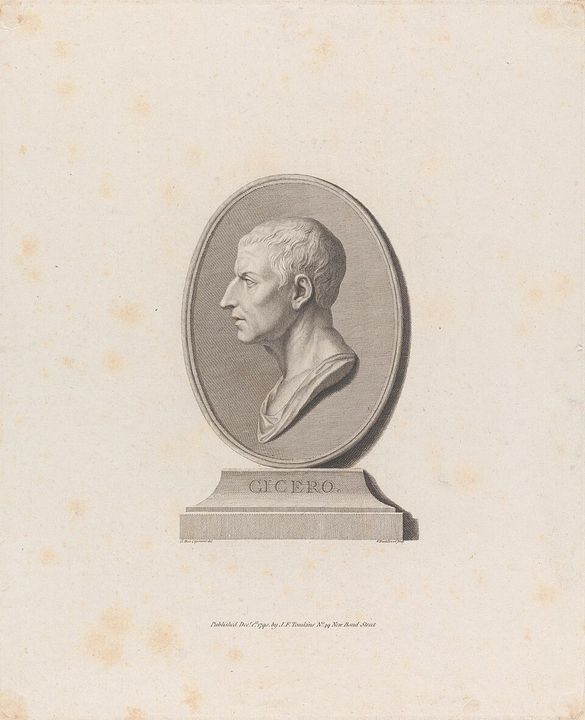
106-43 BC · Roman orator, statesman and philosopher, consul in 63 BC
Cicero, engraving by Francesco Bartolozzi (1790). Source · CC0
About Marcus Tullius Cicero
Marcus Tullius Cicero (106-43 BC) was a Roman orator, lawyer, statesman, and philosopher from Arpinum. A new man without consular ancestors, he rose through the offices of state to the consulship of 63 BC, when he suppressed the conspiracy of Catiline. Exiled in 58 BC for executing the conspirators without trial and recalled the next year, he wrote his major philosophical works in the 40s and was killed on the orders of Mark Antony after attacking him in the Philippics.
The First Oration Against Catiline is the speech Cicero, as consul, delivered to the Roman senate on 8 November 63 BC in the temple of Jupiter Stator, with Lucius Sergius Catilina himself sitting among the senators. Catiline, twice defeated for the consulship and deep in debt, had been organizing a rising: his ally Gaius Manlius was raising an army in Etruria, and on the night of 6-7 November conspirators met at the house of Marcus Laeca, where two men undertook to murder Cicero at his morning reception.
Cicero wrote his two dialogues on the state in the troubled 50s BC, when the Roman Republic was strained by the private power of Pompey, Caesar and Crassus. On the Commonwealth (De re publica), published in 51 BC, imitates Plato's Republic but asks what the best constitution is for a real people, and answers with Rome itself.
On Duties is Cicero's last philosophical work, written in the autumn of 44 BC, in the months after the murder of Julius Caesar, and addressed as a letter in three books to his son Marcus, then studying philosophy at Athens under the Peripatetic Cratippus. Cicero follows, with freedom, the Stoic Panaetius of Rhodes, whose treatise on duty (kathēkon, Latin officium) he adapts for a Roman reader, adding examples from Roman history and from his own career.