Work record
First Oration Against Catiline
63 BC · Ancient · Oratory · Latin
Abstract
Background. After losing two consular elections, Catiline turned to armed revolt backed by debtors and discharged veterans. Late in October the senate gave the consuls emergency powers, and an attempt on Cicero's life followed days later.
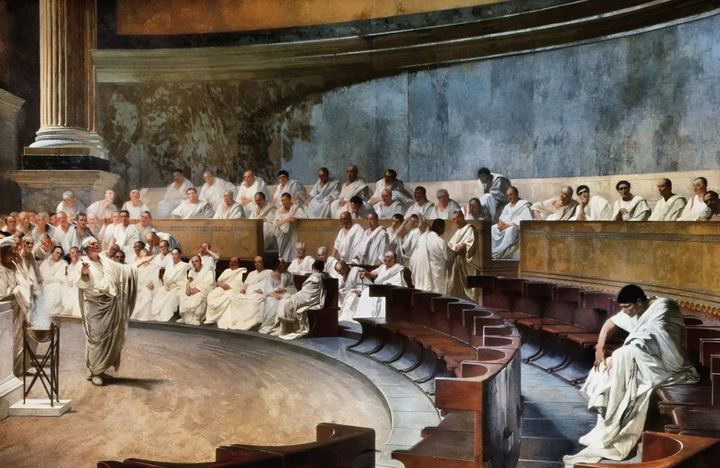
Occasion. Cicero convened the senators at a fortified temple near the Palatine and found the accused among them, shunned by everyone on nearby benches.
Argument. Rather than seek a death sentence, the consul demonstrates that his informers have tracked every move, recites ancestral precedents for killing subversives, and then urges Catiline out of Rome so that the plot will declare itself as open war. Sending one ringleader to execution, he reasons, would drive the remaining traitors underground; letting him go to the rebel army draws them all into the light.
Rhetoric. Rapid interrogation, mock omission of private scandal, and personified voices of the homeland carry the attack. A medical comparison and a closing invocation of Jupiter round it off.
Significance. Catiline fled that night; he died in battle at Pistoria the next winter after his urban accomplices were strangled in December. The executions brought Cicero both honor and, five years on, exile. Its first sentence remains the best-known line of Latin prose, and the oration has been studied in schools since antiquity.
Key figures
- Marcus Tullius Cicero: Consul and speaker, a new man from Arpinum
- Lucius Sergius Catilina: Patrician conspirator, sitting in the senate as he is denounced
- Gaius Manlius: Commander of the rebel force gathering in Etruria
- Marcus Porcius Laeca: Host of the nocturnal meeting where Cicero's murder was planned
- Jupiter Stator: Protecting god of the meeting place, invoked in the closing prayer

Summary
The First Oration Against Catiline is the speech Cicero, as consul, delivered to the Roman senate on 8 November 63 BC in the temple of Jupiter Stator, with Lucius Sergius Catilina himself sitting among the senators. Catiline, twice defeated for the consulship and deep in debt, had been organizing a rising: his ally Gaius Manlius was raising an army in Etruria, and on the night of 6-7 November conspirators met at the house of Marcus Laeca, where two men undertook to murder Cicero at his morning reception. Cicero, warned in advance, kept them out and summoned the senate. The speech opens with a famous burst of questions, rendered by Yonge as When, O Catiline, do you mean to cease abusing our patience? Cicero then cries out against the age (the Latin O tempora, o mores) because the senate knows everything and yet this man lives. He reminds the house that it has already passed its emergency decree and cites precedents in which consuls killed dangerous citizens at once. He then shows Catiline that every plan is known: the date Manlius would take up arms, the planned massacre of 28 October, the failed attempt on Praeneste, and the meeting at Laeca's house. Instead of ordering an execution, Cicero commands Catiline to leave Rome and take his followers with him, so that the conspiracy will reveal itself in open war. He describes how the senators emptied the benches around Catiline when he sat down, and personifies the fatherland pleading with Catiline to depart. He answers an imagined objection that he should simply kill him, arguing that executing one man would leave the disease in the republic, and ends with a prayer to Jupiter Stator to defend the city. Catiline left that night for Manlius's camp. Cicero later secured evidence against the conspirators remaining in Rome, and five were executed in December after a senate debate. Catiline died fighting near Pistoria early in 62 BC. Cicero revised and published his consular speeches in 60 BC, and the First Catilinarian became a school text for nearly two thousand years.
Virtues in this work
- Prudence: Cicero chooses to drive Catiline out rather than execute him, reasoning in sections 30-32 that exile will expose the whole conspiracy while a single death would hide it.
- Fortitude: Knowing assassins had been sent to his house, Cicero confronts Catiline face to face in the senate and accepts the unpopularity his course may bring.
- Justice: The speech insists that the consul's duty is the safety of the whole republic and that the senate's decree exists to protect citizens from murder and arson.
Plot or Argument
- The opening assault (sections 1-2)
Cicero bursts out with questions about how long Catiline will abuse the senate's patience, points to the guards and watches posted through the city, and laments an age in which the senate knows the plot and yet the plotter lives and sits among them.
- Precedent and the senate's decree (sections 3-6)
He recalls Scipio Nasica, Ahala, Opimius, and Marius, who acted swiftly against dangerous citizens, notes that the senate's emergency decree lies sheathed like a sword, and explains that he delays only until no one can deny the justice of acting.
- The plot exposed (sections 7-10)
Cicero proves his knowledge: he predicted Manlius's rising to the day, foiled the planned massacre and the night attack on Praeneste, and knows of the meeting at Laeca's house and the assassins sent to his door. He orders Catiline to leave the city and take his band with him.
- Catiline's life and the silent senate (sections 11-21)
He reviews Catiline's private crimes, often by pretending to pass over them, describes the empty benches around him, lets the fatherland speak in her own voice, and points out that the senators' silence is itself a verdict.
- Why exile rather than death (sections 22-32)
Cicero predicts Catiline will go to Manlius and his silver eagle, imagines the republic reproaching him for letting an enemy go, and answers that killing one man would only check the disease, while his departure will draw off all the conspirators at once.
- Prayer to Jupiter Stator (section 33)
He sends Catiline to his impious war and calls on Jupiter, protector of the city since Romulus, to drive the conspirators from the temples, homes, and lives of the citizens and to punish them, living and dead.
Characters
- Marcus Tullius Cicero, Speaker; consul of 63 BC
The consul who has uncovered the plot and uses the speech to drive Catiline from Rome.
- Lucius Sergius Catilina (Catiline), Addressee
A patrician of ruined fortune, present in the senate, whom Cicero accuses of plotting murder, arson, and revolution.
- Gaius Manlius, Catiline's ally
Former soldier raising an army in Etruria; Cicero predicts that Catiline will join his camp.
- Marcus Porcius Laeca, Conspirator
The senator at whose house in the Scythe-makers' street the conspirators met; Yonge calls him Marcus Lecca.
Key claims
The main steps of the argument, in order, and how they fit together.
- Catiline is plotting the destruction of Rome, its citizens, and its government.How it is supported: Evidence of Manlius's army in Etruria and the meeting at Laeca's house.
- The consul knows every detail of the conspiracy, so Catiline cannot hide his plans.How it is supported: Cicero recounts the predicted date of Manlius's rising, the foiled massacre, and the failed attack on Praeneste.
- Roman precedent and the senate's emergency decree would justify putting Catiline to death at once.How it is supported: The examples of Scipio Nasica, Ahala, Opimius, and Marius.
- The senate's silence and the empty benches around Catiline show that he has already been judged.How it is supported: A description of the senators drawing away, and the fatherland personified pleading with him.
- Executing Catiline alone would only check the disease and leave his accomplices hidden in the city.How it is supported: A medical comparison to a fever that is relieved for a moment but not cured.
- If Catiline goes to Manlius's camp, his followers will go with him and the plot will become open war.How it is supported: A prediction of his flight to the rebel army and its silver eagle.
Argument map
Supported by
- 1Catiline is plotting the destruction of Rome, its citizens, and its government.
which rests on
- 2The consul knows every detail of the conspiracy, so Catiline cannot hide his plans.
- 4The senate's silence and the empty benches around Catiline show that he has already been judged.
- 3Roman precedent and the senate's emergency decree would justify putting Catiline to death at once.
- 6If Catiline goes to Manlius's camp, his followers will go with him and the plot will become open war.
which rests on
- 5Executing Catiline alone would only check the disease and leave his accomplices hidden in the city.
Therefore
Plain-language summaries of the author's argument, not quotations.
Lessons
Vigilance as a duty of office
Cicero's power in the speech comes from knowledge: he names dates, houses, and plans before Catiline can deny them. The consul presents watchfulness for the republic's safety as the first duty of anyone entrusted with public office.
- Why does Cicero list Catiline's plans in such detail in sections 7-10?
- How does the claim that he watches far more actively than Catiline plots shift the balance of power in the room?
- What responsibilities come with knowing of a danger that others do not?
Restraint in the use of power
Cicero holds a decree that would allow him to execute Catiline but chooses to order him out of the city instead. He argues that killing one man would leave the conspiracy hidden, while exile will expose it. The speech shows a magistrate weighing justice, prudence, and public opinion before acting.
- What reasons does Cicero give for not putting Catiline to death immediately?
- Is his restraint a matter of principle, strategy, or concern for his reputation?
- Later, Cicero was exiled for executing conspirators without trial. How does that outcome bear on the choices debated in this speech?
The force of silence and shame
In sections 16-21 Cicero turns the senate's empty benches and silence into evidence. Catiline is condemned not by a vote but by the visible refusal of his peers to sit near him or defend him, and Cicero names this shame as a judgment Catiline cannot escape.
- What does Cicero mean by saying that while they are silent they are loud and eloquent?
- Why might public shame be more powerful than a formal sentence in this situation?
- When is silence a form of speech, and when is it a failure to speak?
Context
By the 60s BC the Roman republic was strained by debt, ambitious nobles, veterans of Sulla's wars without land, and the precedent of armed politics. Catiline, a patrician who had served under Sulla, lost consular elections in 64 and 63 BC and turned to a program of debt cancellation and revolt. The senate's ultimate decree, passed in late October 63 BC, charged the consuls to see that the republic suffered no harm, a measure whose legal limits were already disputed.
Composition
Cicero spoke on 8 November 63 BC (some scholars place it on 7 November) in the temple of Jupiter Stator, a defensible site near the Palatine. He delivered the Second Catilinarian to the people the next day, the Third on 3 December after intercepting letters carried by envoys of the Allobroges, and the Fourth during the senate's debate of 5 December, when Caesar argued for imprisonment and Cato for death. In a letter to Atticus of 60 BC Cicero mentions assembling his consular speeches for publication, so the text we read is a revised version.
Reception
The executions earned Cicero the title of father of his country but also led to his exile in 58 BC under a law of Publius Clodius. Sallust's War with Catiline gives a rival account. The opening question, Quo usque tandem, became one of the best-known sentences in Latin, and the speech was a standard text in Roman schools, medieval and Renaissance grammar schools, and modern Latin classrooms. C. D. Yonge's literal translation of 1856, used here, was widely read in Victorian England.
Comparisons
- the-fall-of-the-roman-republic
Plutarch's Life of Cicero, one of the six lives in this volume, narrates the conspiracy, the senate meeting, and the December executions from the biographer's distance, and records the price Cicero later paid.
- friends-romans-countrymen
Shakespeare's Antony works a Roman crowd by irony and pathos two decades after Cicero's speech; Cicero, by contrast, attacks a man to his face before the senate and relies on evidence and indignation.
- give-me-liberty-or-give-me-death
Patrick Henry, schooled in Ciceronian oratory, opens with rhetorical questions and ends with a decisive appeal, adapting the Roman pattern to a provincial convention facing a crisis.
- pericles-funeral-oration
Pericles praises the city to unite it in mourning, while Cicero defends the city against an enemy within; together they show the two great purposes of civic oratory, celebration and defense.
Quotes
Frequently cited
“When, O Catiline, do you mean to cease abusing our patience? How long is that madness of yours still to mock us?”
Frequently cited
“Shame on the age and on its principles! The senate is aware of these things; the consul sees them; and yet this man lives.”
Frequently cited
“while they are quiet they approve, while they permit me to speak they vote, while they are silent they are loud and eloquent.”
“O ye immortal gods, where on earth are we? in what city are we living? what constitution is ours?”
“purge the city of your presence; you will deliver me from a great fear, when there is a wall between me and you.”
“Now, your country, which is the common parent of all of us, hates and fears you”
“for you are not, O Catiline, one whom either shame can recall from infamy, or fear from danger, or reason from madness.”
“so this disease which is in the republic, if relieved by the punishment of this man, will only get worse and worse, as the rest will be still alive.”
For Students
A reading companion for classical Christian high school students. See the student guide.
Reading Guide
Watch for
- The opening volley of rhetorical questions in section 1 and the exclamation against the age in section 2.
- The chain of precise dates in sections 7-8 (21, 27, and 28 October; 1 November) that proves Cicero's knowledge.
- Praeteritio in section 14, where Cicero says he will pass over Catiline's crimes while naming them.
- Prosopopoeia in sections 18 and 27-29, where first the fatherland addresses Catiline and then the republic addresses Cicero.
- The fever simile in section 31 and the closing prayer to Jupiter Stator in section 33.
Key terms and names
- Consul
- One of the two annually elected chief magistrates of Rome; Cicero speaks with the authority of the office in 63 BC.
- Conscript fathers
- The formal address to the Roman senate (patres conscripti), used throughout the speech when Cicero turns from Catiline to the senators.
- Senate's decree
- The senatus consultum ultimum, the emergency resolution charging the consuls to see that the republic suffered no harm, which Cicero says lies sheathed in its parchment.
- Jupiter Stator
- Jupiter the Stayer, whose temple, vowed by Romulus according to legend, housed this meeting; Cicero invokes him in the first and last parts of the speech.
- Manlian camp
- The army Gaius Manlius was gathering in Etruria near Faesulae; Cicero dares Catiline to go and lead it.
- Prosopopoeia
- A figure in which an absent person or abstraction is made to speak; Cicero gives voices to the fatherland and the republic.
- Praeteritio
- Drawing attention to something by claiming to pass over it, as Cicero does with Catiline's private crimes in section 14.
- Novus homo
- A new man, the first of his family to reach the consulship; the republic's reproach in section 28 reminds Cicero he rose with no ancestral renown.
Seminar Questions
- Comprehension What evidence does Cicero offer in sections 7-10 that he knows Catiline's plans?
- Comprehension What does Cicero order Catiline to do, and why does he say he is not ordering banishment?
- Interpretation Why does Cicero begin with questions addressed directly to Catiline instead of a formal statement to the senate?
- Interpretation How does the fatherland's speech in section 18 change the relationship between Catiline and Rome, and why does Cicero frame it as a parent addressing a son?
- Interpretation In sections 27-29 Cicero imagines the republic reproaching him for weakness. Why would a speaker raise the strongest objection to his own course?
- Interpretation How does the fever simile in section 31 support Cicero's choice of exile over execution?
- Big Question When a state faces an enemy within, how should it balance swift protection of the community against the legal rights of citizens?
- Big Question Is eloquence a safeguard of free government or a danger to it?
Faith Connections
- Romans 13:3-4 (Scripture)
Paul describes the magistrate as one who does not bear the sword in vain but is a terror to evil works; Cicero's speech dramatizes a magistrate deciding when and how to use that sword.
- Proverbs 28:1 (Scripture)
The wicked flee when no man pursues, but the righteous are bold as a lion; Cicero presents Catiline as a man whose own guilt and the senate's silence drive him from the city.
- Augustine, City of God II-III (Church Fathers)
Augustine draws repeatedly on Sallust and Cicero to describe the moral decline of the late republic, citing the age of Catiline as evidence that Rome's gods had not preserved its virtue.
- Augustine, Confessions III.4 (Great Conversation)
Augustine says that reading Cicero's Hortensius at nineteen changed his affections and turned him toward the love of wisdom, a sign of how deeply Cicero's prose shaped Christian learning.
Logic and Rhetoric
Central argument: Catiline is plotting the destruction of Rome; the consul knows every detail of the plot; executing Catiline alone would leave his accomplices hidden in the city; therefore Catiline should leave Rome and take his followers, so that the conspiracy is exposed and can be destroyed in the open.
Rhetorical device: Prosopopoeia. In section 18 the fatherland silently speaks to Catiline, and in sections 27-29 the republic addresses Cicero by name, letting Rome itself argue both sides of the question of punishment.
Debate: Resolved: Cicero was right to drive Catiline from Rome rather than order his immediate execution.
Memory Work
When, O Catiline, do you mean to cease abusing our patience? How long is that madness of yours still to mock us?
while they are quiet they approve, while they permit me to speak they vote, while they are silent they are loud and eloquent.
Writing Prompts
Essay: Evaluate Cicero's argument in sections 12 and 30-32 that exile would serve the republic better than execution, considering both his reasons and what happened after Catiline left Rome.
Comparison with Mark Antony's Funeral Oration ("Friends, Romans, countrymen"): Compare Cicero's direct assault on Catiline with Antony's indirect manipulation of the crowd in Shakespeare's Julius Caesar. Which speaker's methods are more honest, and which are more effective?
Medical Lens
The speech is political, but Cicero twice reaches for medical metaphor. In section 30 he calls the conspiracy a disease and a full-grown plague of the republic, and in section 31 he compares the city to a fevered patient who drinks cold water, feels relief, and then suffers worse. The simile assumes an audience familiar with fevers and with the debate, live among Greek and Roman physicians, over whether and when to give water to the febrile. The repeated words for Catiline's madness and frenzy are moral and political terms of abuse in Roman oratory, not clinical descriptions, and are best read that way.
- Section 30
Cicero calls the conspiracy a disease of the republic that execution would check but not eradicate, and hopes Catiline's departure will remove its root and seed.
- Section 31
The simile of fever patients who drink cold water, seem relieved, and then grow worse, applied to the danger hidden in the veins and bowels of the republic.
Creative Prompts
- Dialogue
Write the reply Catiline might have given in the senate after Cicero sat down (Sallust reports that he answered angrily before leaving), keeping to the facts the speech reveals and the charges it makes.
- Classroom
Stage the senate scene: one student delivers sections 1-2 and 16-21 aloud while the class, as senators, physically moves away from a student playing Catiline; then discuss how the empty benches function as an argument.
- Essay
Analyze how Cicero uses prosopopoeia, letting the fatherland speak in sections 18 and 27-29, to answer both Catiline and the critics who wanted him executed.
Further Reading
- Political Speeches, Cicero, trans. D. H. Berry
Oxford World's Classics translation of all four Catilinarians with introduction and notes.
- Catiline's War, The Jugurthine War, Histories, Sallust, trans. A. J. Woodman
Sallust's narrative of the conspiracy, the main ancient account besides Cicero's own.
- Cicero: The Life and Times of Rome's Greatest Politician, Anthony Everitt
- Cicero: A Portrait, Elizabeth Rawson
Verification notes
The date of 8 November 63 BC is the most commonly given; some scholars argue for 7 November. The sequence of the four Catilinarians, the December debate, and the publication of the consular speeches in 60 BC are standard. Quotations follow Yonge's 1856 translation as stored, which contains printing errors (for example thus for this, baud for band, and stiffer for suffer in section 31); quotes here avoid those passages or stop before them. The stored text also carries stray chapter numbers left from the Perseus layout. Yonge spells Laeca as Lecca and in section 23 prints Manilius for Manlius.
No verification flags recorded.