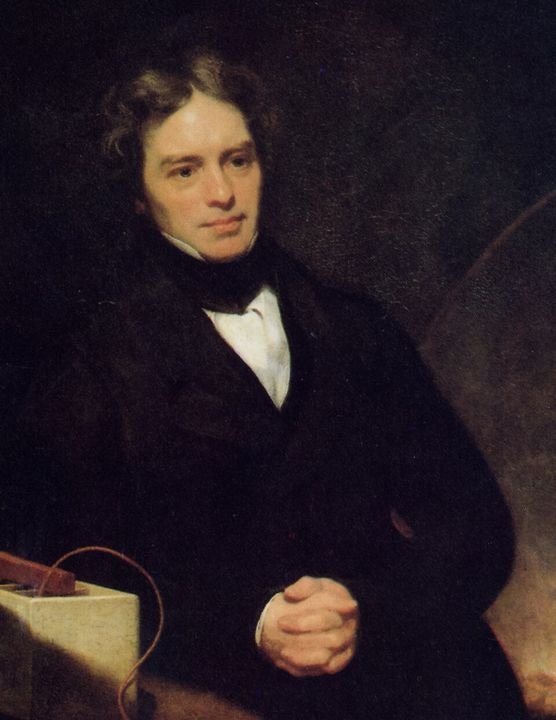
Michael Faraday (1791-1867) was born in Newington Butts, Surrey, the son of a blacksmith, and had little formal schooling; apprenticed to a London bookbinder, he educated himself by reading the books he bound. After attending Humphry Davy's lectures in 1812 he became Davy's laboratory assistant at the Royal Institution in 1813, and spent the rest of his working life there, becoming its first Fullerian Professor of Chemistry in 1833. He discovered electromagnetic rotation (1821), electromagnetic induction (1831), the laws of electrolysis (1832-34), and the magneto-optical effect and diamagnetism (1845), and gave the Royal Institution's Christmas lectures for young people many times. A lifelong member and sometime elder of the small Sandemanian church, he declined a knighthood and the presidency of the Royal Society.
Frequently Cited
“When the contact was made, there was a sudden and very slight effect at the galvanometer, and there was also a similar slight effect when the contact with the battery was broken.”
“for though it is very easy to talk of atoms, it is very difficult to form a clear idea of their nature, especially when compound bodies are under consideration.”
“There is no better, there is no more open door by which you can enter into the study of natural philosophy, than by considering the physical phenomena of a candle.”
“whenever a result happens, especially if it be new, you should say, “What is the cause? Why does it occur?” and you will in the course of time find out the reason.”
“that you may, like it, shine as lights to those about you; that, in all your actions, you may justify the beauty of the taper by making your deeds honourable and effectual in the discharge of your duty to your fellow-men.”
Experimental Researches in Electricity gathers the numbered papers that Michael Faraday read to the Royal Society and printed in its Philosophical Transactions, in which he discovered electromagnetic induction, showed that all kinds of electricity are one, and found the quantitative laws of electrolysis. Volume 1, first published in London in 1839, collects the first fourteen Series, written between 1831 and 1838, in 1,748 numbered paragraphs, with a preface, an index and plates; the library text is the 1849 second edition reprint.
The Chemical History of a Candle prints six lectures that Michael Faraday gave to a 'juvenile audience' at the Royal Institution in London over the Christmas season of 1860–61. Faraday opens by declaring that no door into natural philosophy is more open than the burning candle, and he keeps the whole course tied to that single object while it leads him through heat, chemistry, the air and the living body.