Work record
Experimental Researches in Electricity, Volume 1
1839 · 19th Century · Essays · English
Abstract
Background. Oersted's 1820 demonstration that currents deflect compasses raised the converse question. A self-taught former bookbinder working at the Royal Institution answered it in 1831 and kept going for seven years. He read the first paper to the Royal Society in November 1831, and the fourteenth in June 1838.
Method. Each Series reports apparatus, trials and results in sequence, cross-referenced by paragraph number and illustrated with plates. Mathematics is almost absent; the argument rests on varied, repeated experiment. Faraday reports dead ends and corrections openly, and in the preface he insists on reprinting the papers as first written, so readers can follow a discovery as it unfolded.
Findings. Changing magnetism induces current, as shown with coils, a ring, moving magnets and a turning copper disc. Battery, friction, magnet, heat and electric fish yield one electricity. Passing a fixed charge through compounds frees chemically equivalent weights, and induction travels by polarized particles of the medium.
Key Concepts. Magneto-electric induction, the electro-tonic state, identity of electricities, electrolyte, electrode, anode, cathode, ion, electrochemical equivalent, self-induction, specific inductive capacity.
Significance. These papers founded electrical engineering and quantitative electrochemistry and supplied the physical picture that Maxwell turned into field equations. The unit named for Faraday and the words he coined remain in daily scientific use. Today's generators, motors and transformers all descend from the coil and disc of the opening paper.
Key figures
- Michael Faraday: Experimenter at the Royal Institution and narrator of the papers
- André-Marie Ampère: Theorist of electrodynamics whose work frames the first experiments
- François Arago: Discoverer of the spinning-disc effect that induction explains
- Humphry Davy: Faraday's mentor, whose electrochemical views are revised
- Samuel Hunter Christie: Host of the experiments with the Royal Society's magnet
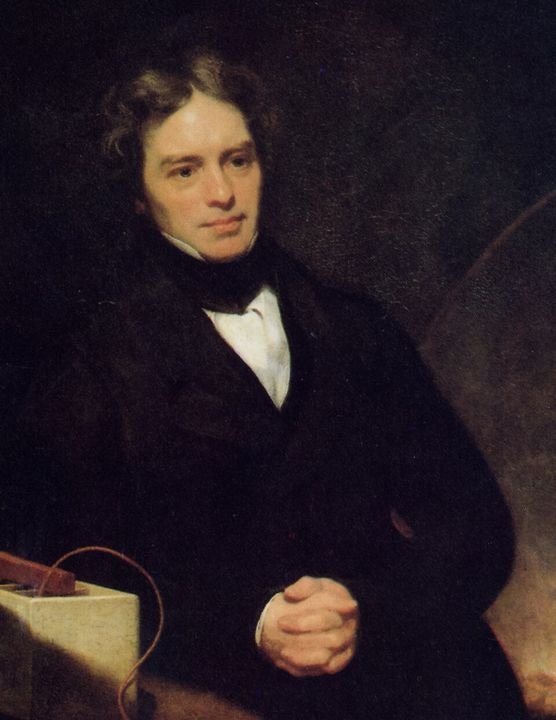

Summary
Experimental Researches in Electricity gathers the numbered papers that Michael Faraday read to the Royal Society and printed in its Philosophical Transactions, in which he discovered electromagnetic induction, showed that all kinds of electricity are one, and found the quantitative laws of electrolysis. Volume 1, first published in London in 1839, collects the first fourteen Series, written between 1831 and 1838, in 1,748 numbered paragraphs, with a preface, an index and plates; the library text is the 1849 second edition reprint. Faraday wrote the Series as a running laboratory record, and he says in the preface that he reprinted them as written rather than recast them. The First Series (read November 1831) opens by asking why, if a current produces magnetism, magnetism should not produce a current. Faraday winds two coils of wire on a block of wood and on an iron ring, connects one to a battery and the other to a galvanometer, and finds a brief current in the second coil only when the first is switched on or off. He then produces currents by moving magnets in and out of a coil, names the effect magneto-electric induction, proposes an electro-tonic state of matter, explains Arago's rotating-disc puzzle, and builds the first generator, a copper disc turned between the poles of the Royal Society's great magnet. The Second Series obtains currents from the earth's own magnetism. The Third Series (1833) compares five kinds of electricity: voltaic, common or frictional, magneto-electric, thermo-electric and animal electricity from the torpedo fish, testing each for heat, magnetism, chemical decomposition, sparks and physiological effects, and concludes that they differ only in quantity and intensity. The Fourth to Seventh Series turn to electrochemistry. Faraday shows that many solids conduct only when melted, argues that decomposition is a property of the current acting along the liquid rather than of attraction to the poles, and, with new terms of his own (electrode, anode, cathode, electrolyte, ion, anion, cation), proves that the amount of a substance decomposed is proportional to the quantity of electricity passed, and that the weights released are chemical equivalents. He devises the volta-electrometer to measure that quantity. The Eighth Series examines the voltaic pile and argues that its power is chemical in origin; the Ninth describes the extra current induced by a current in its own wire; the Tenth improves the battery. The Eleventh to Fourteenth Series develop a new theory: induction is an action of contiguous particles of the matter between charged bodies, not action at a distance, and different insulators have a specific inductive capacity. These papers laid the experimental foundation for the field theory later given mathematical form by James Clerk Maxwell.
Virtues in this work
- Industry: Faraday ran thousands of trials over seven years, recording each in numbered paragraphs.
- Humility: In paragraph 869 he declines to claim knowledge of atoms that his experiments could not support.
- Prudence: In the Seventh Series he coins new terms chosen not to imply theories he had not proved.
Plot or Argument
- Preface
Faraday explains that the fourteen Series were written in parts over seven years and are reprinted unaltered, and expresses satisfaction that they agree so well.
- First and Second Series (1831-1832): Electromagnetic induction
Coils, an iron ring and moving magnets produce transient currents; the electro-tonic state is proposed; Arago's rotations are explained and a copper disc becomes a continuous generator; terrestrial magnetism is shown to induce currents.
- Third Series (1833): The identity of electricities
Voltaic, common, magneto-, thermo- and animal electricity are compared effect by effect and found to be one power differing in degree.
- Fourth to Sixth Series (1833-1834): Conduction and decomposition
A new law of conduction for melted solids, a critique of theories of electrochemical decomposition, and studies of the power of metals to cause gases to combine.
- Seventh Series (1834): Definite electrolytic action
New nomenclature of electrode, anode, cathode, electrolyte and ion; the volta-electrometer; the law that chemical action is definite for a definite quantity of electricity, and electrochemical equivalents equal to chemical equivalents.
- Eighth to Tenth Series (1834-1835): The voltaic pile and self-induction
The battery's power is traced to chemical action; the extra current of a wire on itself is described; an improved battery is proposed.
- Eleventh to Fourteenth Series (1837-1838): Induction through matter
Static induction is shown to act through intervening particles; insulators differ in specific inductive capacity; conduction, discharge and the nature of the electric force are reconsidered.
Characters
- Michael Faraday, author and experimenter
Narrates his own experiments in numbered paragraphs, including failures and corrections.
- André-Marie Ampère, French physicist
His theory of electrodynamics is the background against which Faraday seeks induced currents.
- François Arago, French physicist
Discovered the rotation of a magnetized needle over a spinning copper disc, which Faraday explains by induction.
- Humphry Davy, Faraday's teacher
His Bakerian Lectures on electrochemistry are discussed and corrected in the electrochemical Series.
- Samuel Hunter Christie, mathematician and colleague
Assisted the experiments with the Royal Society's great magnet at his house.
Lessons
Asking the symmetrical question
Faraday began from a simple reversal: since Oersted had shown that an electric current makes magnetism, could magnetism make a current? Years of failed attempts preceded the discovery that the effect appears only when something changes. The First Series shows how a good question and patient experiment can open a new science.
- Why did Faraday's coils show a current only at the moment the battery was connected or broken?
- What did this teach him about the role of motion and change in induction?
- Can you think of other discoveries that came from turning a known fact around?
Naming things well
In the Seventh Series Faraday coins electrode, anode, cathode, electrolyte and ion, choosing words that would not commit him to a theory he could not prove. He worries that the old word pole suggests attraction to a point. Careful vocabulary is shown as part of careful science.
- Why did Faraday think the word pole was misleading?
- What does his remark that he is jealous of the term atom show about his caution?
One force in many forms
The Third Series patiently tests five kinds of electricity, from the battery to the torpedo fish, for the same set of effects. Faraday concludes that they differ only in quantity and intensity, not in nature. The method, a table of effects checked one by one, is a model of building a general conclusion from many particular trials.
- What effects did Faraday look for in each kind of electricity?
- Why was it important to include animal electricity from the torpedo?
Measurement turns a mystery into a law
By inventing the volta-electrometer, which measures electricity by the gas it releases from water, Faraday could show that the same quantity of electricity always decomposes chemically equivalent amounts of different substances. A qualitative curiosity became a quantitative law linking electricity and chemical combination.
- How does the volta-electrometer measure a quantity of electricity?
- What did the law of electrochemical equivalents suggest about the connection between electricity and the forces that hold compounds together?
- Why might Faraday have hesitated to explain the law in terms of atoms?
Context
In 1820 Hans Christian Oersted showed that an electric current deflects a compass needle, and Ampère and Arago at once developed the science of electromagnetism. Faraday, trained in chemistry under Humphry Davy at the Royal Institution, produced continuous electromagnetic rotation in 1821 and tried at intervals to obtain electricity from magnetism. On 29 August 1831 he succeeded with a wire-wound iron ring, and in the following decade he moved between physics and chemistry, linking electricity to chemical affinity and developing the idea of lines of force acting through space and matter.
Composition
Each Series was read to the Royal Society and printed in the Philosophical Transactions between 1831 and 1838. Faraday collected the first fourteen, with an index, into Volume 1 in 1839, published by Richard and John Edward Taylor in London; a second volume followed in 1844 and a third in 1855. The electrochemical nomenclature of the Seventh Series was worked out in correspondence with William Whewell and others. The attached text is the second edition of Volume 1 (1849).
Reception
The discovery of induction was recognised at once and led within a few years to magneto-electric machines, and later to the dynamo, the transformer and electric power generation. The laws of electrolysis became foundations of electrochemistry, and the unit of charge per mole of electrons is named the faraday. Faraday's ideas of fields and lines of force were taken up by William Thomson and given mathematical expression by James Clerk Maxwell, whose Treatise on Electricity and Magnetism (1873) acknowledged his debt to Faraday's Researches.
Comparisons
- faraday-chemical-history-of-a-candle
The same experimenter speaks to children at the Royal Institution's Christmas lectures, with the same care to show rather than tell; the Researches are his record for fellow scientists.
- gilbert-de-magnete
Gilbert's experiments with the terrella founded the study of magnetism in 1600; Faraday's Second Series uses the earth's own magnetism, which Gilbert first described, to generate currents.
- principia
Newton's gravity acts at a distance, a point he declined to explain; Faraday's later Series argue that electric induction acts through contiguous particles of intervening matter, a step toward field theory.
- einstein-relativity
Einstein's special theory grew from the electrodynamics of moving bodies, including the induction between a magnet and a conductor that Faraday discovered.
- lavoisier-elements-of-chemistry
Lavoisier's chemistry of elements and combining weights supplies the equivalents that Faraday's Seventh Series shows to be electrochemical as well.
Quotes
Frequently cited
“When the contact was made, there was a sudden and very slight effect at the galvanometer, and there was also a similar slight effect when the contact with the battery was broken.”
Frequently cited
“Here therefore was demonstrated the production of a permanent current of electricity by ordinary magnets”
Frequently cited
“for though it is very easy to talk of atoms, it is very difficult to form a clear idea of their nature, especially when compound bodies are under consideration.”
“I may be allowed to express my great satisfaction at finding, that the different parts, written at intervals during seven years, harmonize so well as they do.”
“the hope of obtaining electricity from ordinary magnetism, have stimulated me at various times to investigate experimentally the inductive effect of electric currents”
“The sensation upon the tongue, and the flash before the eyes, which I at first obtained only in a feeble degree (56.), have been since exalted by more powerful apparatus, so as to become even disagreeable.”
“The phenomena in the five kinds or species quoted, differ, not in their character but only in degree”
“Thus, 8 is the electro-chemical equivalent of oxygen, whether separating from hydrogen, or tin, or lead”
For Students
A reading companion for classical Christian high school students. See the student guide.
Reading Guide
Watch for
- The opening question of the First Series, paragraphs 1-5, and the coil experiment of paragraph 10.
- The copper disc between the poles of the great magnet in paragraphs 83-90.
- The table of effects in the Third Series, tested for each of the five kinds of electricity.
- The new words introduced at the start of the Seventh Series, and Faraday's reasons for each.
- His caution about atoms in paragraph 869.
Key terms and names
- Induction
- The production of a current or electrical state in one body by another nearby; Faraday's great discovery is magneto-electric induction.
- Galvanometer
- A needle instrument that detects small currents; its brief jumps revealed induction in the First Series.
- Electro-tonic state
- A peculiar condition Faraday proposed for matter near a current, later absorbed into his idea of lines of force.
- Electrolyte
- Faraday's word for a compound that is decomposed by a current passing through it, such as water.
- Anode and cathode
- The surfaces where the current enters and leaves an electrolyte, named in the Seventh Series.
- Ion
- Faraday's term for the parts of an electrolyte that travel toward anode or cathode, called anions and cations.
- Electrochemical equivalent
- The amount of a substance released by a fixed quantity of electricity; Faraday showed it equals the ordinary chemical equivalent.
Seminar Questions
- Comprehension What did Faraday observe when he connected and disconnected the battery in the First Series, and what did he not observe while the current flowed?
- Comprehension Which five kinds of electricity does the Third Series compare, and what is its conclusion?
- Comprehension What does the volta-electrometer measure, and how?
- Interpretation Why does Faraday reprint his papers unchanged rather than rewriting them as a finished book?
- Interpretation Faraday was jealous of the term atom. Was his caution a strength or a weakness in his science?
- Interpretation How does the idea that induction acts through contiguous particles challenge the picture of forces acting at a distance?
- Big Question If the many forms of electricity are one power, what does that suggest about the unity of nature?
Faith Connections
- Romans 1:20 (Scripture)
The invisible things of God are understood by the things that are made. Faraday, a devout Sandemanian, regarded the laws he uncovered as the works of the Creator to be read with care.
- Job 38:35 (Scripture)
Canst thou send lightnings? God's question to Job takes on a new edge in the Third Series, where Faraday shows that the lightning of the machine, the battery and the living fish are one power.
- Francis Bacon, Novum Organum (Great Conversation)
Bacon urged natural philosophers to proceed by patient, recorded experiment and tables of instances; Faraday's numbered paragraphs and his table of effects in the Third Series follow that program.
Logic and Rhetoric
Central argument: Electric currents produce magnetism; nature shows many symmetries; therefore magnetism should produce currents under some condition. Experiment shows that it does, but only when the magnetic condition changes. Extending the inquiry, Faraday shows that every kind of electricity produces the same effects, that a fixed quantity of electricity decomposes chemically equivalent amounts of matter, and that induction travels through the intervening particles. Therefore electricity, magnetism and chemical affinity are aspects of connected powers acting through matter.
Rhetorical device: numbered propositions. Every paragraph is numbered, and in the Seventh Series (from paragraph 822) Faraday states his conclusions as a list of propositions numbered with Roman numerals, letting the reader check each against the experiments cross-referenced in parentheses.
Debate: Resolved: that Faraday's lack of mathematics helped rather than hindered his discoveries.
Memory Work
When the contact was made, there was a sudden and very slight effect at the galvanometer, and there was also a similar slight effect when the contact with the battery was broken.
Writing Prompts
Essay: Trace the path of the First Series from Faraday's question in paragraph 4 to the generator of paragraph 90, and argue what each step contributed to the discovery.
Comparison with The Chemical History of a Candle: Compare Faraday writing for the Royal Society in the Researches with Faraday speaking to children in The Chemical History of a Candle. What stays the same in his way of thinking?
Medical Lens
The Researches are a work of physics and chemistry, but they touch medicine at two points. In the Third Series Faraday includes the physiological effects of each kind of electricity, a frog's convulsions, the shock, the taste on the tongue and the flash before the eyes, and he treats animal electricity from the torpedo and the electric eel (gymnotus) as identical in nature with that of the battery, closing the debate opened by Galvani and Volta over whether living tissue has its own electricity. Indirectly, his induction coil gave medicine the interrupted induced current that physicians such as Guillaume Duchenne in France applied in the 1850s as faradization, used in neurology to stimulate muscles and, through the later nineteenth century and into the First World War, in the treatment of hysterical paralysis and some cases of shell shock. That later medical history lies outside the book itself.
- Third Series, paragraphs 279, 332 and 347
Physiological effects of voltaic, common and magneto-electricity: shocks, convulsions of a frog, sensations on the tongue and flashes before the eyes.
- Third Series, Section V (paragraphs 351-359)
Animal electricity from the torpedo and gymnotus compared with other kinds and found identical in nature.
- First Series, paragraphs 6-33
The interwound coils and the welded iron ring (paragraph 27) whose interrupted secondary current later became the basis of medical faradization.
Creative Prompts
- Classroom
Rebuild Faraday's First Series experiment with a coil, a magnet and a sensitive meter, and write up the result in his numbered-paragraph style.
- Essay
Faraday had almost no mathematics. Using the Researches, argue how far experiment and careful description alone can carry a science.
- Dialogue
Write a conversation between Faraday and Davy about the Seventh Series' new words anode, cathode and ion.
- Fiction
Narrate the afternoon of 29 August 1831 from the point of view of Faraday's assistant watching the galvanometer needle.
Further Reading
- The Chemical History of a Candle, Michael Faraday
- A Treatise on Electricity and Magnetism, James Clerk Maxwell
Gives mathematical form to Faraday's lines of force.
- Michael Faraday, L. Pearce Williams
- Faraday, Maxwell, and the Electromagnetic Field, Nancy Forbes and Basil Mahon
Verification notes
Series contents, reading dates and paragraph numbers follow the attached text, which is the 1849 second edition of Volume 1 (first edition 1839). The Fourteenth Series ends at paragraph 1748 in the attached text. Faraday's biography (Royal Institution, Fullerian chair 1833, Sandemanian membership) and the date of 29 August 1831 from his laboratory diary are standard. Whewell's part in the nomenclature is documented in their correspondence but not named in this text. The medical history of faradization is presented as a later development. Quotes are exact substrings of the attached file.
- Whether the 1849 reprint differs from the 1839 first edition beyond its title page.