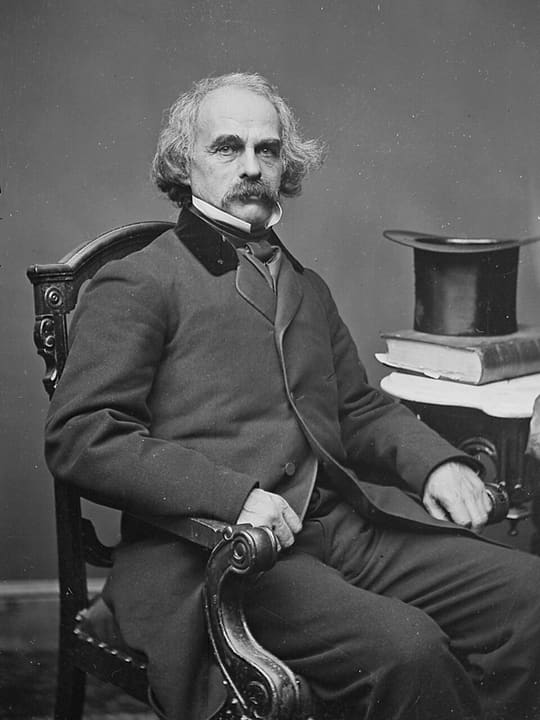
Nathaniel Hawthorne (1804-1864) was an American novelist and short-story writer whose fiction returns obsessively to Puritan New England, inherited guilt, secrecy and moral symbolism. Born in Salem, he was conscious of his family's Puritan past, including a judge in the Salem witch trials. His romances helped define American psychological and historical fiction.
“Hope spiritualizes the earth; Hope makes it always new; and, even in the earth's best and brightest aspect, Hope shows it to be only the shadow of an infinite bliss hereafter.”
“every human being who suffers any thing evil to get into his nature, or to remain there, is a kind of Minotaur, an enemy of his fellow-creatures, and separated from all good companionship, as this poor monster was.”
“Before this ugly edifice, and between it and the wheel-track of the street, was a grass-plot, much overgrown with burdock, pigweed, apple-peru, and such unsightly vegetation”
The Scarlet Letter is set in seventeenth-century Puritan Boston but begins with a nineteenth-century frame, The Custom-House, in which a narrator claims to discover an embroidered letter A and the story of Hester Prynne. Hester appears on the scaffold with her infant Pearl, condemned to wear the scarlet letter for adultery while refusing to name the child's father.
A Wonder-Book for Girls and Boys is Nathaniel Hawthorne's first book of Greek myths retold for children. Six stories are set inside a frame: Eustace Bright, an eighteen-year-old Williams College student on vacation, tells them to a crowd of children staying at Tanglewood, a country house in the Berkshires, whom Hawthorne gives flower and plant names such as Primrose, Periwinkle, Sweet Fern, Dandelion, Squash-Blossom and Buttercup.
Tanglewood Tales is Nathaniel Hawthorne's second book of Greek myths retold for children, a sequel to A Wonder-Book for Girls and Boys. In a short introduction called The Wayside, Hawthorne pretends that the stories were written by his young friend Eustace Bright, a Williams College student who had told the first set to a group of children at Tanglewood in the Berkshires; Eustace visits Hawthorne's snowy Concord hillside with six new stories, and Hawthorne agrees to act as editor.