Work record
A Wonder-Book for Girls and Boys
1851 · 19th Century · Collection · English
Abstract
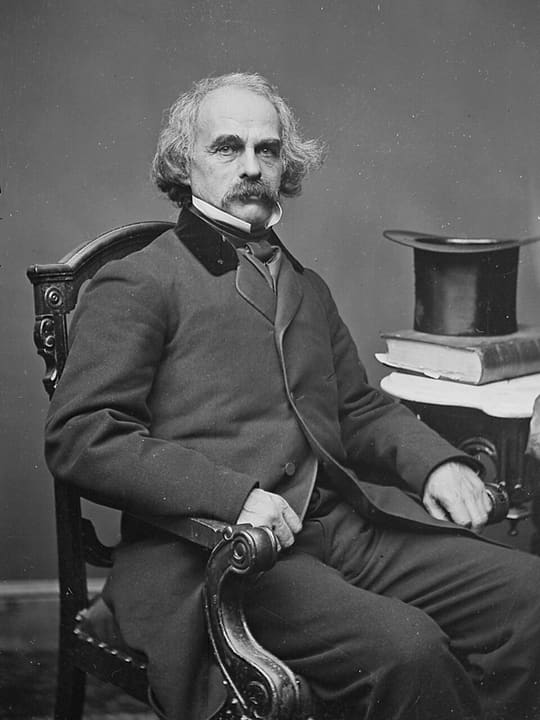
Background. Living in a rented red cottage at Lenox, Hawthorne spent the warm months of 1851 recasting classical fables for young American readers. He attributed them to a fictional college youth and placed the storytelling at a Berkshire country house he called Tanglewood.
Content. Perseus wins the Gorgon's head with borrowed wings and helmet; a Phrygian king starves amid gold until he renounces his wish; the first children of the world loose every sorrow and then a comforter; the strongest of heroes bargains with a sky-bearing giant; two aged peasants feed disguised gods; and a youth bridles a winged horse to kill a three-headed beast.
Frame. Between stories the listeners argue, pelt their narrator with questions and change with the seasons, from autumn foliage through snow to spring on a mountaintop. A learned host complains that the versions are too Gothic, and the book ends with a joke about the author himself.
Themes. Greed undone by love, hospitality rewarded, hope surviving misfortune, and the trust of children set against grown-up doubt. Hawthorne repeatedly interrupts the action to address his small hearers directly, drawing a plain moral without stopping the fun.
Significance. With its 1853 sequel, the collection became a standard first meeting with Greek myth for American families and attracted illustrators from Hammatt Billings to Walter Crane.
Main characters
- Eustace Bright: Student narrator who spins the myths for the Tanglewood children
- Perseus: Son of Danaë, sent to bring back Medusa's head
- Quicksilver: Playful Mercury, guide and guest in several tales
- Midas: Gold-loving king cured of his wish
- Marygold: His daughter, turned to a statue and restored
- Pandora: Curious child who opens the forbidden box
- Hercules: Seeker of the Hesperides' apples who briefly carries the sky
- Baucis and Philemon: Aged hosts rewarded for kindness to disguised gods
- Bellerophon: Patient rider of Pegasus and slayer of the Chimæra

Summary
A Wonder-Book for Girls and Boys is Nathaniel Hawthorne's first book of Greek myths retold for children. Six stories are set inside a frame: Eustace Bright, an eighteen-year-old Williams College student on vacation, tells them to a crowd of children staying at Tanglewood, a country house in the Berkshires, whom Hawthorne gives flower and plant names such as Primrose, Periwinkle, Sweet Fern, Dandelion, Squash-Blossom and Buttercup. Each tale has an introductory scene and an after-the-story scene, and the frame moves through the year from autumn on the Tanglewood porch, to a winter play-room and fireside, to a spring hillside and the bare summit of a hill. In The Gorgon's Head, Perseus is sent by the scheming King Polydectes to fetch the head of Medusa; guided by the merry traveller Quicksilver and his wise unseen sister, he tricks the Three Gray Women, called Scarecrow, Nightmare and Shakejoint, out of their single eye, borrows winged slippers and a helmet of invisibility from the Nymphs, takes the head, and turns the king and his courtiers to stone. In The Golden Touch, King Midas is granted his wish that everything he touches shall become gold, until his breakfast turns to metal and his little daughter Marygold becomes a golden statue when he kisses her; washed in the river, he learns that bread, water and his child are worth more than all the gold on earth. The Paradise of Children tells how the child Pandora, living with the boy Epimetheus in a world without trouble, opens a mysterious box and releases the Troubles, until a small winged spirit called Hope flies out to comfort them. In The Three Golden Apples, Hercules wrestles the shape-changing Old Man of the Sea, sails in a great golden cup, and persuades the giant Atlas to fetch the apples of the Hesperides, then tricks him into taking back the sky. The Miraculous Pitcher tells how the poor old couple Baucis and Philemon welcome two strangers whom their churlish village has mocked; their milk pitcher never empties, the village sinks beneath a lake, and the couple are turned at last into an oak and a linden whose branches embrace. In The Chimæra, Bellerophon waits at the Fountain of Pirene, trusting a child who has seen the winged horse Pegasus, bridles him, and rides to destroy the three-headed Chimæra of Lycia. In the frame, Mr. Pringle, the scholarly owner of Tanglewood, finds Eustace's free handling of the myths too Gothic. Hawthorne's preface is dated Lenox, July 15, 1851, and the book was published that year in Boston by Ticknor, Reed and Fields. The library text is the Houghton Mifflin edition with Walter Crane's designs, which are not reproduced.
Virtues in this work
- Charity: Baucis and Philemon give their last bread and milk to two ragged strangers whom the whole village has mocked.
- Temperance: Midas learns, when his breakfast turns to gold, that bread and water matter more than riches, and he washes away the Golden Touch.
- Hope: Hope flies out of Pandora's box last and promises to stay with mankind as long as they live in the world.
- Fortitude: Bellerophon waits patiently day after day at the Fountain of Pirene before he can bridle Pegasus and face the Chimæra.
- Friendship: The little boy at the fountain keeps faith with Bellerophon, and the hero says the child's faith won the victory.
Plot or Argument
- Tanglewood Porch: The Gorgon's Head
On an autumn morning Eustace tells the children how Perseus, aided by Quicksilver, steals the Gray Women's eye, wins the Nymphs' gifts, beheads Medusa, and returns to petrify Polydectes.
- Shadow Brook: The Golden Touch
Beside a brook Eustace tells of Midas, whose wish turns food, roses and finally Marygold to gold, and who gladly washes the gift away in the river.
- Tanglewood Play-Room: The Paradise of Children
Snowbound indoors, the children hear how Pandora's curiosity lets the Troubles out of the box and how Hope comes out last to stay with mankind.
- Tanglewood Fireside: The Three Golden Apples
Before the fire, with Mr. Pringle listening, Eustace tells how Hercules reaches Atlas at the edge of the world and outwits the giant who wants to leave him holding the sky.
- The Hill-Side: The Miraculous Pitcher
In spring Eustace tells of Baucis and Philemon, whose kindness to two strangers fills their pitcher with endless milk while their unkind village is drowned.
- Bald Summit: The Chimæra
On a hilltop looking toward the Taconic hills and the Catskills, the last tale follows Bellerophon, Pegasus and a faithful child to the slaying of the Chimæra; Eustace then jokes about the neighbor in the red house who writes books.
Characters
- Eustace Bright, storyteller of the frame
A cheerful Williams College student who tells the old myths in his own lively way to the children at Tanglewood.
- Primrose, eldest of the children
A saucy, clever girl who teases Eustace and crowns him with a laurel wreath at the end.
- Mr. Pringle, owner of Tanglewood
A learned gentleman who listens to one of Eustace's tales and gently objects that it is not classical enough.
- Perseus, hero of The Gorgon's Head
A brave young man sent to fetch Medusa's head, who succeeds by obeying his divine helpers exactly.
- Quicksilver, divine helper
Hawthorne's merry name for Mercury, who appears with a twisted staff in four of the tales.
- King Midas, hero of The Golden Touch
A king who loves gold more than anything except, as he discovers too late, his daughter.
- Marygold, Midas's daughter
A loving little girl who becomes a golden statue at her father's kiss and is restored by river water.
- Pandora, heroine of The Paradise of Children
A curious child who cannot leave the mysterious box alone.
- Epimetheus, Pandora's playmate
The boy in whose cottage the box is left, who shares the blame for opening it.
- Hercules, hero of The Three Golden Apples
A strong, good-humored hero who seeks the golden apples and outwits Atlas.
- Atlas, giant
The giant who holds up the sky and tries to leave Hercules with the burden.
- Baucis and Philemon, old couple
Poor, kindly villagers who share their little food with strangers and are rewarded.
- Bellerophon, hero of The Chimæra
A young man who waits patiently at a fountain to tame Pegasus and fight the Chimæra.
- Pegasus, winged horse
The wild, beautiful steed whom Bellerophon bridles and finally sets free.
Lessons
What is truly precious
Midas wins the power to turn everything into gold and nearly starves, then loses his daughter to his own touch. When the stranger asks him to choose between the Golden Touch and a cup of water, a crust of bread or Marygold, he chooses the ordinary things every time. Hawthorne teaches children that the common gifts of daily life are worth more than riches.
- What happens when Midas tries to eat his breakfast?
- Why does Midas say that a piece of bread is worth all the gold on earth?
- What would you have chosen if the stranger had offered you the Golden Touch?
Hope after trouble
Pandora's curiosity lets the Troubles out into the world, and Hawthorne does not pretend they ever went back into the box. But Hope flies out last and promises to stay as long as people live, and the storyteller says he is almost glad Pandora peeped in. The tale shows that sorrow is real, and so is the hope that outlasts it.
- Why does Pandora want so badly to open the box?
- What does Hope promise Pandora and Epimetheus?
- Hope says she is made of tears as well as smiles. What do you think that means?
Welcoming the stranger
The villagers set their dogs and children on two ragged travellers, while Baucis and Philemon give them their best seat and their last bread and milk. The guests turn out to be gods; the village becomes a lake, and the old couple's cottage becomes a palace of welcome. The story honors hospitality to people who seem to have nothing to give back.
- How do the villagers treat the two travellers, and how do Baucis and Philemon treat them?
- What is strange about the milk pitcher?
- Why do you think the old couple are turned into trees that grow together?
Faith and patience
Bellerophon waits day after day at the Fountain of Pirene while grown-ups tell him Pegasus does not exist. Only a small child believes him and keeps watch beside him, and in the end Bellerophon says the child's faith won the victory. Patience and trust are shown as a kind of courage.
- Who in the story believes that Pegasus is real, and who does not?
- How does Bellerophon finally catch Pegasus?
- Why does Bellerophon give Pegasus his freedom at the end?
Context
In 1851 American children generally met the Greek myths through Latin schoolbooks, classical dictionaries and handbooks. Hawthorne set out to tell them as fireside stories for American boys and girls, using the Latin names then usual (Jupiter, Mercury, Hercules) and inventing homely touches such as the name Quicksilver, Midas's daughter Marygold and the Gray Women called Scarecrow, Nightmare and Shakejoint. His preface admits that he has shaped the old fables anew and given them a Gothic or romantic guise.
Composition
Hawthorne wrote the book at Lenox, Massachusetts, where his family rented a small red house; the preface is dated Lenox, July 15, 1851, and he describes it as a task fit for hot weather. The Tanglewood frame draws on the surrounding Berkshire scenery, with Monument Mountain, the Taconic hills and Shadow Brook named in the text. At the end Eustace jokes about the silent man in the red house and hopes the publisher J. T. Fields will issue his stories through Ticknor and Co. with pictures by Billings, which is what happened: Ticknor, Reed and Fields of Boston published the book in 1851 with illustrations by Hammatt Billings.
Reception
A Wonder-Book succeeded well enough that Hawthorne wrote a sequel, Tanglewood Tales (1853), and the two volumes remained standard introductions to Greek myth for American children for generations. Later illustrated editions included Houghton Mifflin's 1892 edition with sixty designs by Walter Crane, which is the basis of the library text. Hawthorne himself anticipates scholarly objections through Mr. Pringle, who calls Eustace's versions Gothic.
Comparisons
- tanglewood-tales
Hawthorne's sequel continues the fiction of Eustace Bright as author but drops the Tanglewood interludes; together the two books cover twelve myths, from Perseus and Midas here to Theseus, Proserpina and Jason there.
- kingsley-the-heroes
Kingsley retold Perseus for his own children five years later in a far more solemn, Homeric style; comparing the two Perseus stories shows Hawthorne's comic Gray Women against Kingsley's reverent account of Athene's charge.
- metamorphoses
Ovid is the main ancient source for Midas and for Baucis and Philemon; Hawthorne invents Marygold and turns Ovid's brief tale of the old couple into a full story of village unkindness and divine welcome.
- bulfinch-age-of-fable
Bulfinch, writing four years later, tells the same myths compactly and closely after the ancient poets for adult readers, while Hawthorne expands and reshapes them for children; the two versions of Baucis and Philemon make a clear pair.
- the-scarlet-letter
Hawthorne's adult masterpiece of the year before is preoccupied with sin and concealment; A Wonder-Book shows the same author writing in a sunny, playful voice, while still drawing moral lessons from his stories.
Quotes
Frequently cited
“Children possess an unestimated sensibility to whatever is deep or high, in imagination or feeling, so long as it is simple likewise.”
Frequently cited
“Hope spiritualizes the earth; Hope makes it always new; and, even in the earth's best and brightest aspect, Hope shows it to be only the shadow of an infinite bliss hereafter.”
“the commonest things, such as lie within everybody's grasp, are more valuable than the riches which so many mortals sigh and struggle after.”
“glad as my nature is, I am partly made of tears as well as smiles.”
“By the time you have stood there as long as I did, you will begin to learn patience!”
“Providence put me here, I hope, among other reasons, in order that I may make you what amends I can for the inhospitality of my neighbors.”
“But if thy faith had not helped me, I should never have waited for Pegasus, and never have gone up above the clouds, and never have conquered the terrible Chimæra.”
For Students
A reading companion for classical Christian high school students. See the student guide.
Reading Guide
Watch for
- The scenes before and after each story, when Eustace and the Tanglewood children talk about what they have heard.
- Quicksilver and his twisted staff: notice in which stories he turns up and how he helps.
- Every thing Midas touches on the morning his wish comes true, from the bedpost to his breakfast to Marygold.
- Who believes in Pegasus at the Fountain of Pirene, and who laughs at the idea.
- The seasons in the frame: autumn at the start, snow in the middle, spring on the hillside at the end.
Key terms and names
- Tanglewood
- The country house in the Berkshire hills where Eustace tells his stories to the children.
- Gorgon
- One of three monstrous sisters with snakes for hair; anyone who looks at Medusa's face is turned to stone.
- The Golden Touch
- The gift Midas asks for, which turns everything he touches into gold, even his food and his daughter.
- Quicksilver
- Hawthorne's name for the messenger god Mercury, a quick, joking traveller who helps the heroes.
- Hesperides
- The maidens who guard the tree of golden apples at the far western edge of the world.
- Chimæra
- A fire-breathing monster with three heads, a lion's, a goat's and a snake's, that ravages Lycia.
Seminar Questions
- Comprehension How does Perseus get the Gray Women to tell him where the Nymphs live?
- Comprehension What happens to the village after Baucis and Philemon welcome the two travellers?
- Comprehension What comes out of Pandora's box last, and what does it promise?
- Interpretation Midas says gold is not everything once he has lost Marygold. Why does it take losing her for him to understand?
- Interpretation Why do you think the child at the fountain sees Pegasus's reflection when the grown-ups do not?
- Interpretation Mr. Pringle does not like the way Eustace tells the myths. Do you think Eustace should change his stories to please him?
- Big Question Is it ever good to be curious, like Pandora, or is curiosity always dangerous?
Faith Connections
- Hebrews 13:2 (Scripture)
Be not forgetful to entertain strangers: for thereby some have entertained angels unawares. Baucis and Philemon welcome two ragged travellers who turn out to be gods, a pagan story that Christian readers have long set beside this verse and Abraham's welcome of three visitors in Genesis 18.
- Luke 12:15 (Scripture)
Jesus warns that a man's life does not consist in the abundance of the things he possesses. Midas learns the same thing at breakfast, when all his gold cannot buy him a mouthful of bread.
- Romans 8:24-25 (Scripture)
Paul says we are saved by hope and wait for what we do not see with patience. Hawthorne's Hope speaks of something good and beautiful still to be given hereafter, and Bellerophon waits patiently for a horse he has never seen.
- Basil the Great, Address to Young Men on the Right Use of Greek Literature (Church Fathers)
Basil taught Christian students to take from the pagan stories whatever leads to virtue. Hawthorne, writing for children, likewise draws from the myths lessons about greed, kindness, hope and patience.
Logic and Rhetoric
Central argument: Hawthorne's preface argues that the myths belong to no single age, so every age may retell them in its own manner and with its own morality; children respond to what is deep and high if it is simple; therefore the myths may be reshaped freely for children without being written down to them.
Rhetorical device: anaphora. In The Chimæra, Bellerophon thanks the child with a sentence that repeats the words and never have three times, piling up everything the child's faith made possible.
Debate: Resolved: that Pandora's opening of the box did more good than harm, since it let Hope into the world.
Memory Work
glad as my nature is, I am partly made of tears as well as smiles.
the commonest things, such as lie within everybody's grasp, are more valuable than the riches which so many mortals sigh and struggle after.
Writing Prompts
Essay: Choose the hero you admire most in the book, such as Perseus, Hercules or Bellerophon, and explain in three reasons from the story why he deserves to be called a hero.
Comparison with Tanglewood Tales: Compare the Gorgon's Head in this book with the Minotaur in Tanglewood Tales. How are Perseus and Theseus alike as young heroes, and who helps each of them succeed?
Medical Lens
Medicine is incidental. The Golden Touch is a fable of hunger: Midas cannot eat or drink because every mouthful turns to metal, and the cure is a plunge into the river and a sprinkling of water, a folk-tale purification rather than any medical treatment. The Miraculous Pitcher shows two very old, very poor people sharing scanty food, and the gods renew their age and let them grow old together as trees. The Gray Women, who share one eye between them, are comic figures of old age and blindness rather than portraits of disease. The book offers a psychiatric reader little beyond these images of want, age and restoration.
- The Golden Touch
Midas's breakfast of trout, cakes and coffee turns to gold in his mouth, and he realizes he faces starvation in the midst of riches.
- The Gorgon's Head
The Three Gray Women pass a single eye from hand to hand and are helpless while Perseus holds it.
- The Miraculous Pitcher
Baucis and Philemon share their last bread, honey and milk, and are later given renewed age as an oak and a linden.
Creative Prompts
- Classroom
Give each child a Tanglewood flower name, gather outdoors or on a porch, and let one child play Eustace Bright retelling The Golden Touch in his or her own words.
- Fiction
Write what happens the day after Marygold is changed back from gold: what does she remember, and how is her father different?
- Dialogue
Act out the scene in which Hercules tricks Atlas into taking back the sky, with one child as each character and a narrator to describe the falling stars.
- Poetry
Write a short poem that the oak and the linden whisper to travellers who rest beneath them.
- Essay
Mr. Pringle says Eustace has spoiled the classical myths. Write a letter from Eustace defending his way of telling them to children.
Further Reading
- Tanglewood Tales, Nathaniel Hawthorne
The 1853 sequel, with Theseus, the Pygmies, Cadmus, Circe, Proserpina and the Golden Fleece.
- The Heroes, Charles Kingsley
Perseus, the Argonauts and Theseus retold for children in 1856.
- Metamorphoses, Ovid
The Latin source for Midas, Baucis and Philemon, and much of Perseus.
- D'Aulaires' Book of Greek Myths, Ingri and Edgar Parin d'Aulaire
Verification notes
Story contents, the frame characters, the preface date (Lenox, July 15, 1851) and all quotations were checked by exact search against the stored Project Gutenberg #32242 text, which reproduces the Houghton Mifflin edition with Walter Crane's designs (the title page gives copyright dates of 1851, 1879, 1883 and 1892). Publication by Ticknor, Reed and Fields in 1851 with Hammatt Billings's illustrations follows the library's Tanglewood Tales record and the joke in the closing frame; web checking was not available while this record was written. Hawthorne departs freely from the ancient myths (for example, Marygold and the comic Gray Women are his inventions); the record follows his version. The Tanglewood house is treated as Hawthorne's fictional setting; its relation to the Tappan family's neighboring estate was not checked.
- Some sources give the first edition's title-page date as 1852 although the book appeared in November 1851; confirm against a bibliography.