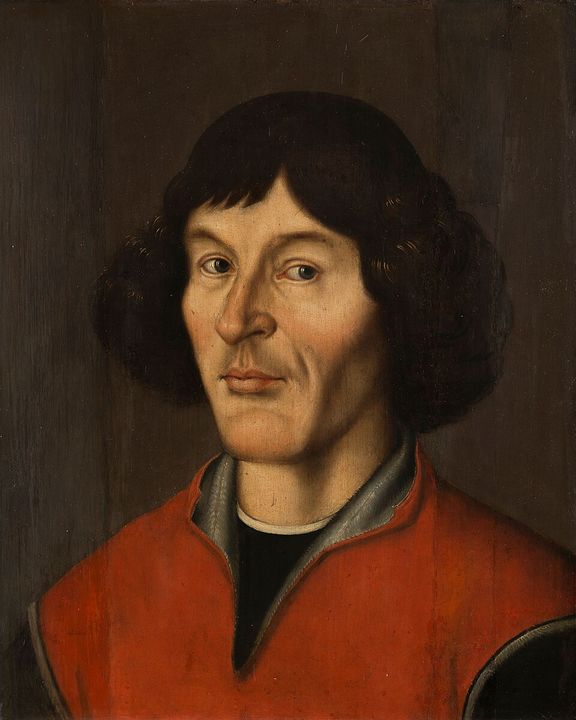
Nicolaus Copernicus (1473–1543) was born at Toruń in Royal Prussia, then under the Polish crown, and was raised after his father's death by his maternal uncle Lucas Watzenrode, later Prince-Bishop of Warmia. He studied at Kraków and then in Italy at Bologna, Padua and Ferrara, where he took a doctorate in canon law in 1503, and he also studied medicine. As a canon of the cathedral chapter of Frombork (Frauenburg) in Warmia he served as administrator, envoy and physician, wrote a treatise on the reform of the coinage, and pursued astronomy in his spare hours. He circulated a brief outline of his system, the Commentariolus, around 1510–1514, and died at Frombork in May 1543, shortly after his great book came from the press.
On the Revolutions of the Heavenly Spheres (De revolutionibus orbium coelestium) is the Latin treatise in which Nicolaus Copernicus, a canon of the cathedral of Frombork in Warmia, set the sun near the centre of the universe and made the earth a planet that turns daily on its axis and travels yearly around the sun. It was printed at Nuremberg by Johannes Petreius in 1543.