Work record
On the Revolutions of the Heavenly Spheres
1543 · Renaissance Early Modern · Essays · Latin
Abstract
Background. Astronomy since antiquity had placed a stationary earth at the centre, with planets carried on combinations of circles following Ptolemy. A cathedral canon in Warmia, working mostly alone, sought an arrangement that would honour uniform circular motion and give the planets a fixed order. He also hoped to help the calendar reform then under discussion in Rome.
Content. Opening books argue that the earth spins daily, circles the sun yearly and is one planet among six. The planets' backward loops become a side effect of our own travel. Later books rebuild the theories of the sun, moon and planets with tables, and catalogue the fixed stars.
Prefaces. Osiander's unsigned note recommends the hypotheses only as aids to computation. The author's address to Paul III recounts his hesitation, his friends' encouragement and the Greek thinkers who had let the earth move.
Availability. The library holds no text of this work. The familiar English versions by Wallis and Rosen are still in copyright, and no public-domain translation has been confirmed, so this entry is limited to description and a study guide.
Significance. Its calculations were adopted quickly and its cosmology slowly, amid objections from physics and from Scripture. Kepler, Galileo and Newton built on it, and the phrase Copernican revolution now names any reversal of perspective.
Key figures
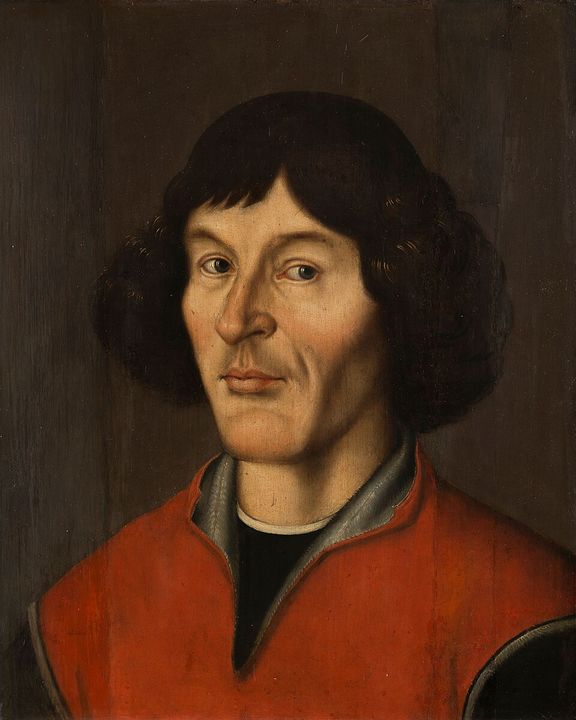
- Nicolaus Copernicus: Canon of Frombork, astronomer and physician
- Pope Paul III: Dedicatee of the work
- Georg Joachim Rheticus: Wittenberg mathematician who persuaded Copernicus to publish
- Andreas Osiander: Lutheran theologian who oversaw printing and added the unsigned note to the reader
- Tiedemann Giese: Bishop of Chełmno, friend who urged publication
- Claudius Ptolemy: Alexandrian astronomer whose Almagest Copernicus answers and imitates

Summary
On the Revolutions of the Heavenly Spheres (De revolutionibus orbium coelestium) is the Latin treatise in which Nicolaus Copernicus, a canon of the cathedral of Frombork in Warmia, set the sun near the centre of the universe and made the earth a planet that turns daily on its axis and travels yearly around the sun. It was printed at Nuremberg by Johannes Petreius in 1543. The library does not include the full text: no public-domain English translation has been identified, since the standard versions by Charles Glenn Wallis (1939, reprinted 1952) and Edward Rosen (1978) remain under copyright. This record therefore offers a summary and study guide only, with no quotations. The printed book opens with an unsigned note to the reader, written by the Lutheran theologian Andreas Osiander, who saw the book through the press. It tells readers that astronomical hypotheses need not be true or even probable, only adequate for calculation. Copernicus's own preface follows, a dedication to Pope Paul III. In it he explains that he long hesitated to publish an opinion that would seem absurd, that his friends Cardinal Nikolaus von Schönberg and Bishop Tiedemann Giese urged him on, that the disagreements among astronomers led him to search the ancient authors for other views, and that he found Greek writers who had let the earth move. He writes that mathematics is written for mathematicians. The work has six books. Book I argues that the universe and the earth are spherical, that the motion of the earth is no more absurd than that of the heavens, and sets out the order of the planets around the sun, with Mercury and Venus closest and Saturn farthest, explaining their apparent backward loops as effects of the earth's own motion. It closes with chapters of plane and spherical trigonometry. Book II treats the circles of the celestial sphere and includes a catalogue of more than a thousand stars. Book III treats precession and the length of the year, Book IV the moon, and Books V and VI the planets in longitude and latitude. Copernicus kept uniform circular motion and used small circles in place of Ptolemy's equant, so his system still required many circles. The book's young advocate Georg Joachim Rheticus had come to Frombork in 1539 and published an early account, the Narratio prima, in 1540. According to a later report, Copernicus received a printed copy on the day of his death. Erasmus Reinhold's Prussian Tables (1551) used its calculations, while Tycho Brahe, Kepler and Galileo debated its physical truth over the next century.
Virtues in this work
- Prudence: The dedication explains that Copernicus withheld his work for many years, weighing the ridicule it might bring, until competent friends urged its publication.
- Friendship: Copernicus credits Bishop Tiedemann Giese and Cardinal Schönberg with pressing him to publish, and Rheticus left his Wittenberg post to study with him and carry the book to press.
- Industry: Books II to VI work out the motions of sun, moon and planets with new tables and a star catalogue, the product of decades of observation and calculation.
- Humility: Copernicus submits his work to the judgment of the Pope and of learned mathematicians rather than claiming final authority.
Plot or Argument
- Osiander's note to the reader
An anonymous preface, later shown by Kepler to be by Andreas Osiander, presents the work's hypotheses as calculating devices that need not describe the real heavens.
- Dedication to Pope Paul III
Copernicus explains his long hesitation, the encouragement of Schönberg and Giese, the disagreements of astronomers that drove his search, and the ancient precedents for a moving earth. He submits the work to the Pope's judgment and to that of competent mathematicians.
- Book I: the cosmological argument
The universe and the earth are spherical; the heavenly motions are circular and uniform; the earth's rotation and revolution are defended against the arguments of Aristotle and Ptolemy; the planets are ordered by their periods around the sun; and the retrograde motions of the planets are explained by the earth's motion. Closing chapters supply trigonometry.
- Book II: the sphere and the stars
Copernicus explains the circles of the celestial sphere, risings and settings, and the variation of day length, and gives a catalogue of fixed stars adapted from Ptolemy's.
- Book III: precession and the sun
He analyses the precession of the equinoxes and the length of the year, and works out the apparent motion of the sun as the earth's annual motion.
- Book IV: the moon
A new lunar model, built of combinations of circles, avoids the great variation in the moon's distance that Ptolemy's model required, and treats eclipses.
- Books V–VI: the planets
The motions of Saturn, Jupiter, Mars, Venus and Mercury are worked out in longitude and then in latitude, with tables for computing their positions.
Lessons
A simpler order can be a reason to believe
Copernicus's system did not at first predict planetary positions much better than Ptolemy's, and it still used many circles. Its appeal lay in the way it fixed the order and distances of the planets and explained their backward loops by a single cause, the earth's motion. The book teaches that coherence and explanatory unity are themselves forms of evidence, though not final proof.
- How does the motion of the earth explain why Mars sometimes appears to move backward against the stars?
- Why might an astronomer of 1543 have preferred Ptolemy's system even after reading Copernicus?
- Is a more unified explanation more likely to be true?
Calculating device or true description
Osiander's note says that astronomical hypotheses need only save the appearances, while Copernicus's own dedication treats the earth's motion as real. The two prefaces set out a question that runs through the history of science: whether a successful theory describes the world or only orders our observations.
- Why might Osiander have thought his note would help the book find readers?
- Do you think Copernicus himself would have agreed with it? What in his dedication suggests an answer?
Recovering the ancients to go beyond them
Copernicus searched Cicero, Plutarch and other ancient writers for anyone who had moved the earth, and found Philolaus, Heraclides and Ecphantus. Like many Renaissance scholars he presented his innovation as the recovery of an older wisdom, and then worked it out with mathematical care no ancient had given it.
- Why would Copernicus want ancient precedents for a new idea?
- In what ways is his book a continuation of Ptolemy's Almagest as well as a challenge to it?
Patience in publishing
Copernicus outlined his system decades before he printed it and published only when friends pressed him. His dedication reveals both caution about ridicule and a wish that competent judges, not the merely clever, should weigh the work.
- What reasons does Copernicus give for his long delay?
- When is caution in announcing a new idea wise, and when does it become a fault?
Context
Since the second century, astronomy had followed Ptolemy's Almagest, in which the earth stands still at the centre and each planet moves on circles combined with epicycles, eccentrics and the equant. Medieval Islamic astronomers at Maragha and Damascus, among them al-Tusi and Ibn al-Shatir, had designed alternatives to the equant, and some of their geometric devices closely resemble those Copernicus used. The Church's need for an accurate calendar, discussed at the Fifth Lateran Council (1512–1517), gave astronomical reform practical urgency.
Composition
Copernicus worked on the book for decades at Frombork, making his own observations with simple instruments, and his autograph manuscript survives in the Jagiellonian Library at Kraków. Rheticus, a young mathematics professor from Wittenberg, persuaded him to publish and carried the manuscript to Nuremberg; when Rheticus left for Leipzig, Osiander oversaw the printing and added the unsigned note to the reader.
Reception
Astronomers valued the book's calculations, and Reinhold's Prussian Tables made them widely used. Many readers, Catholic and Protestant, regarded the moving earth as contrary to physics and to the plain sense of Scripture, and others treated it as a useful hypothesis. Kepler identified Osiander as the author of the note in 1609. In 1616 the Congregation of the Index suspended the book until corrected, and in 1620 it issued a short list of corrections presenting the earth's motion as hypothesis; the prohibition of books teaching the earth's motion was eased in 1758 and the book left the Index in 1835. Owen Gingerich's census of surviving first and second editions shows that it was read and annotated widely.
Comparisons
- ptolemy-almagest
Copernicus modelled his book's structure, mathematical method and star catalogue on the Almagest, while moving the centre of the system from the earth to near the sun and dropping the equant.
- kepler-new-astronomy-and-harmony-of-the-world
Kepler, a convinced Copernican, replaced Copernicus's circles with ellipses and exposed Osiander as the author of the note to the reader.
- galileo-selected-writings
Galileo's telescopic discoveries and his Letter to the Grand Duchess Christina carried the Copernican question into the debate over Scripture and natural philosophy.
- principia
Newton's laws of motion and gravitation supplied the physical explanation of planetary motion around the sun that Copernicus lacked.
- duhem-the-aim-and-structure-of-physical-theory
Duhem, who also wrote on the ancient idea of saving the appearances, defended a view of physical theory close to the one expressed in Osiander's note.
- kuhn-the-structure-of-scientific-revolutions
Kuhn, author of an earlier study of the Copernican revolution, drew on it as a model of how one scientific framework replaces another.
Quotes
For Students
A reading companion for classical Christian high school students. See the student guide.
Reading Guide
Watch for
- This library record has no full text: no public-domain English translation has been identified, and the standard translations by Wallis and Rosen are under copyright. Read the book in a library or classroom copy alongside this guide.
- The two prefaces. Compare Osiander's unsigned note, which calls the hypotheses mere tools, with Copernicus's dedication to Pope Paul III.
- Book I, chapter 10, on the order of the heavenly spheres, where the sun is placed at the centre and the planets are ordered by their periods.
- Copernicus's answers in Book I to the ancient objections that a moving earth would leave clouds, birds and falling objects behind.
- How much of Ptolemy remains: the uniform circles, the star catalogue and the mathematical methods.
Key terms and names
- Heliocentric
- Sun-centred. In Copernicus's system the sun sits near the centre and the earth is one of the planets moving around it.
- Geocentric
- Earth-centred. The Ptolemaic and Aristotelian systems placed a motionless earth at the centre of the universe.
- Epicycle
- A small circle whose centre moves along a larger circle. Both Ptolemy and Copernicus used epicycles to match observed planetary positions.
- Equant
- A point off the centre of a planet's circle from which its motion appears uniform. Copernicus rejected it as a violation of truly uniform circular motion.
- Retrograde motion
- The apparent backward loop of a planet against the stars. Copernicus explains it as the effect of the earth overtaking or being overtaken by another planet.
- Precession of the equinoxes
- The slow shift of the equinox points against the stars, which Copernicus treats in Book III as a motion of the earth's axis.
- Saving the appearances
- The ancient goal of devising geometrical models that match what is observed, whether or not they describe physical reality. Osiander's note appeals to this tradition.
Seminar Questions
- Comprehension What are the three motions Copernicus assigns to the earth, and which observed facts does each explain?
- Comprehension In the dedication, what reasons does Copernicus give for searching for a new arrangement of the heavens, and which ancient authors did he find?
- Comprehension What does Osiander's note to the reader claim about astronomical hypotheses?
- Interpretation Why might Copernicus have dedicated his book to the Pope? What does he hope the dedication will accomplish?
- Interpretation Copernicus says mathematics is written for mathematicians. Why does he limit the audience he wants to judge his work?
- Interpretation Copernicus kept uniform circular motion while giving up the motionless earth. What does this tell you about which ancient principles he thought were essential?
- Big Question When a new scientific idea seems to conflict with the plain sense of Scripture, how should Christians weigh the two? Consider the ways Augustine, Copernicus's readers and Galileo approached the question.
Faith Connections
- Psalm 19:1-6 (Scripture)
'The heavens declare the glory of God.' The psalm describes the sun going forth like a bridegroom and running its course; it was among the passages early readers cited in debates over the moving earth, and also a text astronomers of every view read as praise of the Creator's order.
- Joshua 10:12-13 (Scripture)
The sun standing still at Gibeon was the passage most often raised against the earth's motion in the sixteenth and seventeenth centuries, and its interpretation became central to the debate.
- Augustine, The Literal Meaning of Genesis I.19 (Church Fathers)
Augustine warns Christians against making confident claims about the natural world that knowledgeable unbelievers can see are mistaken, lest Scripture be brought into disrepute. Later writers on the Copernican question, including Galileo, appealed to this counsel.
- Lactantius, Divine Institutes III.24 (Great Conversation)
In the dedication Copernicus recalls that Lactantius had mocked those who said the earth is round, as a reminder that learned men can speak foolishly about matters outside their competence.
Logic and Rhetoric
Central argument: The astronomers' systems disagree among themselves and use devices such as the equant that break the principle of uniform circular motion; if the earth is given a daily rotation and a yearly revolution around the sun, the planets fall into a single order fixed by their periods, their backward motions follow from the earth's own motion, and their distances can be calculated; therefore the sun-centred arrangement better reveals the true structure of the universe.
Rhetorical device: appeal to authority (ancient precedent). In the dedication Copernicus disarms the charge of novelty by citing Cicero on Hicetas and Plutarch on Philolaus, Heraclides and Ecphantus, presenting the moving earth as an ancient opinion revived rather than a reckless invention.
Debate: Resolved: A scientific theory that explains more with fewer assumptions should be preferred even before it predicts more accurately.
Writing Prompts
Essay: Osiander's note says astronomical hypotheses need not be true; Copernicus's dedication treats the earth's motion as real. Explain both positions and argue which better describes what astronomy, or any science, should aim at.
Comparison with Almagest: Compare the opening books of the Almagest and De revolutionibus. Which arguments for a motionless earth does Ptolemy give, and how does Copernicus answer each one?
Medical Lens
The book itself has no medical content. Copernicus studied medicine at Padua and served as physician to his uncle the bishop, to fellow canons and to others in Warmia, so he belongs to the long line of physicians who also pursued astronomy. In his era astronomy and medicine were closely linked through astrological medicine and the timing of treatments, though De revolutionibus is purely mathematical astronomy.
Creative Prompts
- Classroom
Act out retrograde motion: one student walks a small inner circle as the earth while another walks a larger outer circle as Mars, and a third records the direction in which the earth student sees Mars against a wall of 'fixed stars'.
- Essay
Write the letter Tiedemann Giese might have sent Copernicus urging him to publish, using the reasons the dedication says his friends gave.
- Classroom
Put Osiander's note and Copernicus's dedication on trial: one team argues that the book should be read as a calculating device, the other that it claims to describe the real heavens.
Further Reading
- The Copernican Revolution, Thomas S. Kuhn
- The Book Nobody Read, Owen Gingerich
- A More Perfect Heaven, Dava Sobel
- Three Copernican Treatises, Edward Rosen (trans.)
Translations of the Commentariolus, Rheticus's Narratio prima and a letter on Werner's astronomy.
- The Sleepwalkers, Arthur Koestler
Verification notes
No full text is stored and no quotations are given, per the library's rule that nothing be quoted unless verified word for word in a public-domain English source; the Wallis (1939/1952) and Rosen (1978) translations are under copyright. The summary and guide describe the work in paraphrase from standard accounts of its structure, prefaces and publication. The contents of the dedication (Schönberg, Giese, Lactantius, Cicero and Plutarch, 'mathematics is written for mathematicians') and the book divisions are well attested. The report that Copernicus received a printed copy on his deathbed comes from a letter of Tiedemann Giese and is given as a report. Dates for the Index (1616 suspension, 1620 corrections, 1758 easing, 1835 removal) follow standard histories.
- Chapter numbers cited in the reading guide (Book I, ch. 10 on the order of the spheres) against a full translation.
- The number of stars in the Book II catalogue (usually given as 1,024).
- The dating of the Commentariolus (c. 1510–1514).
- A public-domain English translation, if one is identified, before adding any quotations.