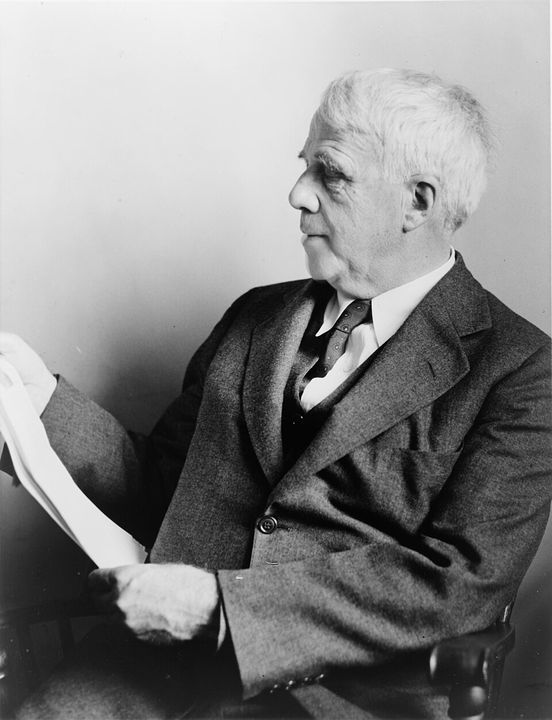
Robert Lee Frost (1874-1963) was born in San Francisco and raised from the age of eleven in Lawrence, Massachusetts. He farmed at Derry, New Hampshire, from 1900 and taught at Pinkerton Academy before taking his family to England in 1912, where his first two books were published in London. Back in New England from 1915, he farmed, taught at Amherst and other colleges, and received the Pulitzer Prize for Poetry four times.
“I shall be telling this with a sigh Somewhere ages and ages hence: Two roads diverged in a wood, and I-- I took the one less traveled by, And that has made all the difference.”
This volume joins Robert Frost's first three books of poems, all written about New England farm country and published between 1913 and 1916. A Boy's Will (London, 1913) is a book of short lyrics arranged in three parts, and the library text keeps the original contents page, where each title is followed by an italic gloss in the third person describing what the youth of the book is feeling: in Into My Own he imagines stealing away into dark trees and believes those who follow will find him only more sure of all he thought was true; in Storm Fear he is afraid of his own isolation; in The Tuft of Flowers a mower finds a patch of butterfly weed spared by the man who scythed the field before him and decides that men work together whether they work together or apart; and in Mowing a scythe whispers in the hay while the speaker concludes that fact is the sweetest dream labor knows.
1915; collected 1916 · Early 20th Century · Poetry
The Road Not Taken is a twenty-line lyric in four five-line stanzas, first printed in The Atlantic Monthly in August 1915 and placed by Frost, in italics, at the head of his third book, Mountain Interval (1916). It is among the most quoted American poems and among the most often misread.