Work record
The Road Not Taken
1915; collected 1916 · Early 20th Century · Poetry · English
Abstract
Background. Frost drafted these stanzas during his English years, after rambles in Gloucestershire with Edward Thomas, whose habit of lamenting every route they chose amused him. The Atlantic printed it on his return home, and Henry Holt set it first in his next volume.
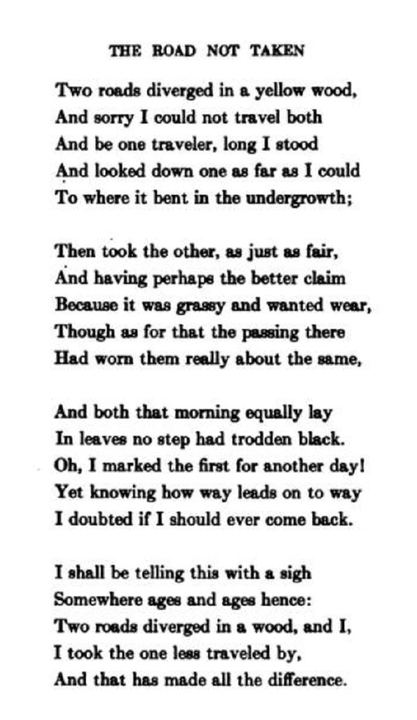
Content. Halted where a path splits beneath golden foliage, the walker gazes along one branch, then picks its twin because it looks grassier, while conceding that foot traffic had marked both equally. Fallen leaves cover each way without a footprint. Promising himself a later return, he suspects one route will lead to another and he will never come back. He then foresees an old man recounting the morning, insisting he chose the less frequented path and that it altered everything.
Form. Each stanza uses only two rhyme sounds, and conversational rhythm hides the strict pattern. A dash and a doubled pronoun near the end create a hesitation before the final claim.
Themes. Free choice, chance, regret, and the shaping of personal history through narrative drive the poem, which never settles whether its lone speaker should be trusted.
Significance. A favorite at commencements and in advertising, it is just as often cited by critics as a model of irony hidden in plain sight, and its misremembered title has entered common speech.

Summary
The Road Not Taken is a twenty-line lyric in four five-line stanzas, first printed in The Atlantic Monthly in August 1915 and placed by Frost, in italics, at the head of his third book, Mountain Interval (1916). It is among the most quoted American poems and among the most often misread. In the first stanza a traveler stands where two roads diverge in a yellow, autumn wood. Sorry that he cannot travel both and still be one traveler, he stands a long time looking down one road to where it bends into the undergrowth. In the second he takes the other, which seems just as fair and perhaps has the better claim because it is grassy and wants wear. At once he qualifies himself: the passing there had worn them really about the same. The third stanza presses the point. Both roads lay equally that morning in leaves no step had trodden black. He tells himself he will keep the first for another day, yet knows that way leads on to way and doubts he will ever come back. The final stanza moves into the future. Ages and ages hence, the traveler predicts, he will tell this story with a sigh, saying that two roads diverged and he took the one less traveled by, and that has made all the difference. The careful reader has just been told that the roads were nearly identical, so the closing claim belongs to the older self's retelling rather than to the facts of the morning. Frost wrote the poem while living in England, and he said it grew out of walks with his friend the Welsh poet Edward Thomas, who would regret whichever path they took and wish he had taken the other. Frost warned audiences that the poem was tricky. Its regular rhyme scheme (abaab), loose iambic tetrameter, and plain diction make it easy to memorize, while its irony about choice, chance, and the stories people tell about their lives keeps it open to argument.
Virtues in this work
- Prudence: The traveler stands long and looks down one road as far as he can before choosing, modeling deliberation even when the future cannot be seen.
- Humility: The poem's admission that the roads were worn really about the same quietly exposes the temptation to inflate one's own choices into heroic stories.
Plot or Argument
- The fork in the yellow wood (stanza 1)
Two roads diverge in an autumn wood. Unable to travel both, the traveler stands a long while and looks down the first as far as it can be seen, to where it bends in the undergrowth.
- The choice and its qualification (stanza 2)
He takes the other road, which seems just as fair and perhaps more inviting because it is grassy and wants wear, then admits that the two had been worn really about the same.
- The equal roads and the lost return (stanza 3)
Both roads lie under untrodden leaves that morning. He saves the first for another day, but knows how one way leads to the next and doubts he will ever come back.
- The future retelling (stanza 4)
Looking ahead ages and ages, he imagines telling the story with a sigh: he took the road less traveled, and that has made all the difference.
Characters
- The traveler, Speaker
The I of the poem, who chooses between two nearly identical roads and imagines how he will later describe the choice.
Lessons
Read what the poem says, not what it is remembered to say
Stanzas 2 and 3 state plainly that the roads were worn about the same and lay equally in leaves. The famous last lines therefore describe a future telling, not the morning's facts. Careful reading means holding the whole poem together before drawing a moral from its ending.
- Which lines in stanzas 2 and 3 undercut the idea that one road was less traveled?
- Why does the poem put its most famous claim in the future tense, with a sigh?
- Why do you think the poem is so often quoted as praise of nonconformity?
Choices close doors
The traveler is sorry he cannot be one traveler and still go both ways. He tells himself he will return, but knows how way leads on to way. The poem honors the real cost of choosing: every decision gives up a life that might have been.
- What does the traveler mean by being one traveler?
- Is keeping the first road for another day self-deception, hope, or both?
- Can a person choose well without knowing where either road leads?
The stories we tell about ourselves
The closing stanza shows a man shaping his past into a meaningful story. Frost leaves open whether the sigh is regret, contentment, or a wry awareness that the difference was made by the telling as much as by the road.
- What might the sigh in line 16 express?
- Does the choice make all the difference, or does the later retelling?
- Is it dishonest to give a past choice more meaning than it had at the time?
Context
Frost lived in England from 1912 to early 1915 and found his first real audience there. In Gloucestershire he became close friends with Edward Thomas, a critic who began writing poetry under Frost's encouragement. Their country walks gave rise to the poem, which Frost later described as a gentle joke about Thomas's habit of regretting whichever path they chose.
Composition
Frost wrote the poem in 1914-1915 and sent a draft to Thomas, who took it as a serious meditation on choice rather than a tease. It appeared in The Atlantic Monthly in August 1915, shortly after Frost's return to America, and opened Mountain Interval the next year. Thomas enlisted in 1915 and was killed at the Battle of Arras in April 1917.
Reception
The poem became one of the best-known in American literature, recited at graduations and quoted as a motto of independent choice. Frost repeatedly cautioned that it was a tricky poem, and critics from the mid-twentieth century onward have emphasized its irony. It is frequently misremembered under the title The Road Less Traveled.
Comparisons
- tennyson-ulysses
Tennyson's aging hero resolves to keep traveling toward an untraveled world, while Frost's traveler looks back on a single fork; one poem celebrates resolve, the other examines how we narrate a decision.
- the-pilgrims-progress
Bunyan's Christian must keep to the strait and narrow way and avoid the byways that tempt him, a world where the right road is clearly marked; Frost's roads are morally indistinguishable.
- if-kipling
Kipling's poem, published a few years earlier, gives confident advice about choosing and enduring, whereas Frost withholds advice and lets the reader notice the gap between choice and later story.
- tintern-abbey
Wordsworth also revisits a place in memory and reflects on how a past self differs from the present one; Frost compresses that Romantic retrospection into a prediction about a future retelling.
- frost-early-poems
The Road Not Taken opens Mountain Interval (1916), one of the three early books gathered in the library's Frost volume; beside Mending Wall, Birches and The Death of the Hired Man it shows the same plain New England speech turned toward choice, memory and neighbourliness.
Quotes
Frequently cited
“Two roads diverged in a yellow wood, And sorry I could not travel both And be one traveler, long I stood”
Frequently cited
“I shall be telling this with a sigh Somewhere ages and ages hence: Two roads diverged in a wood, and I-- I took the one less traveled by, And that has made all the difference.”
“Then took the other, as just as fair, And having perhaps the better claim, Because it was grassy and wanted wear;”
“Though as for that the passing there Had worn them really about the same,”
“Oh, I kept the first for another day! Yet knowing how way leads on to way, I doubted if I should ever come back.”
For Students
A reading companion for classical Christian high school students. See the student guide.
Reading Guide
Watch for
- The phrase be one traveler in line 3 and the regret it expresses.
- The word perhaps in line 7 and the admission in lines 9-10 that the roads were worn really about the same.
- Leaves no step had trodden black in line 12, which makes both roads equally untraveled that morning.
- The shift into the future tense at line 16 and the sigh that comes with it.
- The dash and repeated I in lines 18-19, where the speaker seems to pause before claiming the less traveled road.
Key terms and names
- Diverged
- Split off in different directions; the poem opens and nearly closes with the same image of two diverging roads.
- Wanted wear
- Lacked wear, that is, looked less used; the old sense of want as lack, not desire.
- Quintain
- A five-line stanza; each of the poem's four stanzas rhymes abaab.
- Iambic tetrameter
- A line of four iambic feet; Frost loosens it with extra unstressed syllables so the poem sounds like speech.
- Irony
- A gap between what is said and what is true; the final claim of a less traveled road follows the speaker's own admission that the roads were alike.
- Edward Thomas
- Frost's Welsh friend, a poet and critic whose indecision on country walks Frost said prompted the poem.
Seminar Questions
- Comprehension Why does the traveler stand so long at the fork in stanza 1?
- Comprehension What reasons does he give for choosing the second road, and how does he qualify them?
- Interpretation If both roads lay equally in leaves no step had trodden black, why does the speaker later say he took the one less traveled by?
- Interpretation What might the sigh in line 16 mean: regret, satisfaction, nostalgia, or something else? Support your answer from the poem.
- Interpretation Why does Frost title the poem The Road Not Taken rather than after the road the speaker chose?
- Big Question Do our choices make us who we are, or do the stories we tell about our choices do more of the work?
- Big Question How should a person live with the knowledge that every choice closes off other lives he might have lived?
Faith Connections
- Matthew 7:13-14 (Scripture)
Christ contrasts the broad way that leads to destruction with the narrow way that leads to life, a fork where the roads differ completely; Frost's poem sharpens the contrast by offering two roads with no visible difference.
- Proverbs 16:9 (Scripture)
A man's heart plans his way, but the Lord directs his steps, a word of comfort for a traveler who cannot see past the bend in the undergrowth.
- Augustine, Confessions VIII (Great Conversation)
Augustine recounts the long struggle and the moment in the Milan garden that turned his life, a story of a choice whose meaning he understood only in looking back, as Frost's speaker expects to do.
Logic and Rhetoric
Central argument: The traveler faced two roads that were, by his own account, worn about the same; he chose one on slight grounds and knew he would not return; yet he expects to tell the story later as the choice of the less traveled road that made all the difference; therefore the meaning of a choice is shaped partly by the retelling.
Rhetorical device: Irony. Stanza 2 admits the roads were worn really about the same, and stanza 4 claims the speaker took the one less traveled by.
Debate: Resolved: The speaker of The Road Not Taken is deceiving himself in the final stanza.
Memory Work
I shall be telling this with a sigh Somewhere ages and ages hence: Two roads diverged in a wood, and I-- I took the one less traveled by, And that has made all the difference.
Though as for that the passing there Had worn them really about the same,
Writing Prompts
Essay: Argue whether The Road Not Taken is a celebration of individual choice or a gentle critique of the way people mythologize their choices, using the evidence of stanzas 2 and 3 as well as the ending.
Comparison with Ulysses: Tennyson's Ulysses and Frost's traveler both think about the roads of their lives. Compare how each speaker regards past choices and future journeys, and what each poem suggests about resolve and regret.
Creative Prompts
- Poetry
Write a poem of four five-line stanzas about a small choice you made, ending with how you expect to describe it to someone twenty years from now; let the reader see any gap between the facts and the story.
- Classroom
Ask half the class to argue that the poem praises bold individual choice and the other half that it gently mocks how people mythologize their choices, with each side required to cite specific lines from stanzas 2-4.
- Essay
Explain how the tense shifts in The Road Not Taken (past, then future) shape the meaning of the final line, and why Frost might have called it a tricky poem.
Further Reading
- The Poetry of Robert Frost, Edward Connery Lathem (ed.)
The standard collected edition of Frost's poems.
- The Road Not Taken: Finding America in the Poem Everyone Loves and Almost Everyone Gets Wrong, David Orr
- Now All Roads Lead to France: The Last Years of Edward Thomas, Matthew Hollis
Covers the Frost-Thomas friendship and the poem's place in it.
- Robert Frost: A Life, Jay Parini
Verification notes
Publication in The Atlantic Monthly (August 1915) and Mountain Interval (1916) is standard, as is the connection with Edward Thomas. Frost's remarks that the poem was tricky and a joke on Thomas are well attested from his readings and letters but are paraphrased here rather than quoted. The text follows the 1916 Mountain Interval as stored, including the double hyphen after and I in line 18.
No verification flags recorded.