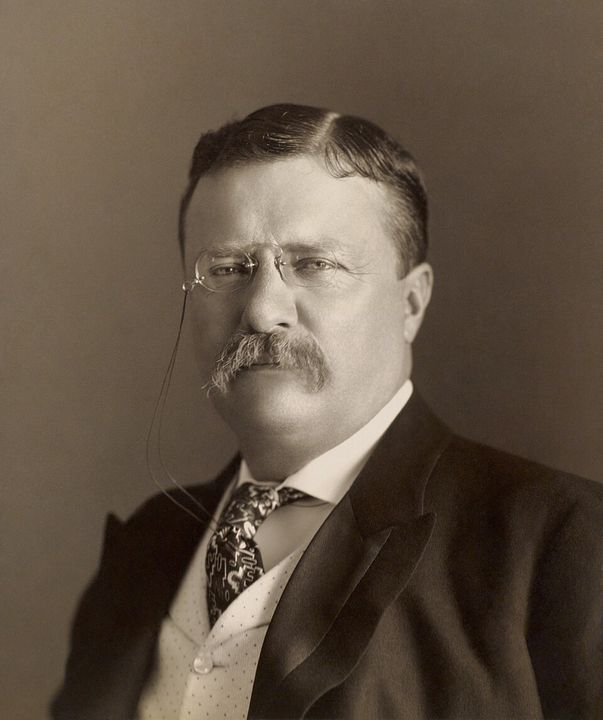
Theodore Roosevelt (1858-1919) was a New York legislator, Dakota rancher, historian, civil service commissioner, New York police commissioner, and assistant secretary of the Navy before leading the Rough Riders in Cuba in 1898. He became governor of New York, vice president, and in 1901, after McKinley's assassination, the twenty-sixth president. Leaving office in 1909, he hunted in East Africa and toured Europe in 1910, then ran for president again in 1912 on the Progressive ticket. He wrote some three dozen books.
“The credit belongs to the man who is actually in the arena, whose face is marred by dust and sweat and blood; who strives valiantly; who errs, and comes short again and again, because there is no effort without error and shortcoming; but who does actually strive to do the deeds; who knows the great enthusiasms, the great devotions; who spends himself in a worthy cause; who at the best knows in the end the triumph of high achievement, and who at the worst, if he fails, at least fails while daring greatly, so that his place shall never be with those cold and timid souls who know neither victory nor defeat.”
“There were all kinds of things of which I was afraid at first, ranging from grizzly bears to "mean" horses and gun-fighters; but by acting as if I was not afraid I gradually ceased to be afraid.”
“every executive officer, and above all every executive officer in high position, was a steward of the people bound actively and affirmatively to do all he could for the people”
On 23 April 1910 Theodore Roosevelt, a year out of the presidency and fresh from a long hunting expedition in East Africa, addressed a packed hall at the Sorbonne in Paris. He spoke as the citizen of one great republic to the citizens of another, and his subject was the character that self-government demands of ordinary people.
Theodore Roosevelt's Autobiography, written at Sagamore Hill in 1913, is less a full life than a series of chapters on the work and convictions of a public man. A foreword dated 1 October 1913 calls for joining practical efficiency with lofty idealism.