Work record
Abington School District v. Schempp
1963 · Postwar Contemporary · Court Decision · English
Abstract
Question Presented. When a state directs its public schools to begin each day with Scripture verses and the Lord's Prayer, even with an opt-out on parental request, does it make a law respecting an establishment of religion contrary to the First and Fourteenth Amendments?
Arguments. The Pennsylvania and Maryland families said that state-run devotions placed official weight behind particular beliefs and that pupils could not freely step out. The districts described the readings as moral and literary instruction, stressed that no one had to take part, and contended that banning them would install secularism as an official creed while slighting believers who wanted them.
Holding. By eight votes to one the justices invalidated both the statute and the city rule. Clark asked whether an enactment's purpose or main effect promotes or hinders religion and found these morning ceremonies did both; he added that teaching about Scripture objectively stays lawful. Goldberg, with Harlan, endorsed accommodation that stops short of sponsorship. Stewart would have sent the cases back for evidence of actual compulsion.
Significance. The inquiry into purpose and effect became the foundation of Lemon's three-part standard, which the justices set aside in 2022 for an approach grounded in historical practice.
Text. Included are the majority, the Goldberg concurrence and the full Stewart dissent, without notes.
Key figures
- Edward and Sidney Schempp: Unitarian parents of Abington high-school students
- Madalyn Murray: Baltimore mother who brought the companion suit with her son
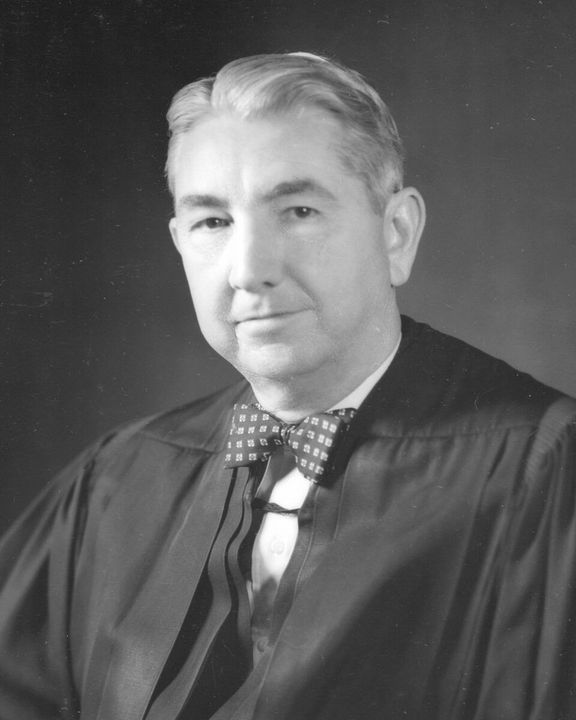
- Tom C. Clark: Justice who framed the purpose-and-effect inquiry
- Arthur J. Goldberg: Concurring justice who warned against a brooding devotion to the secular
- Potter Stewart: Sole dissenter, asking for proof that any pupil was coerced

Summary
A Pennsylvania statute required that at least ten verses of the Holy Bible be read, without comment, at the opening of each public school day. At Abington Senior High School, outside Philadelphia, the verses were broadcast over the public-address system each morning and followed by the Lord's Prayer, recited in unison. Edward Schempp and his wife Sidney, Unitarians whose children attended the school, sued to stop the practice. A three-judge federal court ruled for them in 1959; after the legislature added a provision excusing children on a parent's written request, the court heard the case again and again held the statute invalid. In the companion case, Murray v. Curlett, Madalyn Murray and her son William challenged a 1905 Baltimore rule providing for the reading of a Bible chapter or the Lord's Prayer at opening exercises, and the Maryland Court of Appeals upheld the rule by four votes to three. The question was whether such state-required devotional exercises in public schools violate the Establishment Clause as applied to the states through the Fourteenth Amendment. The families argued that reading Scripture and reciting a prayer were religious observances that the state organized, and that excusal did not remove the pressure on children to conform. The school authorities argued that the exercises served secular purposes such as promoting moral values, countering materialism and teaching literature, that participation was voluntary, and that forbidding them would establish a religion of secularism and disregard the free exercise of the majority. On 17 June 1963 the Court held the practices unconstitutional, eight to one. Justice Clark reviewed the Court's cases from Cantwell and Everson through Engel and stated a test: a law must have a secular legislative purpose and a primary effect that neither advances nor inhibits religion. The exercises, prescribed as part of the school day and conducted by teachers, were religious ceremonies and failed that test; the excusal provision did not cure them. Clark added that the state may not show hostility to religion and that objective study of the Bible and religion as part of a secular education remains permitted. Justice Goldberg, joined by Justice Harlan, agreed but warned that an untutored devotion to neutrality could produce hostility to religion, and that the Constitution permits many forms of accommodation. Justice Stewart dissented, arguing that the records were too thin, that a refusal to permit the exercises might itself burden the free exercise of those who wanted them, and that the cases should be remanded to learn whether any child was in fact coerced. The library text contains Clark's opinion, Goldberg's concurrence and Stewart's dissent; the concurrences of Justices Douglas and Brennan are not included, and notes are left out. Clark's purpose-and-effect test was later combined with an entanglement inquiry in Lemon v. Kurtzman (1971). In Kennedy v. Bremerton School District (2022) the Court said it had abandoned Lemon in favor of reference to historical practices and understandings. William J. Murray III later became a Christian and a Baptist minister.
Virtues in this work
- Justice: Clark holds that a family's freedom of conscience in a public school does not depend on how many neighbors share its beliefs.
- Piety: Clark calls the place of religion in American society an exalted one, entrusted to the home, the church and the individual heart.
- Prudence: Stewart asks for a fuller factual record before the Court decides a question that touches so many schools and families.
Plot or Argument
- Two school districts, two sets of facts
Clark describes the Pennsylvania statute and the morning exercises at Abington, the testimony of the Schempp family and of rival biblical scholars, and then the Baltimore rule challenged by the Murrays.
- Religion in American history and law
Clark grants that religion has been closely identified with the nation's history and government, citing Engel, and insists that religious freedom is equally embedded in American public and private life.
- The reach of the religion clauses
The Court reaffirms that the First Amendment binds the states through the Fourteenth and that the Establishment Clause forbids more than preference for one sect, quoting Everson, McCollum, Zorach, McGowan and Torcaso.
- Purpose and primary effect
From these precedents Clark derives a test asking whether a law's purpose or primary effect is to advance or inhibit religion, and applies it to find the required exercises a religious ceremony that the excusal provision does not save.
- Neither hostility nor a religion of secularism
Clark answers the charge that the decision establishes secularism, distinguishes objective academic study of the Bible, and rejects the claim that majority free exercise requires the exercises, closing with the image of the inviolable citadel of the heart and mind.
- Goldberg on accommodation
Goldberg, for himself and Harlan, describes neutrality as requiring neither sponsorship nor hostility, and notes that the decision leaves untouched patriotic exercises that refer to God and other practices creating none of the dangers the clause guards against.
- Stewart's dissent
Stewart argues that the two religion clauses can conflict, that the Establishment Clause originally restrained only Congress, that parents who want religious exercises have a substantial free exercise claim, and that coercion, not mere exposure, is the proper question, which these records cannot answer.
Characters
- Edward Lewis Schempp, appellee
Unitarian father in Abington Township who sued with his wife Sidney on behalf of their children Roger and Donna.
- Madalyn Murray, petitioner in Murray v. Curlett
Baltimore mother, later known as Madalyn Murray O'Hair, who challenged the city's opening exercises as an atheist.
- William J. Murray III, petitioner in Murray v. Curlett
Her teenage son, a Baltimore public-school student, who decades later became a Baptist minister.
- Justice Tom C. Clark, author of the opinion of the Court
Wrote that the required exercises had a religious purpose and effect, while affirming the place of objective study of religion.
- Justice Arthur J. Goldberg, concurring
Joined by Justice Harlan, cautioned that neutrality must not become hostility toward religion.
- Justice Potter Stewart, dissenter
Would have remanded both cases to determine whether the exercises actually coerced any child.
Lessons
The purpose-and-effect test
Clark distilled earlier decisions into two questions: what is the purpose of the law, and what is its primary effect? If either is to advance or inhibit religion, the law exceeds what the Establishment Clause allows. The test gave lower courts a working method and later became the first two prongs of the Lemon test.
- What two questions does Clark ask about a law touching religion?
- Why did the Court find the Abington exercises religious in purpose despite the state's secular justifications?
- Is a test based on purpose and effect easier or harder to apply than one based on history and tradition?
Devotion versus study
The Court distinguished between conducting a religious exercise and teaching about religion. Clark wrote that a complete education may include comparative religion and the Bible's literary and historic qualities, so long as the study is presented objectively. The distinction shaped how public schools have approached the Bible ever since.
- What kinds of Bible study does Clark say remain permissible in public schools?
- How would a teacher tell the difference between reading Scripture devotionally and studying it objectively?
- Can the Bible be fully understood as literature and history apart from its religious claims?
Neutrality and its critics
All the opinions speak of neutrality, but they mean different things by it. Clark understood it as a government that neither sponsors nor opposes religion. Goldberg warned that rigid neutrality could slide into a brooding devotion to the secular. Stewart argued that forbidding exercises some families wanted might itself place the state's weight on one side of private choice.
- How does Clark answer the claim that the decision establishes a religion of secularism?
- What does Goldberg mean by an untutored devotion to neutrality?
- Is a school that holds no religious exercises neutral, or has it taken a side?
Coercion, consent and the majority
Pennsylvania allowed children to be excused, and most families apparently welcomed the exercises. The majority held that excusal did not save a state-organized ceremony and that constitutional rights do not depend on majority vote. Stewart answered that the right question was whether any child was actually coerced, which required fuller records.
- Why did the excusal provision not change the Court's conclusion?
- What evidence would Stewart have wanted the lower courts to gather on remand?
- Should the wishes of a local majority count in deciding how a public school opens its day?
Context
Daily Bible reading had been a feature of many American public schools since the common-school movement of the nineteenth century, often using the King James Version, and several states required it by statute. Catholic objections to Protestant Bible reading in the nineteenth century had led to disputes in cities such as Philadelphia and Cincinnati. After the Court applied the Establishment Clause to the states in Everson (1947), it struck down released-time instruction on school premises in McCollum (1948) and a state-composed prayer in Engel v. Vitale (1962).
Composition
The Schempp suit was filed in 1958, and Pennsylvania amended its statute in December 1959 to permit excusal; the three-judge district court reheard the case and again held for the family in 1962. The Murray case reached the Court from the Maryland Court of Appeals. The two cases were argued together, and the Court's opinions run to more than a hundred pages in the U.S. Reports, including Brennan's long historical concurrence.
Reception
The decision drew strong public reaction; members of Congress proposed constitutional amendments to restore school prayer and Bible reading, none of which passed. Many religious leaders opposed the ruling, while others, including some Baptist and Jewish organizations, supported it as protecting voluntary faith. Clark's remarks on academic study encouraged Bible-as-literature and religion courses in public schools. Scholars continue to debate whether the decision expressed neutrality or a preference for secular public life, and the purpose-and-effect test was set aside in Kennedy v. Bremerton School District (2022).
Comparisons
- engel-v-vitale
Clark built directly on the 1962 prayer decision, and Stewart, its lone dissenter, again stood alone; Schempp extended Engel's rule from a state-written prayer to Scripture reading and the Lord's Prayer.
- the-bible
The Scripture whose daily reading was at issue; Clark's opinion affirms that it is worthy of study for its literary and historic qualities.
- everson-v-board-of-education
Clark relied on Everson's statement that the state must be neutral toward believers and non-believers, while Stewart drew on its reminder that the state need not be religion's adversary.
- lemon-v-kurtzman
Chief Justice Burger's 1971 test adopted Schempp's purpose and primary effect as its first two prongs and added excessive entanglement.
- west-virginia-v-barnette
Clark quoted the 1943 flag-salute decision on withdrawing certain subjects from political majorities, applying its reasoning about compelled exercises in school to religious devotions.
Quotes
Frequently cited
“The test may be stated as follows: what are the purpose and the primary effect of the enactment? If either is the advancement or inhibition of religion then the enactment exceeds the scope of legislative power as circumscribed by the Constitution.”
Frequently cited
“It certainly may be said that the Bible is worthy of study for its literary and historic qualities. Nothing we have said here indicates that such study of the Bible or of religion, when presented objectively as part of a secular program of education, may not be effected consistently with the First Amendment.”
Frequently cited
“What our Constitution indispensably protects is the freedom of each of us, be he Jew or Agnostic, Christian or Atheist, Buddhist or Freethinker, to believe or disbelieve, to worship or not worship, to pray or keep silent, according to his own conscience, uncoerced and unrestrained by government.”
“The place of religion in our society is an exalted one, achieved through a long tradition of reliance on the home, the church and the inviolable citadel of the individual heart and mind.”
“But untutored devotion to the concept of neutrality can lead to invocation or approval of results which partake not simply of that noninterference and noninvolvement with the religious which the Constitution commands, but of a brooding and pervasive devotion to the secular and a passive, or even active, hostility to the religious.”
“It is, I think, a fallacious oversimplification to regard these two provisions as establishing a single constitutional standard of 'separation of church and state,' which can be mechanically applied in every case to delineate the required boundaries between government and religion.”
For Students
A reading companion for classical Christian high school students. See the student guide.
Reading Guide
Watch for
- Clark's acknowledgment that religion has been closely identified with American history and government.
- The two-part purpose-and-effect test at the opening of Part V.
- Clark's answer to the charge of a religion of secularism and his paragraph on objective study.
- Goldberg's distinction between accommodation and hostility.
- Stewart's example of chaplains for soldiers stationed far from home.
Key terms and names
- Establishment Clause
- The First Amendment's provision that Congress shall make no law respecting an establishment of religion, applied to the states through the Fourteenth Amendment.
- Free Exercise Clause
- The First Amendment's protection against laws prohibiting the free exercise of religion.
- Devotional exercise
- An act of worship, such as prayer or Scripture reading for spiritual edification, as distinct from academic study.
- Accommodation
- Government action that makes room for citizens' religious practice without sponsoring it.
- Remand
- To send a case back to a lower court for further proceedings, as Stewart would have done here.
Seminar Questions
- Comprehension What did the Pennsylvania statute require, and how were the exercises conducted at Abington Senior High School?
- Comprehension What reasons did the school authorities give for the exercises, and why did the Court reject them?
- Comprehension On what grounds does Stewart say the records were inadequate?
- Interpretation How does Clark distinguish the exercises here from the released-time program upheld in Zorach v. Clauson?
- Interpretation Goldberg agrees with the result but writes separately. What does his concurrence add or qualify?
- Big Question Can a public school be truly neutral about religion, and if so, what would neutrality look like in its daily life?
Faith Connections
- Deuteronomy 6:6-7 (Scripture)
The command to teach God's words diligently to one's children at home and on the way bears on Clark's reliance on the home and church for religious formation.
- Matthew 6:5-6 (Scripture)
Jesus' teaching on praying in secret rather than to be seen by others has been cited on both sides of the debate over public prayer.
- James Madison, Memorial and Remonstrance (1785) (Great Conversation)
Madison's argument against a Virginia assessment for teachers of religion is quoted throughout the Court's religion-clause cases from Everson onward.
Logic and Rhetoric
Central argument: Clark reasons that the religion clauses require government neutrality, that a law whose purpose or primary effect advances or inhibits religion violates that neutrality, and that state-required Bible reading and prayer at the start of the school day are religious ceremonies with that purpose and effect; Stewart replies that the clauses must be balanced and that only proof of coercion should invalidate the exercises.
Rhetorical device: concession and distinction. Clark concedes the Bible's worth for study and the historic place of religion in American life before distinguishing such study from devotional exercises (quote 1).
Debate: Resolved: that a public school which permits voluntary Scripture reading at the start of the day establishes religion.
Memory Work
It certainly may be said that the Bible is worthy of study for its literary and historic qualities. Nothing we have said here indicates that such study of the Bible or of religion, when presented objectively as part of a secular program of education, may not be effected consistently with the First Amendment.
What our Constitution indispensably protects is the freedom of each of us, be he Jew or Agnostic, Christian or Atheist, Buddhist or Freethinker, to believe or disbelieve, to worship or not worship, to pray or keep silent, according to his own conscience, uncoerced and unrestrained by government.
Writing Prompts
Essay: Explain what Clark, Goldberg and Stewart each mean by government neutrality toward religion, and evaluate which account best fits the situation of a public-school classroom.
Comparison with Engel v. Vitale: Compare the state-composed prayer struck down in Engel with the Bible reading and Lord's Prayer struck down in Schempp, and explain whether the differences between them should have mattered.
Medical Lens
The opinions address devotional Bible reading and prayer in public schools and raise no medical or health questions.
Creative Prompts
- Classroom
Hold a moot court on the February 1963 argument: one counsel for the Schempp family, one for the Abington School District, and a bench whose members each write a short opinion modeled on Clark, Goldberg or Stewart.
- Essay
Design a one-semester public-school elective on the Bible as literature and history, and explain how each unit would meet Clark's standard of objective presentation.
- Dialogue
Write a conversation in 1963 between a Pennsylvania parent who welcomed the morning readings and Edward Schempp, each explaining his view of what the school owed his children.
- Essay
Apply Clark's purpose-and-effect test and Stewart's coercion test to a school practice such as a moment of silence, and explain whether the two tests reach different results.
Further Reading
- Ellery's Protest: How One Young Man Defied Tradition and Sparked the Battle over School Prayer, Stephen D. Solomon
Account of the Schempp family and the Abington litigation from its beginnings in 1956.
- The Battle over School Prayer: How Engel v. Vitale Changed America, Bruce J. Dierenfield
Concise history of the school-prayer cases and the public response to them, including Schempp.
- Separation of Church and State, Philip Hamburger
Legal historian's study arguing that the separation idea developed later than the First Amendment, useful background for Stewart's dissent.
Verification notes
Three quotations from Clark, one from Goldberg and two from Stewart were each found by Grep as exact substrings of content/texts/abington-school-district-v-schempp.txt. The stored text spells the eldest Schempp son's name Ellory; he is usually called Ellery. The stored Stewart dissent contains a transcription slip (evehhanded) in a passage not quoted here. The date of the original filing, the 1962 rehearing and William J. Murray's later ministry come from secondary histories rather than the opinions.
- Confirm that the Schempp suit was filed in 1958 and that the district court's second decision came in 1962.
- Confirm the wording of the 1905 Baltimore rule (a chapter of the Bible and/or the Lord's Prayer) from the opinion's Part I.
- Confirm the description of William J. Murray III as a Baptist minister.