Work record
The Articles of Confederation
1777 (ratified 1781) · 18th Century · Political Theory · English
Abstract
Background. Having broken with Britain, the new states needed a lawful common authority for war, loans and foreign alliances. A committee led by Dickinson drafted terms in 1776; Congress revised them and approved the plan in late 1777, and Maryland's holdout over western land claims postponed its operation until 1781.
Structure. Thirteen numbered sections cover the union's name, reserved state powers, the mutual rights of citizens moving between states, a one-chamber Congress, prohibitions on the states, finance, the enumerated authority of Congress, a recess committee, Canada, inherited debts, and permanence.
Key Concepts. States keep whatever is not explicitly granted. Each delegation casts a single ballot; nine are needed for war, money or treaties. Expenses are apportioned by surveyed land values, yet only state assemblies may tax. Changing the text requires every legislature.
Significance. Congress under this charter secured peace in 1783 and organized the Northwest Territory, but chronic revenue shortfalls and commercial quarrels prompted the 1787 Convention. Its successor, operating from 1789, kept full faith and credit and other features while adding an executive, federal courts and taxing power.
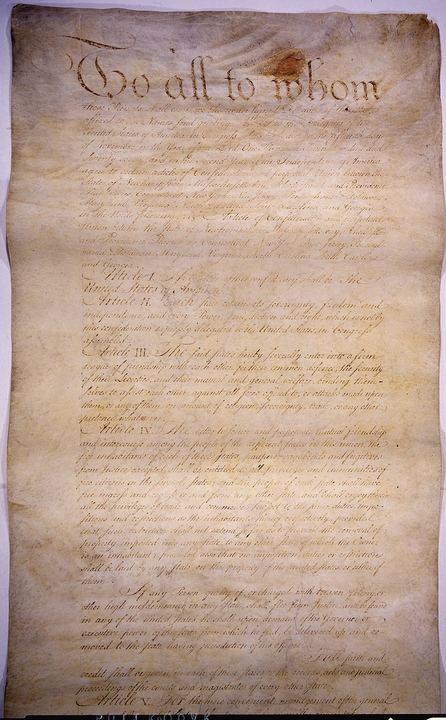
Text. The library follows the Avalon Project transcription drawn from a 1927 government compilation edited by Charles C. Tansill. It ends with the delegates' confirmation dated at Philadelphia in July 1778 but leaves out their signatures, grouped by state, which appear on the engrossed parchment held by the National Archives.
Key figures
- John Dickinson: Pennsylvanian who wrote the committee draft of 1776
- Richard Henry Lee: Virginian whose resolution asked for a plan of union
- Henry Laurens: Presiding officer of Congress at adoption

Summary
The Articles of Confederation and Perpetual Union were the first written frame of government for the United States. Richard Henry Lee's resolution of June 1776 asked Congress to prepare independence, foreign alliances and a plan of confederation together, and a committee chaired by John Dickinson produced a draft that summer. Wartime business, and sharp disputes over representation, the apportionment of expenses and western lands, delayed adoption until 15 November 1777, when Congress, driven from Philadelphia by the British, approved the text at York, Pennsylvania. Ratification required every state. Twelve had agreed by early 1779, but Maryland refused until states with claims to lands beyond the Appalachians, especially Virginia, agreed to cede them to the Union. Maryland's delegates signed on 1 March 1781, and the Articles took effect. The document has thirteen articles. Article I names the confederacy The United States of America. Article II states that each state keeps its sovereignty, freedom and independence, and every power not expressly delegated to the United States in Congress assembled. Article III describes the union as a firm league of friendship for common defense, the security of liberties and mutual welfare. Article IV guarantees the free inhabitants of each state the standing of citizens in the others, provides for returning fugitives from justice, and requires full faith and credit for other states' court records. Article V sets out Congress: two to seven delegates per state, appointed yearly and recallable, limited to three years in six, with each state casting one vote. Article VI forbids states to make treaties, keep standing forces in peacetime, or wage war without the consent of Congress, though each must keep a militia. Articles VII and VIII leave the appointment of regimental officers to the states and divide common expenses according to the value of each state's surveyed land, with the taxes raised by the state legislatures. Article IX, the longest, gives Congress power over war and peace, treaties, ambassadors, Indian affairs, coinage, post offices and the army and navy, and an elaborate procedure for settling disputes between states; the most important measures need the assent of nine states. Article X creates a Committee of the States to act during recesses, Article XI offers Canada admission, Article XII pledges the Union to pay earlier war debts, and Article XIII declares the Union perpetual and forbids any alteration not confirmed by every state legislature. A closing paragraph thanks the Great Governor of the World and records the delegates' ratification at Philadelphia on 9 July 1778. Under the Articles Congress won the war, made the Treaty of Paris of 1783 and passed the Northwest Ordinance of 1787. It had no separate executive or national courts, could only request money from the states, and could not regulate trade, and amendment proved impossible. After the Annapolis Convention of 1786 and Shays' Rebellion in Massachusetts, the Philadelphia Convention of 1787 proposed a new Constitution, which replaced the Articles in 1789. The library text, from the Avalon Project, omits the list of signers.
Virtues in this work
- Friendship: Article III joins the states in a firm league of friendship, binding each to assist the others against any attack.
- Prudence: The authors guard against concentrated power by keeping all undelegated powers with the states and requiring nine states for war and borrowing.
- Justice: Article IX sets out a careful procedure of commissioners drawn by lot to settle boundary disputes between states fairly.
Plot or Argument
- Preamble and Articles I-III: name, sovereignty, league
The delegates greet all to whom the presents come and name the thirteen states. The confederacy is styled The United States of America; each state retains its sovereignty and every power not expressly delegated; the states enter a firm league of friendship for common defense and mutual welfare.
- Article IV: citizens of a common union
Free inhabitants of each state enjoy the rights of free citizens in every other state, with exceptions for paupers, vagabonds and fugitives; fugitives charged with serious crimes are to be delivered up; each state gives full faith and credit to the others' records.
- Article V: the Congress
Delegates are appointed annually by the state legislatures, may be recalled, serve no more than three years in six, enjoy freedom of speech and debate, and vote by state, one vote each.
- Articles VI-VIII: limits on the states and common expenses
States may not conduct foreign relations, form separate alliances, keep peacetime forces beyond Congress's allowance, or wage war except under invasion; they must maintain militia. States appoint regimental officers. Common costs come from a treasury supplied by the states in proportion to the value of their land, with taxes levied by the state legislatures.
- Article IX: the powers of Congress
Congress holds the powers of war and peace, treaties, ambassadors, prize courts, coinage, weights and measures, Indian affairs, post offices and military appointments; it resolves boundary disputes between states through a court of commissioners; it may borrow and requisition troops by quota. The gravest measures require nine states.
- Articles X-XII: recess committee, Canada, debts
A Committee of the States may act in recess within limits; Canada may join on acceding, other territories only with nine states' consent; debts contracted by Congress before the Articles are a charge on the United States.
- Article XIII and ratification
Every state must abide by the determinations of Congress; the Union is perpetual; amendments need Congress's agreement and confirmation by every state legislature. The delegates, crediting the Great Governor of the World, ratify on behalf of their states.
Characters
- John Dickinson, principal drafter
Pennsylvania delegate who wrote the committee's 1776 draft of the Articles.
- Richard Henry Lee, mover of the resolution
Virginia delegate whose June 1776 resolution called for independence, alliances and a plan of confederation.
- Henry Laurens, President of Congress
South Carolina delegate presiding over Congress when the Articles were adopted in November 1777.
- Committee of the States, body created by Article X
One delegate per state, empowered to act while Congress is in recess.
Lessons
A league of sovereign states
Article II keeps each state's sovereignty and every power not expressly delegated, and Article III calls the union a league of friendship. The Articles describe something between an alliance and a nation, and that choice shaped every other provision.
- What word in Article II limits the powers given to the United States?
- Why might states that had just fought for independence from a distant government want to keep their sovereignty?
- Is a league of friendship the same thing as a nation?
Equal votes for unequal states
Article V gives each state one vote in Congress regardless of population, and Article IX requires nine states for the most serious decisions. Small and large states argued over this rule, and the argument returned at the Constitutional Convention of 1787.
- How many votes did Virginia have compared with Delaware?
- Why would large states object to this rule, and small states defend it?
- What does the requirement of nine states protect against?
Power to ask but not to compel
Article VIII lets Congress set each state's share of common expenses but leaves the actual taxing to the state legislatures. When states failed to pay, Congress had no means to collect, one of the weaknesses that led to the call for a new Constitution.
- Who actually levies the taxes under Article VIII?
- What could Congress do if a state did not send its share?
The difficulty of change
Article XIII made the Union perpetual and required every state legislature to confirm any amendment. Proposals to give Congress a modest import duty failed because a single state could refuse, and the framers of 1787 instead wrote a new plan with its own ratification rule.
- Why might the authors have demanded unanimity for amendments?
- Was the Philadelphia Convention right to propose a new Constitution rather than amend the Articles?
Context
The thirteen states declared independence in July 1776 while already at war, and needed a common government to raise an army, borrow money and make alliances, above all with France. Congress was operating without any written authority, and Americans who had resisted Parliament's claims of power were wary of creating a strong central government of their own.
Composition
Congress appointed a drafting committee on 12 June 1776; John Dickinson's draft was reported in July 1776 and debated through 1777. The final text was adopted at York, Pennsylvania, on 15 November 1777 and sent to the states; delegates began signing on 9 July 1778. Maryland withheld ratification until Virginia and other states promised to cede their western land claims, and its delegates signed on 1 March 1781, when the Articles came into force. The library text is the Avalon Project transcription from Documents Illustrative of the Formation of the Union (1927) and omits the signers.
Reception
The Confederation Congress concluded the Revolutionary War, negotiated the Treaty of Paris (1783), and passed the Land Ordinance of 1785 and the Northwest Ordinance of 1787. Its lack of taxing and commercial power, and the impossibility of amendment, led to the Annapolis Convention of 1786 and the Philadelphia Convention of 1787. The Federalist papers argued the Articles were inadequate, while many Anti-Federalists defended their emphasis on the states. Historians have long debated whether the Confederation period was a time of crisis or of reasonable achievement.
Comparisons
- the-founding-documents
The Constitution answers the Articles point by point: a separate executive and judiciary, taxing and commerce powers for Congress, representation by population in the House, and amendment by three-fourths of the states.
- the-federalist-papers
Federalist Nos. 15-22 catalogue the defects of the Confederation, such as legislation for states rather than individuals and the lack of a power to tax.
- the-anti-federalist-papers
Anti-Federalist writers defended the Articles' principle that the states keep their sovereignty and warned that a consolidated government would endanger liberty.
- mayflower-compact
Both documents bind separate parties by written agreement into a common political body; the compact joins individual men, the Articles join sovereign states.
- magna-carta
Both limit a central authority through written terms and joint consent; Magna Carta checks a king, the Articles deliberately avoid creating any executive.
- madison-selected-writings
Madison's Notes of Debates record the 1787 Convention's arguments over the Articles' one-state-one-vote rule and its weak revenue system.
Quotes
Frequently cited
“Each state retains its sovereignty, freedom, and independence, and every power, jurisdiction, and right, which is not by this Confederation expressly delegated to the United States, in Congress assembled.”
Frequently cited
“The said States hereby severally enter into a firm league of friendship with each other, for their common defense, the security of their liberties, and their mutual and general welfare”
“Full faith and credit shall be given in each of these States to the records, acts, and judicial proceedings of the courts and magistrates of every other State.”
“In determining questions in the United States in Congress assembled, each State shall have one vote.”
“And the Articles of this Confederation shall be inviolably observed by every State, and the Union shall be perpetual”
For Students
A reading companion for classical Christian high school students. See the student guide.
Reading Guide
Watch for
- Article II's phrase expressly delegated, and how it limits Congress.
- Article III's description of a league of friendship rather than a single nation.
- Article V's rule that each state has one vote, and the term limits on delegates.
- Article VIII, where Congress decides the shares of common expenses but the states levy the taxes.
- Article XIII's unanimity rule for amendments and the closing reference to the Great Governor of the World.
Key terms and names
- Confederation
- A union of states that keep their own sovereignty; the Articles call it a firm league of friendship.
- Sovereignty
- Supreme political authority; Article II says each state retains it.
- Expressly delegated
- Clearly and specifically handed over in writing; under Article II only such powers belong to Congress.
- Requisition
- A formal request by Congress to the states for money or troops, which the states were expected but could not be forced to supply.
- Committee of the States
- A body of one delegate from each state created by Article X to act when Congress was in recess.
- Full faith and credit
- The duty in Article IV for each state to honour the court records and judicial acts of the others.
- Ratification
- Formal approval by the states; the Articles needed all thirteen and took effect only when Maryland signed in 1781.
Seminar Questions
- Comprehension According to Article II, which powers belong to the states and which to Congress?
- Comprehension How many votes does each state have in Congress, and how many states must agree to make war, coin money or borrow?
- Comprehension Under Article VIII, how is the money for common expenses divided among the states, and who collects it?
- Interpretation Why did the authors call the union a league of friendship instead of a single government?
- Interpretation Why might Congress have left the Articles with no separate executive or national courts?
- Interpretation Article XIII calls the Union perpetual and requires every state to agree to amendments. Do these two rules strengthen or weaken the Union?
- Big Question Is it better for a free people to have a weak central government that cannot easily oppress them, or a stronger one that can act decisively?
Faith Connections
- Ecclesiastes 4:9-12 (Scripture)
Two are better than one, and a threefold cord is not quickly broken; the Articles bind thirteen states for strength in common defense.
- Exodus 18:13-26 (Scripture)
Jethro counsels Moses to share judgment among rulers of thousands, hundreds and tens, an early picture of dividing authority among levels of government.
- Johannes Althusius, Politica (1603) (Great Conversation)
The Reformed jurist described political order as a series of covenanted associations, from family and town to province and commonwealth, a framework often compared with confederal government.
Logic and Rhetoric
Central argument: Because the states are sovereign and fear a distant power like the one they have just resisted, they should delegate only specific powers for war, diplomacy and common business to a Congress in which each state votes equally, keep all other powers themselves, and bind one another permanently to the league.
Rhetorical device: enumeration with reservation. Article II pairs a sweeping list (sovereignty, freedom, independence, every power, jurisdiction, and right) with the limiting clause not expressly delegated (quote 0), making the reservation of state power the controlling idea.
Debate: Resolved: that the Articles of Confederation should have been amended rather than replaced.
Memory Work
Each state retains its sovereignty, freedom, and independence, and every power, jurisdiction, and right, which is not by this Confederation expressly delegated to the United States, in Congress assembled.
In determining questions in the United States in Congress assembled, each State shall have one vote.
Writing Prompts
Essay: Choose three weaknesses of the Articles of Confederation (for example in Articles V, VIII and XIII) and explain how each one came from the authors' fear of a strong central power.
Comparison with The Federalist Papers: Compare the Articles' description of a league of friendship with Publius's argument in The Federalist that the Union needed a government acting directly on individuals.
Medical Lens
The Articles are a frame of government with no medical content; their provisions concern sovereignty, war, finance, diplomacy and disputes between states.
Creative Prompts
- Classroom
Hold a mock Confederation Congress in which each table is a state with one vote, and try to pass a measure that needs nine states and an amendment that needs all thirteen.
- Essay
Using Articles II, VIII and XIII, explain why many Americans by 1787 believed the Confederation needed a new frame of government.
- Dialogue
Write a conversation in 1780 between a Maryland delegate and a Virginia delegate about western lands and why Maryland will not yet sign.
- Fiction
Tell the story of a Continental soldier in 1781 waiting for pay that Congress has asked the states to send.
Further Reading
- The Articles of Confederation, Merrill Jensen
Classic study of the making of the Articles and the debates over sovereignty and western lands.
- The Beginnings of National Politics, Jack N. Rakove
History of the Continental Congress and the drafting and working of the Articles.
- The Creation of the American Republic, 1776-1787, Gordon S. Wood
Study of American political ideas from independence to the Constitution.
- Shh! We're Writing the Constitution, Jean Fritz
Lively account for young readers of the Convention that replaced the Articles.
Verification notes
All five quotations were found by Grep in content/texts/articles-of-confederation.txt (Avalon Project transcription). The library text omits the list of signers. Dates of the drafting committee, adoption at York, the July 1778 signing and Maryland's ratification on 1 March 1781 were checked against general sources, including the National Archives milestone-documents page; sources differ on whether Dickinson's draft was reported on 2 or 12 July 1776, so the record says only July 1776.
- Confirm that Henry Laurens was President of Congress on 15 November 1777.
- Confirm the specific Federalist numbers (15-22) cited for the defects of the Confederation.