Work record
The Gettysburg Address
1863 · 19th Century · Oratory · English
Abstract
Background. In July 1863 the armies of Meade and Lee fought for three days around a Pennsylvania crossroads town, leaving thousands of Union dead in shallow graves. Local organizers bought land on Cemetery Hill for a national burial ground and set its consecration for mid-November.
Occasion. Everett held the platform for two hours with a classical survey of the campaign. The president followed after a hymn, with brief closing words of dedication.
Content. Lincoln recalls the founders of 1776 and their creed of equality, then calls the present struggle a trial of whether a republic so grounded can survive. Halfway through he declares that no ceremony could sanctify ground the fallen had already made holy. His closing period hands the soldiers' task to his listeners and pledges national rebirth and the survival of popular rule.
Themes. Sacrifice and its debt, the gap between speech and action, and the Declaration as the nation's true charter run through all ten sentences. Biblical diction lends the civic occasion the weight of a liturgy.
Significance. Party newspapers judged it by their loyalties, yet within a generation it had become the definitive statement of what the Union fought for. Schoolchildren memorize it, its last words are routinely cited as a definition of democracy, and its text is cut in stone at the president's memorial in Washington.
Key figures
- Abraham Lincoln: Sixteenth president, invited to give the formal dedicatory remarks
- Edward Everett: Former Harvard president and senator who delivered the main oration
- David Wills: Gettysburg attorney who organized the cemetery and invited Lincoln
- Ward Hill Lamon: Lincoln's friend and marshal of the day, who introduced him

Watch the summary
The Gettysburg Address in 117 seconds · 1:57
Summary
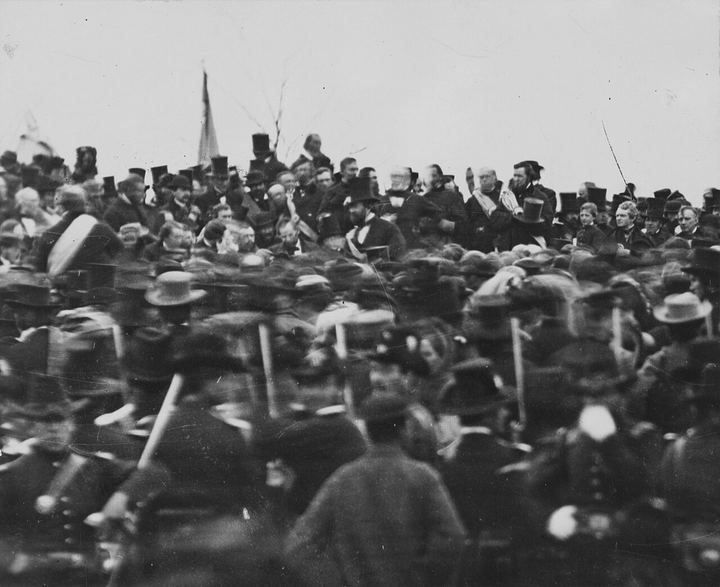
On 19 November 1863, four and a half months after the Union victory at Gettysburg, Pennsylvania, a large crowd gathered to dedicate the Soldiers' National Cemetery, where Union soldiers killed in the fighting of 1-3 July were being reinterred. The principal orator was Edward Everett, the former secretary of state and president of Harvard, who spoke for about two hours. David Wills, the local attorney who organized the cemetery, had asked President Lincoln to offer a few appropriate remarks as the formal act of dedication. Lincoln spoke for roughly two minutes, about 270 words. The address moves through time in three steps. It begins in the past, eighty-seven years earlier, when the fathers founded a nation on the proposition that all men are created equal; Lincoln dates the nation from the Declaration of Independence of 1776. It turns to the present: a civil war is testing whether any nation so founded can long endure, and the crowd has come to set aside part of the field for those who died that the nation might live. Then Lincoln reverses his own premise. The living cannot truly dedicate, consecrate, or hallow the ground, because the men who struggled there have already done it; the world will forget the words spoken that day but never the deeds. What remains for the living is to be dedicated to the unfinished work. The last sentence, long and cumulative, binds the hearers to a resolve that the dead shall not have died in vain, that the nation under God shall have a new birth of freedom, and that government of, by, and for the people shall not perish. The speech names no battle, general, state, or enemy, and it speaks of the war's purpose in terms broad enough to cover the whole nation. Its cadences echo the King James Bible. Newspaper reactions divided largely along party lines, but Everett wrote to Lincoln the next day that he wished he had come as near the central idea of the occasion in two hours as Lincoln had in two minutes. Five manuscript copies in Lincoln's hand survive, differing slightly in wording; the address is carved on the south wall of the Lincoln Memorial.
Virtues in this work
- Piety: Lincoln treats the soldiers' graves as ground already hallowed and resolves that the nation under God shall have a new birth of freedom.
- Humility: He insists that the speakers' poor power can neither add nor detract and predicts the world will little note what they say.
- Justice: The address grounds the nation on the proposition that all men are created equal and calls the war a test of it.
- Fortitude: Rather than mourning alone, Lincoln asks the living to take up the unfinished work and the great task remaining before them.
Plot or Argument
- The founding: a nation conceived in liberty (Sentence 1)
Lincoln reaches back eighty-seven years to 1776 and describes the nation's birth in biblical language: the fathers brought it forth, conceived in liberty and dedicated to the proposition of human equality. The word proposition frames the founding as a claim still awaiting proof.
- The present test on the battlefield (Sentences 2-5)
The war is a test of whether such a nation can last. The crowd stands on part of the field that tested it, met to dedicate a resting place for those who gave their lives that the nation might live, and Lincoln affirms that this act is fitting and proper.
- The reversal: the dead have already consecrated the ground (Sentences 6-8)
Lincoln turns on the very ceremony he is performing. The living cannot dedicate, consecrate, or hallow the field; the brave men, living and dead, have done that beyond anyone's power to add or detract. The world will forget the speeches and remember the deeds.
- The charge to the living (Sentences 9-10)
The dedication shifts from ground to hearers. The living must take up the unfinished work and draw increased devotion from the dead, resolving that they did not die in vain, that the nation under God will have a new birth of freedom, and that popular government will not perish from the earth.
Key claims
The main steps of the argument, in order, and how they fit together.
- The nation was founded eighty-seven years earlier in liberty and dedicated to the proposition that all men are created equal.How it is supported: Appeal to the Declaration of Independence of 1776, in biblical language of birth.
- The civil war tests whether any nation founded and dedicated in this way can long endure.How it is supported: The present war framed as a trial of the founding proposition.
- The soldiers who died at Gettysburg gave their lives so that the nation might live.How it is supported: The occasion itself: the dedication of a cemetery on the battlefield.
- Setting aside part of the field as their resting place is fitting and proper.How it is supported: Affirmation of the ceremony being performed.
- Yet the living cannot truly dedicate or hallow the ground, because the brave men who struggled there already have.How it is supported: A reversal of the speech's own premise, contrasting words with deeds.
- The world will little remember the speeches made that day but will never forget what the soldiers did.How it is supported: Contrast between speech and action.
- The living must dedicate themselves to the unfinished work, so that the dead shall not have died in vain.How it is supported: Appeal to the debt owed to those who sacrificed.
- Through this devotion the nation under God will have a new birth of freedom and popular government will not perish.How it is supported: Closing pledge, echoing scriptural ideas of rebirth.
Argument map
Supported by
- 2The civil war tests whether any nation founded and dedicated in this way can long endure.
which rests on
- 1The nation was founded eighty-seven years earlier in liberty and dedicated to the proposition that all men are created equal.
- 4Setting aside part of the field as their resting place is fitting and proper.
which rests on
- 3The soldiers who died at Gettysburg gave their lives so that the nation might live.
- 5Yet the living cannot truly dedicate or hallow the ground, because the brave men who struggled there already have.
which rests on
- 6The world will little remember the speeches made that day but will never forget what the soldiers did.
- 7The living must dedicate themselves to the unfinished work, so that the dead shall not have died in vain.
which rests on
- 8Through this devotion the nation under God will have a new birth of freedom and popular government will not perish.
Therefore
Plain-language summaries of the author's argument, not quotations.
Lessons
Honoring the dead by finishing their work
Lincoln refuses to let a cemetery dedication remain a ceremony. He argues that the soldiers' sacrifice cannot be improved by words, so the only fitting tribute is for the living to take up the task the dead advanced. Remembrance, in this speech, is a form of obligation.
- Why does Lincoln say the living cannot dedicate the ground, when that is exactly what the ceremony was for?
- What is the unfinished work Lincoln asks his hearers to carry on, and why does he leave it partly unnamed?
- How might a family or a school honor someone's sacrifice in the way Lincoln describes?
The founding as a proposition to be proved
By dating the nation from 1776 and calling equality a proposition, Lincoln treats the Declaration of Independence as the nation's defining creed and the war as its proof. The speech teaches that a people founded on an idea must keep showing that the idea can endure.
- Why might Lincoln count the nation's age from the Declaration rather than from the Constitution of 1787?
- What does it mean to call a moral truth a proposition that is being tested?
- Is a nation built on an idea stronger or more fragile than one built on shared ancestry or territory?
The power of brevity
Everett's learned two-hour oration was admired and then largely forgotten; Lincoln's ten sentences became the best-known speech in American history. Lincoln compresses past, present, and future into a single movement and lets plain words such as here, dedicate, and devotion carry the weight through repetition.
- Lincoln predicts that the world will little note what was said that day. Why did that prediction prove wrong?
- Which words does Lincoln repeat most, and what do the repetitions accomplish?
- Can a short speech say more than a long one? What does brevity demand of a speaker?
Context
The Battle of Gettysburg (1-3 July 1863) ended Robert E. Lee's second invasion of the North at the cost of tens of thousands of casualties on both sides. The town was left with thousands of hastily buried dead, and Pennsylvania's governor, Andrew Curtin, backed a plan by the Gettysburg attorney David Wills for a national cemetery for the Union fallen. The dedication came in a year that had also seen the Emancipation Proclamation take effect on 1 January and the fall of Vicksburg on 4 July.
Composition
Lincoln received Wills's invitation in early November, worked on the text in Washington, and revised it at Gettysburg, where he stayed at Wills's house the night before. Five manuscript copies in his hand survive, known by the names of their recipients or first owners (Nicolay, Hay, Everett, Bancroft, and Bliss); they differ slightly, for example in whether the phrase under God appears. Reporters' transcriptions of the delivered speech differ again. The library's text is the version reproduced by the Avalon Project.
Reception
Republican papers praised the address and Democratic papers often belittled it, but its reputation grew steadily after Lincoln's death. Everett's note to Lincoln the following day conceded the point gracefully. The address became a standard school recitation, was carved into the Lincoln Memorial (dedicated 1922), and is now among the most quoted texts in American public life.
Comparisons
- pericles-funeral-oration
Both are state funeral speeches for war dead that turn from praising the fallen to defining the city or nation they died for and charging the living to be worthy of them.
- lincoln-second-inaugural-address
Sixteen months later Lincoln again compressed the war's meaning into a short text, but where Gettysburg resolves to finish the work, the Second Inaugural ponders God's judgment and asks for malice toward none.
- the-founding-documents
Lincoln's opening sentence dates the nation from the Declaration of Independence and restates its central self-evident truth as the proposition on trial at Gettysburg.
- o-captain-my-captain
Whitman's elegy of 1865 mourns the speaker of the Gettysburg Address, completing the passage from his honoring of the war dead to the nation's mourning for him.
Quotes
Frequently cited
“Fourscore and seven years ago our fathers brought forth on this continent a new nation, conceived in liberty and dedicated to the proposition that all men are created equal.”
Frequently cited
“that we here highly resolve that these dead shall not have died in vain, that this nation under God shall have a new birth of freedom, and that government of the people, by the people, for the people shall not perish from the earth.”
“Now we are engaged in a great civil war, testing whether that nation or any nation so conceived and so dedicated can long endure.”
“But in a larger sense, we cannot dedicate, we cannot consecrate, we cannot hallow this ground.”
“The world will little note nor long remember what we say here, but it can never forget what they did here.”
“that from these honored dead we take increased devotion to that cause for which they gave the last full measure of devotion”
For Students
A reading companion for classical Christian high school students. See the student guide.
Reading Guide
Watch for
- The three time frames: the founding in Sentence 1, the war and the ceremony in Sentences 2-5, and the future task in Sentences 9-10.
- The word here, repeated through the second half, tying every claim to the ground where the crowd stood.
- The turn at But in a larger sense, where Lincoln denies the power of the very ceremony he is leading.
- The double use of devotion in the last sentence: the devotion the dead gave and the devotion the living must take from them.
- The final triad of the people, by the people, for the people, which defines the cause without naming parties, states, or generals.
Key terms and names
- Fourscore and seven
- Eighty-seven years, counted in the biblical manner (a score is twenty); it reaches back from 1863 to the Declaration of Independence in 1776.
- Proposition
- A claim put forward to be proved; Lincoln calls human equality the proposition to which the nation was dedicated, so the war becomes its test.
- Consecrate and hallow
- To set apart as sacred; Lincoln says the soldiers' sacrifice has already done this to the field, beyond the power of any ceremony.
- Soldiers' National Cemetery
- The burial ground on Cemetery Hill dedicated on 19 November 1863 for Union soldiers killed in the battle.
- Edward Everett
- Massachusetts statesman and classical scholar who gave the two-hour main oration before Lincoln spoke.
- New birth of freedom
- Lincoln's phrase for the renewal of the nation that the war's sacrifice must bring about, in language that recalls being born again.
Seminar Questions
- Comprehension What event happened fourscore and seven years before 1863, and why does Lincoln start there?
- Comprehension What did the crowd come to Gettysburg to do, according to Sentence 4, and why does Lincoln then say they cannot do it?
- Interpretation Lincoln calls the nation conceived and brought forth. Why describe a country with the language of birth, and how does that prepare for the new birth at the end?
- Interpretation Why does the address never mention the Confederacy, slavery by name, or any general or regiment? What does it gain by this restraint?
- Interpretation How does the meaning of dedicate change between the beginning and the end of the speech?
- Big Question Can the dead lay obligations on the living? What do we owe to those who died for something we inherit?
- Big Question What would it mean for a nation to have a new birth of freedom, and can a people be renewed the way a person can?
Faith Connections
- Psalm 90:10 (Scripture)
The psalm's threescore years and ten is the model for Lincoln's fourscore and seven; the same psalm sets human generations against God's eternity, as the address sets the speakers' brief words against lasting deeds.
- John 3:3-7 (Scripture)
Jesus tells Nicodemus that a man must be born again; Lincoln's new birth of freedom borrows the language of regeneration for a nation's renewal after suffering.
- John 15:13 (Scripture)
Greater love has no man than to lay down his life for his friends; the soldiers' last full measure of devotion is honored in these terms, as a gift that consecrates.
Logic and Rhetoric
Central argument: The nation was founded on the proposition that all men are created equal; the war tests whether such a nation can endure; the dead at Gettysburg gave their lives that it might; words cannot add to their sacrifice; therefore the living honor them only by dedicating themselves to finish the work, so that the nation is renewed in freedom and popular government survives.
Rhetorical device: Anaphora with tricolon. Sentence 6 repeats we cannot three times with rising verbs (dedicate, consecrate, hallow), and the final sentence closes on the triple of the people, by the people, for the people.
Debate: Resolved: The Gettysburg Address is right that what the soldiers did matters more than anything said about it.
Memory Work
Fourscore and seven years ago our fathers brought forth on this continent a new nation, conceived in liberty and dedicated to the proposition that all men are created equal.
that we here highly resolve that these dead shall not have died in vain, that this nation under God shall have a new birth of freedom, and that government of the people, by the people, for the people shall not perish from the earth.
Writing Prompts
Essay: Trace how Lincoln moves from past to present to future in ten sentences, and explain how the reversal in Sentence 6 changes what the word dedicate means by the end.
Comparison with Pericles' Funeral Oration: Pericles and Lincoln both spoke over the war dead of a self-governing people. Compare how each defines the city or nation the soldiers died for and what each asks of the living.
Listen to the book
Public-domain audiobook from LibriVox, read by Mark F. Smith. Recording: Gettysburg Address (version 3) on LibriVox (Internet Archive).
LibriVox recordings are volunteer readings released into the public domain. The reading may follow a different edition from the text in this library.
Creative Prompts
- Classroom
Have students mark every occurrence of here, dedicate, and nation in the ten sentences, then read the address aloud stressing those words and discuss how the repetitions build the argument.
- Essay
Set Lincoln's address beside a passage of Everett's oration from the same afternoon and explain why the shorter speech outlasted the longer one.
- Fiction
Write the evening of 19 November 1863 from the point of view of a Gettysburg townsperson who helped bury the dead in July and stood in the crowd that afternoon.
Further Reading
- Lincoln at Gettysburg: The Words That Remade America, Garry Wills
Pulitzer Prize-winning study of the address's sources, including the Greek funeral oration, and its effect on American self-understanding.
- The Gettysburg Gospel: The Lincoln Speech That Nobody Knows, Gabor Boritt
Detailed account of the day, the manuscripts, and the speech's slow rise to fame.
- Lincoln's Sword: The Presidency and the Power of Words, Douglas L. Wilson
- Gettysburg: The Last Invasion, Allen C. Guelzo
Narrative history of the battle whose dead the address commemorates.
Verification notes
Date, occasion, and the roles of Everett and Wills are well documented. Five manuscript copies exist and differ slightly; the stored text is the version reproduced by the Avalon Project, and quotations follow it exactly, including its punctuation. Crowd size and the speech's exact duration are estimates. Everett's note is paraphrased rather than quoted here.
No verification flags recorded.