Work record
The Virginia Statute for Religious Freedom
1777 (enacted 1786) · 18th Century · Political Theory · English
Abstract
Background. Anglicanism had been Virginia's tax-supported church, and dissenting preachers had faced jail. Jefferson wrote this bill during the postwar revision of the state's code, but it stalled. A later plan to fund Christian teachers by public levy provoked Madison's 1785 protest and a flood of petitions, after which the Assembly took up Jefferson's draft and passed an amended version early in 1786.
Argument. One extended sentence of reasons holds that God made the mind free, that coercion breeds pretence, that uninspired rulers have no dominion over others' faith, that office should not hinge on creed, and that government may act only against conduct that breaks the public peace.
Provisions. Nobody may be forced to attend or finance worship or be penalized for belief; everyone may profess and defend religious views with no effect on civil standing. A closing declaration concedes that future legislators cannot be legally bound, yet calls any repeal a violation of natural right.
Significance. Jefferson ranked the act among the three deeds recorded on his tombstone. It informed Madison's drafting of federal religion clauses in 1789, and courts and historians continue to debate how closely it should guide readings of the First Amendment.
Text. The library reproduces the enrolled parchment as transcribed by the Library of Virginia, reflecting legislative cuts to the original draft.
Key figures
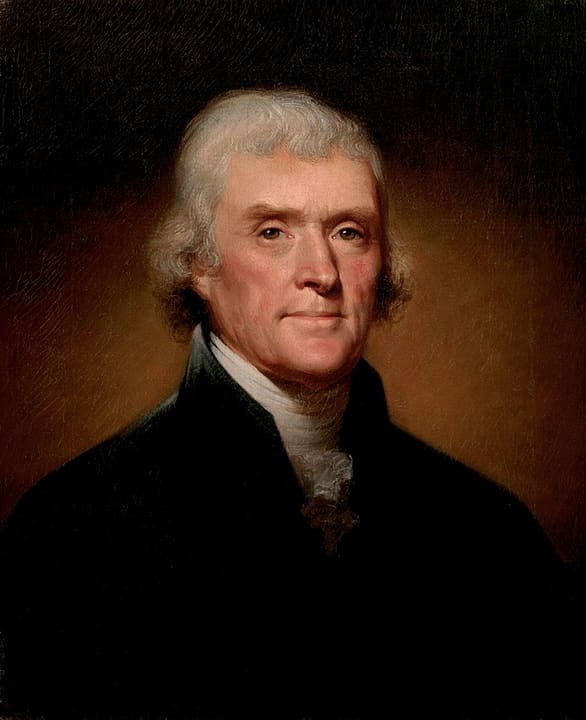
- Thomas Jefferson: Drafter of the bill, abroad in France when it became law
- James Madison: Delegate who revived the bill and steered it to passage
- Patrick Henry: Leading advocate of a tax for Christian teachers
- Archibald Cary: Senate speaker whose signature appears on the enrolled copy
- Benjamin Harrison: Speaker of the lower house, also a signer of the act

Summary
An Act for establishing religious Freedom is a law of the Commonwealth of Virginia, passed by the General Assembly on 16 January 1786. Thomas Jefferson drafted it in 1777 as part of a committee's general revision of Virginia's laws after independence, and it was introduced in 1779, when it failed to pass. The Church of England had been the established church of the colony, supported by taxes, and dissenters such as Baptists and Presbyterians had faced fines and imprisonment. In 1784 a bill supported by Patrick Henry proposed a general assessment, a tax to support teachers of the Christian religion with each taxpayer naming the church to receive his share. James Madison opposed it, and his Memorial and Remonstrance against Religious Assessments (1785), together with many petitions from dissenting congregations, helped defeat it. Madison then brought Jefferson's bill forward and guided it through the Assembly while Jefferson was serving as minister to France. The act has three parts. The first is a single long preamble, a chain of clauses beginning with Whereas. It states that Almighty God created the mind free and that attempts to influence it by punishments or civil disabilities produce only insincere and mean habits and depart from the plan of the holy author of our religion, who, though Lord of body and mind, chose not to spread it by coercion. It charges legislators and rulers, civil and ecclesiastical, with setting up their own fallible opinions as infallible; calls it sinful and tyrannical to compel a man to pay for opinions he disbelieves; holds that even forcing him to support a teacher of his own persuasion deprives him of the liberty of choosing his pastor; and declares that civil rights do not depend on religious opinions any more than on opinions in physics or geometry. Religious tests for office corrupt the religion they mean to encourage. The magistrate may act when principles break out into overt acts against peace and good order, but not before. Truth, left to herself, is the sufficient antagonist of error and needs only free argument and debate. The second part, the enacting clause, provides that no one shall be compelled to attend or support any worship or ministry, nor suffer in body or goods for his religious opinions, and that all shall be free to profess and argue their opinions without any effect on their civil capacities. The third part admits that one Assembly cannot bind later ones, yet declares that the rights asserted are natural rights of mankind and that any repeal would infringe them. The enrolled act is signed by Archibald Cary, Speaker of the Senate, and Benjamin Harrison, Speaker of the House of Delegates. The Assembly shortened Jefferson's preamble before passage, and the library text is the enrolled act as transcribed by the Library of Virginia.
Virtues in this work
- Justice: The act forbids that any citizen be barred from offices of trust or burdened in body or goods because of his religious opinions.
- Humility: It reminds legislators and rulers that they are fallible and uninspired men with no rightful dominion over the faith of others.
- Prudence: It draws a careful line, leaving opinions free while allowing government to act when principles break out into overt acts against peace and good order.
Plot or Argument
- Preamble: the mind created free
The act opens with Almighty God having created the mind free. Temporal punishments and civil incapacities beget insincere and mean habits and depart from the plan of the holy author of our religion, who chose not to propagate it by coercion though it was in his power.
- Preamble: the presumption of rulers and compelled support
Fallible and uninspired legislators and rulers, civil and ecclesiastical, have imposed their opinions and maintained false religions through all time. Compelling contributions for opinions a man disbelieves is sinful and tyrannical, and even compelling support for his own teacher removes his liberty to choose the pastor whose morals he would follow and withdraws a proper incentive from the ministry.
- Preamble: civil rights and religious tests
Civil rights do not depend on religious opinions any more than on opinions in physics or geometry. Barring a citizen from office unless he professes or renounces an opinion injures his natural right and corrupts religion by bribing outward conformity.
- Preamble: the limits of the magistrate and the strength of truth
Restraining opinions because of their supposed ill tendency would make the magistrate's opinion the rule of judgment and destroy religious liberty; government may interfere only when principles break out into overt acts against peace and good order. Truth is great and will prevail if left to herself, with free argument and debate as her natural weapons.
- Enacting clause
No man shall be compelled to frequent or support any religious worship, place or ministry, nor be burdened or suffer on account of his religious opinions; all shall be free to profess and argue their opinions, which shall not diminish, enlarge or affect their civil capacities.
- Declaration of natural right
The Assembly acknowledges that it cannot legally bind future Assemblies, but declares that the rights asserted are natural rights of mankind and that any act repealing or narrowing the statute will infringe natural right.
Characters
- Thomas Jefferson, author
Drafted the bill in 1777; in Paris as American minister when it passed.
- James Madison, legislative sponsor
Wrote the Memorial and Remonstrance of 1785 and carried Jefferson's bill through the Assembly.
- Patrick Henry, supporter of the general assessment
Backed the 1784 bill to support teachers of the Christian religion by tax, which Madison opposed.
- Archibald Cary, Speaker of the Senate
Signed the enrolled act.
- Benjamin Harrison, Speaker of the House of Delegates
Signed the enrolled act.
Lessons
Faith cannot be forced
The preamble argues from the nature of the mind and from the example of the author of Christianity, who chose not to spread his religion by coercion. Punishments and penalties, it says, produce not belief but outward pretence and meanness of spirit.
- What two results of forced religion does the act name?
- Why does the act point to the example of the holy author of our religion?
- Can a law change what a person truly believes?
Paying for another's teaching
The act calls it sinful and tyrannical to make a man pay for the spread of opinions he disbelieves, and holds that even supporting his own church by tax takes away his freedom to choose the pastor he finds most persuasive. This was the issue of the general assessment debate of 1784-1785.
- Why would the act object even to a tax that let each person choose his own church?
- How does the act say voluntary giving benefits ministers?
- Why did Patrick Henry and others think a general assessment would help Virginia?
Opinions and acts
The statute separates opinions, which government may not restrain, from overt acts against peace and good order, which it may. It warns that a magistrate who judges opinions by their supposed tendency will simply make his own opinions the rule.
- Where does the act draw the line between what government may and may not do?
- Why is judging opinions by their ill tendency called a dangerous fallacy?
- Is it always easy to tell where an opinion ends and an act begins?
Truth and free argument
The preamble ends with the conviction that truth is great and will prevail if left to herself, needing only free argument and debate. The enacting clause accordingly protects the freedom to profess opinions and to maintain them by argument.
- What are truth's natural weapons, according to the act?
- According to the act, what happens to errors once people are permitted freely to contradict them?
- Does truth always prevail in a free argument?
Context
Before the Revolution the Church of England was established by law in Virginia and supported by public levies, and dissenters, especially Baptist preachers, were sometimes jailed for preaching without licence. The Virginia Declaration of Rights of 1776 declared that all men are equally entitled to the free exercise of religion, but it left open whether the state could support religion by taxes. The debate over a general assessment in 1784-1785 forced that question.
Composition
Jefferson drafted the bill in 1777 for the committee of revisors, and it was printed as Bill No. 82 in their report and introduced in the Assembly in 1779, where it was not passed. After the assessment bill was defeated in 1785, Madison introduced Jefferson's bill. The House of Delegates passed it in December 1785; the Senate amended it, the two houses agreed, and it became law on 16 January 1786. The Assembly removed or shortened several passages of Jefferson's preamble, including its opening argument that opinions follow the evidence presented to the mind rather than the will. Jefferson later wrote in his autobiography that an amendment to insert the words Jesus Christ into the preamble was rejected. The library text is the enrolled act from the Records of the General Assembly, as transcribed by the Library of Virginia.
Reception
Jefferson had the statute translated and circulated in Europe from Paris, where it was widely praised. It remains part of Virginia law, and Jefferson named it as one of the three achievements on his epitaph. Madison drew on the Virginia experience when he proposed the religion clauses of the Bill of Rights in 1789, and the Supreme Court has cited the statute and the Memorial and Remonstrance in interpreting the First Amendment. Historians and judges have disagreed over how far the Virginia settlement should guide the reading of the First Amendment, which applied at first only to Congress.
Comparisons
- madison-selected-writings
Madison's Memorial and Remonstrance (1785) defeated the general assessment with arguments close to the statute's, that religion can be directed only by reason and conviction and that even three pence of compelled support is a matter of principle.
- virginia-declaration-of-rights
Section 16 of the 1776 Declaration of Rights, amended by Madison to speak of the free exercise of religion rather than toleration, is the principle the statute turns into a binding law.
- the-founding-documents
The religion clauses of the First Amendment, proposed by Madison in 1789, forbid Congress to establish religion or prohibit its free exercise, a federal counterpart to the Virginia act.
- jefferson-selected-writings
Query XVII of Jefferson's Notes on the State of Virginia argues for religious freedom in the same spirit, including the remark that a neighbour's belief in twenty gods or none neither picks his pocket nor breaks his leg.
- jefferson-first-inaugural-address
Jefferson's call in 1801 to tolerate error where reason is left free to combat it carries the statute's argument from religion into politics.
- on-liberty
Mill's chapter on liberty of thought and discussion develops at length the statute's conviction that truth gains when error may be openly answered.
Quotes
Frequently cited
“Almighty God hath created the mind free”
Frequently cited
“that to compel a man to furnish contributions of money for the propagation of opinions which he disbelieves is sinful and tyrannical”
Frequently cited
“that Truth is great, and will prevail if left to herself, that she is the proper and sufficient antagonist to error, and has nothing to fear from the conflict, unless by human interposition disarmed of her natural weapons free argument and debate”
“that our civil rights have no dependence on our religious opinions any more than our opinions in physics or geometry”
“that all men shall be free to profess, and by argument to maintain, their opinions in matters of Religion, and that the same shall in no wise diminish, enlarge or affect their civil capacities.”
For Students
A reading companion for classical Christian high school students. See the student guide.
Reading Guide
Watch for
- The single long first paragraph: count its clauses beginning with that and notice how each adds a reason for the law.
- The appeal to the holy author of our religion, who chose not to propagate it by coercion though he had the power.
- The comparison of religious opinions with opinions in physics or geometry.
- The line between opinions and overt acts against peace and good order.
- The final paragraph's admission that one Assembly cannot bind the next, followed by its declaration of natural right.
Key terms and names
- Established church
- A church supported and favoured by law and public taxes; in colonial Virginia it was the Church of England.
- General assessment
- The 1784 proposal to tax Virginians for the support of Christian teachers, with each taxpayer naming the church to receive his share.
- Preamble
- The opening part of a law giving its reasons; here a chain of clauses beginning with Whereas.
- Civil incapacitations
- Legal disabilities, such as being barred from public office, imposed on people for their religious beliefs.
- Magistrate
- A civil officer with power to enforce law; the act forbids the magistrate to intrude into the field of opinion.
- Enrolled act
- The final official copy of a law as passed by both houses and signed by their speakers, which is the library's text.
- Natural rights
- Rights belonging to people by nature rather than by grant of government; the final paragraph places religious freedom among them.
Seminar Questions
- Comprehension What does the enacting clause say no one may be compelled to do?
- Comprehension According to the preamble, what is wrong with requiring a man to support even a teacher of his own religion?
- Comprehension When does the act say it is time enough for government officers to interfere?
- Interpretation Why does the act argue from the example of the holy author of our religion rather than only from reason or rights?
- Interpretation What does the comparison with physics and geometry suggest about how the act views religious opinions and citizenship?
- Interpretation If the Assembly admits it cannot bind later Assemblies, what does the final paragraph accomplish?
- Big Question Is it wrong for a government to require citizens to support religion, even religion they share?
- Big Question Will truth always prevail if left to free argument and debate?
Faith Connections
- Matthew 26:51-53 (Scripture)
Jesus tells Peter to put away his sword and says he could call more than twelve legions of angels; the statute speaks of the Lord of body and mind who chose not to spread his religion by coercion though it was in his power.
- Romans 14:5 (Scripture)
Let every man be fully persuaded in his own mind; the statute rests on the conviction that belief must be the mind's own persuasion.
- Tertullian, To Scapula 2 (Church Fathers)
Tertullian told a Roman governor that it is no part of religion to compel religion, which must be embraced freely, an argument the statute makes against Christian rulers as well.
- John Locke, A Letter Concerning Toleration (1689) (Great Conversation)
Locke argued that the magistrate's power reaches outward acts and not the inward persuasion of the mind, a distinction the statute uses when it separates opinions from overt acts.
Logic and Rhetoric
Central argument: God created the mind free and the founder of Christianity refused to spread it by force; coercion in religion produces only pretended belief, corrupts religion and makes fallible rulers judges of truth; civil rights do not depend on religious opinion; truth needs only free debate; therefore no one should be compelled to support or attend any worship or suffer for his beliefs, and these rights are natural.
Rhetorical device: periodic sentence with accumulated premises. The entire preamble is one sentence of clauses joined by that and semicolons, holding back its conclusion until the words Be it enacted; it ends with the personification of Truth disarmed of her natural weapons (quote 3).
Debate: Resolved: that a government may never use tax money to support religious teaching, even if each taxpayer chooses the church that receives his share.
Memory Work
Almighty God hath created the mind free
that Truth is great, and will prevail if left to herself, that she is the proper and sufficient antagonist to error, and has nothing to fear from the conflict, unless by human interposition disarmed of her natural weapons free argument and debate
Writing Prompts
Essay: Trace how the preamble's reasons lead to each provision of the enacting clause, and explain which reason seems to carry the most weight.
Comparison with Memorial and Remonstrance and Notes of Debates in the Federal Convention: Compare the arguments of Madison's Memorial and Remonstrance with those of the statute's preamble, and explain how the two documents worked together to settle Virginia's assessment debate.
Medical Lens
The statute concerns religious liberty and the limits of civil government and has no medical content.
Creative Prompts
- Dialogue
Write a debate in the Virginia House of Delegates in 1784 between a supporter of Patrick Henry's general assessment and a Baptist petitioner who opposes it.
- Classroom
Mark each Whereas clause of the preamble on a large chart and trace how each one leads to a part of the enacting clause.
- Fiction
Tell the story of a Baptist preacher jailed in Virginia in the early 1770s who lives to hear that the act has passed in 1786.
- Essay
Explain why the act's final paragraph declares the rights natural even though it admits that a later Assembly could legally repeal the law.
Further Reading
- The Virginia Statute for Religious Freedom: Its Evolution and Consequences in American History, Merrill D. Peterson and Robert C. Vaughan (eds.)
Collection of essays by historians on the statute's making and influence.
- Church and State in Revolutionary Virginia, 1776-1787, Thomas E. Buckley
Detailed history of the assessment debate and the statute's passage.
- The First Freedoms: Church and State in America to the Passage of the First Amendment, Thomas J. Curry
Survey of church-state arrangements in the colonies and early states.
- Wellspring of Liberty: How Virginia's Religious Dissenters Helped Win the American Revolution and Secured Religious Liberty, John A. Ragosta
Study of the Baptist and Presbyterian dissenters who pressed for religious freedom.
Verification notes
All five quotations were found by Grep in content/texts/virginia-statute-for-religious-freedom.txt, the Library of Virginia transcription of the enrolled act. The enrolled act reflects the Assembly's amendments, so its wording differs from Jefferson's 1777 draft and from versions printed from that draft (which begin Well aware that Almighty God hath created the mind free). The account of the rejected Jesus Christ amendment rests on Jefferson's autobiography (1821). Signatures of Archibald Cary and Benjamin Harrison are taken from the transcription.
- Confirm the date the House of Delegates first passed the bill in December 1785 (often given as 17 December).
- Confirm the bill's number (82) in the 1779 Report of the Committee of Revisors.
- Confirm the current location of the statute in the Code of Virginia.