Work record
Buck v. Bell
1927 · Early 20th Century · Court Decision · English
Abstract
Content Note. The decision upheld forced sterilization and uses diagnostic labels of the 1920s; readers should approach it with guidance.
Question Presented. Could Virginia, consistent with the Fourteenth Amendment's guarantees of due process and equal protection, order a young woman confined in a state colony to undergo an operation ending her ability to bear children, on the ground that her supposed condition was inherited?
Arguments. Buck's attorney maintained that the Constitution forbade the government to end anyone's power of parenthood, and that singling out residents of institutions treated like cases unequally. Virginia pointed to the hearings, guardian and appeals the act required, to its legislative declarations on heredity, and to benefits it claimed for patients and public alike.
Holding. Eight justices sustained the act. Holmes found the hearings adequate, accepted the findings below, likened the demand to the sacrifices of soldiers, and invoked the 1905 vaccination precedent. A law applied as far as its means reach, he added, satisfies equal protection. Butler alone voted otherwise.
Later History. Virginia operated under the act for nearly fifty years until repeal in 1974, and its governor apologized in 2002. The ruling still stands formally, though Skinner (1942) treated procreation as a basic liberty. Archival work published in 2008 revealed that the young woman had ordinary intelligence and that her attorney had worked with the Colony's side.
Key figures
- Carrie Buck: Committed young woman chosen as the test case
- John H. Bell: Colony superintendent named as defendant in error
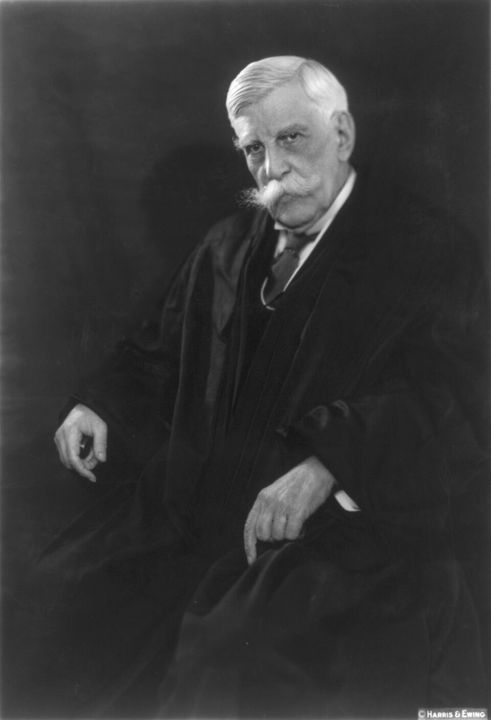
- Oliver Wendell Holmes Jr.: Author of the eight-justice opinion
- Pierce Butler: Lone dissenter, without a written opinion
- Aubrey Strode: Drafter of the Virginia act and the Colony's lawyer

Summary
This record concerns compulsory sterilization and is best read with a teacher's guidance. In March 1924 Virginia enacted a statute permitting the superintendents of certain state institutions to have inmates sterilized if, after a hearing, they were found to be afflicted with hereditary forms of insanity or what the law called imbecility. The statute's preamble declared that heredity played an important part in transmitting such conditions and that sterilized patients could be discharged to support themselves. Its sponsors, including the Colony's attorney Aubrey Strode and its superintendent Dr. Albert Priddy, sought a test case to establish its validity. They chose Carrie Buck, an eighteen-year-old committed to the State Colony for Epileptics and Feeble Minded near Lynchburg after giving birth to a daughter. Her mother was also an inmate of the Colony. The Colony's board ordered the operation, and the Amherst County Circuit Court and the Supreme Court of Appeals of Virginia affirmed. Priddy died in 1925, and his successor, Dr. John H. Bell, became the named party. Buck's lawyer argued that the statute denied her due process, because the state had no power to take away a person's capacity to have children, and equal protection, because it applied only to the few people in institutions and not to the many outside them. The state answered that the procedure contained careful safeguards, that the legislature had made findings about heredity, and that the measure served both the patients and the public. On 2 May 1927 the Court affirmed, eight to one. Justice Holmes found that the procedure, with notice, a guardian, a hearing and two levels of appeal, gave Buck due process. On the substance he accepted the legislative and judicial findings, reasoned that the public welfare could call on citizens for lesser sacrifices than the lives it asks in war, and cited Jacobson v. Massachusetts (1905), which upheld compulsory vaccination. He closed that paragraph with the sentence, in the period's language, "Three generations of imbeciles are enough." He rejected the equal protection claim on the ground that a law does enough when it applies a policy as far as its means allow. Justice Butler dissented without opinion. The library text is Holmes's entire opinion, followed by the note of Butler's dissent; nothing else from the report is included. Carrie Buck was sterilized in October 1927. Virginia sterilized several thousand more people before repealing the law in 1974, and many other states passed or used similar statutes. In Skinner v. Oklahoma (1942) the Court struck down a sterilization law for certain criminals without overruling Buck, and the opinion has never been formally overruled. In 2002 Governor Mark Warner apologized on behalf of Virginia. Paul Lombardo's Three Generations, No Imbeciles (2008) documented that Carrie Buck was of normal intelligence, that her daughter Vivian did well in school before her early death, and that Buck's own counsel, Irving Whitehead, was closely tied to the Colony and its lawyer and did little to defend her.
Virtues in this work
- Justice: The case shows by its failure what justice requires: a genuine defense, honestly tested facts and regard for the person before the court.
- Humility: The confident scientific claims accepted by the legislature and the Court proved false, a warning against certainty in judging the worth of other people.
- Fortitude: Carrie Buck lived for more than five decades after the operation, working and twice marrying, while bearing a loss no later apology could restore.
Plot or Argument
- The case and the constitutional claims
Holmes identifies the writ of error from Virginia's highest court and the two claims under the Fourteenth Amendment: denial of due process and denial of equal protection.
- The statute and its procedure
He summarizes the 1924 act's preamble and then its procedure: a petition by the superintendent, notice to the inmate and a guardian, a hearing before the board, and appeals to the circuit court and the Supreme Court of Appeals. He concludes that procedurally Buck received due process.
- The substantive challenge
Turning to the substance, Holmes accepts the lower court's findings, compares the measure to the sacrifices the public welfare demands in war, and relies on Jacobson v. Massachusetts to hold that the state's power extends this far.
- Equal protection
To the objection that the law reaches only the inmates of certain institutions, Holmes answers that a law applying a policy to all within its lines, and expanding as its means allow, does all that is required.
- Judgment and dissent
The judgment is affirmed, and the report notes only that Justice Butler dissents.
Characters
- Carrie Buck, plaintiff in error
Young Virginia woman committed to the State Colony and ordered sterilized; later research found her of normal intelligence.
- Dr. John H. Bell, defendant in error
Superintendent of the State Colony who succeeded Albert Priddy and carried out the operation in 1927.
- Justice Oliver Wendell Holmes Jr., author of the opinion of the Court
Wrote the brief opinion upholding the Virginia statute for eight justices.
- Justice Pierce Butler, dissenter
Dissented without filing an opinion.
- Aubrey Strode, counsel for the Colony
Virginia legislator and lawyer who drafted the sterilization statute and defended it in court.
- Irving Whitehead, counsel for Carrie Buck
Former member of the Colony's board whose close ties to its leaders were documented by later historians.
Lessons
Procedure is not the whole of justice
Holmes devotes much of the opinion to the statute's careful procedure and concludes that Buck received due process. Yet the facts later uncovered show that hearings and appeals did not prevent a mistaken result, since her own lawyer did not seriously contest the evidence. The case invites students to ask what procedure can and cannot guarantee.
- What procedural safeguards does Holmes list in the Virginia statute?
- Why might a fair-looking procedure still produce an unjust result?
- What responsibilities does a lawyer have toward a client who cannot easily defend herself?
Deference to findings of fact
Holmes says the Court cannot declare, as a matter of law, that the grounds found by the legislature and the trial court do not exist. Because the record was built by parties seeking the same outcome, the Court's deference rested on facts no one had truly tested. The case shows how an appellate court depends on the record that comes before it.
- What findings did the Circuit Court of Amherst County make about Carrie Buck?
- How does an appeals court decide which facts to accept?
- Should judges ever look behind the findings of a lower court and a legislature?
The reach of an analogy
Holmes rests his reasoning on Jacobson v. Massachusetts, treating the principle behind compulsory vaccination as broad enough to cover sterilization. Students can examine how far an analogy between a temporary public-health measure in an epidemic and a permanent operation on one person can fairly be carried.
- What did the Court decide in Jacobson, and why does Holmes cite it?
- What differences between vaccination and sterilization might weaken the analogy?
Science, law and human dignity
The statute's preamble presented the hereditary transmission of mental conditions as settled experience, reflecting the eugenics movement then supported by many scientists, physicians and reformers. Later genetics and the historical record overturned those claims in Carrie Buck's case. The decision raises lasting questions about how courts and legislatures should treat confident scientific claims when bodily integrity is at stake.
- What does the statute's preamble say about heredity?
- What later evidence did Paul Lombardo find about Carrie Buck and her daughter?
- What does it mean to say that every person bears the image of God, and how might that conviction shape law?
Context
The eugenics movement, drawing on the work of Francis Galton and on early studies of heredity, held that society could improve its future by discouraging reproduction among people judged unfit. Indiana passed the first compulsory sterilization law in 1907, and by the 1920s many states had similar laws, some struck down by state courts. Harry Laughlin of the Eugenics Record Office drafted a model sterilization law that influenced Virginia's statute.
Composition
Strode drafted the 1924 act with Priddy's encouragement, and the two arranged a challenge in order to obtain a ruling from the highest court. At the 1924 hearing a Red Cross nurse and teachers testified about the Buck family, Arthur Estabrook of the Eugenics Record Office examined Carrie's infant daughter, and Laughlin supplied a deposition without having met Carrie. The case was argued in Washington in April 1927.
Reception
The decision encouraged further sterilization laws in the United States, and tens of thousands of people were sterilized under them in the following decades. Its reasoning was later cited by defendants at the Nuremberg trials. Skinner v. Oklahoma (1942) treated procreation as a basic right, and later scholarship, especially Lombardo's, exposed the collusive character of the original litigation. Virginia's General Assembly expressed regret in 2001, and Governor Warner apologized in 2002.
Comparisons
- jacobson-v-massachusetts
Holmes rests his holding on this 1905 vaccination case, extending its account of the police power from an epidemic measure to a permanent operation.
- on-the-origin-of-species
Darwin's theory of natural selection was adapted by his cousin Francis Galton into the eugenic program reflected in the Virginia statute's preamble, a use Darwin himself did not propose.
- the-descent-of-man
Darwin's discussion of how civilized societies care for the weak was quoted by eugenicists, though Darwin also called such sympathy the noblest part of human nature.
- griswold-v-connecticut
Thirty-eight years later the Court protected decisions about having children against state intrusion, a contrast with the deference Holmes showed Virginia.
- lochner-v-new-york
Holmes's dissent in Lochner urged deference to legislative majorities, the same restraint that led him to uphold Virginia's statute in 1927.
Quotes
Frequently cited
“Three generations of imbeciles are enough.”
Frequently cited
“It is the usual last resort of constitutional arguments to point out shortcomings of this sort.”
“There can be no doubt that so far as procedure is concerned the rights of the patient are most carefully considered”
“We have seen more than once that the public welfare may call upon the best citizens for their lives.”
“The principle that sustains compulsory vaccination is broad enough to cover cutting the Fallopian tubes.”
“Mr. Justice BUTLER dissents.”
For Students
A reading companion for classical Christian high school students. See the student guide.
Reading Guide
Watch for
- The two Fourteenth Amendment claims named in the first paragraph.
- The list of procedural steps the statute required before any operation.
- The findings of the Circuit Court that Holmes quotes and declines to question.
- The reliance on Jacobson v. Massachusetts.
- Holmes's answer to the equal protection argument in the final paragraph.
Key terms and names
- Eugenics
- A movement of the late nineteenth and early twentieth centuries that sought to improve the human population by controlling reproduction.
- Writ of error
- The procedure, used before 1928, by which a higher court reviewed a lower court's judgment for errors of law.
- Substantive due process
- The doctrine that the Due Process Clause limits what a state may do, not only how it does it.
- Equal protection
- The Fourteenth Amendment's command that no state deny any person within its jurisdiction the equal protection of the laws.
- Police power
- A state's general authority to legislate for health, safety, morals and welfare.
Seminar Questions
- Comprehension What did Virginia's 1924 statute permit, and what procedure did it require?
- Comprehension On what two constitutional grounds did Carrie Buck challenge the statute?
- Comprehension Which earlier case does Holmes rely on, and for what principle?
- Interpretation Why does Holmes treat the findings of the legislature and the trial court as beyond question?
- Interpretation How does Holmes's comparison to the sacrifices of citizens in war shape his argument?
- Big Question What limits should protect a person's body from the state, even when experts and legislators agree that the public good requires otherwise?
Faith Connections
- Genesis 1:27-28 (Scripture)
Man and woman are created in God's image and blessed to be fruitful, a teaching that Christian critics of eugenics invoked against compulsory sterilization.
- Psalm 139:13-14 (Scripture)
The psalmist praises God for being fearfully and wonderfully made, an affirmation of the worth of every person.
- Pius XI, Casti Connubii (1930) (Great Conversation)
Three years after the decision, the encyclical rejected compulsory sterilization by public authority.
Logic and Rhetoric
Central argument: Holmes argues that the statute's procedure satisfies due process; that the findings of heredity cannot be questioned as a matter of law; that if the state may require citizens' lives and compulsory vaccination, it may require this lesser measure; and that a law reaching only some of those similarly situated still gives equal protection when it applies its policy as far as its means allow.
Rhetorical device: argument from the greater to the lesser (a fortiori). Holmes reasons that because the public welfare may demand the lives of the best citizens, it may demand lesser sacrifices of others (quote 1), and that the vaccination precedent covers this case (quote 2).
Debate: Resolved: that a careful legal procedure is sufficient to make a state's interference with a person's body consistent with due process.
Memory Work
There can be no doubt that so far as procedure is concerned the rights of the patient are most carefully considered
Writing Prompts
Essay: Evaluate Holmes's argument step by step, identifying which premises later evidence undermined and whether the reasoning would stand even if the facts had been as the trial court found.
Comparison with Jacobson v. Massachusetts: Compare the state power upheld in Jacobson with the power upheld in Buck v. Bell, and explain whether Holmes was right to treat them as the same principle.
Medical Lens
Buck v. Bell is a central document in the history of eugenics, hereditarian theories of mental illness and intellectual disability, and the ethics of institutional medicine. It shows physicians and institution superintendents acting as advocates for a statute, the use of hereditary-degeneration theory as legislative fact, and the absence of informed consent; it is now taught in medical ethics as a case of professional and legal failure. Holmes's opinion uses the diagnostic vocabulary of 1927, which should be read as historical terminology.
- Opinion of the Court, the statute's preamble: that experience has shown that heredity plays an important part in the transmission of insanity, imbecility, etc.
Holmes summarizes the legislative findings on heredity and the discharge of institutionalized patients, the hereditarian premises on which the statute rested.
- Opinion of the Court, review of procedure: The superintendent first presents a petition to the special board of directors of his hospital or colony
The procedure by which an institution's superintendent initiated the operation and the board, courts and guardian reviewed it, a window on the authority of asylum administrators in the 1920s.
- Opinion of the Court, closing paragraph: so far as the operations enable those who otherwise must be kept confined to be returned to the world, and thus open the asylum to others
Holmes links sterilization to the discharge of patients and the freeing of institutional beds, reflecting the period's view of the asylum's custodial role.
Creative Prompts
- Essay
Write the dissent Justice Butler never filed, explaining in the legal terms available in 1927 why Virginia's statute should not stand.
- Classroom
Using Lombardo's findings, hold a classroom inquiry into how the 1924 trial record was assembled, and identify each point at which a vigorous defense lawyer might have changed it.
- Essay
Compare Holmes's use of Jacobson v. Massachusetts with the facts of Jacobson itself, and judge whether the analogy holds.
- Dialogue
Write a conversation in 2002 between a Virginia historian and a high school student on the day of Governor Warner's apology, discussing what an apology can and cannot accomplish.
Further Reading
- Three Generations, No Imbeciles: Eugenics, the Supreme Court, and Buck v. Bell, Paul A. Lombardo
The definitive history of the case, based on the trial record and archival research.
- Imbeciles: The Supreme Court, American Eugenics, and the Sterilization of Carrie Buck, Adam Cohen
Narrative account of the people who brought, argued and decided the case.
- In the Name of Eugenics: Genetics and the Uses of Human Heredity, Daniel J. Kevles
Standard history of the eugenics movement in Britain and the United States.
- Eugenics and Other Evils, G. K. Chesterton
A 1922 Christian critique of the eugenics movement, written while such laws were being enacted.
Verification notes
Because the subject is compulsory sterilization, the record keeps clinical description to the minimum the opinion itself contains, and Holmes's diagnostic terms are quoted only where needed and treated as period vocabulary. All six quotations were confirmed by Grep as exact substrings of content/texts/buck-v-bell.txt. Later history (the 1974 repeal, the 2002 apology, and the findings about Carrie Buck's intelligence and her counsel) follows Lombardo's 2008 study.
- Confirm the argument date (usually given as 22 April 1927).
- Confirm the date of Carrie Buck's operation (usually given as 19 October 1927).
- Confirm the approximate number of persons sterilized under the Virginia law (often given as more than 7,000 or about 8,300).
- Confirm that the Virginia General Assembly's resolution of regret was adopted in 2001.