Work record
Elements, Book I
c. 300 BCE · Ancient · Essays · Ancient Greek
Abstract
Background. Teaching in Ptolemaic Alexandria, Euclid organized three centuries of Greek mathematics into thirteen books. The first lays down the foundations that the others presuppose. The library reproduces it from Casey's Victorian school edition, without figures.
Content. Starting from named objects, granted constructions with straightedge and compass, and common notions about equality, Euclid proceeds through congruent triangles, inequalities among sides and angles, parallels, and equal areas. Each result cites its predecessors. The climax shows that for any right triangle the squares built on the two shorter sides together equal the square on the longest, and the final proposition proves the reverse.
Method. Every proposition is either a construction to perform or a property to establish. Many arguments are indirect, assuming the contrary and deriving an impossibility. The assumption about non-meeting lines is held back until it is indispensable.
Edition. Casey rewords the opening definitions, counts Euclid's last two postulates among his axioms, and adds examination questions and exercises for students working without a teacher. His notes defend Euclid's restriction to ideal lines and circles and explain technical vocabulary such as converse, lemma and corollary.
Significance. For over two millennia this book defined what rigorous proof looks like, shaping philosophy, physics and schooling. Doubts about its parallel assumption eventually produced alternative geometries in the nineteenth century.
Key figures
- Euclid: Alexandrian geometer and compiler of the Elements
- John Casey: Nineteenth-century Irish mathematician whose school edition is used
- Pythagoras: Early thinker credited by tradition with Proposition 47
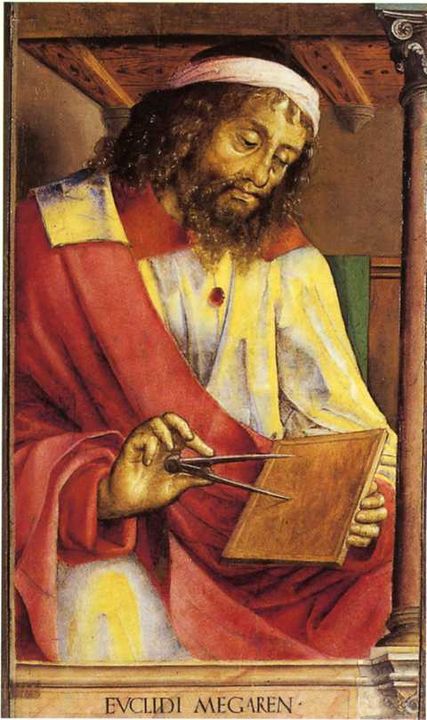

Summary
Book I of Euclid's Elements, composed at Alexandria around 300 BCE, is the opening of the most widely studied mathematics textbook in history. It builds the geometry of straight lines, angles, triangles and parallelograms from a short list of starting points, and it ends with the theorem now named for Pythagoras and its converse. The library text is Book I in the English edition of the Irish mathematician John Casey, The First Six Books of the Elements of Euclid (Dublin, 1885 and later editions), taken from Project Gutenberg. Casey keeps Euclid's order of propositions but rewords some definitions, adds notes, questions for examination and exercises, and rearranges the starting assumptions in the manner of nineteenth-century school editions. The diagrams are not reproduced, so readers should draw each figure as they go. The book opens with definitions: a point has position but no dimensions, a line is length without breadth, and so on through angles, triangles, polygons and the circle. Three postulates grant the right to draw a straight line between two points, to extend it, and to describe a circle with any centre and radius. Twelve axioms follow, from 'things which are equal to the same are equal to each other' to the statement that two lines making interior angles less than two right angles will meet. Casey places among these axioms the famous assumption about parallels that Euclid listed as his fifth postulate. Forty-eight propositions follow, each either a problem (something to construct) or a theorem (something to prove). Proposition 1 constructs an equilateral triangle on a given line using two circles. Propositions 4 and 8 give the side-angle-side and side-side-side tests for congruent triangles; Proposition 5 proves that the base angles of an isosceles triangle are equal, the step long nicknamed the pons asinorum. Propositions 13 to 26 treat angles at a point, the exterior angle, and the relations of sides and angles in a triangle, including Proposition 20, that any two sides of a triangle together exceed the third. Propositions 27 to 32 develop parallel lines, and Proposition 32 proves that the three angles of every triangle equal two right angles. Propositions 33 to 46 deal with parallelograms and with comparing areas, ending with the construction of a square. Proposition 47 proves that in a right-angled triangle the square on the hypotenuse equals the squares on the other two sides, and Proposition 48 proves the converse. Casey closes with questions on the whole book and more than fifty further exercises.
Virtues in this work
- Prudence: Each proof cites the exact postulate, axiom or earlier proposition it relies on, refusing to take any step on mere appearance.
- Industry: Casey's exercises after Propositions 1, 5 and 47 ask the pupil to work out new proofs for himself once he has mastered the book.
- Humility: Euclid asks the reader to grant the drawing of a line in Postulate i, admitting, as Casey notes, that no drawn line is truly geometrical.
Plot or Argument
- Definitions
Casey's definitions name the objects of plane geometry: point, line, straight (right) line, surface, plane, angle, the kinds of angle and triangle, polygons and the circle, with its centre, radius and diameter. Brief notes explain why a point has no dimensions and a line no breadth.
- Postulates, axioms and terms of art
Three postulates allow the drawing of lines and circles; twelve axioms state general truths about equals and wholes and the geometrical assumptions that magnitudes which coincide are equal, that all right angles are equal, and that lines meeting a third at interior angles less than two right angles will meet. Casey then defines theorem, problem, converse, corollary, lemma and the parts of a demonstration.
- Propositions 1-12: first constructions
Using only the postulates, Euclid constructs an equilateral triangle, copies a line to a new point, cuts off a given length, bisects angles and lines, and draws perpendiculars. Proposition 4 (side-angle-side) and Proposition 8 (side-side-side) establish congruence, and Proposition 5 proves the base angles of an isosceles triangle equal.
- Propositions 13-26: angles and triangles
Adjacent angles on a line make two right angles; vertical angles are equal; the exterior angle of a triangle exceeds either interior opposite angle; the greater side faces the greater angle; any two sides exceed the third. Proposition 26 completes the congruence tests with angle-side-angle.
- Propositions 27-34: parallels
After definitions of parallel lines, Propositions 27 and 28 show when a transversal guarantees parallels, and Proposition 29, the first to use the parallel axiom, proves the converse. Proposition 32 shows that a triangle's three angles equal two right angles, and Proposition 34 that opposite sides and angles of a parallelogram are equal.
- Propositions 35-46: area
Parallelograms and triangles on the same or equal bases and between the same parallels are equal in area. Euclid shows how to build a parallelogram equal to a given triangle or rectilineal figure in a given angle, and Proposition 46 constructs a square on a given line.
- Propositions 47-48: the right triangle
Proposition 47 proves by comparing triangles and rectangles that the square on the hypotenuse equals the sum of the squares on the other two sides. Proposition 48 proves the converse directly, as Casey notes, an exception to Euclid's usual indirect proofs of converses.
- Questions and exercises on Book I
Casey ends with thirty-six questions on the whole book, some with answers, and more than fifty exercises on medians, perpendiculars, quadrilaterals and constructions, intended to train students to find proofs of their own.
Characters
- Euclid, author
Alexandrian geometer whose Elements arranges earlier Greek geometry as a chain of proofs from first principles.
- John Casey, editor and translator
Irish mathematician (1820-1891) whose school edition supplies the library text with notes, questions and exercises.
- Pythagoras, traditional discoverer
Sixth-century BCE Greek thinker to whom ancient tradition credits the theorem proved in Proposition 47.
- Proclus, ancient commentator
Fifth-century CE Neoplatonist whose Commentary on Book I is the main ancient source for Euclid's life and the history of the propositions.
Lessons
Begin from what is granted
Book I asks the reader to accept only a few definitions, postulates and axioms and then proves everything else. Each proposition cites the earlier ones it uses, so the whole book becomes a single chain. The method teaches that a proof is only as strong as its starting points and that every step must be accounted for.
- Which postulate and which axiom does Proposition 1 use, and where?
- Why does Casey say that Euclid 'postulates' the drawing of a straight line instead of simply assuming that we can draw one?
- What is the difference between an axiom and a proposition that is merely obvious?
Theory, not only practice
Casey points out that Proposition 2, which copies a length to a new point, would be unnecessary if Euclid allowed the compass to carry distances. Euclid restricts himself to the ideal operations of drawing lines and circles because he is teaching theoretical geometry: the constructions must be justified, not merely performed.
- Why is a drawn line on paper never a true geometrical line, according to Casey's note on the postulates?
- What does Proposition 2 accomplish, and why might a carpenter think it pointless?
- What is gained by limiting the tools one is allowed to use?
The parallel assumption
The assumption that certain lines must meet (Casey's Axiom xii, Euclid's fifth postulate) is used for the first time in Proposition 29. Everything before it holds without it. Later mathematicians spent centuries trying to prove it from the other assumptions, and in the nineteenth century Lobachevsky, Bolyai and Riemann showed that consistent geometries can be built on different assumptions about parallels.
- Why does Proposition 29 need Axiom xii when Propositions 27 and 28 do not?
- How does Proposition 32 on the angles of a triangle depend on the theory of parallels?
- Does the existence of other geometries make Euclid's less true, or show what kind of truth geometry has?
Proof by contradiction
Many propositions, such as 6, 14 and 29, are proved indirectly: Euclid supposes the opposite of what he wants and shows that it leads to something absurd, such as a part equal to the whole. Casey's questions ask students to name this method and to see when Euclid uses it.
- In Proposition 6, what does Euclid suppose, and what absurdity follows?
- Why does Casey call the proof of Proposition 48 an exception?
- Where else, outside geometry, do people argue by showing that the opposite view leads to absurdity?
Context
Greek geometry had grown for three centuries before Euclid, from the traditions about Thales and Pythagoras to the work of Eudoxus and Theaetetus in Plato's circle. Euclid worked at Alexandria, the new capital of the Ptolemaic kingdom, where royal patronage supported the Museum and Library. The Elements gathered earlier results into a deductive order so successful that most earlier elementary textbooks were lost.
Composition
The Elements has thirteen books: plane geometry (I-VI), number theory (VII-IX), incommensurable magnitudes (X) and solid geometry (XI-XIII). Book I lays the foundation for the rest. The text was transmitted in Greek manuscripts, translated into Arabic and from Arabic into Latin in the twelfth century, and first printed in Latin at Venice in 1482. Henry Billingsley's English translation appeared in 1570. John Casey's edition of the first six books was published in Dublin in the 1880s for school and university use; the library text is its Book I.
Reception
For centuries Book I was a standard part of a liberal education in Europe, the Islamic world and later America. Abraham Lincoln recorded that he studied the first six books while a lawyer to sharpen his reasoning. Nineteenth-century work on non-Euclidean geometry showed that the parallel assumption is independent of the others, and David Hilbert's Foundations of Geometry (1899) supplied assumptions that Euclid had used without stating. Teachers have since debated whether Euclid's own order or a modern textbook sequence is the better school course; both approaches have defenders.
Comparisons
- aristotle-posterior-analytics-and-physics
Aristotle's Posterior Analytics describes knowledge as demonstration from first principles that are true, primary and better known than the conclusions; Book I of the Elements is the classic example of that ideal carried out.
- archimedes-the-method
Archimedes builds on Euclid's geometry but reveals the mechanical, heuristic reasoning by which he discovered results before proving them in the strict Euclidean manner.
- poincare-science-and-hypothesis
Poincare argues that Euclid's axioms of geometry, and the parallel assumption in particular, are neither experimental facts nor necessary truths but conventions chosen for convenience.
- discourse-on-method
Descartes says the long chains of simple reasoning used by geometers gave him the model for his method of conducting the reason in every science.
- principia
Newton cast the Principia in the form of definitions, axioms and geometrically proved propositions, so that Euclid's form became the model for mathematical physics.
- the-republic
Book VII of the Republic places geometry in the education of the guardians because it draws the soul toward unchanging truth; Euclid's Elements gave later schools the textbook for that course.
Quotes
“A point is that which has position but not dimensions.”
“A line is length without breadth.”
“Things which are equal to the same, or to equals, are equal to each other.”
“The whole is greater than its part.”
“Euclid’s object was to teach Theoretical and not Practical Geometry, and the only things he postulates are the drawing of right lines and the describing of circles.”
“the sum of the three internal angles is equal to two right angles.”
“In a right-angled triangle (ABC) the square on the hypotenuse (AB) is equal to the sum of the squares on the other two sides (AC, BC).”
For Students
A reading companion for classical Christian high school students. See the student guide.
Reading Guide
Watch for
- The bracketed references in each proof, which show exactly which postulate, axiom or earlier proposition is being used.
- The difference between problems (constructions, ending 'which was required to be done') and theorems (proofs).
- Proposition 5, the first proof many students find hard, and why Casey adds a question about its method.
- Proposition 29, the first use of the parallel axiom.
- How Propositions 35-46 prepare the area arguments of Proposition 47.
Key terms and names
- Postulate
- A construction one is asked to grant without proof, such as drawing a straight line between two points.
- Axiom (common notion)
- A general truth taken as self-evident and incapable of demonstration, such as 'the whole is greater than its part.'
- Theorem
- A proposition stating a property to be proved, consisting of a hypothesis and a conclusion.
- Problem
- A proposition in which something is to be constructed under given conditions.
- Congruent
- Able to be made to coincide by superposition; equal in every respect.
- Converse
- A theorem whose hypothesis is the conclusion of another, as Proposition 48 is of Proposition 47.
- Indirect proof
- Proof that shows the contradictory of a proposition to be false, often by reaching an absurdity.
Seminar Questions
- Comprehension What do the three postulates allow the geometer to do, and what do they not allow?
- Comprehension How does Proposition 1 construct an equilateral triangle, and which axiom proves the three sides equal?
- Comprehension What does Proposition 47 state, and what does Proposition 48 add?
- Interpretation Why does Euclid prove so many things that seem obvious, such as Proposition 20?
- Interpretation Why is it significant that Euclid delays using the parallel axiom until Proposition 29?
- Interpretation Casey says the superposition used in geometry is 'only mental.' What does he mean, and why does it matter?
- Big Question Are the truths of geometry discovered or invented?
- Big Question Should every kind of knowledge, including ethics and theology, try to argue from first principles as Euclid does?
Faith Connections
- Job 38:4-5 (Scripture)
God asks Job who laid the measures of the earth and stretched the line upon it; the order that geometry studies is presented as the Creator's work.
- Proverbs 8:27-29 (Scripture)
Wisdom was present 'when he set a compass upon the face of the depth', an image of measure and boundary at the creation.
- Wisdom of Solomon 11:20 (Scripture)
'Thou hast ordered all things in measure and number and weight', a verse often cited by medieval teachers to explain the place of mathematics in learning.
- Augustine, On Free Choice of the Will II (Church Fathers)
Augustine argues that the truths of number are unchanging and common to all minds, and treats them as a pointer toward the eternal Truth that is God.
Logic and Rhetoric
Central argument: Grant a few definitions, three constructions and a set of self-evident axioms. From these alone, by steps each justified by what precedes, one can construct the basic figures, establish when triangles are congruent, prove the properties of parallels and parallelograms, compare areas, and finally show that the square on the hypotenuse of a right triangle equals the squares on the other two sides.
Rhetorical device: reductio ad absurdum. In Proposition 29 Euclid supposes the alternate angles unequal, shows that the parallel lines would then meet, which contradicts the hypothesis that they are parallel, and concludes that the angles are equal.
Debate: Resolved: That high school students should learn geometry from Euclid's own propositions rather than from a modern textbook.
Memory Work
Things which are equal to the same, or to equals, are equal to each other.
In a right-angled triangle (ABC) the square on the hypotenuse (AB) is equal to the sum of the squares on the other two sides (AC, BC).
Writing Prompts
Essay: Choose one proposition from Book I and explain its proof step by step, naming each postulate, axiom and earlier proposition it uses; then explain what the proof teaches about the nature of certainty.
Comparison with Science and Hypothesis: Euclid presents his axioms as self-evident; Poincare calls the axioms of geometry conventions. Using Book I and Poincare's chapters on geometry, explain each view of the parallel assumption.
Medical Lens
A work of pure geometry with no medical content. Its deductive form influenced later ideals of method in many sciences, including the systematic medical writing of Galen, who admired geometrical demonstration, but Book I itself says nothing about medicine.
Creative Prompts
- Classroom
With only a straightedge and compass, construct Propositions 1, 9 and 10 on paper, then write out each proof, citing every postulate, axiom and earlier proposition you use.
- Dialogue
Write a conversation between a student and a carpenter: the carpenter asks why anyone would prove Proposition 2 when a ruler can measure the line, and the student explains Euclid's purpose.
- Essay
Trace the chain of propositions that Proposition 47 depends on, back to the definitions and postulates, and explain what this shows about how a deductive system is built.
- Fiction
A young Lincoln studies Book I by candlelight on the circuit. Write the scene in which a proof finally makes sense to him.
Further Reading
- The Thirteen Books of Euclid's Elements, Thomas L. Heath (trans. and ed.)
The standard English translation, with extensive commentary on each proposition.
- A Commentary on the First Book of Euclid's Elements, Proclus (trans. Glenn R. Morrow)
The ancient commentary that preserves much of what is known about Euclid and early Greek geometry.
- Byrne's Euclid: The First Six Books of the Elements of Euclid with Coloured Diagrams and Symbols, Oliver Byrne
An 1847 edition that replaces lettered diagrams with coloured shapes.
- Foundations of Geometry, David Hilbert
Hilbert's axioms supply the assumptions Euclid used without stating them.
Verification notes
Contents follow the stored text, which is Book I of John Casey's edition from Project Gutenberg #21076; Casey's definitions and axioms are numbered and worded differently from Euclid's Greek, and he lists Euclid's fourth and fifth postulates among his axioms (xi and xii). All seven quotations were found by search in content/texts/euclid-elements-book-i.txt and copied exactly; Casey's typographic apostrophe is kept. Facts about Euclid's life rest on late sources, chiefly Proclus. The 1482 Venice first printing, Billingsley's 1570 translation and Lincoln's remark (in his 1860 autobiographical sketch) are standard.
- The date of Casey's first edition (the stored text names Dublin, 1885 and later editions; some bibliographies give 1882).
- Casey's life dates (1820-1891) as given here.