Work record
Gibbons v. Ogden
1824 · 19th Century · Court Decision · English
Abstract
Question Presented. New York had granted inventors an exclusive privilege over steam navigation in its waters. Could the state enforce that grant against vessels carrying a federal license, and what does the clause giving Congress authority over trade among the states actually cover?
Arguments. Gibbons's advocates claimed navigation was part of commerce, that national authority over it excluded state rules, and that his federal enrollment entitled him to sail anywhere. Ogden's advocates answered that the states had retained all unsurrendered sovereignty, that commerce meant the exchange of goods rather than passenger traffic, that harbors and pilots had always been local concerns, and that a licensing statute could not cancel a lawful state grant.
Holding. Every participating justice joined in reversing the New York decree. Navigation falls within commerce; congressional authority reaches any trade touching more than one state, wherever it occurs; and the 1793 statute overrode the conflicting grant. The opinion left open whether states retain concurrent authority, and it did not reach Gibbons's alternative claim under the clause protecting inventors' patents.
Significance. Competition opened on the Hudson and fares fell. Cooley (1851) later allowed local rules absent congressional action, and the broad definition supported the Interstate Commerce Act of 1887 and New Deal regulation.
Key figures
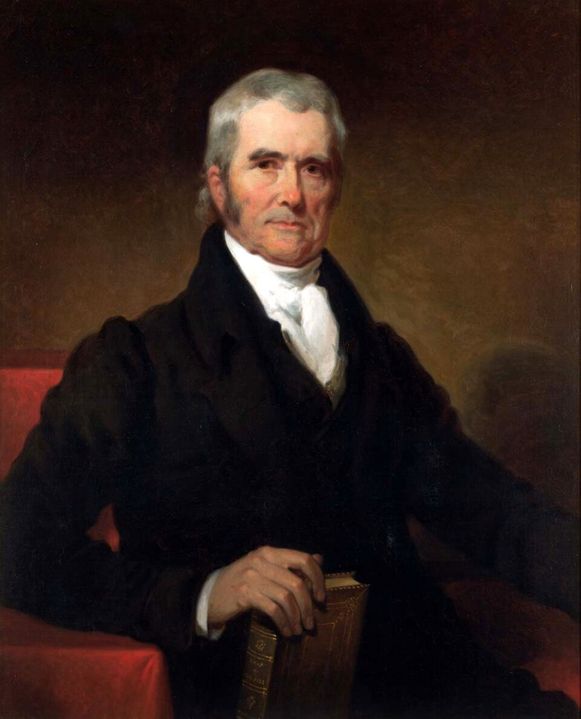
- John Marshall: Chief Justice defining interstate trade for a unanimous bench
- Thomas Gibbons: Steamboat operator holding a federal coasting permit
- Aaron Ogden: Ferry owner operating under the Fulton-Livingston grant
- William Johnson: Concurring justice who saw congressional authority over trade as exclusive

Summary
After Robert Fulton's steamboat made its run up the Hudson in 1807, the New York legislature confirmed and extended an exclusive right, held by Fulton and Robert R. Livingston, to navigate all state waters with vessels propelled by steam. Anyone else needed their license. Aaron Ogden, a former governor of New Jersey, acquired rights under the monopoly to run a ferry between Elizabethtown, New Jersey, and New York City. His former partner Thomas Gibbons began running rival steamboats on the same route, one of them captained by the young Cornelius Vanderbilt, relying on a federal coasting license issued under an act of Congress of 1793. Ogden obtained an injunction from Chancellor James Kent, the New York Court of Errors affirmed it in 1820, and Gibbons appealed. Daniel Webster and Attorney General William Wirt argued for Gibbons that the power to regulate commerce among the states was given to Congress, that commerce includes navigation, that this power was exclusive, and that in any event the New York grant collided with the federal license. Thomas J. Oakley and Thomas Addis Emmet defended the monopoly for Ogden. The states, they said, had been sovereign before the Constitution and kept every power not surrendered; commerce meant buying and selling goods, not carrying passengers; the states had always regulated their own waters, harbours and pilots; and New York's law, endorsed by its legislature, Council of Revision and judges, was a valid exercise of concurrent power that a mere license did not override. The Court, in Chief Justice Marshall's opinion of 2 March 1824, ruled unanimously for Gibbons. Rejecting a construction that would confine federal powers to the narrowest compass, Marshall held that commerce is not merely traffic but intercourse, including navigation; that commerce among the states is commerce concerning more states than one, which does not stop at state lines but reaches into the interior; and that the power to regulate it is complete in itself, limited only by the Constitution and by the political accountability of Congress. He found great force in the argument that the power was exclusive, but did not rest the decision on it. Inspection, quarantine and similar laws he treated as state police measures. Because the coasting license gave Gibbons's vessels the right to navigate New York waters, the monopoly law conflicted with an act of Congress and had to yield under the Supremacy Clause. The library text gives Marshall's opinion; Justice Johnson's concurrence, the arguments of counsel and footnotes are not reproduced. The decision ended the steamboat monopoly and was followed by rapid growth of steam traffic in New York waters. The Court later held, in Cooley v. Board of Wardens (1851), that states may regulate some local aspects of commerce when Congress is silent. Marshall's definition of commerce among the states became the textual foundation for the Interstate Commerce Act of 1887 and the twentieth-century expansion of federal regulation, including Wickard v. Filburn (1942).
Virtues in this work
- Justice: The Court opens navigation between New York and New Jersey to any vessel licensed by Congress, ending a monopoly that kept rival boats out of shared waters.
- Prudence: Marshall decides the case on the narrow ground of conflict with the 1793 act, leaving the harder question of exclusive power for another day.
- Humility: The opinion begins by honouring the New York judges and legislators who had upheld the monopoly, treating their views as entitled to great respect.
Plot or Argument
- The decree and New York's case
Marshall summarizes Gibbons's claim that New York's exclusive grant is repugnant to the commerce and patent clauses, and acknowledges that the laws have been upheld by the legislature, the Council of Revision and the judges of New York, names entitled to great respect.
- Against narrow construction
Granting that the states were once sovereign and joined only by a league, Marshall says the Constitution changed that relation. He accepts a rule of natural and obvious meaning but rejects a strict construction that would cripple the government, warning that refined reasoning can leave the Constitution a magnificent structure unfit for use.
- What is commerce?
Answering the claim that commerce means only buying and selling, Marshall holds that it is intercourse and includes navigation, as the embargo power, the ban on port preferences and universal understanding at the founding confirm.
- Among the several states, and the power to regulate
Commerce among the states concerns more states than one and may pass into the interior, while the completely internal commerce of a state is reserved to it. The power to regulate is plenary within its objects; the people's influence at elections is the restraint the Constitution relies on.
- Exclusive or concurrent? Taxation, inspection and pilots
The opinion distinguishes the concurrent taxing power from the commerce power, treats inspection, quarantine and health laws as part of the states' police power, and finds great force, though no final ruling is needed, in the argument that the commerce power is exclusive.
- Collision with the act of Congress
Whether New York acted under a concurrent commerce power or its police power, its law must yield where it conflicts with a federal statute. The 1793 coasting act licenses vessels, steam or sail, to navigate freely; the injunction against Gibbons therefore cannot stand, and the patent question need not be decided.
Characters
- John Marshall, Chief Justice; author of the opinion
Wrote the Court's opinion defining commerce and its regulation among the states.
- William Johnson, Associate Justice; concurrence
Jefferson appointee who would have held the commerce power exclusive in Congress.
- Thomas Gibbons, appellant
Georgia-born lawyer and planter living in New Jersey who ran steamboats under a federal coasting license.
- Aaron Ogden, appellee
Former New Jersey governor and senator operating a ferry under rights from the Fulton-Livingston monopoly.
- Daniel Webster, counsel for Gibbons
Argued that the commerce power was complete and exclusive in Congress.
- Thomas Addis Emmet, counsel for Ogden
Irish-born New York advocate who defended the state's concurrent power over its waters.
- James Kent, Chancellor of New York
Eminent jurist whose court issued and defended the injunction against Gibbons.
Lessons
Defining a single word
Ogden's counsel read commerce as traffic in goods; Marshall read it as intercourse, including navigation and the carrying of passengers. The scope of national power over the economy for the next two centuries flowed from how this one word was defined in 1824.
- What evidence from the rest of the Constitution does Marshall use to show that commerce includes navigation?
- Why was it important to Ogden's side that commerce meant only buying and selling?
- Should the meaning of a constitutional word be fixed by its use in 1787 or allowed to grow with new technologies?
Where national and state power meet
Marshall drew a line: commerce that concerns more states than one belongs to Congress, while the completely internal commerce of a state is left to it, along with inspection, health and quarantine laws. Much later constitutional history concerns where exactly that line runs.
- Give one example Marshall offers of commerce reserved to the states.
- Why does Marshall say commerce among the states cannot stop at state boundaries?
- As economies become more connected, is any commerce still completely internal to a state?
Deciding no more than necessary
Marshall admitted the strong case for treating the commerce power as exclusive but rested the decision on the narrower ground that New York's law conflicted with an existing act of Congress. He also declined to address the patent clause. Johnson, by contrast, would have decided the larger question.
- Why might Marshall have preferred the narrower ground of conflict with the 1793 act?
- What are the advantages of a concurring justice stating a broader view, as Johnson did?
Monopoly, invention and the public
New York had rewarded Fulton and Livingston with exclusive rights to encourage a risky invention, and other states had answered with retaliatory laws of their own. The case shows how a grant meant to promote progress could become a barrier between states, and why the framers had given Congress power over commerce among them.
- What reasons might New York have had for granting the steamboat monopoly?
- How did the monopoly affect travellers and boat owners in neighbouring states?
- Is a temporary monopoly a fair reward for invention?
Context
Under the Articles of Confederation the states had imposed duties and restrictions on one another's trade, and the commerce clause was meant to end such rivalries. By the 1810s steamboats were transforming travel, and New York's grant to Fulton and Livingston prompted New Jersey and Connecticut to pass retaliatory laws. Gibbons and Ogden, once partners, had become bitter personal enemies, which helped carry the dispute through every level of the courts.
Composition
Kent's injunction was issued in 1819 and affirmed by the New York Court for the Trial of Impeachments and the Correction of Errors in 1820. The appeal was argued in February 1824 and decided on 2 March 1824; it appears in Henry Wheaton's ninth volume of reports. The library text, from Wikisource, contains the Opinion of the Court.
Reception
The decision was popular, since it opened the waters around New York to competing steamboats and lowered fares. Within the Court the question of exclusive versus concurrent state power remained unsettled for decades, through Willson v. Black Bird Creek Marsh Co. (1829) and Cooley v. Board of Wardens (1851). Historians note that Marshall's opinion avoided the most divisive question of the day, whether states could regulate the movement of enslaved people and free Black sailors, which Johnson had faced on circuit in South Carolina.
Comparisons
- wickard-v-filburn
Justice Jackson's 1942 opinion began from Marshall's broad description of the commerce power before upholding federal limits on wheat grown for use on a single farm, a far reach of the 1824 definition.
- mcculloch-v-maryland
Both opinions reject strict construction of federal powers and invoke the Supremacy Clause against a state law; McCulloch concerns implied powers, Gibbons an enumerated one.
- articles-of-confederation
The Articles gave Congress no power to regulate trade among the states, a defect the commerce clause was written to cure and Marshall's opinion recalls.
- the-federalist-papers
Federalist Nos. 11 and 22 urged a national power over commerce to prevent the states' competing trade regulations, the problem the steamboat monopoly had revived.
- the-anti-federalist-papers
Anti-Federalist writers feared that general grants of power would draw internal affairs into the national government, the concern Ogden's counsel pressed and Marshall answered by reserving completely internal commerce to the states.
Quotes
Frequently cited
“Commerce, undoubtedly, is traffic, but it is something more: it is intercourse.”
Frequently cited
“This power, like all others vested in Congress, is complete in itself, may be exercised to its utmost extent, and acknowledges no limitations other than are prescribed in the Constitution.”
“Commerce among the States cannot stop at the external boundary line of each State, but may be introduced into the interior.”
“The completely internal commerce of a State, then, may be considered as reserved for the State itself.”
“In every such case, the act of Congress or the treaty is supreme, and the law of the State, though enacted in the exercise of powers not controverted, must yield to it.”
“The State of New York maintains the Constitutionality of these laws, and their Legislature, their Council of Revision, and their Judges, have repeatedly concurred in this opinion.”
For Students
A reading companion for classical Christian high school students. See the student guide.
Reading Guide
Watch for
- Marshall's respectful acknowledgment of New York's legislature, Council of Revision and judges.
- The definition of commerce as intercourse and the evidence offered for including navigation.
- The phrase concerns more States than one and the matching reservation of completely internal commerce to the states.
- The discussion of inspection, quarantine and health laws as state police powers.
- The point at which Marshall sets aside the question of exclusivity and decides on conflict with the 1793 act.
Key terms and names
- Commerce Clause
- Article I, Section 8's grant to Congress of power to regulate commerce with foreign nations, among the several states and with the Indian tribes.
- Monopoly
- An exclusive right to carry on a trade; New York gave Fulton and Livingston one over steam navigation in its waters.
- Coasting license
- A federal licence under the act of 1793 allowing a vessel to trade along the coast and between ports of the United States.
- Concurrent power
- A power that both the national and state governments may exercise, such as taxation.
- Exclusive power
- A power that belongs to one government only, so that the other may not exercise it even when the first is silent.
- Police power
- The states' general authority to protect health, safety and order, under which Marshall placed inspection and quarantine laws.
- Injunction
- A court order forbidding a party to do something; Chancellor Kent's barred Gibbons from running his boats in New York waters.
Seminar Questions
- Comprehension What right had New York given to Fulton and Livingston, and how did Ogden come to rely on it?
- Comprehension On what federal law did Gibbons rely when he ran his steamboats?
- Comprehension What did Ogden's counsel say the word commerce meant, and how did Marshall define it?
- Interpretation Why does Marshall say the only restraints on the commerce power are the wisdom of Congress and the influence of voters at elections?
- Interpretation Why might Marshall have chosen not to decide whether the commerce power is exclusive?
- Interpretation How does Marshall's warning against narrow construction compare with his acceptance of a natural and obvious reading of the text?
- Big Question When a new invention changes how people live and trade, which level of government is best placed to regulate it, and why?
Faith Connections
- Proverbs 11:26 (Scripture)
He that withholdeth corn, the people shall curse him; Scripture's suspicion of those who hoard what others need bears on the debate over an exclusive right to the waterways.
- 1 Kings 5:1-12 (Scripture)
Hiram and Solomon make a league to float timber by sea between their realms, an ancient example of trade carried across borders by agreement between governments.
- Adam Smith, The Wealth of Nations, Book I (1776) (Great Conversation)
Smith argued that monopolies granted by governments raise prices and restrict trade, a widely read argument in the period when New York's grant was challenged.
Logic and Rhetoric
Central argument: Commerce among the states includes navigation and every form of intercourse that concerns more states than one; Congress's power to regulate it is complete within that sphere; and because Congress had licensed Gibbons's vessels to navigate freely, New York's monopoly conflicted with federal law and had to yield.
Rhetorical device: definition by expansion. Marshall grants the opponent's term and enlarges it in a single sentence (quote 0): commerce is traffic, but it is something more, it is intercourse, so that the narrower meaning is contained within the broader one rather than rejected.
Debate: Resolved: that the power to regulate commerce among the states should belong to Congress alone, even when Congress has not acted.
Memory Work
Commerce, undoubtedly, is traffic, but it is something more: it is intercourse.
The completely internal commerce of a State, then, may be considered as reserved for the State itself.
Writing Prompts
Essay: Explain how Marshall defines both commerce and among the several states, and evaluate whether his definitions leave a meaningful sphere for state power.
Comparison with Wickard v. Filburn: Compare Marshall's account of the commerce power in 1824 with the Court's use of it in Wickard v. Filburn in 1942. Is Wickard a faithful application of Gibbons or an extension of it?
Medical Lens
Marshall mentions state quarantine and health laws only to classify them as police powers; the opinion has no medical substance.
Creative Prompts
- Classroom
Run a moot court in which Webster and Wirt's team argues that the commerce power is exclusive and includes navigation, Oakley and Emmet's team defends New York's monopoly as concurrent state power, and the bench must decide whether to reach the exclusivity question at all.
- Essay
Write a brief for Aaron Ogden that defends the monopoly using the history of state control over harbours, pilots and inland waters.
- Fiction
Tell the story of a day aboard Gibbons's steamboat in 1818, with Captain Vanderbilt dodging the New York sheriffs sent to enforce the injunction.
- Essay
Apply Marshall's distinction between commerce that concerns more states than one and the completely internal commerce of a state to a present-day activity, and explain where you would draw the line.
Further Reading
- The Steamboat Monopoly: Gibbons v. Ogden, 1824, Maurice G. Baxter
Short study of the monopoly, the parties and the litigation.
- Gibbons v. Ogden, Law, and Society in the Early Republic, Thomas H. Cox
Places the case in the economic and political life of New York and New Jersey.
- The First Tycoon: The Epic Life of Cornelius Vanderbilt, T. J. Stiles
Opening chapters describe Vanderbilt's work for Gibbons during the steamboat war.
Verification notes
Grep verified all six quotations as exact strings in content/texts/gibbons-v-ogden.txt. In the stored text the paragraph about powerful and ingenious minds appears at the end rather than in its original position near the opening; the record describes it in the plot section without quoting it. Web search was unavailable, so the dates of Kent's injunction and the Court of Errors decision, and the names of counsel follow standard accounts and should be confirmed. The remark about Johnson's South Carolina circuit case (Elkison v. Deliesseline, 1823) reflects historians' commentary. Vote verified Oct 2026 against Justia, Oyez and Annenberg Classroom: 6-0, Johnson concurring, Thompson not participating.
- Confirm the years of Kent's injunction (1819) and the Court of Errors affirmance (1820).
- Confirm that the paragraph on powerful and ingenious minds belongs early in the opinion as printed in the U.S. Reports.