Work record
Wickard v. Filburn
1942 · Early 20th Century · Court Decision · English
Abstract
Question Presented. Can Congress, regulating interstate trade in grain, penalize a farmer for wheat raised beyond his quota when that surplus is fed to livestock, milled for family bread or kept for next season's sowing?
Arguments. Filburn's side held that planting and eating are local acts outside federal reach, touching the national market only remotely. Government lawyers replied that the statute governed marketing alone, and in any case that a quota system would collapse if crops kept at home escaped it, so control was a necessary and proper means.
Holding. No justice dissented. Rejecting older tests that sorted activities into direct and indirect, Jackson asked only whether an activity substantially affects interstate trade. Grain grown for one's own table displaces purchases and can spill onto the market when prices rise, and the combined behaviour of thousands of similar farms moves national prices. Claims that the speech by the Secretary voided the growers' vote, or that the higher penalty was retroactive, also failed.
Significance. The decision marked the fullest extent of judicial deference to Congress on economic matters after 1937. Its reasoning governed commerce cases for decades and was invoked in Gonzales v. Raich in 2005, while Lopez in 1995 and the Affordable Care Act ruling of 2012 treated it as an outer boundary.
Key figures
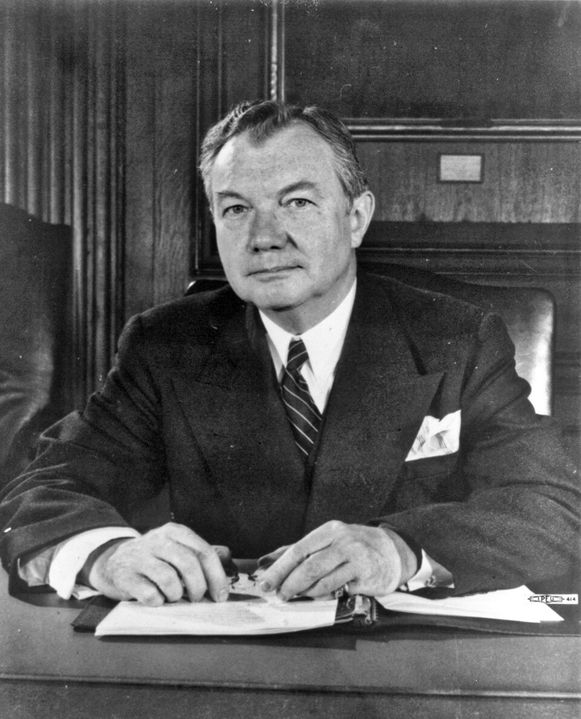
- Robert H. Jackson: Wrote the opinion sustaining the wheat quota
- Roscoe Filburn: Ohio dairy and poultry farmer penalized for planting beyond his allotment
- Claude Wickard: Agriculture Secretary administering the 1938 Act

Summary
Wickard v. Filburn, 317 U.S. 111, decided on 9 November 1942, tested how far the commerce power of Congress could reach into the fields of a single farm. Under the Agricultural Adjustment Act of 1938, the Secretary of Agriculture set national wheat quotas, approved by referendum of growers, and divided them into acreage allotments for each farm. Roscoe Filburn, who kept dairy cattle and poultry on a small farm in Montgomery County, Ohio, received an allotment of 11.1 acres for 1941 but sowed 23. Much of his wheat was fed to his animals, ground into flour for his household or saved as seed. The excess acres yielded 239 bushels, on which the government assessed a penalty of 49 cents a bushel, raised from 15 cents by an amendment passed after he planted. A three-judge district court enjoined collection, partly because Secretary Claude Wickard had praised the quota program in a radio speech shortly before the referendum. Filburn argued that growing grain and eating it at home was production and consumption, local activities whose effects on interstate commerce were at most indirect and so beyond the reach of Congress. The government answered that the Act regulated only marketing, and alternatively that controlling wheat grown for home use was necessary and proper to make its regulation of the interstate market effective. The Court reversed without dissent in an opinion by Justice Robert H. Jackson. He first held that the Secretary's speech could not invalidate the referendum. Turning to the Constitution, Jackson reviewed the course of decisions from Chief Justice Marshall's broad reading in Gibbons v. Ogden through the later distinctions between production and commerce and between direct and indirect effects, and declared those labels no longer controlling. Even local activity, he wrote, may be reached if it exerts a substantial economic effect on interstate commerce. Drawing on stipulated economic data about world prices, regional patterns of production and the large share of the crop consumed on farms, he concluded that home-grown wheat competes with purchased wheat, and that one farmer's trivial contribution counts when taken together with that of many others in the same position. The opinion ends by rejecting the claims that the penalty denied due process or operated retroactively. The library text follows the U.S. Reports but begins with the lower court's rulings; the opening statement of Filburn's farm and acreage and the reporter's footnotes are omitted. The aggregation principle became a foundation of later Commerce Clause doctrine. The Court cited Wickard heavily in Gonzales v. Raich (2005), while United States v. Lopez (1995) and the 2012 health-care decision, National Federation of Independent Business v. Sebelius, discussed it in drawing limits on the commerce power.
Virtues in this work
- Prudence: Jackson grounded the decision in stipulated economic facts about wheat markets rather than in abstract categories.
- Humility: The Court declared that the wisdom, workability or fairness of the wheat plan was for Congress, not judges, to weigh.
- Industry: Filburn's mixed farm of dairy, poultry and wheat, feeding his animals and family from his own fields, is the self-reliant labour at the centre of the case.
Plot or Argument
- The Secretary's radio address and the referendum
Jackson disposes of the district court's view that Secretary Wickard's speech, 'Wheat Farmers and the Battle for Democracy', tainted the growers' vote, observing that nothing showed any voter heard or was misled by it and that a Cabinet officer's comments cannot undo a referendum.
- Framing the commerce question
Darby had already upheld federal regulation of production for commerce, but this Act reaches wheat never intended for market. Filburn calls such regulation local and indirect; the government defends it as regulation of marketing or, alternatively, as necessary and proper to interstate regulation.
- From Gibbons to the end of formulas
The opinion traces a century of decisions: Marshall's expansive account, the long era in which most cases concerned state power, the later tests of production versus commerce and direct versus indirect effects, and the recent decisions that set those categories aside in favour of actual economic effects.
- The economics of wheat
Relying on stipulated facts, Jackson describes the collapse of world wheat prices, the gap between protected domestic prices and the world market, the difference between specialized wheat regions and mixed farms, and the variability of wheat consumed where it is grown.
- Aggregation and competition with the market
Wheat grown for home use supplies a need that would otherwise be met by purchases, and in rising markets it may flow into commerce. One farmer's share is trivial, but taken together with many others it substantially affects price, which Congress may regulate.
- Burdens of regulation and the due process claims
Jackson accepts that regulation restrains the self-interest of some for the advantage of others and leaves such conflicts to Congress. He rejects the due process challenge, treating the quota and penalty as conditions of a program that also offered benefits, and finds no forbidden retroactivity because the penalty attached at threshing. Reversed.
Characters
- Robert H. Jackson, author of the opinion of the Court
Former Attorney General, newly appointed to the bench, who wrote the unanimous opinion.
- Roscoe C. Filburn, appellee
Ohio farmer who exceeded his 1941 wheat allotment and sued to stop collection of the marketing penalty.
- Claude R. Wickard, appellant, Secretary of Agriculture
Administrator of the wheat quota program whose May 1941 radio speech the lower court held against the government.
- Harlan Fiske Stone, Chief Justice
Presided over the Court and had written United States v. Darby (1941), on which the opinion builds.
- John Marshall, cited authority
Chief Justice whose opinion in Gibbons v. Ogden (1824) Jackson presents as the starting point of commerce-power doctrine.
Lessons
Labels versus economic effects
Before 1937 the Court often decided commerce cases by asking whether an activity was 'production' or 'commerce' and whether its effects were 'direct' or 'indirect'. Jackson's opinion rejects these formulas and asks instead whether an activity exerts a substantial economic effect on interstate commerce, a shift in method that changed the scope of federal power.
- What categories did earlier cases use to separate national from local matters?
- Why does Jackson think those categories had stopped working?
- Is a test based on economic effects more or less predictable than one based on labels?
The arithmetic of aggregation
Filburn's 239 bushels could not move a national market. The Court's answer was to consider his conduct together with that of every farmer similarly situated, since Congress legislates for classes of activity rather than single cases. The principle has since been applied far beyond agriculture.
- How does wheat a farmer feeds his own chickens affect the price of wheat sold elsewhere?
- What limits, if any, does the aggregation principle leave on federal power?
- Can you think of another small activity that becomes significant when multiplied by millions?
Who weighs the costs of regulation
Jackson acknowledges that the quota forced some farmers to buy what they could have grown and benefited specialized growers. He answers that conflicts of economic interest are for Congress, not courts, to resolve, a statement of judicial deference that reflects the Court's new posture after the New Deal struggles.
- Who gained and who lost under the wheat quota, according to the opinion?
- Why does the Court say it has nothing to do with the wisdom or fairness of the plan?
- When, if ever, should courts examine the fairness of economic legislation?
Reading Marshall in 1942
Jackson grounds his conclusion in Gibbons v. Ogden, claiming that Marshall had described the commerce power with a breadth never exceeded and had located restraints on it in politics rather than in judicial review. Students can weigh how a twentieth-century court used an early nineteenth-century precedent.
- What did Marshall say about where restraints on the commerce power must come from?
- Is it fair to use a steamboat case to decide a wheat case?
Context
Falling world grain prices in the 1920s and 1930s drove many American wheat farmers toward ruin. The New Deal responded with programs limiting supply to raise prices, beginning with the Agricultural Adjustment Act of 1933, which the Court struck down in United States v. Butler (1936). Congress rebuilt the program on the commerce power in 1938. After 1937 the Court upheld national labor and wage legislation in cases such as NLRB v. Jones and Laughlin Steel and United States v. Darby.
Composition
The case was first argued in May 1942 and reargued in October, after Justice Byrnes had resigned. Jackson's opinion was announced on 9 November 1942 with no separate opinions. The library text reproduces the U.S. Reports as transcribed on Wikisource, beginning with the district court's holdings and omitting the opening statement of facts and all footnotes.
Reception
Wickard came to be taught as the high-water mark of deference to Congress under the Commerce Clause. For half a century after 1937 the Court struck down no federal statute as beyond that power, until United States v. Lopez (1995). The Court relied on Wickard to uphold federal drug laws as applied to home cultivation in Gonzales v. Raich (2005), and in National Federation of Independent Business v. Sebelius (2012) Chief Justice Roberts distinguished it on the ground that Filburn had engaged in the activity of growing wheat.
Comparisons
- gibbons-v-ogden
Jackson treats Marshall's 1824 steamboat opinion as the source of a commerce power whose limits lie chiefly in the political process.
- mcculloch-v-maryland
The government's fallback argument that control of home-grown wheat is necessary and proper to market regulation rests on Marshall's reading of implied powers.
- lochner-v-new-york
Lochner exemplifies the earlier willingness of courts to review economic legislation under due process; Wickard's refusal to weigh the fairness of the wheat plan shows the reversal of that approach.
- the-federalist-papers
Madison in Federalist No. 45 described federal powers as few and defined, chiefly external, a passage often set against the breadth of the commerce power approved here.
- the-anti-federalist-papers
Brutus warned that the general government's powers would expand until they absorbed the states, an argument revived by critics of the aggregation principle.
- the-wealth-of-nations
Smith's account of prices set by supply and demand underlies the stipulated economics Jackson relies on, though Smith drew very different conclusions about government control of grain.
Quotes
Frequently cited
“But even if appellee's activity be local and though it may not be regarded as commerce, it may still, whatever its nature, be reached by Congress if it exerts a substantial economic effect on interstate commerce and this irrespective of whether such effect is what might at some earlier time have been defined as 'direct' or 'indirect.'”
Frequently cited
“That appellee's own contribution to the demand for wheat may be trivial by itself is not enough to remove him from the scope of federal regulation where, as here, his contribution, taken together with that of many others similarly situated, is far from trivial.”
“questions of the power of Congress are not to be decided by reference to any formula which would give controlling force to nomenclature such as 'production' and 'indirect' and foreclose consideration of the actual effects of the activity in question upon interstate commerce.”
“At the beginning Chief Justice Marshall described the Federal commerce power with a breadth never yet exceeded.”
“It is of the essence of regulation that it lays a restraining hand on the selfinterest of the regulated and that advantages from the regulation commonly fall to others.”
“And with the wisdom, workability, or fairness, of the plan of regulation we have nothing to do.”
For Students
A reading companion for classical Christian high school students. See the student guide.
Reading Guide
Watch for
- Jackson's dismissal of the radio-speech issue before he reaches the Constitution.
- The two arguments the government offers: that the Act regulates only marketing, and that it is necessary and proper.
- The historical review that begins with Marshall and ends with the rejection of formulas such as 'direct' and 'indirect'.
- The stipulated statistics about world wheat prices and wheat consumed on the farm.
- The sentence on trivial contributions taken together with those of many others.
Key terms and names
- Commerce Clause
- Article I, Section 8, Clause 3, giving Congress power to regulate commerce among the several states.
- Acreage allotment
- The number of acres of wheat each farm could plant without penalty under the 1938 Act.
- Farm marketing excess
- Wheat produced beyond the farm's quota, subject to a per-bushel penalty unless stored or surrendered.
- Substantial economic effect
- Jackson's test: Congress may reach even local activity if its effect on interstate commerce is substantial.
- Aggregation
- Considering one person's activity together with that of all others similarly situated when measuring its effect on commerce.
- Direct and indirect effects
- An older doctrinal distinction under which only activities directly affecting commerce could be regulated by Congress.
Seminar Questions
- Comprehension What penalty did Filburn owe, and why had it increased after he planted?
- Comprehension What did the district court decide about Secretary Wickard's speech, and how did Jackson respond?
- Comprehension What are the two arguments the government offers in defense of the Act?
- Interpretation Explain in your own words how wheat that never leaves Filburn's farm can affect interstate commerce.
- Interpretation Why does Jackson describe the history of Commerce Clause cases before stating his test?
- Interpretation Does the Court's refusal to judge the fairness of the plan strengthen or weaken its conclusion?
- Big Question If almost every activity affects the national economy in some way, what keeps a government of enumerated powers limited?
Faith Connections
- Genesis 41:33-36 (Scripture)
Joseph advises Pharaoh to store a fifth of the grain in years of plenty, an ancient example of public management of the harvest.
- Leviticus 25:1-7 (Scripture)
The sabbatical year commands the land to rest, a divine limit on planting that invites reflection on who may restrict cultivation and why.
- Leo XIII, Rerum Novarum (1891) (Great Conversation)
The encyclical defends private property while allowing the state to intervene for the common good, the balance at issue in the wheat quota.
Logic and Rhetoric
Central argument: Because the commerce power is to be measured by actual economic effects rather than labels, and because home-grown wheat, taken together across many farms, substantially affects the supply and price of wheat in interstate markets, Congress may regulate even wheat a farmer grows for his own use.
Rhetorical device: concession followed by aggregation. Jackson concedes that Filburn's contribution may be trivial by itself before turning the concession around: taken together with many others it is far from trivial (quote 3).
Debate: Resolved: that the Commerce Clause permits Congress to regulate goods produced for personal use.
Memory Work
But even if appellee's activity be local and though it may not be regarded as commerce, it may still, whatever its nature, be reached by Congress if it exerts a substantial economic effect on interstate commerce and this irrespective of whether such effect is what might at some earlier time have been defined as 'direct' or 'indirect.'
That appellee's own contribution to the demand for wheat may be trivial by itself is not enough to remove him from the scope of federal regulation where, as here, his contribution, taken together with that of many others similarly situated, is far from trivial.
Writing Prompts
Essay: Trace how Jackson moves from Marshall's account of the commerce power to the conclusion that Congress may regulate wheat fed to a farmer's chickens, and evaluate each step of the argument.
Comparison with Gibbons v. Ogden: Compare Marshall's definition of commerce in Gibbons v. Ogden with the way Jackson uses it in Wickard v. Filburn, and decide whether Jackson extends Marshall's reasoning or transforms it.
Medical Lens
The opinion deals with agricultural economics, federal power and due process; wheat appears only as a commodity, with no discussion of food, nutrition or health.
Creative Prompts
- Classroom
Hold a moot court in which one side argues for Filburn using only pre-1937 precedents and the other for the Secretary using Gibbons and Darby.
- Essay
Apply Jackson's aggregation reasoning to a present-day activity of your choice and explain whether Congress could regulate it under the commerce power.
- Dialogue
Write a conversation in 1941 between Roscoe Filburn and a county agricultural agent who has come to measure his wheat fields.
- Fiction
Tell the story of an Ohio farm family in the summer of 1941 deciding whether to store, surrender or pay the penalty on their excess wheat.
Further Reading
- Rethinking the New Deal Court: The Structure of a Constitutional Revolution, Barry Cushman
Study of the changes in Commerce Clause and due process doctrine in the 1930s.
- The Supreme Court Reborn: The Constitutional Revolution in the Age of Roosevelt, William E. Leuchtenburg
Essays on the Court-packing plan and the transformation of constitutional law that preceded Wickard.
- The Struggle for Judicial Supremacy, Robert H. Jackson
Jackson's own 1941 account of the conflict between the Court and the New Deal, written shortly before his appointment.
- Scorpions: The Battles and Triumphs of FDR's Great Supreme Court Justices, Noah Feldman
Group biography that places Jackson's commerce-clause work within the Roosevelt Court.
Verification notes
All six quotations were found by Grep in content/texts/wickard-v-filburn.txt and copied exactly, including the running-together of selfinterest as it appears in the source. The library text omits the opinion's opening statement of facts, so the details of Filburn's farm (Montgomery County, 11.1 acres allotted, 23 sown, 239 excess bushels) come from standard accounts of the U.S. Reports rather than the stored text; the 15- and 49-cent penalties do appear in it. Web search was unavailable during writing, so these figures and the number of participating justices are listed for checking. Verified Oct 2026 (Constitution Center, Oyez, LII): 8-0, Byrnes not participating; argued 4 May 1942, reargued 13 October 1942, decided 9 November 1942.
- Confirm Filburn's figures: 11.1 acres allotted, 23 acres sown, 239 bushels of excess wheat.