Work record
Theogony and Works and Days
c. 700 BC · Ancient · Poetry · Greek
Abstract
Background. A Boeotian farmer-poet, working in the same oral verse tradition as Homer, gave Greece its first systematic account of the divine generations and its first poem of moral instruction.
Narrative. Theogony moves from the gaping void through three reigns. Heaven imprisons his offspring; Cronos ends that reign and then devours his own; Zeus, rescued as a baby, wins a decade of war with help from monstrous allies, and allots each deity a portion of honour. Prometheus' rivalry with Zeus explains the sacrifice, fire and the making of woman.
Instruction. Works and Days turns from gods to a quarrel between brothers over land. To shame Perses, Hesiod tells of the jar of evils, the declining races and a predatory hawk, then lays out a year of ploughing, reaping and voyaging timed by stars.
Themes. Kingship among immortals, the price of cunning, labour as the human lot, straight and crooked judgement, and reverence for the right season.
Library Text. Evelyn-White's 1914 Loeb version renders the hexameters as numbered prose paragraphs. The stored file also carries his introduction, fragments of lost works such as the Catalogue of Women, and The Shield of Heracles.
Significance. Herodotus credited Homer and Hesiod with fixing the Greek gods' names and honours. Plato, Virgil and Ovid all reworked these poems.
Main characters
- Hesiod: Boeotian shepherd turned poet, speaker of both poems
- Perses: His brother, who seized the larger share of their land
- Gaia: Earth, first mother, who arms Cronos against Heaven
- Cronos: Titan king who devours his offspring
- Zeus: Victor over the Titans and guardian of justice
- Prometheus: Trickster Titan who steals fire for mankind
- Pandora: First woman, sent as the price of fire
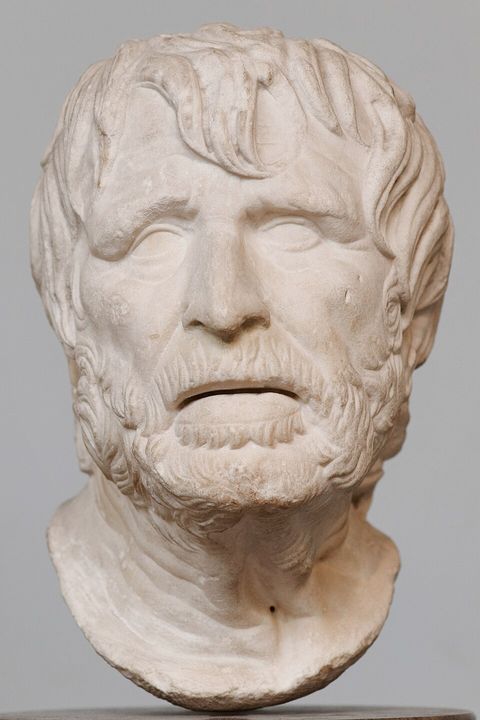

Summary
Hesiod's two complete poems are the oldest Greek attempts to explain, in verse, where the gods came from and how a man ought to live under them. Both are in dactylic hexameter, the meter of Homer, and both begin with the Muses. The Theogony, about a thousand lines long, opens on Mount Helicon, where the Muses appear to Hesiod as a shepherd, tell him they can speak falsehoods that resemble truth as well as truth itself, and breathe a divine voice into him. The poem then sets out the generations of the cosmos. First comes Chaos, then Earth, Tartarus and Eros; Earth bears starry Heaven, and from their union come the Titans, the Cyclopes and the Hundred-Handers. Because Heaven hides his children within Earth, she gives a flint sickle to her youngest son Cronos, who ambushes and maims his father and separates him from Earth; Aphrodite rises from the sea foam that follows. Cronos in turn swallows his own children by Rhea until Rhea gives him a stone wrapped in swaddling clothes and hides the infant Zeus in Crete. Grown, Zeus frees his siblings and the Hundred-Handers, defeats the Titans in a ten-year war, shuts them in Tartarus, overcomes the monster Typhoeus, and distributes honours among the gods. A central episode tells how Prometheus tricked Zeus over the sacrifice at Mecone and stole fire, and how Zeus answered by having the first woman fashioned. The poem closes with Zeus's marriages, beginning with Metis and Themis, and a list of goddesses who bore children to mortal men. Works and Days, some 830 lines, is addressed to Hesiod's brother Perses, who has taken more than his share of their inheritance with the help of bribe-taking lords. Hesiod distinguishes a good Strife, which spurs men to work, from a bad one that breeds quarrels; tells the story of Pandora's jar, from which every evil escapes but Hope; describes the five races of men, golden, silver, bronze, the heroes and the present iron age; and gives the fable of the hawk and the nightingale before praising Justice as the daughter of Zeus. The second half is a farmer's year keyed to the rising and setting of stars such as the Pleiades and Sirius, with advice on ploughing, harvest, winter, sailing and marriage, followed by maxims and a calendar of lucky and unlucky days. Evelyn-White's prose translation appeared in the Loeb Classical Library in 1914. The library file holds the Hesiodic part of that volume: his introduction, Works and Days, Theogony, the fragments of the Catalogue of Women and other lost poems, and The Shield of Heracles; the Homeric Hymns from the same volume have their own record.
Virtues in this work
- Industry: Hesiod urges Perses to fill his barns by working in the right season instead of loitering at the court-house.
- Justice: Hesiod rebukes the bribe-swallowing lords and promises that the city giving straight judgements to strangers and citizens will flourish.
- Temperance: Hesiod warns against loading all one's goods on a ship or overloading a wagon, and sums it up as due measure in all things.
- Prudence: Epimetheus forgets his brother's warning and accepts Pandora, understanding only when the evil is already his.
- Piety: Works and Days tells men to sacrifice to the gods with clean hands, and blames the silver race for refusing honour to the immortals.
Plot or Argument
- Theogony: the Muses of Helicon (ll. 1-115)
A hymn to the Muses, who dance on Helicon and sing of the gods; their meeting with Hesiod the shepherd, the gift of the laurel staff, and their power to bring forgetfulness of grief through song; the gifts they give to kings who judge straightly.
- Theogony: first beings and the overthrow of Heaven (ll. 116-210)
Chaos, Earth, Tartarus and Eros come first. Earth bears Heaven, mountains and Sea, then the Titans, Cyclopes and Hundred-Handers. Heaven hides his children in Earth, and Cronos ends his rule with the sickle; the Furies, Giants and Aphrodite are born from what follows.
- Theogony: the descendants of Night, Sea and the Titans (ll. 211-452)
Long genealogies: the children of Night (Doom, Death, Sleep, Strife and others), the sea deities descended from Nereus, Ocean's daughters and the rivers, Styx and her children, and a hymn to Hecate, honoured by Zeus above all.
- Theogony: Cronos, Rhea and the birth of Zeus (ll. 453-506)
Cronos swallows his children, Rhea hides the newborn Zeus in Crete and gives Cronos a stone, and Zeus forces his father to bring the swallowed gods up again; the Cyclopes give him thunder and lightning.
- Theogony: Prometheus and the first woman (ll. 507-616)
The sons of Iapetus; Prometheus' trick with the ox at Mecone, the hiding and theft of fire, the fashioning of a woman by Hephaestus and Athena as the price, and Prometheus bound with an eagle feeding on his liver until Heracles frees him.
- Theogony: the war with the Titans and Typhoeus (ll. 617-885)
Zeus frees the Hundred-Handers, and with their help wins the long war against the Titans, who are cast into Tartarus; a description of the underworld, its gates, Night, Sleep and Death; Zeus's thunderbolts destroy the monster Typhoeus, and the gods ask Zeus to be their king.
- Theogony: the marriages of Zeus and the goddesses' mortal sons (ll. 886-1022)
Zeus swallows Metis and gives birth to Athena from his head, then marries Themis, Eurynome, Demeter, Mnemosyne, Leto and Hera; the poem ends with goddesses who bore children to mortal men, such as Thetis to Peleus and Aphrodite to Anchises, and a turn toward the Catalogue of Women.
- Works and Days: Perses, the two Strifes and Pandora (ll. 1-105)
An invocation of Zeus, who raises and humbles men; the good Strife of competition and the bad Strife of quarrels; the dispute with Perses over their inheritance; Prometheus, the fire, and Pandora, whose jar releases every evil but keeps Hope inside.
- Works and Days: the five races and the praise of Justice (ll. 106-380)
The golden, silver, bronze, heroic and iron races; the fable of the hawk and the nightingale; the just city that flourishes and the unjust city punished by Zeus; the steep road to Goodness; the praise of work and the rules of neighbourliness.
- Works and Days: the farmer's year and sailing (ll. 381-694)
Ploughing and harvest timed by the Pleiades, Orion and Sirius; making a plough and a wagon; the misery of winter in the month Lenaeon; summer rest in the shade; the right season for sailing, and Hesiod's one voyage, to the games of Amphidamas at Chalcis.
- Works and Days: marriage, maxims and the days (ll. 695-828)
The right age to marry, rules for reverence and conduct, and a calendar of the days of the month that are favourable or unfavourable for tasks.
- Fragments and The Shield of Heracles
The library file continues with Evelyn-White's collection of fragments of the Catalogue of Women and other lost Hesiodic poems, and The Shield of Heracles, a short poem, usually judged not to be Hesiod's own, on Heracles' fight with Cycnus and the scenes on his shield.
Characters
- Hesiod, poet and narrator
Shepherd of Helicon called by the Muses, who also speaks as the elder brother and farmer of Works and Days.
- Perses, Hesiod's brother
Addressee of Works and Days, who has taken more than his share of the inheritance and is urged to work and deal justly.
- The Muses, daughters of Zeus and Mnemosyne
Nine goddesses of song who inspire the poet and bring forgetfulness of sorrow.
- Gaia (Earth), primordial mother
Bears Heaven and the Titans and plots against both Heaven and Cronos to protect her children.
- Ouranos (Heaven), first ruler of the cosmos
Hides his children within Earth and is overthrown by Cronos.
- Cronos, youngest Titan
Overthrows his father, then swallows his own children for fear of being overthrown in turn.
- Rhea, wife of Cronos
Saves the infant Zeus by giving Cronos a stone in swaddling clothes.
- Zeus, king of gods and men
Defeats the Titans and Typhoeus, divides the honours of the gods, and upholds Justice among men.
- Prometheus, son of Iapetus
Crafty Titan who deceives Zeus at Mecone and steals fire for men.
- Epimetheus, brother of Prometheus
Accepts the gift of Pandora against his brother's warning.
- Pandora, the first woman
Fashioned by the gods as the price of fire; she lifts the lid of the jar.
- Dike (Justice), daughter of Zeus
Personified Justice, who reports to her father when men give crooked judgements.
Lessons
Order won out of conflict
The Theogony presents the cosmos as a story of succession: Heaven is overthrown by Cronos, and Cronos by Zeus, until Zeus ends the cycle by swallowing Metis and sharing honours among the gods. For Hesiod, the present order of the world is good because it rests on Zeus's victory and his fair distribution of rights.
- Why does each ruler before Zeus fear his own children, and how does Zeus finally escape the pattern?
- What role do the Hundred-Handers and the Cyclopes play in Zeus's victory?
- Does the Theogony present Zeus's rule as earned, inherited or simply imposed?
Work as the road to goodness
Works and Days answers Perses' greed with a theology of labour: the gods have hidden the means of life, so men must earn their bread by toil in the right season. Hesiod turns farming into a moral discipline, in which diligence, foresight and good neighbourliness are the marks of a just man.
- What is the difference between the two kinds of Strife, and why does Hesiod praise one of them?
- Why does Hesiod say that the road to Goodness is steep at first but easy at the top?
- How does the farming calendar connect the work of a household to the order of the heavens?
Justice and the crooked judges
Hesiod complains of lords who swallow bribes and give crooked judgements, but he insists that Justice is the daughter of Zeus and that the city that judges straightly will flourish. The fable of the hawk and the nightingale shows the claim of mere strength, which the poem then rejects for men, though it allows it among beasts.
- Who is the hawk, and who is the nightingale, in Hesiod's fable for princes?
- How does the poem describe the just city and the unjust city?
- Is Hesiod's confidence that Zeus punishes injustice a description of the world, a hope, or a warning?
Hope, decline and the human condition
The stories of Pandora and the five races explain why life is hard: evils and diseases have been loosed upon the earth, and the iron race lives by toil and sorrow. Yet Hope stays within the jar, and Hesiod says even the iron age will have some good mingled with its evils.
- Why might Hesiod tell two different stories, Pandora and the five races, to explain the same hardships?
- Is Hope's remaining in the jar a blessing kept for men, or an evil held back?
- Why does the heroic race interrupt the pattern of decline from gold to iron?
Context
Hesiod composed in Boeotia in mainland Greece, probably around 700 BC, in a world of small farming communities governed by local aristocratic judges and only beginning to use the alphabet. His poems stand at the head of Greek didactic poetry and were, with Homer, the chief authorities on the gods for later Greeks; Herodotus (2.53) says that Homer and Hesiod gave the Greeks their account of the gods' origins, names and honours.
Composition
The poems come out of the same oral hexameter tradition as Homer's, and scholars still debate how far they were written down by Hesiod himself. The relative dates of Hesiod and Homer are uncertain. Since the discovery of Hittite and Babylonian texts in the 20th century, many scholars have compared the Theogony's succession of divine kings with the Hittite Song of Kumarbi and the Babylonian Enuma Elish, and the five races with Near Eastern and Persian schemes, though the routes of any borrowing are disputed. The ending of the Theogony and parts of Works and Days, especially the Days, may be later additions. Evelyn-White's prose translation was published in the Loeb Classical Library in 1914.
Reception
The five ages shaped Plato's myth of the metals in the Republic and Ovid's account of the ages in Metamorphoses I. Virgil called his Georgics a song of Ascra (Georgics II.176), naming Hesiod as his model for didactic farming poetry. The Theogony's genealogies underlie later handbooks such as Apollodorus' Library, and the Pandora story passed into European art and proverb, where her jar became a box in the Renaissance.
Comparisons
- homeric-hymns
Printed in the same 1914 Loeb volume; the Hymns praise single gods in Homer's meter, while the Theogony sets all of them in one family tree under Zeus.
- apollodorus-library
The Library's first book retells the Theogony's succession of Heaven, Cronos and Zeus, the war with the Titans and Typhoeus in plain prose, often following Hesiod's genealogy closely.
- metamorphoses
Ovid's Book I recasts Hesiod's races as four ages of gold, silver, bronze and iron, dropping the heroic race, and opens with a cosmogony from chaos.
- the-republic
Plato's noble lie of the metals in Book III and the decline of constitutions in Book VIII draw on Hesiod's races of gold, silver, bronze and iron.
- bulfinch-age-of-fable
Bulfinch's opening chapters on the origin of the gods, Prometheus and Pandora and the four ages pass Hesiod's stories, mixed with Ovid's, to 19th-century readers.
- the-bible
Genesis 1-3 also tells of creation, the first woman and the entrance of toil and pain into human life, but by the word of one Creator rather than through generations of gods.
Quotes
Frequently cited
“Only Hope remained there in an unbreakable home within under the rim of the great jar, and did not fly out at the door”
Frequently cited
“Badness can be got easily and in shoals: the road to her is smooth, and she lives very near us. But between us and Goodness the gods have placed the sweat of our brows: long and steep is the path that leads to her, and it is rough at the first”
Frequently cited
“Work is no disgrace: it is idleness which is a disgrace.”
Frequently cited
“we know how to speak many false things as though they were true; but we know, when we will, to utter true things.”
Frequently cited
“Verily at the first Chaos came to be, but next wide-bosomed Earth, the ever-sure foundations of all”
“Of themselves diseases come upon men continually by day and by night, bringing mischief to mortals silently; for wise Zeus took away speech from them.”
“Observe due measure: and proportion is best in all things.”
“For though a man have sorrow and grief in his newly-troubled soul and live in dread because his heart is distressed, yet, when a singer, the servant of the Muses, chants the glorious deeds of men of old and the blessed gods who inhabit Olympus, at once he forgets his heaviness and remembers not his sorrows at all”
For Students
A reading companion for classical Christian high school students. See the student guide.
Reading Guide
Watch for
- The Muses' warning on Helicon that they can tell lies that look like truth, and what it implies for the poem that follows.
- Each succession of power in the Theogony: how Heaven, Cronos and Zeus come to rule and how each tries to keep it.
- The two tellings of Prometheus and the first woman, once in the Theogony and again in Works and Days.
- The pattern of decline in the five races, and the race of heroes that breaks it.
- How the farming year in Works and Days is set by the stars, birds and plants rather than by a written calendar.
Key terms and names
- Theogony
- Greek for the birth or genealogy of the gods; Hesiod's poem traces them from Chaos and Earth to the children of Zeus.
- Chaos
- In Hesiod the first thing that came to be, a yawning gap rather than a confused mixture of matter.
- Titans
- The children of Heaven and Earth, led by Cronos, whom Zeus defeats and imprisons in Tartarus.
- Hundred-Handers
- Cottus, Briareos and Gyes, sons of Earth and Heaven with a hundred arms, whose help wins Zeus the war against the Titans.
- Pandora
- The first woman in Works and Days, named because all the Olympians gave her a gift; she opens the jar of evils.
- Dike
- Justice, a daughter of Zeus, who sits beside her father and tells him of men's crooked judgements.
- Pleiades
- A star cluster whose dawn rising and setting mark harvest and ploughing in Hesiod's farming year.
- Ascra
- Hesiod's village under Helicon in Boeotia, which he calls bad in winter, sultry in summer and good at no time.
Seminar Questions
- Comprehension What gifts do the Muses give Hesiod on Helicon, and what do they tell him about their own speech?
- Comprehension How does Rhea save Zeus from Cronos, and how does Zeus win the war against the Titans?
- Comprehension What wrong has Perses done to his brother, and what does Hesiod urge him to do instead?
- Interpretation Why does Hesiod tell the Prometheus story in both poems, and how do the two versions differ in purpose?
- Interpretation What does the fable of the hawk and the nightingale mean for princes, and why does Hesiod follow it at once with the praise of Justice?
- Interpretation Why does Hesiod wish he had died before or been born after the race of iron, and what hope does he still allow it?
- Big Question Is hard work a punishment, a remedy or a path to goodness, and can it be all three?
- Big Question If the Muses can sing falsehoods that look like truth, how should a reader receive a poem that claims divine inspiration?
Faith Connections
- Genesis 3:17-19 (Scripture)
God tells Adam that he will eat bread in the sweat of his face; Hesiod's gods likewise hide the means of life so that men must toil, though in Genesis the cause is human disobedience rather than a quarrel between gods.
- Proverbs 6:6-11 (Scripture)
The sluggard is sent to the ant to learn foresight in summer; Works and Days gives the same counsel to Perses, with the drones and the full barns.
- Genesis 1:1-3 (Scripture)
In Genesis the one God creates heaven and earth by his word; in the Theogony Earth and Heaven are themselves gods who are born and bear children. The contrast is a fruitful starting point for discussing creation and generation.
- Augustine, City of God VI (Church Fathers)
Augustine examines the Roman scholar Varro's division of theology into the mythical theology of the poets, the natural theology of the philosophers and the civil theology of cities, and argues that the poets' stories of the gods cannot ground true worship; Hesiod is the founding poet of that mythical theology.
Logic and Rhetoric
Central argument: Zeus now rules the world by right of victory and fair distribution of honours; the gods have hidden the means of life and loosed evils upon men; therefore a man must live by honest work in its season and straight justice, for Zeus rewards these and punishes violence.
Rhetorical device: fable (ainos). In Works and Days, ll. 202-211, Hesiod tells a fable for princes in which a hawk seizes a nightingale and boasts that it is foolish to resist the stronger, then turns at once to Perses to reject violence.
Debate: Resolved: that Works and Days is more a poem about justice than a poem about farming.
Memory Work
Work is no disgrace: it is idleness which is a disgrace.
Observe due measure: and proportion is best in all things.
Writing Prompts
Essay: Explain how Hesiod connects the cosmic order of the Theogony with the moral order of Works and Days, using Zeus's victory over the Titans, the figure of Justice and the advice to Perses.
Comparison with Metamorphoses: Compare Hesiod's five races in Works and Days with Ovid's ages of the world in Metamorphoses I. What is gained or lost when Ovid leaves out the heroes?
Medical Lens
Hesiod writes centuries before Greek medicine became a craft with its own texts, so his poems show the older frame in which illness is sent by the gods rather than explained by nature. In the Pandora story, diseases escape the jar and wander among men by day and night without a voice, so that they arrive unannounced; the line is often cited as the earliest Greek statement that disease is ubiquitous and unpredictable, and the plain observation that men grow old quickly in misery sits beside it. Hunger and famine run through Works and Days as the farmer's constant fear, and Zeus is said to spare the just city from famine and plague. The farming calendar notes the effects of the seasons on the body, such as the dog-days when Sirius parches head and knees and men are feeblest, which anticipates the seasonal attention of later Hippocratic writings such as Airs, Waters, Places, though Hesiod gives no theory. The Theogony names Sleep and Death as twin children of Night, the one gentle and the other pitiless, and makes Mnemosyne (Memory) the mother of the Muses, whose song brings forgetfulness of grief. Modern readers sometimes connect that passage with the consoling power of poetry and music in mourning; this is an interpretation, not Hesiod's own language of treatment.
- Works and Days, ll. 90-105
Before Pandora men lived free from heavy sickness; after the jar is opened, silent diseases roam by day and night.
- Works and Days, ll. 225-247
The just city knows no famine; the unjust city suffers famine and plague sent by Zeus, and its women bear no children.
- Works and Days, ll. 582-596
High summer, when Sirius parches head and knees and Hesiod prescribes shade, food and diluted wine.
- Theogony, ll. 75-103
The Muses, daughters of Memory, give a song that lets a grieving man forget his sorrow.
- Theogony, ll. 211-225 and 758-766
Night bears Death, Sleep and the tribe of Dreams; later Sleep and Death dwell together beneath the earth.
Creative Prompts
- Essay
Compare Hesiod's five races with Ovid's four ages in Metamorphoses I. What does Hesiod gain by including the race of heroes?
- Poetry
Write a short calendar poem in Hesiod's manner, linking a season's work in your own region to a star, bird or flower that announces it.
- Dialogue
Write the conversation between Hesiod and Perses at the court-house, with Perses making the strongest case for himself and Hesiod answering with the two Strifes.
- Classroom
Draw the family tree of the Theogony from Chaos to the children of Zeus, marking each succession of power and how it is won.
Further Reading
- Theogony and Works and Days, Hesiod, trans. M. L. West
Modern prose translation with introduction and notes (Oxford World's Classics).
- Theogony, M. L. West (ed.)
Greek text with full commentary (Oxford, 1966); a companion edition of Works and Days followed in 1978.
- The Georgics, Virgil
Latin farming poem that names Hesiod as its model.
- Early Greek Myth: A Guide to Literary and Artistic Sources, Timothy Gantz
Traces each myth back to its earliest sources, Hesiod among the first.
Verification notes
Contents and structure are secure. All eight quotations were checked verbatim against the stored Gutenberg text; line ranges come from the translator's bracketed markers, narrowed by counting within his blocks, so single-line references are approximate within each block. In the stored file Works and Days comes before the Theogony, as in the Loeb volume, with some fragments of lost poems between them, and the Catalogue fragments and The Shield of Heracles after. The file keeps Evelyn-White's footnote numbers inline in the text (for example after 'asphodel'). Dating of Hesiod and the relation of his poems to Near Eastern myths are matters of scholarly debate. Evelyn-White's birth year is given as 1884 from standard reference sources.
- Single-line references for quotations (e.g. Works and Days l. 311 and l. 694) are counted within the translator's blocks; check against a Greek line-numbered edition before citing.
- Line ranges for the Theogony's major divisions follow common scholarly outlines and may differ by a few lines between editions.