Work record
Lochner v. New York
1905 · Early 20th Century · Court Decision · English
Abstract
Question Presented. Does a New York statute capping bakery employees at ten hours daily and sixty weekly take away the freedom of masters and workmen to bargain, without due process of law, in breach of the Fourteenth Amendment?
Arguments. Lochner's side held that selling one's labor is a liberty the Constitution shields, that baking was a common occupation with ordinary risks, and that the measure favored a union rather than protecting anyone's health. The state replied that cellar shops full of heat and flour harmed those who toiled in them, and that elected lawmakers were entitled to act on that finding.
Holding. A five-justice majority struck down the cap. Peckham reasoned that adult bakers could look after themselves and that the law bore no substantial relation to sanitation or public welfare. Three dissenters, writing through Harlan, urged judicial deference to legislative findings on health; Holmes, separately, objected that the majority read laissez-faire economics into the charter.
Significance. The ruling lent its name to roughly four decades in which federal judges scrutinized economic regulation closely. The justices sustained hours rules for women in 1908 and for factory hands in 1917, and from 1937 onward accepted wage and hour legislation, though lawyers and historians still argue over how to assess the decision.
Text. Readers will find Peckham's opinion, part of Harlan's, and every word of Holmes's, with notes omitted.
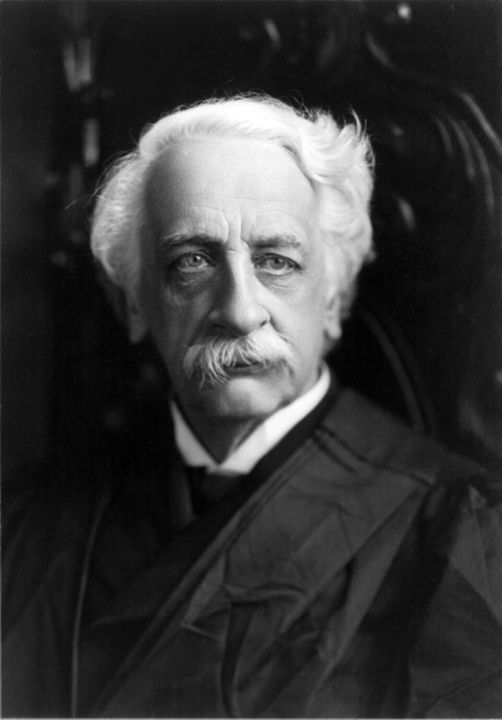
Key figures
- Joseph Lochner: Utica bakery owner fined under the state hours law
- Rufus W. Peckham: New York jurist who wrote that bakers are not wards of the State
- John Marshall Harlan: Dissenter for three, urging deference on health findings
- Oliver Wendell Holmes Jr.: Lone dissenter who rejected reading Spencer into the Constitution
- Henry Weismann: Attorney for Lochner

Summary
In 1895 New York passed the Bakeshop Act, which regulated the sanitation of bakeries and provided that no employee could be required or permitted to work in a bakery more than sixty hours a week or ten hours a day. The hours provision was carried into the state's Labor Law of 1897. Joseph Lochner, who owned a small bakery in Utica, was charged with allowing an employee to work more than sixty hours in one week; it was his second offense, and he was fined fifty dollars. The state's intermediate appellate court and then its Court of Appeals, by four votes to three, upheld the conviction, and Lochner sought review in Washington. The question was whether the hours limit deprived employers and employees of liberty without due process of law under the Fourteenth Amendment. Lochner's counsel, Henry Weismann, argued that the right to buy and sell labor was part of the liberty the amendment protects, that baking was an ordinary trade no more dangerous than many others, and that the law served the interests of organized labor rather than public health. New York answered that the legislature had found long hours in hot, dusty, often underground bakeshops injurious to workers, that the state's police power plainly extended to health, and that courts should defer to that judgment. On 17 April 1905 the Court reversed, five to four. Justice Peckham, building on Allgeyer v. Louisiana (1897), held that freedom of contract is protected liberty, subject to reasonable exercises of the police power. The Court must ask whether a law is a fair and appropriate health measure or an arbitrary interference. Bakers, he wrote, were as intelligent and capable as other workmen and not wards of the state; the trade was not unhealthy enough to justify the limit; clean bread did not depend on hours; and the law's real purpose was to regulate labor in a private business. Justice Harlan, joined by Justices White and Day, dissented on the ground that a statute must be upheld unless plainly beyond legislative power, and cited medical writers describing bakers' long night hours in overheated rooms. Justice Holmes, dissenting alone, wrote that the case was decided upon an economic theory much of the country did not hold, that the Fourteenth Amendment does not enact Herbert Spencer's Social Statics, and that the word liberty should not prevent a dominant opinion from becoming law unless fundamental principles would plainly be infringed. The library text gives Peckham's opinion, the opening portion of Harlan's dissent and Holmes's complete dissent, without footnotes. The Court upheld women's hours laws in Muller v. Oregon (1908) and a ten-hour law for factory workers in Bunting v. Oregon (1917). West Coast Hotel Co. v. Parrish (1937) upheld a minimum-wage law and turned the Court away from Lochner's approach, and the period from about 1897 to 1937 is often called the Lochner era.
Virtues in this work
- Prudence: Harlan counsels that judges facing honest doubt about a health law should leave the responsibility with the legislature.
- Justice: Peckham insists that the state may not favor one class of workers through a law dressed as a health measure if it bears no real relation to health.
- Humility: Holmes writes that his own agreement or disagreement with an economic theory has nothing to do with the right of a majority to embody its opinions in law.
Plot or Argument
- The charge and the right of contract
Peckham identifies the statute, notes that required means no more than an agreement voluntarily made, and declares that the general right to contract about one's business is part of the liberty protected by the Fourteenth Amendment, citing Allgeyer v. Louisiana.
- The police power and its limits
The states may regulate for safety, health, morals and general welfare, and Holden v. Hardy (1898) upheld an eight-hour law for miners. But every such law must be a fair, reasonable and appropriate exercise of that power, and the Court itself must decide whether it is.
- Not a valid labor law
Viewed purely as a labor law, the act fails: bakers are equal in intelligence and capacity to men in other trades and are in no sense wards of the State.
- Not a valid health law
Baking is not unhealthy to a degree that warrants the limit; nearly every trade affects health somewhat; the public's bread is protected by the act's sanitary sections, not by hours. Peckham concludes that the real object was to regulate hours between master and employees.
- Harlan's dissent (excerpt)
Harlan collects precedents affirming the police power, insists that doubt must be resolved in favor of a statute, and points to medical and statistical writing on the conditions of bakers' work; the excerpt breaks off amid this evidence.
- Holmes's dissent
In a few paragraphs Holmes argues that the Constitution embodies no particular economic theory, lists regulations such as Sunday laws, usury laws and compulsory vaccination that already limit liberty, and proposes that a statute stands unless a rational and fair man would necessarily see it as violating fundamental principles.
Characters
- Joseph Lochner, plaintiff in error
German-born owner of a bakery in Utica, New York, convicted for allowing an employee to work over sixty hours a week.
- Justice Rufus W. Peckham, author of the majority opinion
New Yorker who wrote for the Court that the hours limit was an arbitrary interference with liberty of contract.
- Justice John Marshall Harlan, dissenter
Wrote for three dissenters that the legislature's health judgment deserved deference.
- Justice Oliver Wendell Holmes Jr., dissenter
Wrote a brief solo dissent arguing that judges should not read an economic theory into the Constitution.
- Henry Weismann, counsel for Lochner
Former leader of the bakers' union who had supported the Bakeshop Act before becoming its opponent in court.
- Julius M. Mayer, Attorney General of New York
Defended the statute as a health measure.
Lessons
Liberty of contract as a constitutional right
Peckham's opinion treats the freedom of a worker and an employer to agree on terms as part of the liberty the Fourteenth Amendment protects. The idea drew on a long tradition that valued free labor and the right to pursue a calling, and it placed the burden on the state to justify limits.
- Why does Peckham say the right to buy labor and the right to sell it belong equally to both parties?
- Where in the Fourteenth Amendment does the Court find liberty of contract?
- Is the freedom to make agreements about one's own work a basic liberty?
Who judges the reasons for a law?
All the justices agreed the state could protect health; they disagreed over who decides whether a law really does so. Peckham held that the Court must examine the connection between the means and the end, while Harlan and Holmes would leave the matter to the legislature unless the law was plainly unreasonable.
- What test does Peckham propose for deciding whether a law is a real health measure?
- Why does Harlan say courts must keep their hands off when there is doubt?
- Are judges or legislators better placed to weigh evidence about working conditions?
Evidence and the facts of a trade
The opinions disagree about what baking was actually like. Peckham reviewed mortality statistics and found the trade no worse than many; Harlan quoted writers on occupational disease describing night work in overheated rooms. The case shows how factual judgments shape constitutional conclusions.
- What kinds of evidence do Peckham and Harlan each rely on?
- How might a court today gather facts about the health of an occupation?
A constitution for people of differing views
Holmes argued that a constitution is made for people of fundamentally differing views and should not enact either paternalism or laissez faire. His dissent became a touchstone for judicial restraint, while defenders of Peckham's approach answer that some liberties must be protected even against popular majorities.
- What does Holmes mean by saying a constitution does not embody a particular economic theory?
- Does Holmes's test leave any room for courts to protect liberty against legislatures?
- When should a court let the natural outcome of a dominant opinion become law?
Context
Industrial growth in the late nineteenth century brought long hours in crowded workplaces and a wave of state laws regulating wages, hours and conditions. Many New York bakeries operated in tenement cellars, and reform journalists and labor organizers pressed for sanitary rules and hours limits. At the same time a body of legal thought, associated with Thomas Cooley and Christopher Tiedeman, held that the due process clauses protected individuals against class legislation favoring one group over another.
Composition
The Bakeshop Act passed the New York legislature unanimously in 1895 with backing from the Journeymen Bakers' union. Lochner was convicted in 1902; the Appellate Division affirmed in 1903 and the Court of Appeals in 1904, by four votes to three. The case was argued in Washington on 23-24 February 1905. Holmes's dissent, written in a few paragraphs, became one of the most frequently quoted dissents in American law.
Reception
Progressive critics such as Roscoe Pound attacked the decision's view of freedom of contract, and Louis Brandeis's factual brief in Muller v. Oregon (1908) answered it by assembling evidence on working conditions. The Court continued to strike down some economic regulations, including the minimum wage for women in Adkins v. Children's Hospital (1923), until West Coast Hotel Co. v. Parrish (1937) and later cases adopted a deferential standard for economic legislation. Scholars still debate the decision: many treat it as an example of judges substituting their own views for those of legislatures, while others defend it as a principled protection of individual liberty against special-interest legislation.
Comparisons
- slaughter-house-cases
Justice Field's 1873 dissent on the right to pursue a lawful calling supplied much of the reasoning that Peckham's majority adopted thirty-two years later.
- the-wealth-of-nations
Smith called the property every man has in his own labour the most sacred and inviolable, a view of free labor that shaped the liberty-of-contract tradition behind the majority.
- on-liberty
Mill's principle that society may restrain an individual only to prevent harm to others bears on the dispute over whether bakers needed protection from their own agreements.
- wickard-v-filburn
By 1942 the Court had adopted the deference to economic legislation that Holmes and Harlan urged, upholding federal limits on a farmer's own wheat crop.
- the-federalist-papers
Federalist No. 78 distinguishes judicial judgment from legislative will, the line Holmes accused the majority of crossing and the majority believed it was guarding.
Quotes
Frequently cited
“Statutes of the nature of that under review, limiting the hours in which grown and intelligent men may labor to earn their living, are mere meddlesome interferences with the rights of the individual”
Frequently cited
“The Fourteenth Amendment does not enact Mr. Herbert Spencer's Social Statics.”
Frequently cited
“General propositions do not decide concrete cases. The decision will depend on a judgment or intuition more subtle than any articulate major premise.”
“It is a question of which of two powers or rights shall prevail—the power of the State to legislate or the right of the individual to liberty of person and freedom of contract.”
“We think that there can be no fair doubt that the trade of a baker, in and of itself, is not an unhealthy one to that degree which would authorize the legislature to interfere with the right to labor, and with the right of free contract on the part of the individual, either as employer or employé.”
“If there be doubt as to the validity of the statute, that doubt must therefore be resolved in favor of its validity, and the courts must keep their hands off, leaving the legislature to meet the responsibility for unwise legislation.”
For Students
A reading companion for classical Christian high school students. See the student guide.
Reading Guide
Watch for
- Peckham's statement that the right to purchase and sell labor belongs to both parties.
- The phrase fair, reasonable and appropriate and how Peckham uses it as a test.
- Peckham's claim that bakers are not wards of the State.
- Harlan's presumption that doubt must be resolved in favor of a statute.
- Holmes's list of existing laws that already restrict liberty.
Key terms and names
- Liberty of contract
- The freedom of individuals to make binding agreements, which the majority held was protected by the Fourteenth Amendment.
- Police power
- A state's authority to regulate for health, safety, morals and general welfare.
- Due process of law
- The Fourteenth Amendment's guarantee that no state shall deprive any person of life, liberty or property without fair legal procedure and lawful authority.
- Sui juris
- Latin for of one's own right: an adult legally competent to manage his own affairs.
- Laissez faire
- The economic view that government should leave commerce and labor largely to private agreement.
- Judicial restraint
- The view that judges should defer to legislatures unless a law clearly violates the Constitution.
Seminar Questions
- Comprehension What did the New York statute require, and what was Lochner convicted of?
- Comprehension Why does Peckham conclude that the hours limit is neither a valid labor law nor a valid health law?
- Comprehension What examples of existing laws does Holmes give to show that liberty is already limited?
- Interpretation How does Peckham distinguish Holden v. Hardy, which upheld hours limits for miners?
- Interpretation Harlan and Holmes both dissent. How do their reasons differ?
- Big Question Should the freedom to agree on the terms of one's own work be protected by courts against legislatures, or left to the democratic process?
Faith Connections
- Deuteronomy 24:14-15 (Scripture)
The law forbids taking advantage of a poor and needy hired servant and requires wages paid before sunset, a text often cited in debates about the duties of employers.
- Matthew 20:1-15 (Scripture)
In the parable of the laborers in the vineyard the householder answers complaints by asking whether he may not do what he will with his own, an image of freely agreed wages.
- Leo XIII, Rerum Novarum (1891) (Great Conversation)
Written fourteen years before Lochner, the encyclical defended private property and free agreement while holding that the state may limit working hours to protect workers' bodies and souls.
Logic and Rhetoric
Central argument: Peckham reasons that liberty of contract is protected by the Fourteenth Amendment, that the police power may limit it only through measures with a real and substantial relation to health or safety, and that a sixty-hour limit on adult bakers in an ordinary trade has no such relation; Harlan and Holmes reply that the legislature's judgment must stand unless plainly unreasonable.
Rhetorical device: aphorism. Holmes compresses his whole objection into short, memorable sentences such as the line about Spencer's Social Statics (quote 4) and the maxim that general propositions do not decide concrete cases (quote 5).
Debate: Resolved: that the Constitution protects a right of adults to agree on their own hours of work.
Memory Work
The Fourteenth Amendment does not enact Mr. Herbert Spencer's Social Statics.
It is a question of which of two powers or rights shall prevail—the power of the State to legislate or the right of the individual to liberty of person and freedom of contract.
Writing Prompts
Essay: Evaluate the three opinions in Lochner by explaining what each justice thinks a court should ask when a state limits economic liberty for the sake of health.
Comparison with Slaughter-House Cases: Compare Justice Field's 1873 defense of the right to pursue a lawful calling with Peckham's 1905 defense of liberty of contract, and explain how the dissent of one case became the majority view in the other.
Medical Lens
The justices dispute whether long hours in bakeries endangered workers' health: Peckham weighs trade mortality statistics and finds baking no more unhealthy than many occupations, while Harlan's dissent quotes writers on occupational disease about night work in overheated shops, making the case an early example of courts weighing evidence on workplace health.
Creative Prompts
- Classroom
Hold a moot court in February 1905: Lochner's counsel argues liberty of contract, New York's attorney general argues the police power, and three student justices each write one paragraph modeled on Peckham, Harlan or Holmes.
- Essay
Prepare a short factual brief, in the style later used by Louis Brandeis, collecting the kinds of evidence a court might weigh about the health of bakers in 1905.
- Dialogue
Write a conversation in a Utica bakery between Joseph Lochner and a journeyman baker about whether the sixty-hour rule helps or hinders them.
- Essay
Explain Holmes's test for when a court may strike down a statute, and apply it to one law described in the majority opinion.
Further Reading
- Lochner v. New York: Economic Regulation on Trial, Paul Kens
Narrative history of the bakeshop law, the litigants and the litigation.
- Rehabilitating Lochner: Defending Individual Rights against Progressive Reform, David E. Bernstein
Legal historian's argument that the decision has been misunderstood and its reasoning deserves a fairer hearing.
- The Constitution Besieged: The Rise and Demise of Lochner Era Police Powers Jurisprudence, Howard Gillman
Study tracing the decision to nineteenth-century ideas about class legislation and neutral government.
Verification notes
The six quotations (three from Peckham, one from Harlan, two from Holmes) were each found by Grep as exact substrings of content/texts/lochner-v-new-york.txt, including the em dash and the spelling employé. Harlan's dissent in the stored text is an excerpt that ends while he quotes occupational-health writers. The fifty-dollar fine, Weismann's union background and the Court of Appeals' 4-3 vote come from standard histories such as Kens. COURT_TASK.md lists schoolBand 9-10; the schema allows only 9-12.
- Confirm that Julius M. Mayer argued for New York in the Supreme Court.
- Confirm the dates of the Appellate Division (1903) and Court of Appeals (1904) decisions.