Work record
Farewell to Baseball ("The Luckiest Man on the Face of the Earth")
1939 · Early 20th Century · Oratory · English
Abstract
Background. The Iron Horse's strength had faded through 1938, and in May 1939 he ended his record run of games. A Minnesota clinic then identified the cause as a fatal motor neuron disease, and the club scheduled a tribute for Independence Day.
Occasion. A packed stadium, old teammates from the 1927 champions, gifts, plaques, and speeches by others preceded the honoree, who at first could not trust himself to talk.
Content. Speaking unscripted, Gehrig took up the grim headlines only to overturn them, then thanked spectators, fellow players, owners and managers, the crosstown Giants, the men who kept the field, and his family in turn. The final words weighed misfortune against the abundance still left to him.
Themes. Gratitude chosen in the face of mortality, humility in a champion who never mentions his own feats, and the dignity of a public figure accepting a hard fate. The fans themselves are treated as benefactors rather than an audience.
Significance. Often likened to Lincoln's Gettysburg remarks for its brevity and force, the farewell attached Gehrig's name to the illness in American usage and was restaged in a 1942 Hollywood film. No complete recording exists, so the wording known today rests on press accounts and surviving newsreel fragments.
Key figures
- Lou Gehrig: Yankee first baseman, retiring because of ALS, the speaker
- Eleanor Gehrig: His wife, thanked last as his greatest support
- Joe McCarthy: Yankee manager who spoke at the ceremony
- Jacob Ruppert: Late owner of the Yankees, recalled with gratitude
- Miller Huggins: Gehrig's first Yankee manager, also remembered
- Ed Barrow: Yankee general manager and builder of the club
- Babe Ruth: Former teammate who embraced Gehrig after the speech

Summary
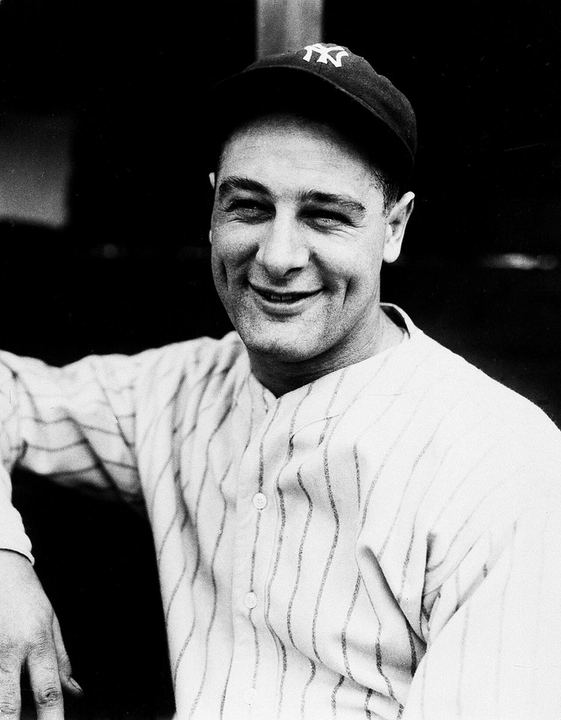
Lou Gehrig's farewell speech was delivered at Yankee Stadium on 4 July 1939, Lou Gehrig Appreciation Day, between the games of a doubleheader against the Washington Senators. Two months earlier Gehrig, whose strength had been failing for a season, had taken himself out of the lineup in Detroit, ending his streak of 2,130 consecutive games. On 19 June, his thirty-sixth birthday, the Mayo Clinic diagnosed amyotrophic lateral sclerosis, a progressive and incurable disease of the motor nerves. A crowd of 61,808 attended; members of the 1927 Yankees, including Babe Ruth, returned for the ceremony, and Gehrig received gifts from his teammates, the rival New York Giants, the stadium staff, and others. Manager Joe McCarthy and other speakers spoke before him. Gehrig at first seemed unable to speak, then came to the microphone without a script and talked for little more than two minutes. He opened by acknowledging the bad news the fans had been reading about and answering it with the claim that he was the luckiest man alive. He then counted his blessings one by one: seventeen years in baseball and the kindness of the fans; the teammates he had played beside; the owner Jacob Ruppert, the general manager Ed Barrow, his first manager Miller Huggins, and McCarthy; the gift from the Giants, a team he had always wanted to beat; the groundskeepers and other workers who had remembered him; his mother-in-law, his parents, who had worked hard to give him an education, and his wife, Eleanor, whom he called a tower of strength. He closed by granting that he had been dealt a bad break while insisting that he had a great deal to live for. Ruth embraced him at the end, and newsreel cameras captured parts of the speech. The Yankees retired his number 4 that day, the first number retired in the major leagues, and the 1942 film The Pride of the Yankees, with Gary Cooper, made the speech known to later generations, though it rearranged the order of its lines.
Virtues in this work
- Humility: Gehrig says nothing of his own records and counts it an honour to have played beside his teammates.
- Fortitude: Weeks after learning his illness was fatal, he stood before more than 61,000 people and spoke without self-pity.
- Hope: He closes by insisting that, despite a bad break, he has a great deal to live for.
- Friendship: Most of the speech is thanks to teammates, managers, rivals, and workers whose company he counts as his good fortune.
Plot or Argument
- The bad news and the claim of good fortune
Gehrig addresses the fans, who had been reading for two weeks about his illness, and sets his own sense of being the luckiest man on earth against it.
- Seventeen years of baseball and its people
He thanks the fans for their encouragement and praises his teammates, then names in turn Jacob Ruppert, Ed Barrow, Miller Huggins, and Joe McCarthy as men he was fortunate to know.
- Gifts from rivals and workers
He counts it a blessing that the New York Giants, the crosstown rivals, sent a gift, and that the groundskeepers and other stadium workers remembered him.
- Family
He thanks his mother-in-law, his parents for their sacrifices to give him an education and a strong body, and his wife for her courage and strength.
- Closing
He concludes that though he has had a bad break he has an awful lot to live for, and the stadium answers with a long ovation.
Key claims
The main steps of the argument, in order, and how they fit together.
- Despite the bad news about his illness, he considers himself the most fortunate man alive.How it is supported: A direct contrast with the headlines the fans had been reading.
- Seventeen years in baseball and the steady kindness of the fans are a great blessing.How it is supported: His own career and the encouragement he received.
- He was fortunate to play beside fine teammates and to know the club's owner, general manager and managers.How it is supported: He names Ruppert, Barrow, Huggins and McCarthy.
- Even rivals and stadium workers have shown him generosity, which he counts as another blessing.How it is supported: A gift from the New York Giants and remembrance from the groundskeepers.
- His parents, mother-in-law and wife have given him sacrifice, support and courage.How it is supported: His parents' hard work for his education and his wife's strength.
- Though he has had a hard break, he still has a great deal to live for.How it is supported: A summing up of the blessings he has just listed.
Argument map
Supported by
- 1Despite the bad news about his illness, he considers himself the most fortunate man alive.
which rests on
- 2Seventeen years in baseball and the steady kindness of the fans are a great blessing.
- 3He was fortunate to play beside fine teammates and to know the club's owner, general manager and managers.
- 4Even rivals and stadium workers have shown him generosity, which he counts as another blessing.
- 5His parents, mother-in-law and wife have given him sacrifice, support and courage.
- 6Though he has had a hard break, he still has a great deal to live for.
Therefore
Plain-language summaries of the author's argument, not quotations.
Lessons
Gratitude as an answer to bad news
Gehrig does not describe his disease or its prognosis. Instead he answers what everyone knew with a long list of people to thank, so that the speech becomes an inventory of gifts rather than of losses. The structure shows gratitude as a deliberate choice about what to dwell on, not a denial of the facts.
- Why does Gehrig mention the bad break at all, both at the beginning and at the end?
- Which people does he thank, and in what order?
- Is it possible to be grateful and grieving at the same time? What does Gehrig's speech suggest?
Humility in the greatest player
One of the most accomplished hitters in baseball history says nothing about his records. He counts it an honour to have played beside his teammates and thanks owners, managers, rivals, and groundskeepers alike. The speech shows humility as attention to others rather than self-deprecation.
- Why might Gehrig leave out his 2,130 consecutive games and his statistics?
- What is the effect of thanking a rival team and the stadium workers in the same breath as the owner?
- How is humility different from thinking little of oneself?
Brevity and plain words
The speech lasted about two minutes and was not written out in full. Its power comes from short, ordinary sentences and a repeated pattern of naming a gift and pausing on it. It shows that an occasion of great feeling often calls for fewer words, not more.
- How does the repeated sentence pattern in the middle of the speech build its effect?
- Why do short speeches like this one and the Gettysburg Address last in memory?
- When have you heard someone say the most by saying very little?
Context
Gehrig had been the steady centre of the Yankee lineup beside Babe Ruth and then Joe DiMaggio, nicknamed the Iron Horse for his durability. During 1938 and spring 1939 his play declined sharply. On 2 May 1939 he told McCarthy he would not play, ending the streak, and in June he went to the Mayo Clinic in Rochester, Minnesota, where physicians diagnosed amyotrophic lateral sclerosis. The Yankees arranged the 4 July appreciation day soon afterwards.
Composition
Gehrig had thought about what to say and his wife is said to have helped him prepare, but he spoke without reading a text. No complete sound recording survives; newsreel footage preserves only parts. The standard wording has been reconstructed from newspaper reports and the surviving film, and published versions differ in details.
Reception
Newspapers across the country reported the speech, and it has been called baseball's Gettysburg Address. Gehrig was elected to the Hall of Fame by special vote that December. The film The Pride of the Yankees (1942) re-staged the speech with the luckiest-man line moved to the end. In the United States ALS has been known ever since as Lou Gehrig's disease, and the speech is regularly replayed and commemorated, including by Major League Baseball's Lou Gehrig Day, first held in 2021.
Comparisons
- on-his-blindness
Milton, losing his sight in middle age, and Gehrig, losing his strength at thirty-six, both turn a bodily affliction into an occasion for patience and thanks rather than complaint.
- the-death-of-ivan-ilyich
Tolstoy's dying judge discovers too late that his life was empty; Gehrig, facing a fatal diagnosis, publicly counts the people who made his life full.
- i-will-fight-no-more-forever
Two short American farewells by men whose struggle has ended: Joseph speaks of the dead and freezing, Gehrig of the living who sustained him, and both are remembered for their plainness.
Quotes
Frequently cited
“Today I consider myself the luckiest man on the face of the earth.”
Frequently cited
“I might have been given a bad break, but I've got an awful lot to live for.”
For Students
A reading companion for classical Christian high school students. See the student guide.
Reading Guide
Watch for
- The opening move, in which Gehrig names the bad news everyone has read and immediately sets his own verdict of good fortune against it.
- The run of sentences in the middle that each name a person or group and close with the same short refrain of appreciation.
- The order of thanks, from fans and teammates through owner and managers, rivals and groundskeepers, to mother-in-law, parents, and wife.
- What Gehrig leaves out: his records, his streak, and any description of his disease.
- The closing sentence, which returns to the bad break of the opening and answers it again.
Key terms and names
- Lou Gehrig Appreciation Day
- The ceremony held by the Yankees at Yankee Stadium on 4 July 1939 between games of a doubleheader, at which Gehrig spoke.
- Amyotrophic lateral sclerosis (ALS)
- A progressive disease of the nerves that control muscles, diagnosed in Gehrig in June 1939 and since known in America by his name.
- The streak
- Gehrig's 2,130 consecutive games played from 1925 to 1939, ended when he benched himself in Detroit on 2 May 1939.
- Joe McCarthy
- The Yankees' manager from 1931, whom Gehrig names among the leaders he was fortunate to play for.
- Miller Huggins
- Gehrig's first Yankee manager, who died in 1929; Gehrig names him among those he was proud to have known.
- Iron Horse
- Gehrig's nickname for his durability and strength, which gives the setting of the speech its poignancy.
Seminar Questions
- Comprehension What had happened to Gehrig in the months before 4 July 1939?
- Comprehension List the people and groups Gehrig thanks in the speech.
- Interpretation Why does Gehrig thank a rival team and the groundskeepers in the same speech as the owner and the manager?
- Interpretation How does the closing sentence answer the opening, and why does Gehrig return to the bad break at all?
- Interpretation Why might Gehrig have chosen to say nothing about his own achievements on the field?
- Big Question Can a person who is dying truly call himself lucky, and what would have to be true about life for that claim to be honest?
- Big Question Is gratitude a feeling that comes to us or a habit we choose and practice?
Faith Connections
- 1 Thessalonians 5:18 (Scripture)
Paul tells believers to give thanks in every thing. Gehrig's speech is a public example of thanks given not for his illness but in the midst of it.
- Philippians 4:11-13 (Scripture)
Paul says he has learned to be content in whatever state he is in, whether abounding or in need. Gehrig, at the height of fame and at the start of a fatal illness, speaks as a man who has learned something similar.
- Boethius, The Consolation of Philosophy, Book II (Great Conversation)
Lady Philosophy reminds the imprisoned Boethius that Fortune has not taken his greatest goods: his wife, his father-in-law Symmachus, and his sons. Gehrig, struck by a worse turn of fortune, likewise counts his family and friends as the goods that remain.
Logic and Rhetoric
Central argument: Good fortune is measured by the people and gifts in a life rather than by its length or its ending. Gehrig has been blessed with loyal fans, great teammates and leaders, generous rivals, faithful workers, and a devoted family. Therefore, though he has been given a bad break, he is the luckiest man alive and has much to live for.
Rhetorical device: epistrophe. In the middle of the speech Gehrig names one blessing after another, the Giants' gift, the groundskeepers, his mother-in-law, his parents, his wife, and ends each sentence with the same brief refrain of appreciation, so that the list builds by repetition.
Debate: Resolved: that Gehrig's farewell speech is the finest short speech in American sport.
Writing Prompts
Essay: Gehrig's speech begins and ends with the bad break he had been given. Analyze how the list of thanks between those two points changes the meaning of the phrase by the time he returns to it.
Comparison with On His Blindness (Sonnet XIX): Compare Gehrig's farewell with Milton's sonnet on his blindness. How does each man respond to the loss of the bodily power on which his work depended, and what does each find that the loss cannot take away?
Medical Lens
Gehrig's illness gave amyotrophic lateral sclerosis its popular American name. The disease had been described by Jean-Martin Charcot in Paris in the 1860s and 1870s as a degeneration of upper and lower motor neurons, but in 1939 there was no treatment that altered its course, and the diagnosis, made at the Mayo Clinic, carried a prognosis of a few years. Gehrig's decline over 1938-1939, from a dominant hitter to a player struggling with routine plays, is one of the best-documented public presentations of the disease. The first drug shown to modestly extend survival, riluzole, was not approved in the United States until 1995. A 2010 neuropathology report raised the possibility that repeated head trauma in athletes can produce a motor neuron disease resembling ALS, prompting speculation about Gehrig, who had suffered concussions; this remains unproven and no autopsy findings are known. For a psychiatric reader, the speech is also a public record of how a man received a terminal diagnosis: it contains no denial of the facts, and it sets against them gratitude, relationships, and a sense of meaning, the resources that later clinicians would discuss under headings such as demoralization and dignity at the end of life.
- Opening
Gehrig refers to the bad news the fans have been reading about and answers it with his claim of good fortune.
- Family section
He thanks his wife for strength and courage, an early public tribute to a caregiver of a patient with a progressive neurological disease.
- Closing
He concludes that despite a bad break he has much to live for.
Creative Prompts
- Classroom
Have each student write a two-minute speech of thanks naming six specific people in the order Gehrig used: those who watched, those who worked beside, those who led, rivals, those who served quietly, and family.
- Essay
Watch the surviving newsreel footage and the re-staged version in The Pride of the Yankees, and write an essay on why the film moved the luckiest-man line to the end and what the change does to the speech.
Further Reading
- Luckiest Man: The Life and Death of Lou Gehrig, Jonathan Eig
- Iron Horse: Lou Gehrig in His Time, Ray Robinson
- My Luke and I, Eleanor Gehrig and Joseph Durso
Verification notes
The speech text is under copyright and is not reproduced; only two short standard lines are quoted, unverified against an authorized text. No full recording survives, and printed versions vary in wording and order; the outline here follows the commonly published version. The attendance of 61,808, the Mayo Clinic diagnosis on 19 June 1939 (announced by the Yankees on 21 June), and the retirement of number 4 at the 4 July ceremony follow the Baseball Hall of Fame and SABR. The suggestion that head trauma played a role in Gehrig's illness is speculative and is presented as such.
- Speech text is under copyright; check quotations against an authorized edition before publication.