Work record
On His Blindness (Sonnet XIX)
written c. 1652-1655; published 1673 · Renaissance Early Modern · Poetry · English
Abstract
Background. Milton lost all sight in his early forties while writing Latin prose for the Commonwealth's Council of State. Grief at the loss and worry over a career apparently ended lie behind this lyric, printed two decades later, after Paradise Lost had appeared.
Content. Recalling Christ's story of a servant who buried his master's money, the poet frets that his own gift now sits idle and that judgment will follow. He nearly protests aloud that labor cannot be demanded of a man left in darkness. A personified virtue checks him: the Almighty lacks nothing, rules like a monarch served by countless swift messengers, and accepts the obedience of anyone who bears his gentle yoke, including servants who stand ready.
Form. Milton keeps the Italian rhymes but runs his first sentence over eight lines and places the turn mid-line, so syntax enacts strain and then calm. The rhymes of the closing six lines fall on need, best, state, speed, rest, and wait.
Themes. Vocation, disability, providence, and the difference between usefulness and faithfulness meet here. Waiting is presented as attentive readiness at a royal court rather than idleness.
Significance. Its closing maxim became proverbial, and teachers pair the sonnet with the epic's invocation to Light and with Samson Agonistes to study how the poet wrote about his own darkness.
Main characters
- The speaker: Blind poet afraid that his idle gift will bring God's rebuke
- Patience: Personified virtue who interrupts and answers his complaint

Summary
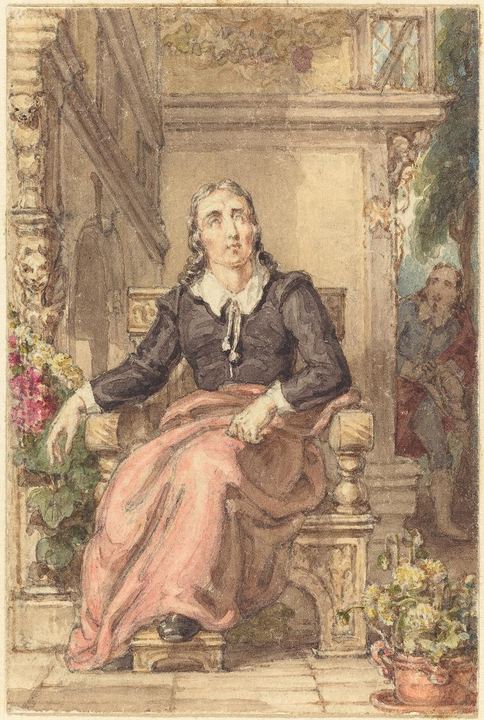
Milton's sonnet on his blindness is a fourteen-line argument between a complaining heart and a corrective voice. It was written in the early 1650s, after Milton, then in his forties and serving the Commonwealth government, had lost his sight entirely. The poem was first printed in his Poems of 1673; the title by which it is known was added by later editors. The octave is a single long, tangled sentence. The speaker considers how his light is spent before half his days are done, in a world now dark and wide. He thinks of the parable of the talents in Matthew 25, where the servant who buried his one talent was cast out. His own talent, his gift for writing, now lies useless in him, though his soul is more eager than ever to serve God and give a true account. Fearing rebuke when the master returns, he asks whether God demands day-labor from a man denied light, a question that recalls the laborers in the vineyard and Christ's words about working while it is day. The turn comes before the octave ends: Patience interrupts to prevent that murmur. Her answer, in the sestet, overturns the premise of the complaint. God does not need anyone's work or even the return of his own gifts. Those who best bear his mild yoke serve him best. His state is kingly, and thousands speed at his bidding over land and ocean without rest. The final line, famous on its own, declares that those who only stand and wait also serve. The sonnet follows the Italian, or Petrarchan, rhyme scheme, but Milton lets the sentences run across the line-endings and across the usual break between octave and sestet. The syntax enacts first the speaker's anxious striving and then Patience's calm, measured reply. The poem has become one of the best-loved English sonnets on vocation, disability, and trust in providence.
Virtues in this work
- Humility: The speaker accepts Patience's correction that God needs neither his work nor his gifts, giving up the idea that his worth lies in his output.
- Faith: The sonnet ends in trust that God's kingly rule includes a place for the servant who cannot labor.
- Fortitude: Patience teaches the speaker to bear the mild yoke of blindness without murmuring, a steadiness under loss rather than a show of strength.
Plot or Argument
- The complaint (lines 1-6)
In one long subordinate clause, the speaker considers his lost sight, the useless talent lodged in him, and his soul's desire to serve his Maker and present a true account lest the returning master chide him.
- The question and the interruption (lines 7-8)
The clause finally reaches its main verb: he foolishly asks whether God exacts day-labor when light is denied. Before the question can harden into grumbling, Patience steps in to prevent the murmur, and the volta falls in the middle of line 8.
- Patience's answer (lines 9-12)
Patience replies that God needs neither man's work nor his own gifts back; those who best bear his mild yoke serve him best. God's state is kingly, and thousands speed at his command across land and ocean.
- The closing maxim (lines 13-14)
The ceaseless messengers are set against those who stand ready at the king's side, and the poem ends with the assurance that waiting itself is service.
Characters
- The speaker, The blind poet
A man in mid-life who has lost his sight and fears that his unused gift will condemn him.
- Patience, Personified virtue
The voice that interrupts the complaint and answers it with a view of God's kingly sufficiency.
Lessons
Usefulness is not the measure of service
The speaker assumes God values him for what he produces. Patience answers that God does not need man's work or his gifts at all. Service is measured by bearing the yoke well, which is possible even when work is impossible.
- What does the speaker assume God wants from him in lines 1-7?
- How does Patience's statement that God does not need man's work free the speaker rather than diminish him?
- Where in your own life does usefulness become the measure of worth?
Reading Scripture into one's own life
Milton applies the parable of the talents to himself with painful literalness, and the parable seems to condemn him. The sonnet shows how a single text, read in isolation, can frighten, and how the wider witness of Scripture (the mild yoke, the angels who serve) corrects it.
- Why does the parable of the talents trouble the speaker so much?
- Which other biblical images does Patience bring in, and how do they change the picture?
- Is the speaker wrong to fear the parable, or is his fear a sign of seriousness?
Patience as an active virtue
The final line is sometimes heard as resignation, but the image is of attendants standing ready in a king's presence, waiting for a command. Waiting here is attentive readiness, and later in life Milton produced his greatest work after this waiting.
- What is the difference between waiting and doing nothing?
- Why does Milton make Patience, rather than God himself, answer the speaker?
- How does knowing that Milton later dictated Paradise Lost affect your reading of the last line?
Context
Milton served the English Commonwealth from 1649 as Secretary for Foreign Tongues, writing Latin defenses of the regicide government. His eyesight, already weakening, failed completely by about 1652; he later wrote that he had continued the work of his first Defence against medical advice. The same years brought the deaths of his first wife, Mary Powell, and their infant son.
Composition
The sonnet is usually dated between 1652 and 1655; its exact date is debated. It was first printed in the 1673 edition of Milton's Poems. The title On His Blindness does not appear in Milton's printing and was supplied by the eighteenth-century editor Thomas Newton; the number XIX follows Milton's numbering in the Trinity Manuscript, while the 1673 printing numbers it XVI.
Reception
The poem is among the most anthologized English sonnets. Its last line passed into common speech, and the sonnet is often taught alongside Milton's lament for his blindness at the opening of Book III of Paradise Lost and the blind hero of Samson Agonistes.
Comparisons
- paradise-lost
The invocation to holy Light at the start of Book III returns to Milton's blindness at epic length, asking for inward illumination in place of the sight he has lost.
- the-collar
Herbert's speaker also rebels against God's service until a single quiet voice interrupts him; both poems turn on a divine answer that dissolves the complaint.
- the-bible
The sonnet is built from the parable of the talents (Matthew 25:14-30), the mild yoke of Matthew 11:29-30, and the image of ministering angels in God's court.
- death-be-not-proud
Donne's Holy Sonnet and Milton's sonnet both use the fourteen-line form for a single sustained argument with a looming threat, death in one and uselessness in the other.
Quotes
Frequently cited
“When I consider how my light is spent Ere half my days in this dark world and wide,”
Frequently cited
“They also serve who only stand and wait.”
“And that one talent which is death to hide Lodged with me useless,”
“"Doth God exact day-labor, light denied?" I fondly ask.”
“God doth not need Either man's work or his own gifts. Who best Bear his mild yoke, they serve him best.”
For Students
A reading companion for classical Christian high school students. See the student guide.
Reading Guide
Watch for
- How long the first sentence runs before reaching its main verb, I fondly ask, in line 8.
- The double meaning of light in line 1 and of talent in line 3.
- Where Patience interrupts: in the middle of line 8 rather than at the start of line 9.
- The contrast in lines 12-14 between the thousands who post over land and ocean and those who stand and wait.
Key terms and names
- Talent
- A large unit of money in the parable of Matthew 25, and by Milton's day also a God-given ability; the speaker's talent is his poetic gift.
- Petrarchan sonnet
- A fourteen-line poem with an octave rhymed abbaabba and a sestet, here cdecde; Milton keeps the rhymes but blurs the break between the parts.
- Volta
- The turn in a sonnet's argument; here it comes at But Patience, partway through line 8.
- Fondly
- In Milton's English, foolishly; the speaker already judges his own question as he asks it.
- Post
- To travel with speed, as a royal messenger; the thousands who post o'er land and ocean are God's ministering servants.
- Personification
- Patience is given a voice and answers the speaker as if she were a person in the room.
Seminar Questions
- Comprehension What does the speaker fear will happen when the master returns, and which parable is he thinking of?
- Comprehension What three things does Patience say about God in lines 9-13?
- Interpretation Why does the speaker call his own question fond, or foolish, in the very act of asking it?
- Interpretation How does the form of the poem, with its long opening sentence and early volta, mirror the speaker's state of mind?
- Interpretation Is the final line a command, a comfort, or a description? What difference does the word also make?
- Big Question If God does not need our work, why work at all? How would Milton, who went on to write Paradise Lost, answer?
Faith Connections
- Matthew 25:14-30 (Scripture)
The parable of the talents supplies the speaker's fear; the servant who hid his one talent was condemned, and the speaker's single talent seems hidden by blindness.
- Matthew 11:28-30 (Scripture)
Christ's easy yoke and light burden lie behind Patience's mild yoke, recasting service as rest rather than strain.
- John 9:4 (Scripture)
Christ's saying that the night comes when no man can work, spoken before healing a man born blind, gives edge to the speaker's question about day-labor without light.
- Augustine, Confessions X (Great Conversation)
Augustine's prayer to give what God commands and command what he wills shares the sonnet's conviction that service rests on God's sufficiency rather than human capacity.
Logic and Rhetoric
Central argument: The speaker reasons: God requires a return on his gifts; my gift is useless without sight; therefore God may condemn me. Patience denies the first premise: God needs neither work nor gifts, and those who bear his yoke serve him best; therefore patient waiting is itself service.
Rhetorical device: Hypophora. In lines 7-14 the speaker poses the question about day-labor and Patience answers it at once, so the sonnet becomes question and reply.
Debate: Resolved: The final line of Milton's sonnet commends readiness rather than resignation.
Memory Work
They also serve who only stand and wait.
When I consider how my light is spent Ere half my days in this dark world and wide,
Writing Prompts
Essay: Argue whether Patience's answer in lines 9-14 truly resolves the speaker's fear about the parable of the talents, or simply sets it aside.
Comparison with The Collar: Both Milton and Herbert stage a complaint against God that is cut short by a single answering voice. Compare how each poem's form builds up the complaint and how each answer changes the speaker.
Medical Lens
The sonnet is a first-person account of acquired blindness in mid-life, focused on vocation and providence rather than symptoms. Milton described his gradual loss of sight in a 1654 Latin letter to Leonard Philaras, who had offered to consult a Paris physician; the cause has been debated ever since, with glaucoma and retinal detachment among the suggestions, and none is certain. For a psychiatric reader, the poem is a compact picture of the fear of uselessness after disability and of a reframing that restores purpose without denying the loss.
- Lines 1-8
The speaker's anxiety that loss of sight has made his gift useless and exposed him to rebuke.
Creative Prompts
- Poetry
Write a Petrarchan sonnet whose octave poses a complaint about a limitation and whose sestet is answered by a personified virtue other than Patience.
- Essay
Trace the word light through the sonnet and through the invocation in Paradise Lost Book III, and explain how Milton turns physical blindness into a question about inner sight.
Further Reading
- The Life of John Milton: A Critical Biography, Barbara K. Lewalski
- John Milton: Life, Work, and Thought, Gordon Campbell and Thomas N. Corns
- Milton's Sonnets, E. A. J. Honigmann (ed.)
Annotated edition of the sonnets with discussion of dating.
- Complete Shorter Poems, John Milton, ed. John Carey
Verification notes
The text quoted is the stored 1901 Thurber printing, which modernizes some spelling (day-labor). The composition date is uncertain; 1652 to 1655 is the usual range. Milton's total blindness by about 1652 and his 1654 letter to Leonard Philaras are well attested; the medical cause of his blindness is unknown and all retrospective diagnoses are conjectural. The title On His Blindness was supplied by Thomas Newton in his eighteenth-century edition of Milton (usually dated 1761, sometimes 1752). The 1673 Poems numbers the sonnet XVI; Milton numbered it 19 in the Trinity Manuscript, the source of the XIX used here.
No verification flags recorded.