Work record
Minersville School District v. Gobitis
1940 · Early 20th Century · Court Decision · English
Abstract
Question Presented. May a Pennsylvania district, consistent with the Fourteenth Amendment's protection of religious freedom, make the pledge and salute a condition of attending its schools when a family's faith treats the gesture as idolatry?
Arguments. For the board, a patriotic exercise required of every child, written with no church in view, is an ordinary means of forming citizens, and the selection of such means belongs to those who run the schools. For the Witness family, officials have no authority to extract a profession that conscience forbids, least of all by withholding free education from a ten-year-old.
Holding. Eight justices voted to reverse the lower courts. Frankfurter held that religious convictions do not excuse obedience to neutral civic requirements, that shared symbols nourish the cohesion on which liberty depends, and that disputes over pedagogy belong in legislatures. Stone, alone, saw compelled belief as different in kind from regulated conduct and insisted that courts protect small faiths.
Significance. This ruling stood for only three years. After public criticism, violence against Witnesses, a 1942 recantation by three members of the majority and two new appointments, Barnette (1943) overruled it. Stone's dissent, in which he cites his Carolene Products footnote, is often read as an early statement of heightened scrutiny for laws affecting minorities.
Key figures
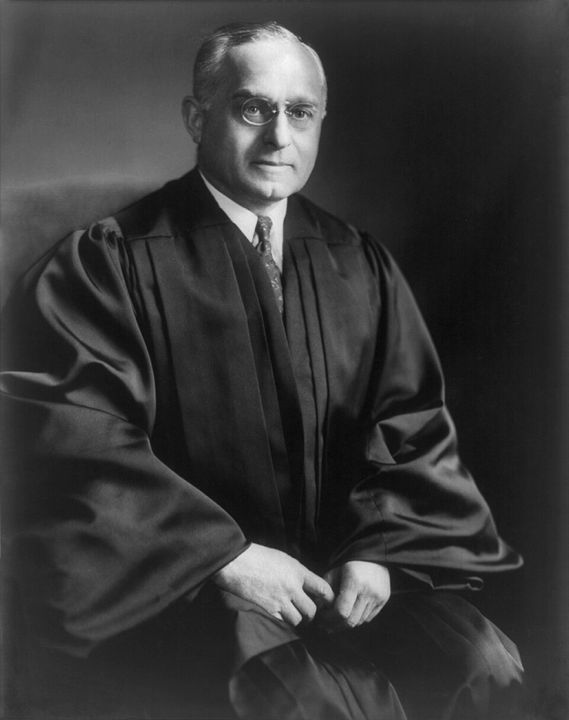
- Felix Frankfurter: Wrote the flag-salute majority, urging deference to legislatures
- Harlan Fiske Stone: Lone dissenter defending freedom from coerced affirmation
- Lillian and William Gobitis: Witness pupils expelled for keeping their arms at their sides
- Walter Gobitis: Father who sued Minersville's board for readmission

Summary
Minersville School District v. Gobitis, 310 U.S. 586, decided on 3 June 1940, asked whether a Pennsylvania public school could expel children who refused, on religious grounds, to salute the American flag. In the autumn of 1935 Lillian Gobitis, then twelve, and her brother William, ten, stopped joining the daily ceremony in which pupils recited the pledge of allegiance with right hands extended toward the flag. The family belonged to the Jehovah's Witnesses, who read the salute as bowing to a graven image forbidden by Exodus 20. The Minersville board expelled both children, and their father Walter sued to have them readmitted. Judge Albert Maris of the federal district court ruled for the family, and the Court of Appeals for the Third Circuit affirmed. The school district argued that a general requirement of patriotic exercise, aimed at no sect, lay within the ordinary power of local boards to shape instruction and to cultivate loyalty in the young. The family answered that the First Amendment, applied to the states through the Fourteenth, forbade officials to compel children to profess what their faith prohibited, especially when the penalty was loss of a public education. The Court reversed by a vote of eight to one. Justice Felix Frankfurter, writing for seven members, with Justice McReynolds concurring in the result, treated religious liberty as a right that must sometimes be adjusted to general laws, citing Reynolds v. United States and the draft cases. He reasoned that national unity is the foundation of national security, that symbols such as the flag gather a people's traditions, and that judges are poorly placed to second-guess a legislature's choice of means for teaching loyalty. Remedy for an unwise law, he wrote, should be sought through persuasion and elections. Justice Harlan Fiske Stone dissented alone. He argued that the law went beyond restraining conduct and compelled children to affirm a belief they did not hold; that the state could teach patriotism by study rather than coerced profession; and that courts owe searching scrutiny to laws touching small religious minorities, citing his own footnote in United States v. Carolene Products (1938). The library text gives Frankfurter's opinion for the Court and Stone's full dissent from the U.S. Reports; the reporter's footnotes are left out. Reports of attacks on Witnesses multiplied in the months after the decision, and several state courts declined to follow it. In Jones v. Opelika (1942) Justices Black, Douglas and Murphy wrote that they now believed Gobitis wrongly decided, and on 14 June 1943 the Court overruled it in West Virginia State Board of Education v. Barnette. The family's surname was spelled Gobitas; the court papers carried a clerical misspelling.
Virtues in this work
- Fortitude: Two children accepted expulsion from school rather than perform a gesture their parents taught them was forbidden by God.
- Prudence: Frankfurter weighed the limits of judicial competence and urged that disputes over teaching loyalty be settled by persuasion and elections.
- Justice: Stone, writing alone against eight colleagues, argued that the Court owed special protection to a small and unpopular faith.
Plot or Argument
- The Minersville ceremony and the children's refusal
Frankfurter recounts the expulsion of Lillian and William, describes the pledge and salute, and states the Witnesses' reading of scripture. He notes the rulings of Judge Maris and the Third Circuit and frames the question as whether the state may require this conduct of children whose consciences forbid it.
- Religious freedom and laws of general application
The opinion surveys the long effort to reconcile liberty of conscience with civil authority and concludes that conscientious scruples have never exempted believers from a general law not aimed at religion, pointing to polygamy, compulsory military training and taxation cases.
- National unity, symbols and the school
Frankfurter argues that a free society rests on cohesive sentiment fostered by the agencies of mind and spirit, that the flag symbolizes the nation above its internal differences, and that the legislature may judge that an exemption for dissenters would weaken the exercise for everyone else.
- Judicial restraint and the remedy of persuasion
Declining to sit as a school board, the Court holds that the choice of means for securing loyalty belongs to the people's representatives; so long as the political process stays open, correcting a foolish law is itself a training in liberty. The judgment is reversed.
- Stone's dissent: compelled affirmation
Stone describes the law as unique in Anglo-American legislation because it compels expression of a sentiment the children reject. He grants that liberties are not absolute but insists that where the state can reach its ends by alternatives that do not coerce belief, it must use them.
- Stone's dissent: minorities and searching scrutiny
Recalling that infringements of liberty have usually been justified in the name of the public good, Stone invokes the Carolene Products footnote and argues that the Constitution is a command that freedom of mind and spirit be preserved, which courts must enforce rather than leave to majorities.
Characters
- Felix Frankfurter, author of the opinion of the Court
Former Harvard law professor and Roosevelt appointee who wrote for the eight-member majority, stressing judicial deference to legislative choices.
- Harlan Fiske Stone, sole dissenter
Associate Justice who argued that the Bill of Rights forbids compelling children to affirm a belief against their religion.
- Lillian and William Gobitis, expelled pupils
Children of a Jehovah's Witness family in Minersville, Pennsylvania, aged twelve and ten when they declined to salute the flag in 1935.
- Walter Gobitis, plaintiff father
Minersville shopkeeper who brought the suit on behalf of his children for their readmission to the public schools.
- Charles Evans Hughes, Chief Justice
Presided over the Court and joined the majority opinion.
- Albert Maris, federal trial judge
District judge whose ruling for the family the Supreme Court reversed; Frankfurter called his opinion thoughtful.
Lessons
Belief, conduct and a law aimed at no sect
Frankfurter's central premise is that religious liberty protects belief but does not exempt believers from general civic duties that are not directed at any church. The Gobitis children were asked to do something every pupil did, and the majority read earlier cases on polygamy and military training as settling that such laws stand even against sincere scruple.
- Which earlier cases does Frankfurter cite to show that conscience does not excuse obedience to a general law?
- Is saluting a flag better described as conduct or as speech?
- Should it matter that the Minersville rule was not written with Jehovah's Witnesses in mind?
Why the majority deferred to the school board
The opinion repeatedly asks who should decide how loyalty is taught. Frankfurter believed that judges, unelected and untrained in pedagogy, should leave the choice of means to legislatures and local boards, trusting citizens to repeal unwise rules through the political process.
- What does Frankfurter mean by saying the court-room is not the arena for debating educational policy?
- How could the Gobitis family have pursued change through the forum of public opinion?
- Are there questions that should never be left to a vote of the majority?
Stone's distinction between teaching and compelling
Stone did not deny the state's interest in patriotism. He argued that the schools could require study of American history and government, including the guarantees of civil liberty, without forcing a child to declare a belief. The difference between instruction and coerced profession became the hinge on which the Court reversed itself three years later.
- What alternatives to the compulsory salute does Stone suggest?
- Why does Stone call the Minersville law unique in Anglo-American legislation?
- Can a school require students to learn about an idea without requiring them to affirm it?
A precedent that lasted three years
Gobitis was decided eight to one, yet within two years three justices in the majority publicly changed their minds, and in 1943 the Court overruled it. Students can study how new members, public events and further reflection led the same institution to a different answer on nearly identical facts.
- What changed between June 1940 and June 1943 on the Court and in the country?
- Is it a strength or a weakness of a court that it can reverse itself so quickly?
Context
In the 1930s many states and school districts adopted compulsory flag exercises, and Jehovah's Witnesses, led by Joseph Rutherford, taught that saluting a national emblem violated the commandment against bowing to images. Hundreds of Witness children were expelled. The case reached the Court in the spring of 1940, as German armies overran Western Europe and Americans debated preparedness and national loyalty.
Composition
The case was argued on 25 April 1940 and decided on 3 June, with Chief Justice Hughes assigning the opinion to Frankfurter. Stone circulated his dissent late in the term and no colleague joined it. The library text follows the U.S. Reports as transcribed on Wikisource, giving Frankfurter's opinion for the Court and Stone's dissent; the reporter's footnotes are not reproduced.
Reception
Much of the legal press criticized the decision, and the months that followed saw numerous reported assaults on Witnesses and their meeting halls, documented by the Justice Department and the American Civil Liberties Union. In Jones v. Opelika (1942) Black, Douglas and Murphy announced their change of view, and with the arrival of Justices Jackson and Rutledge the Court overruled Gobitis in West Virginia State Board of Education v. Barnette (1943). Frankfurter maintained his position in a dissent in that case.
Comparisons
- west-virginia-v-barnette
Barnette overruled Gobitis in 1943 on almost identical facts, with Jackson answering Frankfurter's national-unity argument and Frankfurter restating his view of judicial restraint in dissent.
- reynolds-v-united-states
Frankfurter relies on the 1879 polygamy decision for the principle that a general law may be enforced against religiously motivated conduct; Stone treats compelled speech as a different kind of case.
- virginia-statute-for-religious-freedom
Jefferson's statute declared that no one shall be compelled to frequent or support any religious worship or suffer for his opinions, the tradition Stone invokes against a coerced pledge.
- madison-selected-writings
Madison's Memorial and Remonstrance holds that religion can be directed only by reason and conviction, not force, a premise close to Stone's insistence on freedom of mind and spirit.
- the-founding-documents
The Free Exercise and Free Speech Clauses of the First Amendment, read through the Fourteenth, are the provisions both opinions interpret.
- on-liberty
Mill's warning against the tyranny of the majority over opinion supplies a philosophical counterpart to Stone's concern for small minorities; Frankfurter's trust in public persuasion also echoes Mill's faith in open debate.
Quotes
Frequently cited
“National unity is the basis of national security.”
Frequently cited
“The very essence of the liberty which they guaranty is the freedom of the individual from compulsion as to what he shall think and what he shall say, at least where the compulsion is to bear false witness to his religion.”
“The ultimate foundation of a free society is the binding tie of cohesive sentiment.”
“Conscientious scruples have not, in the course of the long struggle for religious toleration, relieved the individual from obedience to a general law not aimed at the promotion or restriction of religious beliefs.”
“To fight out the wise use of legislative authority in the forum of public opinion and before legislative assemblies rather than to transfer such a contest to the judicial arena, serves to vindicate the self-confidence of a free people.”
“History teaches us that there have been but few infringements of personal liberty by the state which have not been justified, as they are here, in the name of righteousness and the public good, and few which have not been directed, as they are now, at politically helpless minorities.”
For Students
A reading companion for classical Christian high school students. See the student guide.
Reading Guide
Watch for
- The opening paragraph's description of the pledge, the outstretched arm and the Witnesses' reading of scripture.
- Frankfurter's phrase about the hierarchy of legal values and where he places national unity.
- The point where Frankfurter says the case must be viewed as though the Pennsylvania legislature itself had ordered the salute.
- Stone's distinction between teaching patriotism and compelling an affirmation of belief.
- Stone's citation of the Carolene Products footnote on discrete and insular minorities.
Key terms and names
- Free Exercise Clause
- The First Amendment's guarantee that government shall not prohibit the free exercise of religion, applied to Pennsylvania through the Fourteenth Amendment.
- General law
- A rule that applies to everyone alike and is not aimed at any particular religion; Frankfurter treats the flag-salute requirement as one.
- Conscientious scruple
- A moral or religious objection grounded in conscience, such as the Gobitis children's belief that the salute was forbidden worship.
- Judicial restraint
- The view that judges should seldom overturn the choices of elected bodies; it governs Frankfurter's opinion.
- Reversed
- The appellate judgment setting aside the lower courts' rulings for the family.
- Discrete and insular minorities
- Phrase from Stone's 1938 Carolene Products footnote for groups that may need special judicial protection because the political process may not protect them.
Seminar Questions
- Comprehension Why were Lillian and William Gobitis expelled, and what did their faith teach about the salute?
- Comprehension What was the vote, and which justice dissented?
- Comprehension According to Stone, what could the schools require instead of the salute?
- Interpretation Why does Frankfurter think an exemption for a few pupils might weaken the ceremony for all the others?
- Interpretation How does Stone's view of the courts' role differ from Frankfurter's, and what does each fear if the other's view prevails?
- Interpretation Stone writes that the compulsion is to bear false witness. Why does he choose that biblical phrase?
- Big Question Does love of country grow better when it is required or when it is freely offered?
Faith Connections
- Exodus 20:4-5 (Scripture)
The commandment against bowing down to graven images is the text the Witnesses cited as forbidding the salute.
- Daniel 3:1-18 (Scripture)
Shadrach, Meshach and Abednego refuse to bow before the image Nebuchadnezzar set up, a story often recalled in discussions of compelled ceremonies.
- Romans 13:1-7 (Scripture)
Paul's teaching on obedience to governing authorities frames the opposite pull: the Christian duty to honour rulers and civil order.
- Tertullian, Apology (Great Conversation)
Tertullian protested that Christians prayed for the emperor but would not offer incense to his image, distinguishing loyalty from worship.
Logic and Rhetoric
Central argument: Because religious liberty has never excused obedience to general laws, because national unity is an interest of the highest order fostered by shared symbols, and because judges are ill-suited to choose the means of teaching loyalty, the Court should leave the flag-salute requirement to the legislature and the voters.
Rhetorical device: argument from consequences paired with appeal to institutional modesty. Frankfurter moves from the large claim that national unity underlies national security (quote 0) to the modest conclusion that the people's assemblies, not courts, should decide how to secure it (quote 3).
Debate: Resolved: that a public school may require a patriotic ceremony of all pupils so long as the requirement is not aimed at any religion.
Memory Work
Conscientious scruples have not, in the course of the long struggle for religious toleration, relieved the individual from obedience to a general law not aimed at the promotion or restriction of religious beliefs.
The very essence of the liberty which they guaranty is the freedom of the individual from compulsion as to what he shall think and what he shall say, at least where the compulsion is to bear false witness to his religion.
Writing Prompts
Essay: Explain how Frankfurter and Stone each understand the relationship between the flag salute, the school's educational mission and the children's religion, and identify which facts each opinion emphasizes.
Comparison with West Virginia State Board of Education v. Barnette: Compare Frankfurter's national-unity argument in Gobitis with Jackson's reply in Barnette, and explain why the same Court reached opposite results three years apart.
Medical Lens
The opinions concern school discipline, conscience and the scope of judicial review; the only reference to health is Frankfurter's passing list of ordinary state functions.
Creative Prompts
- Classroom
Stage a moot court in which one team argues for the Minersville board and the other for the Gobitis family, using only precedents decided before 1940.
- Essay
Write a short brief for the school district in Frankfurter's terms, then a one-page reply in Stone's terms, and identify the single premise on which they most disagree.
- Dialogue
Imagine a conversation in June 1940 between Lillian Gobitis and a classmate whose brother has just enlisted, each explaining what the flag means to their family.
- Fiction
Tell the story of a Minersville teacher in 1935 who must decide what to do when two pupils remain seated during the morning salute.
Further Reading
- Judging Jehovah's Witnesses: Religious Persecution and the Dawn of the Rights Revolution, Shawn Francis Peters
Detailed history of the flag-salute cases and the events surrounding them from 1935 to 1943.
- Render unto Caesar: The Flag-Salute Controversy, David R. Manwaring
Early scholarly study of the litigation from the local school boards to the Supreme Court.
- Scorpions: The Battles and Triumphs of FDR's Great Supreme Court Justices, Noah Feldman
Group biography of Frankfurter, Black, Douglas and Jackson that discusses both flag-salute decisions.
Verification notes
All six quotations were located by Grep in content/texts/minersville-school-district-v-gobitis.txt and copied exactly, including the period spelling guaranty. The vote, the decision date, McReynolds's concurrence in the result and Stone's lone dissent appear in the library text or are standard facts of the U.S. Reports. Web search was unavailable while this record was written, so background details (the 1935 date of the refusal, the family's spelling of its name, the post-decision attacks and the Jones v. Opelika statement) rest on general knowledge of the standard histories and are flagged below.
- Confirm that the refusal and expulsion took place in the autumn of 1935.
- Confirm that the family spelled its name Gobitas and that Gobitis was a clerical error in the court record.
- Confirm the argument date of 25 April 1940.
- Confirm that Frank Murphy took his seat in February 1940.